634 risultati
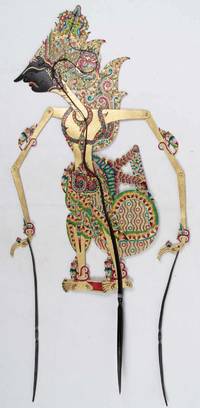
1970rif. 216707Indonesia. Before1970s. Water buffalo hide gilt and pigment elaborately chiselled and cut out 54 x 69 cms arms fully extended painted both sides jointed arms each affixed to horn batons and another spliced horn baton holding the body. This Javanese 'wayang kulit' or leather shadow puppet represents Kresna Krishna in the Hindu epic the Mahabharata. His importance and the reasons for his great regard is that he is considered the 8th avatar of the god Wisnu Visnu the protector and preserver of good and destroyer of evil. The 7th avatar is Rama. In Soeharto’s New Order regime this “lineage” of avatars –particularly Rama--became significant in their own mythical presentation to themselves of the regime. It is in the Ramayana—not Mahabharata—that the final battle against evil forces was to be fought and the dharma upheld. "Kresna is part God an incarnation of the mighty Wisnu. He is the consummate politician diplomat and strategist of war. By far the most intellectually brilliant of the Pendawa sic faction it is Kresna who makes their final victory possible. On the other hand he is the conscienceless liar and an unscrupulous schemer who never hesitates to break the rules when he feels it necessary" Benedict R. O'G. Anderson "Mythology and the Tolerance of the Javanese" Cornell 1965. Also see: Joko Susilo Eisler Shadow-Puppet Collection Catalogue Bates College Lewiston Maine. A particularly fine example. Purchased in Java in the early 1970s. . hardcover
1864rif. 15945Dubuisson, sd 1864 Grand in-8 demi-basane peignée, dos lisse ornée, 387 pp.50 compositions originales en couleurs, 24 hors-texte . Restauration à 1 ff. de texte mais très bon exemplaire.
1862rif. 19971Paris Dubuisson et Cie 1862 in-8 demi-chagrin un volume, reliure demi-chagrin couleur chocolat grand in-octavo Editeur (binding half shagreen in-8 editor) (18,5 x 27,5 cm), reliure d'époque, dos 4 nerfs (spine with raised bands), décorations or et à froid, titre frappé or (gilt title) avec filet or de part et d'autre du titre, entre-nerfs à caissons à fleuron or central avec double filets or, filet large mate et filet or en encadrement, filet à froid de part et d'autre des nerfs, filet or en tête et en pied, plats décorés à froid, percale marron ornée d'un trifle filet à froid en encadrement (plaque éditeur à froid), toutes tranches lisses dorées, marque-page en tissu vert (bookmark in tissue), orné de 24 planches hors-texte lithographiées et coloriées au pochoir et au pinceau + 25 gravures in-texte réhaussées en couleurs, en tête de chapitre, d'aprés les dessins de Duranty par V. Coindre gravées par Gillot, 387 pages, sans date (1862) Paris : Dubuisson et Cie Imprimeurs-Editeurs,
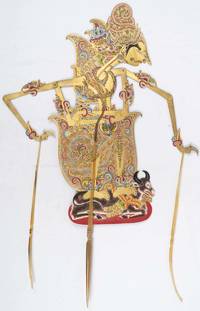
1970rif. 216158Indonesia. Before1970s. Water buffalo hide and pigment elaborately gilt and cut out 54 x 69 cm painted both sides jointed arms each affixed to horn batons and another spliced horn baton holds the body. This puppet represents the dewa Bathara Guru in the Javanese and Balinese 'wayang kulit' or leather shadow puppet theatre tradition. Batara Guru is the Indonesian embodiment of the Hindu deity Shiva and perhaps the most sacred of Indonesian shadow puppets. A dalang puppeteer must make offerings to Guru the supreme god creator and ruler of earth who stands at the origin point of humankind before commencing a shadow play performance. Batara Guru also known as Sang Hyang Manikmaya is conceived of as the younger brother of Semar. The figure is generally shown in meditative repose standing upon his mount the bull. He is viewed as a spiritual teacher and guide directing lesser deities and humans in their earthly endeavors. This particularly fine example is elaborately carved with gilt and rides on the mythical bull Nandini. Bathara Guru the Javanese name for the deity Shiva symbolized the imperfection of man represented in the bodily defects of the puppet: four arms small feet marks on the throat and often though not here depicted with fangs. Purchased in Java in the early 1970s. See: Joko Susilo Eisler Shadow-Puppet Collection Catalogue Bates College Lewiston Maine . hardcover
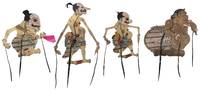
1970rif. 216219Indonesia. Before1970s. Water buffalo hide pigment gilt fabric and hair three of the four figures all with jointed arms painted both sides the arms and bodies affixed to spliced horn batons three for each puppet some abrasion and wear with some loss to the pigment but the set in very good condition: Semar body: 35 x 35 cms; Gareng: 36 x 16 cms; Petruk: 53 x 20 cms; Bagong: 41 x 23 cms. A set of four comedic Punakawan figures. Chief of these is Semar one of the most well-loved figures in Wayang both a humble servant and powerful god. "Semar is usually accompanied by his three adopted sons Gareng Petruk and Bagong and together they are known as the Punakawan 'knowing friends or attendants'." Gregory Churchill et al "Semar ever so smartly" Winayangan 2009. In this set Gareng is the eldest son who limps and has a crippled arm; Petruk is the middle child depicted as tall and lanky who has a distinctive long nose; Bagong is the youngest of the three: a chubby figure with big round eyes thick lips and naïve behaviour. ".the scene where Semar traditionally emerges is called the goro-goro “world in chaos”. The narration of the puppeteer speaks of earthquakes and storms that beset the cosmos but then announces Semar who appears like a shaft of light piercing the dark. Semar’s cosmic and comic humour promises the audience both laughs and wisdom. He is a clown who connects the cosmic and everyday. All opposites and contradictions dissolve in his wisdom and mythos." World Encyclopedia of Puppetry Arts Purchased in Java in the early 1970s. See: Joko Susilo Eisler Shadow-Puppet Collection Catalogue Bates College Lewiston Maine . unknown
1966rif. 1501Paris, Denoël, 1966. Grand in-4 (250 x 32,3 mm) en feuilles, 109 pages + fnch., sous chemise-étui cartonné recouvert de soie rose, dos lisse orné du nom de l'artiste estampé (emboîtage éditeur). ÉDITION ORIGINALE. Préface de Constantin Jelenski "Bellmer ou la douleur déplacée (20 pages). 86 photogravures (dessins, gravures, lithographies et photographies) en hors-texte. Tirage : 130 exemplaires numérotés sur vélin d’Arches pur chiffon, celui-ci l’un des 100 premiers exemplaires (n° 43) accompagnés d’ UNE GRAVURE ORIGINALE D'HANS BELLMER, NUMEROTÉE ET SIGNÉE au crayon. —— ENGLISH DESCRIPTION: Small folio (250 x 323 mm), 109 pp. in a cardboard slipcase covered in pink silk, smooth spine decorated with the artist's stamped name (publisher's slipcase). Préface by Constantin Jelenski. 86 plates reproducing almost one hundred drawings, engravings, lithographs and some photographic works by Bellmer. Edition limited to 130 numbered copies on vélin d'Arches (n° 43), each with an ORIGINAL ENGRAVING SIGNED IN PENCIL BY HANS BELLMER. A bibliophilic copy of this important study of Hans Bellmer's works on paper with the original signed engraving.
rif. DADAX0812828305New unknown
2004rif. 223092004 1 Acrylique sur papier, 2004 signée en bas à droite, titrée au dos, 23 x 30 cm., encadrée.
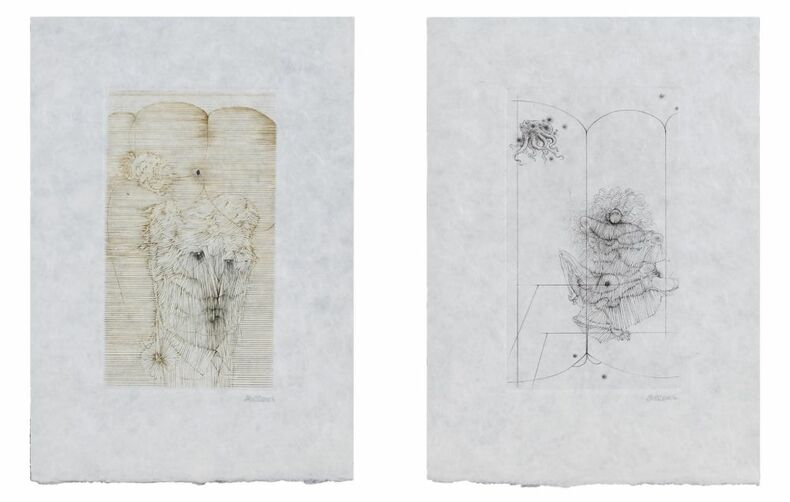
1967rif. 2238Éditions Georges Visat, Paris 1967. La suite est contenue dans une chemise de vélin d'Arches imprimée (23 x 16 cm). - 7 GRAVURES ORIGINALES AU BURIN DE HANS BELLMER, SUR JAPON HASEKAWA NACRÉ, TOUTES SIGNÉES AU CRAYON PAR L'ARTISTE. Note historique et bibliographique : Ces gravures, commandées par Jean-Jacques Pauvert et exécutées en 1953, étaient à l’origine destinées à illustrer la première édition de L'Anglais décrit dans le château fermé d'André Pieyre de Mandiargues. Mais ce projet ne vit jamais le jour. "Bellmer y dessine la trame arachnéenne d'un réseau de lignes droites qui confère aux compositions une irréalité plus marquée qu'à l'accoutumée" (Pierre Dourthe). Ouvrages de référence : F. Flatuhez, Catalogue raisonné des estampes de Hans Bellmer, 1938-1975, n° 17. - Pierre Dourthe, Bellmer, le principe de perversion, Jean-Pierre Faur, 1999, p. 255 - Mandiargues, p.65-66.