643 results
ref. DADAX1861269242New unknown
ref. DADAX1447401891New unknown
ref. DADAX0812828305New unknown
ref. DADAX0811871215New unknown
ref. SONG1443737356Used: Good unknown
ref. DADAX024417914XNew unknown
ref. DADAX023034366XNew unknown
ref. DADAX0415890969New unknown
ref. DADAX0548490805New unknown
ref. 0571532233.Gpaperback. Good. Access codes and supplements are not guaranteed with used items. May be an ex-library book. paperback
1980ref. 384850Los Angeles California 1980. Unbound. Near Fine. Photomechanically reproduced flyer on 8.5" x 11" blue paper. Fine. An original flyer promoting a gig at the Whiskey-a-Go-Go with Social Distortion 45 Grave and the Meat Puppets. Artwork is of marching Nazis. This gig was only a few years before Social Distortion's mid-80s hiatus brought on by frontman Mike Ness' drug addiction; to date they are the highest grossing punk band. Fronted by Dinah Cancer 45 Grave were a Horror punk band formed in 1979. They are considered one of the first American goth rock bands. unknown
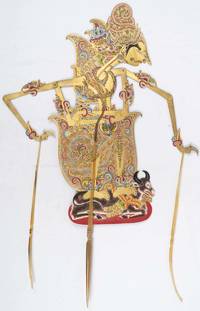
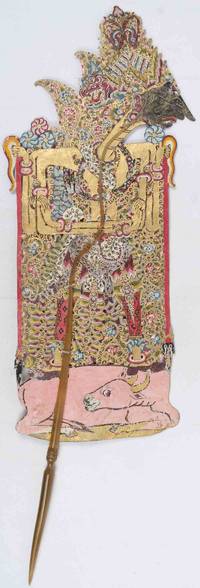
1970ref. 216158Indonesia. Before1970s. Water buffalo hide and pigment elaborately gilt and cut out 54 x 69 cm painted both sides jointed arms each affixed to horn batons and another spliced horn baton holds the body. This puppet represents the dewa Bathara Guru in the Javanese and Balinese 'wayang kulit' or leather shadow puppet theatre tradition. Batara Guru is the Indonesian embodiment of the Hindu deity Shiva and perhaps the most sacred of Indonesian shadow puppets. A dalang puppeteer must make offerings to Guru the supreme god creator and ruler of earth who stands at the origin point of humankind before commencing a shadow play performance. Batara Guru also known as Sang Hyang Manikmaya is conceived of as the younger brother of Semar. The figure is generally shown in meditative repose standing upon his mount the bull. He is viewed as a spiritual teacher and guide directing lesser deities and humans in their earthly endeavors. This particularly fine example is elaborately carved with gilt and rides on the mythical bull Nandini. Bathara Guru the Javanese name for the deity Shiva symbolized the imperfection of man represented in the bodily defects of the puppet: four arms small feet marks on the throat and often though not here depicted with fangs. Purchased in Java in the early 1970s. See: Joko Susilo Eisler Shadow-Puppet Collection Catalogue Bates College Lewiston Maine . hardcover
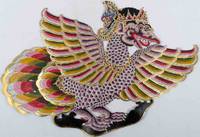
1970ref. 216677Indonesia. Before1970s. Water buffalo hide and pigment elaborately gilt 38 x 56 cm painted both sides minor surface wear and loss of pigment without the baton in very good condition. Figure of Jatayu a demi-god who takes the form of a vulture or an eagle used in the Javanese and Balinese 'wayang kulit' or leather shadow puppet theatre tradition. According to the Ramayana epic Jatayu died while trying to thwart the kidnapping of Dewi Sinta by Rahwana the king of Alengka. A very attractive example. Purchased in Java in the early 1970s. . hardcover
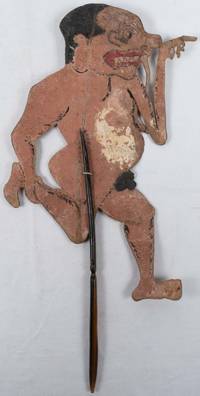
1970ref. 216171Indonesia. Before1970s. Water buffalo hide and pigment 33 x 18cm painted both sides affixed to a spliced horn baton loss at the head surface wear and loss of pigment overall in good condition. A naked devil figure or “Satanan” used in the Javanese and Balinese 'wayang kulit' or leather shadow puppet theatre tradition. Unsurprisingly a menacing and malign figure the puppet is depicted naked with blackened genitals with bared teeth and fangs. Purchased in Java in the early 1970s. . hardcover
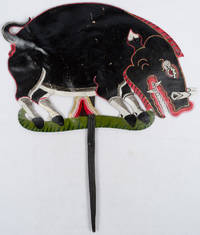
1970ref. 216164Indonesia. Before1970s. Water buffalo hide and pigment 28 x 40 cm painted both sides affixed to a spliced stick some surface wear but in vey good condition. Vivid example of the Wayang kulit Celeng/Babi Hutan or wild boar possibly the character Batara Kalagumarang. In Hindu lore the boar is an avatar of the god Vishnu and symbolizes courage strength and tenacity See: Joko Susilo Eisler Shadow-Puppet Collection Catalogue Bates College Lewiston Maine Purchased in Java in the early 1970s. . unknown
1972ref. 264173South Western Arts Association. Printed by Jacqueline Simkins 1972. First Edition. Trade Paperback. 12 Broadsides 11.75 x 8.5 inches when folded. 1or 2 sheets when folded to create 4 or 8 pages. First edition first printing. A near fine copy in illustrated folder. Folder slightly worn. Scarce with WorldCat locating 1 copy. South Western Arts Association. Printed by Jacqueline Simkins paperback
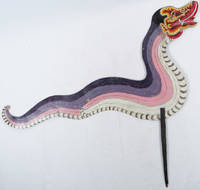
1970ref. 216676Indonesia. Before1970s. Water buffalo hide and pigment 37 x 76 cm painted both sides some surface wear and loss of pigment mounted on the original spliced bamboo baton in very good condition. Figure of a Naga or sea serpent used in the Javanese and Balinese 'wayang kulit' or leather shadow puppet theatre tradition. This puppet appears in many different stories in the Mahabharata epic and in the Javanese tradition can also represent the god and king of all snakes Bathara Naga. Purchased in Java in the early 1970s. . hardcover
1970ref. 216160Indonesia. Before1970s. Water buffalo hide and pigment elaborately gilt and cut out 58 x 25 cm painted both sides a spliced horn baton holds the body some abrasions and fading to the painted surface in good condition overall. This puppet represents the dewa Bathara Guru in the Javanese 'wayang kulit' or leather shadow puppet theatre tradition. Bathara Guru the Javanese name for the deity Shiva symbolized the imperfection of man represented in the bodily defects of the puppet: four arms small feet marks on the throat and often though not here depicted with fangs. Purchased in Java in the early 1970s. See: Joko Susilo Eisler Shadow-Puppet Collection Catalogue Bates College Lewiston Maine . hardcover
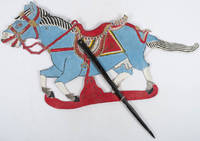
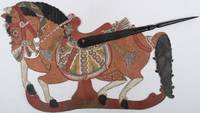
1970ref. 216155Indonesia. Before1970s. Water buffalo hide and pigment 48 x 78.5 cm with tail fully extended painted both sides affixed to an ebonized baton with cotton 51 cms head and tail articulated with string. A Javanese folk puppet depicting a saddled Kuda horse possibly representing the character of Jaran. In traditional all-night shadow puppet performances Jaran appears during the budhalan scene army leaving the kingdom. Purchased in Java in the early 1970s. . unknown
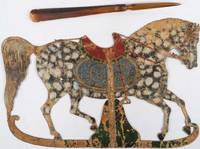
1970ref. 216167Indonesia. Before1970s. Water buffalo hide and pigment 37 x 54 cm the original spliced horn baton present but detached tail attached with thread surface wear and abrasion with significant loss to the pigment. A Javanese folk puppet depicting a saddled Kuda horse possibly representing the character of Jaran. In traditional all-night shadow puppet performances Jaran appears during the budhalan scene army leaving the kingdom. This example has older style colouring the horse with a dappled black and white coat. Purchased in Java in the early 1970s. . unknown
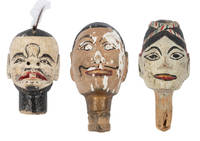
1970ref. 216774Indonesia. Before1970s. Wood and mixed media three puppet heads some loss of pigment and wear more severe in one example all approx 14 x 13 cm sold with an original wooden baton. Three puppet heads one representing Jiweng a clown figure in the Wayang Golek Menak tradition. The other two are from unidentified characters. Most common in West Java rod puppetry dates back to the early 17th Century. Stories may be of Hindu Buddhist or Islamic origin as well as more modern themes. This example is of Wayang Golek Manek is specifically concerned with the Amir Hamza cycle of stories. The stories narrate the exploits of an Arab warrior Hamza. Though from an oral tradition the stories were written down in Persian. Purchased in Java in the early 1970s. Also see: Gregory Churchill et al "Semar ever so smartly. Images of Semar in Indonesian Folk Arts". Winayangan 2009 . unknown
1970ref. 216156Indonesia. Before1970s. Water buffalo hide and pigment 36 x 59 cm painted both sides affixed to an ebonized baton with cotton 43 cms. A Javanese folk puppet depicting a saddled Kuda horse possibly representing the character of Jaran. In traditional all-night shadow puppet performances Jaran appears during the budhalan scene army leaving the kingdom. Purchased in Java in the early 1970s. . unknown
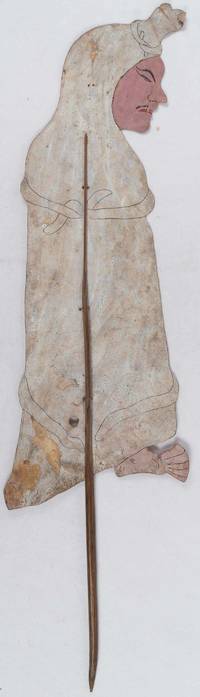
1970ref. 216170Indonesia. Before1970s. Water buffalo hide and pigment 42 x 16 cm painted both sides affixed to a spliced horn baton some surface wear and loss of pigment overall in good condition. Figure of a Pocong used in the Javanese and Balinese 'wayang kulit' or leather shadow puppet theatre tradition. A pocong is a ghost in the form of a corpse wrapped in its burial shroud. The deceased are typically wrapped in a white cloth which is tied at several places including feet torso and neck. Burial is often without a casket. Before closure of a grave the ties must be loosed so that the spirit of the person is released. If not they are doomed to wander the world haunting the living and places at will. Belief has it that they sometimes haunt bamboo or bannana tree groves in order to befriend the living. During early Covid lockdown in Java neighbourhoods would block road access to enforce curfew with one or two people dressed as pocongan as a warning to trespassers. Purchased in Java in the early 1970s. . hardcover
ref. 001042Harper & Row 1989 Book. As New. Hardcover. Signed by Authors. F. Cloth. As New/As New. First Edition. 8vo - over 7¾" - 9¾" tall. ISBN:0-06-021340-X. Presentation by illustrator with original art a tub person. Special copy. Harper & Row, 1989 Hardcover
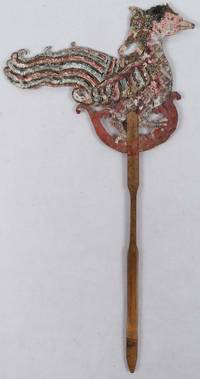
1970ref. 216726Indonesia. Before1970s. Water buffalo hide and pigment chiselled and cut out 17 x 22 figure only affixed to a bamboo baton worn with noticeable loss of pigment. This puppet represents the animal character of Kate Kancana or golden rooster a form assumed by Prince Arjuna in the Javanese Wayang Kulit tradition. Purchased in Indonesia in the early 1970s. See : Joko Susilo Eisler Shadow-Puppet Collection Catalogue Bates College Lewiston Maine . unknown