Debucourt, Philibert-LouisBiblio.com

116 résultats
réf. 2113819Contentum Ltd. Loose sheet. New. High-quality art print based on an original work from the Rijksmuseum. Created in the 18th century 1799. Professionally printed on premium fine-art paper Museum Etching museum quality in size A2. The artwork is printed with a white border museum-style presentation. Contentum Ltd. unknown
réf. 2086241Contentum Ltd. Loose sheet. New. High-quality art print based on an original work from the Rijksmuseum. Created in the 18th century 1799. Professionally printed on premium fine-art paper Museum Etching museum quality in size A2. The artwork is printed with a white border museum-style presentation. Contentum Ltd. unknown
réf. 1816299Contentum Ltd. Loose sheet. New. High-quality art print based on an original work from the Rijksmuseum. Created in the 18th century 1787. Professionally printed on premium fine-art paper Museum Etching museum quality in size A2. The artwork is printed with a white border museum-style presentation. Contentum Ltd. unknown
réf. 2187943Contentum Ltd. Loose sheet. New. High-quality art print based on an original work from the Rijksmuseum. Created in the 19th century 1817. Professionally printed on premium fine-art paper Museum Etching museum quality in size A2. The artwork is printed with a white border museum-style presentation. Contentum Ltd. unknown
réf. 1865411Contentum Ltd. Loose sheet. New. High-quality art print based on an original work from the Rijksmuseum. Created in the 18th century 1789. Professionally printed on premium fine-art paper Museum Etching museum quality in size A2. The artwork is printed with a white border museum-style presentation. Contentum Ltd. unknown
réf. 16967Contentum Ltd. Loose sheet. New. High-quality art print based on an original work from the Artic. Created in the 18th century n.d. Professionally printed on premium fine-art paper Museum Etching museum quality in size A2. The artwork is printed with a white border museum-style presentation. Contentum Ltd. unknown
réf. 251280Contentum Ltd. Loose sheet. New. High-quality art print based on an original work from the Met. Created in the 19th century 1850–80. Professionally printed on premium fine-art paper Museum Etching museum quality in size A2. The artwork is printed with a white border museum-style presentation. Contentum Ltd. unknown
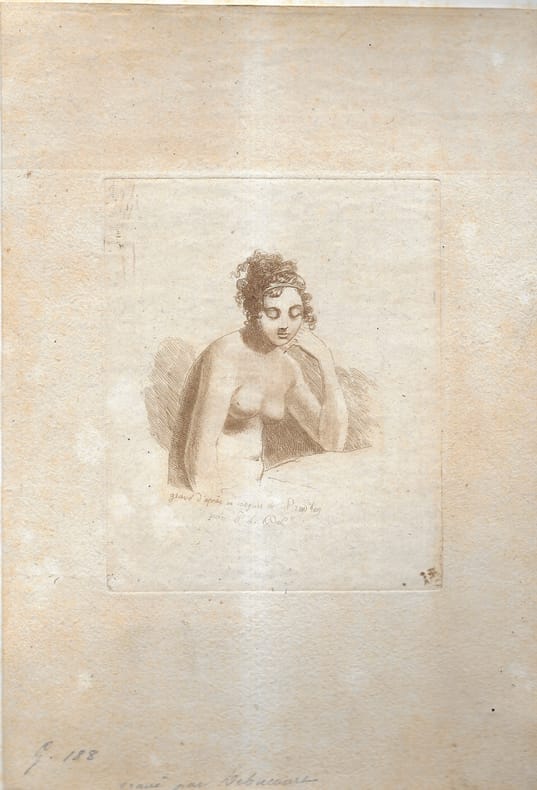
1800réf. 5652Gravé à l’eau-forte d’après un croquis de Prud’hon. Une jeune femme nue, baissant les yeux, coiffée en papillotes, est représentée à mi-corps, la joue appuyée sur sa main gauche. Signature en bas à la pointe. Eau-forte imprimée en bistre, décrite dans le catalogue de Prud’hon (n° 188, page 296) par E. et J. de Goncourt. Fenaille n° 132. Très belle épreuve, grande de marges ( 27,3 x 19,2). Rare. 14,4 x 11,8 Bon circa 1800
1957réf. 53521Paris, Rombaldi, coll. « Costumes et Modes d’Autrefois », n° 4 1957 In-folio 39 x 28 cm. En feuillets sous couverture rempliée et illustrée et étui carton, 12 ff. de texte, 24 planches en couleurs hors texte sur papier vélin des papeteries Aussedat. Exemplaire en très bon état.
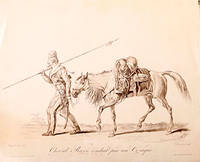
1816réf. 5555Catalogue Fenaille n° 368. Cadre moderne. Collection de costumes dessinés d’après nature par Carle Vernet. N° 4 de la livraison(7 octobre 1816) très bon 1816
1812réf. 56411812 Eau-forte et aquatinte 51 x 67 avec le cadre. Déposé à la Bibliothèque le 31 janvier 1812 par Bance. Aquatinte et eau-forte imprimée en deux tons noir et bleu dans les fonds et la neige. Cette pièce encadrée dans une large marge noire à l’aquatinte ne porte pas de titre. Fenaille n° 307 - 2è état (sur 2) Cadre de l’époque en pin marqueté de filets plus clairs. 51 x 67 avec le cadre. 1812
1814réf. 4369Paris Ch Bance 1814 Une belle gravure coloriée à la main par Debucourt d'après Carle VERNET. Premier état, avec le 1er en haut à gauche de la planche, et le No. 1 en haut à droite. Cette gravure a été conçue comme la première de la série "COLLECTION DE COSTUMES", qui devait être une collection de 56 planches accompagnées d'un texte montrant les costumes des nations. Cette planche a été déposée à la Bibliothèque par Aumontle le 2 novembre 1814 en même temps que la "Marche des officiers anglais". Les Anglais sont représentés de manière assez brutale, comme c'est souvent le cas dans les estampes françaises de l'époque. Il s'agit d'une estampe de bonne qualité, avec des couleurs originales attrayantes. Il y a des rousseurs modérées à fortes sur l'ensemble de la plaque. La surface de la plaque est de 36cm x 27cm. La feuille fait 39cm x 28cm.
1798réf. 5449Retirage par Goupil à la fin du XIXè de cette fameuse planche. Elle est coloriée aux pochoirs. (Fenaille ) Cadre moderne et passe-partout. 520 x 385 1798
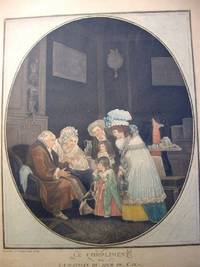
réf. 18249Very Good with no dust jacket. First Edition. Non-Book. This very rare engraving by Philibert-Louis Debucourt entitled "Le Compliment ou La Matinée du jour de l'an" The Compliment or New Year's Morning ca1787. This Etching was printed in blue red yellow carmine and black inks and 11 13/16 × 9 7/8 in 30 × 25.1 cm. It is printed on woven paper which has been framed and shows light sunning. We believe this to be an original etching as we have been unable to confirm the existence of restrikes and as such is very scarce. Most engravings by Debucourt of this subject are in museums and national galleries. The engraving is offered unframed.; 12" x 10" . unknown
1817réf. 17910Précédés d'un Discours sur l'élégie héroïque, par M. Treneuil (1763-1818). Ses élégies héroïques sont d'inspiration religieuse et monarchique.Sommaire : Discours sur l'Élégie héroïque. Poêmes Élégiaques : Les Tombeaux de l'abbaye royale de Saint-Denis - L'Orpheline du Temple - L'Héroïsme de la piété fraternelle, ou l'Oratoire de la Barrière du Trône - La Captivité de Pie VI - Le Martyre de Louis XVI.Édition originale. A Paris, chez Firmin Didot, Imprimeur du Roi, et de l'Institut Royale de France - 1817 - 319 pages. Frontispice de Deveze et Debucourt. Envoi autographe de l'auteur sur la page du faux titre "offert à Monsieur Audry(?) par l'auteur".Reliure plein veau blond glacé de l'époque. Dos lisse orné et doré avec pièce de titre maroquin rouge. Roulette dorée sur les coupes. Tranches jaspées bleues. Pas de rousseur. Très bon état. Format in-8°(21x13).
1820réf. 902872AGParis, [um 1820]. Aquatinta mit Punktierstich 29,5 x 23 cm (hoch), Blattgröße 32,5 x 24,5 cm.
1820réf. 015887Paris Circa 1820 1820. Early Printing . Single Sheet. Near Fine. Color Engraving. Nineteenth Century Engraving 25 5/8" X 19 3/4" On Laid Paper Watermarked Mbm Produced In Color. Complete With Full Margins As Issued With Title In French Below The Image Which Is Approximately 39.5 X 30 Cm. The Engraver's Name Is Also Present At Lower Right. Philibert-Louis Debucourt 1755 - 1832 Was A French Painter And Engraver. Debucourt Was Born In Paris In 1755 And Became A Pupil Of Vien. He Executed A Few Plates In Mezzotint Such As The Heureuse Famille The Benediction De La Mariée And The Cruche Cassée After His Own Designs. Most Of His Work Was However In Aquatint. He Became The Leading Maker Of Multi-Plate Colour Prints Combining Washes Of Aquatint With Line-Engraving.2 He Used A Number Of Different Techniques But Most Involved Three Colour Plates And A Fourth Key Plate Outlining The Design In Black. Debucourt's Father-In-Law Was The Sculptor Louis-Philippe Mouchy. In The Marriage Contract Mouchy Generously Offered To Provide A Three-Room Apartment At The Louvre Where Debucourt Lived For Twelve And A Half Years. The Address Of This Apartment Is Often Given On His Prints. Some Of His Work Was Satirical Such As La Promenade Publique An Aquatint Of 1792 Showing A Crowd In The Gardens The Palais-Royal. As Well As Work From His Own Designs He Made Aquatints After Carle Vernet Including The Horse Frightened By A Lion The Horse Frightened By Lightning And The Strayed Huntsman. Debucourt Was Assisted For Some Years By His Pupil And Nephew Jean-Pierre-Marie Jazet. unknown
1787réf. 015962Paris: Louis-Philibert Deboucourt 1787. Early Printing . Single Sheet. Very Good . 18 1/2" x 12 3/4. Color Engraving. An Important Eighteenth Century Engraving One Of The First To Be Printed In Color By The Use Of Several Different Impressions Each Precisely Aligned. Laid Paper. Complete With Full Margins As Issued With Plate Mark 11" X 15" Overall Size 18 3/8" X 12 3/4". This State Of The Plates Has The Stone Beneath The Lamb Colored Blue With The Three Stones To The Right Colored Successively Brown Blue And Brown. Text Is "Peint Et Grave Par De Bucourt Peitre Du Roy 1727 Sic" To Left With Text At Center "Heur Et Malheur / Ou / La Cruce Cassee / A Paris Chez L'auteur Cour Du Louvre La 5Eme Porte Agauche En Entrant Par La Colonade Au 1Er." Plate Mark On All Four Sides With Adjustment Reference Marks. Philibert-Louis Debucourt 1755 - 1832 Was A French Painter And Engraver. Debucourt Was Born In Paris In 1755 And Became A Pupil Of Vien. He Executed A Few Plates In Mezzotint Such As The Heureuse Famille The Benediction De La Mariée And The Cruche Cassée After His Own Designs. Most Of His Work Was However In Aquatint. He Became The Leading Maker Of Multi-Plate Colour Prints Combining Washes Of Aquatint With Line-Engraving.2 He Used A Number Of Different Techniques But Most Involved Three Colour Plates And A Fourth Key Plate Outlining The Design In Black. Debucourt's Father-In-Law Was The Sculptor Louis-Philippe Mouchy. In The Marriage Contract Mouchy Generously Offered To Provide A Three-Room Apartment At The Louvre Where Debucourt Lived For Twelve And A Half Years. The Address Of This Apartment Is Often Given On His Prints. Some Of His Work Was Satirical Such As La Promenade Publique An Aquatint Of 1792 Showing A Crowd In The Gardens The Palais-Royal. As Well As Work From His Own Designs He Made Aquatints After Carle Vernet Including The Horse Frightened By A Lion The Horse Frightened By Lightning And The Strayed Huntsman. Debucourt Was Assisted For Some Years By His Pupil And Nephew Jean-Pierre-Marie Jazet. Louis-Philibert Deboucourt unknown
1787réf. 0159631787. Original Art Work . Single Sheet. Very Good . 18 1/2" x 12 3/4. Color Engraving. An Important Eighteenth Century Color Engraving One Of The First To Be Produced In Color By Plates. Laid Paper. Complete With Full Margins As Issued With Plate Mark 11" X 15". This State Of The Plates Has The Stone Beneath The Lamb Colored Brown With The Three Stones To The Right Colored Successively Blue Brown And Part Blue/Part Brown. Text Is "Peint Et Grave Par De Bucourt Peitre Du Roy 1727 Sic" To Left With Text At Center "Heur Et Malheur / Ou / La Cruce Cassee / A Paris Chez L'auteur Cour Du Louvre La 5Eme Porte Agauche En Entrant Par La Colonade Au 1Er." Plate Mark On All Four Sides With Adjustment Reference Marks. Philibert-Louis Debucourt 1755 - 1832 Was A French Painter And Engraver. Debucourt Was Born In Paris In 1755 And Became A Pupil Of Vien. He Executed A Few Plates In Mezzotint Such As The Heureuse Famille The Benediction De La Mariée And The Cruche Cassée After His Own Designs. Most Of His Work Was However In Aquatint. He Became The Leading Maker Of Multi-Plate Colour Prints Combining Washes Of Aquatint With Line-Engraving.2 He Used A Number Of Different Techniques But Most Involved Three Colour Plates And A Fourth Key Plate Outlining The Design In Black. Debucourt's Father-In-Law Was The Sculptor Louis-Philippe Mouchy. In The Marriage Contract Mouchy Generously Offered To Provide A Three-Room Apartment At The Louvre Where Debucourt Lived For Twelve And A Half Years. The Address Of This Apartment Is Often Given On His Prints. Some Of His Work Was Satirical Such As La Promenade Publique An Aquatint Of 1792 Showing A Crowd In The Gardens The Palais-Royal. As Well As Work From His Own Designs He Made Aquatints After Carle Vernet Including The Horse Frightened By A Lion The Horse Frightened By Lightning And The Strayed Huntsman. Debucourt Was Assisted For Some Years By His Pupil And Nephew Jean-Pierre-Marie Jazet. unknown
1899réf. 4519Tirage à 315 exemplaires : un des 300 sur papier vélin à la forme. Superbe ouvrage. 1/2 chagrin violet, dos à nerfs orné, filets dorés sur les mors, covertures conservées. Reliure Seigneur Paris Morgand 1899 1 volume grand in-4°
1800réf. 12763Paris: Charles Bance & Aumont 1800. Aquatint engraving printed in colour à la poupée on wove paper. Very good condition apart from some overall light soiling and minor foxing. Trimmed close to plate mark on all sides. A striking beautifully coloured engraving after the renowned 16th-century Venetian Mannerist Tintoretto. A representation of the Italian painter's enigmatic mistress this plate is part of a series of three aquatints Debucourt completed after paintings by Tintoretto Rubens and Raphael depicting their respective mistresses. This print is a stunning example of the single plate colour printing technique used in France beginning in the 18th century. The effect is achieved by inking a single plate with several different colours by using a rag stump a process known as à la poupée. The outcome achieved by this laborious method of inking has a wonderful painterly effect and creates a delicacy of image which is charming to behold. Although a painter by training Philibert-Louis Debucourt is primarily renowned as one of the most innovative colour printmakers of the eighteenth century. Born in 1781 he studied with Joseph Marie Vien at the French Academy. After several years of exhibiting his paintings at the Salon he turned to printmaking in 1781. During the mid 1780s he began experimenting with the complicated multiple-plate colour printing process a technique that was refined and revolutionized by Jean-François Janinet. Debucourt found success with his colour intaglio prints of Parisian high society and he quickly earned a reputation as a skilled and prolific engraver. The bulk of his prints however were based on paintings by other artists and completed after the turn of the century. Despite his intense focus on printmaking he continued to exhibit his paintings alongside his engravings at the Salon throughout his life. Cf. Benezit Dictionnaire des Peintres Sculpteurs Dessinateurs et Graveurs vol. 4 p. 323; cf. Regency to Empire: French Printmaking 1715-1814 p. 346; Fenaille L'oeuvre gravé de P.-L. Debucourt 1755-1832 pp. 257-8. Charles Bance & Aumont unknown
1800réf. 12765Paris: Charles Bance & Aumont 1800. Aquatint engraving printed in colour à la poupée on wove paper. Very good condition apart from some overall light soiling minor foxing and a skillfully repaired small loss in the left margin. Trimmed close to plate mark on all sides. A striking beautifully coloured engraving after the renowned 17th-century Flemish painter Peter Paul Rubens. A representation of Rubens' sister-in-law Susanna Lunden this plate is part of a series of three aquatints Debucourt completed after paintings by Tintoretto Rubens and Raphael. Susan Lunden was the daughter of the Antwerp silk merchant Daniel Fourment and the sister of Rubens' second wife Helena. Originally titled 'Le Chapeau de Paille' The Straw Hat the painting after which this plate is engraved dates from around 1622-25 and may have been a marriage portrait intended for Lunden's second husband Arnold. This print is a stunning example of the single plate colour printing technique used in France beginning in the 18th century. The effect is achieved by inking a single plate with several different colours by using a rag stump a process known as à la poupée. The outcome achieved by this laborious method of inking has a wonderful painterly effect and creates a delicacy of image which is charming to behold. Although a painter by training Philibert-Louis Debucourt is primarily renowned as one of the most innovative colour printmakers of the eighteenth century. Born in 1781 he studied with Joseph Marie Vien at the French Academy. After several years of exhibiting his paintings at the Salon he turned to printmaking in 1781. During the mid 1780s he began experimenting with the complicated multiple-plate colour printing process a technique that was refined and revolutionized by Jean-François Janinet. Debucourt found success with his colour intaglio prints of Parisian high society and he quickly earned a reputation as a skilled and prolific engraver. The bulk of his prints however were based on paintings by other artists and completed after the turn of the century. Despite his intense focus on printmaking he continued to exhibit his paintings alongside his engravings at the Salon throughout his life. Cf. Benezit Dictionnaire des Peintres Sculpteurs Dessinateurs et Graveurs vol. 4 p. 323; cf. Regency to Empire: French Printmaking 1715-1814 p. 346; Fenaille L'oeuvre gravé de P.-L. Debucourt 1755-1832 pp. 257-8. Charles Bance & Aumont unknown
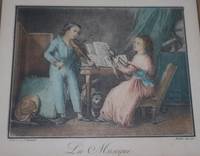
1800réf. 21178Paris presumed 1800. Near Fine. A handsome and scarce hand-colored aquatint from the Age of Enlightenment as a boy and girl essay a duet he on the violin she a lute as a cat skulks under the music table. The hallmarks of the Enlightenment are the globe and telescope in the background but also the idealized presentation of childhood we think. N.d. circa early 19th century. The frame measures about 35 by 39 cm. The print itself including the visible portion of the margin is 16.5 by 19.5 cm. The frame and matting are attractive and we thus think virtually any buyer would be happy to retain it. The frame is gilt and green and some red speckling and it has an Rococo band or Rinceaux ornate but in no way upstaging the picture. The matting has width with ruled lines adjacent to the print itself and drawing us in as well as picking up the framing ruled line of the print itself. Debucourt 1755-1835 was a versatile painter and engraver. Mallet 1759-1835 too was both a painter and engraver who collaborated with Debucourt often we believe. The Latin credits at the base of the picture tell us that Debucourt did the original piece of artwork upon which the print was based and Mallet took care of the printing. We should think though that there was some blurring of the roles of the two artists. We note that this isn't the only print the two collaborated on with the title of "La Musique". We haven't been able to locate another copy of this one though. The print has a few faint stains virtually unnoticeable unless one looks very closely. unknown
réf. 51-1937Paris: Basset circa 1820. Aquatine on rag paper. 27 x 42 cm. on sheet size 38.5 x 46 cm. Dayot 99b. 2nd state of 2 with lettering. Paris: Basset, circa 1820. unknown
1820réf. 24099A Paris, chez Rolland, s.d. [circa 1800]. Dimensions à vue : 444 x 328 mm + passe-partout + cadre.