COLLECTIFMareMagnum
Debucourt, Philibert LouisAntiquariat.de
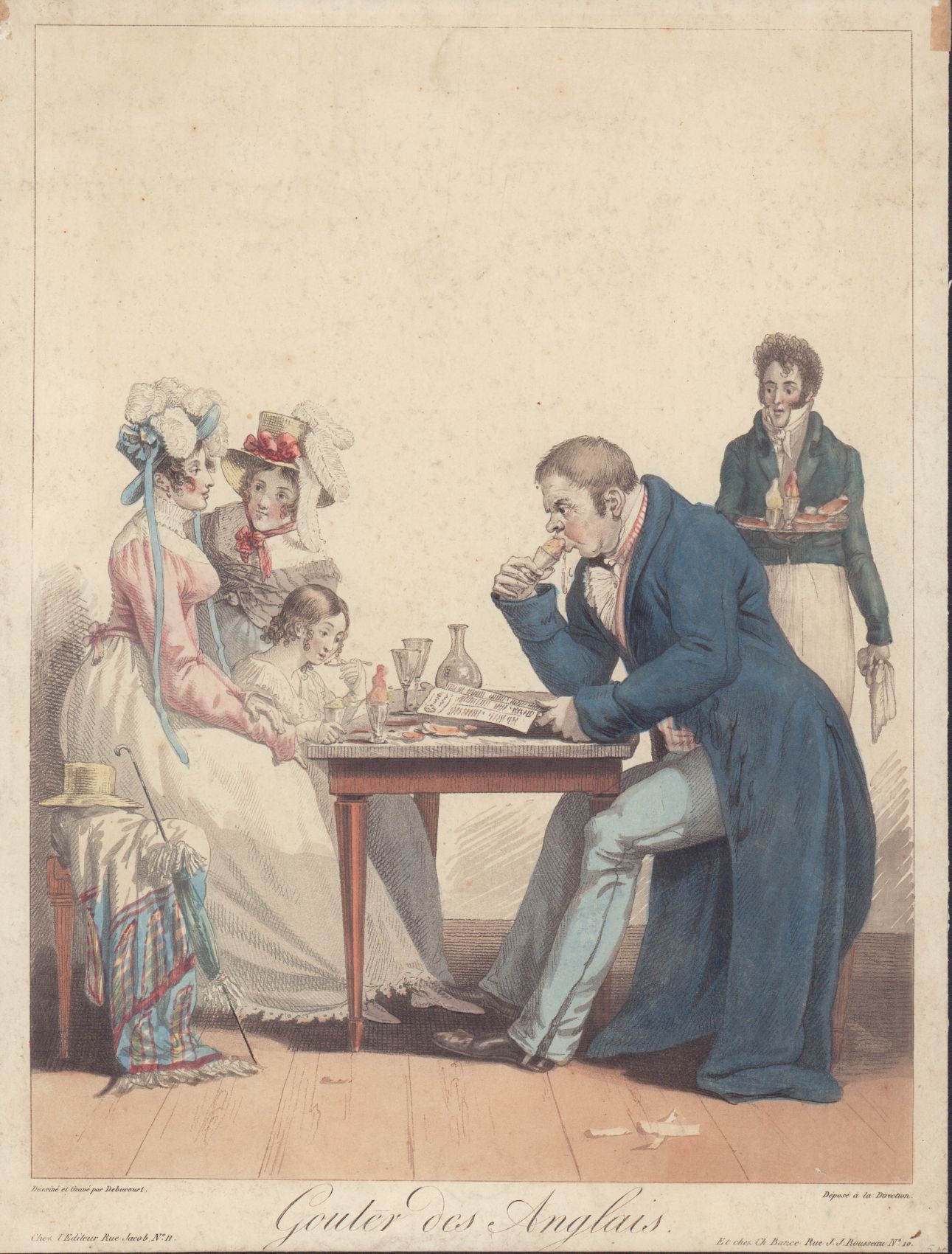
Gouter des Anglais. -
1820Best.-Nr. 902872AGParis, [um 1820]. Aquatinta mit Punktierstich 29,5 x 23 cm (hoch), Blattgröße 32,5 x 24,5 cm.
Antiquariat Tautenhahn · Deutschland250,00 €
132 Ergebnisse
1930Paris, Léon Ullman Laboratoires Le Brun Vers 1930. In-4 carré broché non paginé, illustré. Tache à la couverture sinon Bon état
1820Best.-Nr. 902872AGParis, [um 1820]. Aquatinta mit Punktierstich 29,5 x 23 cm (hoch), Blattgröße 32,5 x 24,5 cm.
1800Best.-Nr. 12765Paris: Charles Bance & Aumont 1800. Aquatint engraving printed in colour à la poupée on wove paper. Very good condition apart from some overall light soiling minor foxing and a skillfully repaired small loss in the left margin. Trimmed close to plate mark on all sides. A striking beautifully coloured engraving after the renowned 17th-century Flemish painter Peter Paul Rubens. A representation of Rubens' sister-in-law Susanna Lunden this plate is part of a series of three aquatints Debucourt completed after paintings by Tintoretto Rubens and Raphael. Susan Lunden was the daughter of the Antwerp silk merchant Daniel Fourment and the sister of Rubens' second wife Helena. Originally titled 'Le Chapeau de Paille' The Straw Hat the painting after which this plate is engraved dates from around 1622-25 and may have been a marriage portrait intended for Lunden's second husband Arnold. This print is a stunning example of the single plate colour printing technique used in France beginning in the 18th century. The effect is achieved by inking a single plate with several different colours by using a rag stump a process known as à la poupée. The outcome achieved by this laborious method of inking has a wonderful painterly effect and creates a delicacy of image which is charming to behold. Although a painter by training Philibert-Louis Debucourt is primarily renowned as one of the most innovative colour printmakers of the eighteenth century. Born in 1781 he studied with Joseph Marie Vien at the French Academy. After several years of exhibiting his paintings at the Salon he turned to printmaking in 1781. During the mid 1780s he began experimenting with the complicated multiple-plate colour printing process a technique that was refined and revolutionized by Jean-François Janinet. Debucourt found success with his colour intaglio prints of Parisian high society and he quickly earned a reputation as a skilled and prolific engraver. The bulk of his prints however were based on paintings by other artists and completed after the turn of the century. Despite his intense focus on printmaking he continued to exhibit his paintings alongside his engravings at the Salon throughout his life. Cf. Benezit Dictionnaire des Peintres Sculpteurs Dessinateurs et Graveurs vol. 4 p. 323; cf. Regency to Empire: French Printmaking 1715-1814 p. 346; Fenaille L'oeuvre gravé de P.-L. Debucourt 1755-1832 pp. 257-8. Charles Bance & Aumont unknown books
1800Best.-Nr. 12763Paris: Charles Bance & Aumont 1800. Aquatint engraving printed in colour à la poupée on wove paper. Very good condition apart from some overall light soiling and minor foxing. Trimmed close to plate mark on all sides. A striking beautifully coloured engraving after the renowned 16th-century Venetian Mannerist Tintoretto. A representation of the Italian painter's enigmatic mistress this plate is part of a series of three aquatints Debucourt completed after paintings by Tintoretto Rubens and Raphael depicting their respective mistresses. This print is a stunning example of the single plate colour printing technique used in France beginning in the 18th century. The effect is achieved by inking a single plate with several different colours by using a rag stump a process known as à la poupée. The outcome achieved by this laborious method of inking has a wonderful painterly effect and creates a delicacy of image which is charming to behold. Although a painter by training Philibert-Louis Debucourt is primarily renowned as one of the most innovative colour printmakers of the eighteenth century. Born in 1781 he studied with Joseph Marie Vien at the French Academy. After several years of exhibiting his paintings at the Salon he turned to printmaking in 1781. During the mid 1780s he began experimenting with the complicated multiple-plate colour printing process a technique that was refined and revolutionized by Jean-François Janinet. Debucourt found success with his colour intaglio prints of Parisian high society and he quickly earned a reputation as a skilled and prolific engraver. The bulk of his prints however were based on paintings by other artists and completed after the turn of the century. Despite his intense focus on printmaking he continued to exhibit his paintings alongside his engravings at the Salon throughout his life. Cf. Benezit Dictionnaire des Peintres Sculpteurs Dessinateurs et Graveurs vol. 4 p. 323; cf. Regency to Empire: French Printmaking 1715-1814 p. 346; Fenaille L'oeuvre gravé de P.-L. Debucourt 1755-1832 pp. 257-8. Charles Bance & Aumont unknown books
Best.-Nr. 05714Paris: Chez l'Editeur 1827. Parisian Life in All Its Splendor and Absurdity One Hundred and Fifteen Superb Hand-Colored Plates Depicting the Fashions Foibles and Amusements of Post-Revolutionary Paris The Exceptionally Rare Complete Third Edition of Le Bon Genre BON GENRE LE. Observations sur les Modes et les Usages de Paris pour Servir d'Explication aux 115 Caricatures Publiées Sous le Titre de Bon Genre Depuis le Commencement du Dix-Neuvième Siècle. Paris: Chez l'Éditeur Pierre de la Mésangère 1827. Third edition containing 115 hand-colored plates eleven more than the first edition of 1817. Large folio 14 7/8 x 10 7/8 inches; 378 x 277 mm. 4 24 pp. of descriptive text. One hundred and fifteen finely engraved and beautifully hand-colored plates by Georges-Jacques Gatine after designs by various artists including George Dutailly François-Joseph Bosio Louis-Marie Lanté and Horace Vernet. Printed by Vassal et Essling. A duplicate of plate 16 loosely inserted. Some occasional light foxing principally confined to the blank margins the plates generally fresh and clean with excellent contemporary coloring. Contemporary half crimson straight-grain morocco over marbled boards smooth spine elaborately decorated and lettered in gilt. Some light wear to head and foot of spine. An excellent copy of one of the rarest and most delightful collections of early nineteenth-century French fashion and social caricature. An exceptionally rare complete copy of the third edition of Le Bon Genre one of the most important and entertaining pictorial records of Parisian society in the opening decades of the nineteenth century. With 115 superbly hand-colored plates depicting the fashions customs occupations recreations and social eccentricities of the emerging French bourgeoisie. First published in 1817 Le Bon Genre represents a remarkable development in the history of French illustrated books. At once a fashion portfolio a social panorama and an affectionate frequently mischievous satire of contemporary manners it offers an extraordinarily vivid picture of Parisian life during the years following the French Revolution and the Napoleonic era. Unlike conventional fashion publications whose principal purpose was to illustrate the latest modes of dress Le Bon Genre places its fashionable subjects within the social situations that gave their clothing meaning. Its elegant ladies and gentlemen attend parties exchange compliments promenade in public gardens flirt dance dine quarrel and indulge in an astonishing variety of amusements. The result is a wonderfully revealing portrait of a society in which fashion leisure and public display had become essential expressions of social identity. The series is particularly significant for its depiction of the expanding urban middle class. The upheavals of the Revolution and the subsequent transformations of French society had altered established distinctions of rank and privilege. Wealth fashionable appearance manners and participation in the social life of the capital increasingly provided alternative means of establishing status. Le Bon Genre captures this changing world with exceptional wit and delicacy. Its subjects include fashionable young women in the latest Parisian dresses extravagantly attired gentlemen awkward suitors eccentric visitors and an almost inexhaustible procession of entertainers and fashionable characters. The collection is equally remarkable for its representation of popular entertainment. Among the many delightful subjects are performances by the celebrated rope-dancing troupes of Forioso and Ravel Indian jugglers acrobats performing dogs magic lantern exhibitions and elaborate amusement-park attractions. These images offer a fascinating record of entertainments that were enormously popular in their day but are seldom illustrated with such immediacy and charm. Particularly engaging are the plates depicting three ladies enjoying sorbets no. 4 a magic lantern entertainment no. 31 performing dogs no. 35 a balancing act no. 91 an extraordinary performer capable of swallowing almost anything no. 93 and an enormous amusement slide no. 97. The series encompasses subjects as varied as domestic pastimes fashionable entertainments theatrical performances courtship public promenades and the curious diversions of the Parisian pleasure grounds. The English provide another recurring source of amusement. Their clothing manners and social conventions are frequently represented as awkward or eccentric when contrasted with the supposedly superior elegance of Parisian society. Such images reflect the long-standing rivalry between France and England and the enduring French conviction that Paris was the undisputed capital of European fashion. The humor however is not confined to foreigners. French society itself is subjected to a gentle but persistent scrutiny its pretensions and absurdities exposed through exaggerated gestures incongruous situations and carefully observed details of dress and behavior. The illustrations are distinguished by their delicacy of line animated compositions and exceptionally attractive hand-coloring. Many plates contain several figures engaged in lively social interaction while others concentrate upon individual costumes or eccentric characters. Together they form a remarkable visual record of the manners and amusements of the early nineteenth century. Of particular importance is the accompanying descriptive text which provides explanations of the individual caricatures and their social significance. This commentary transforms the collection from a series of attractive prints into a coherent and unusually informative document of contemporary French life. The publication was conceived and directed by Pierre-Joseph-Antoine Le Bouc de la Mésangère 1761-1830 one of the most influential figures in the history of French fashion journalism. Born in Anjou La Mésangère originally pursued an ecclesiastical and academic career entering the Congregation of the Brothers in 1784 and subsequently teaching philosophy and literature at the Collège de La Flèche. During the revolutionary Terror he was forced into hiding but following the fall of Robespierre in 1794 he established himself in Paris as a writer and journalist. In 1799 he became associated with the influential Journal des Dames et des Modes eventually directing a publication that exercised an extraordinary influence upon contemporary standards of elegance and taste. Under his guidance fashion illustration developed into an increasingly sophisticated form of cultural commentary recording not merely clothing but the manners aspirations and changing social habits of fashionable society. For Le Bon Genre La Mésangère brought together designs by several accomplished artists including George Dutailly François-Joseph Bosio Louis-Marie Lanté and Horace Vernet. Their compositions were engraved by Georges-Jacques Gatine one of the foremost costume engravers of the period whose elegant line and sensitive rendering of detail were ideally suited to the fashionable subjects. Gatine had already established a considerable reputation through his work for the Journal des Dames et des Modes. His engravings for Le Bon Genre display the same refinement and precision combined with a greater freedom of expression and an unmistakable sense of humor. The importance of the collection was recognized by Gordon N. Ray who described Gatine as the leading costume engraver of his time and characterized Le Bon Genre as a lively mixture of caricatures of contemporary people and scenes. Vyvyan Holland in Hand Coloured Fashion Plates 1770 to 1899 noted the particular attention paid to the contrast between English and French fashions with the former frequently represented in deliberately unflattering terms. Millia Davenport in The Book of Costume emphasized the distinction between these lively social caricatures and conventional fashion plates noting that the series was accompanied by explanatory paragraphs describing the scenes represented. The first edition of Le Bon Genre published in 1817 contained 104 plates. Eleven additional plates were incorporated into the expanded series by the time of the 1822 edition and the present third edition of 1827 retains the full complement of 115 plates. The complete series is exceptionally scarce. Earlier bibliographical research located only four institutional copies of the 1827 edition two copies of the 1822 edition and no copies of the first edition in the OCLC/KVK records consulted. These figures should be regarded as a historical search result rather than an exhaustive census of surviving examples. The present copy complete with all 115 beautifully hand-colored plates and preserved in its handsome contemporary crimson morocco binding is a particularly desirable example of this celebrated and increasingly difficult-to-obtain work. A remarkable combination of fashion history social satire and popular entertainment Le Bon Genre stands among the most engaging illustrated records of Parisian life during the first quarter of the nineteenth century. References: Colas 2240; Vicaire I pp. 839-842; Rahir 332; Davenport 2280A-2281; Ray The Art of the French Illustrated Book p. 141; Vyvyan Holland Hand Coloured Fashion Plates 1770 to 1899 p. 51. Paris: Chez l'Editeur, 1827 unknown books
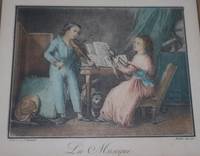
1800Best.-Nr. 21178Paris presumed 1800. Near Fine. A handsome and scarce hand-colored aquatint from the Age of Enlightenment as a boy and girl essay a duet he on the violin she a lute as a cat skulks under the music table. The hallmarks of the Enlightenment are the globe and telescope in the background but also the idealized presentation of childhood we think. N.d. circa early 19th century. The frame measures about 35 by 39 cm. The print itself including the visible portion of the margin is 16.5 by 19.5 cm. The frame and matting are attractive and we thus think virtually any buyer would be happy to retain it. The frame is gilt and green and some red speckling and it has an Rococo band or Rinceaux ornate but in no way upstaging the picture. The matting has width with ruled lines adjacent to the print itself and drawing us in as well as picking up the framing ruled line of the print itself. Debucourt 1755-1835 was a versatile painter and engraver. Mallet 1759-1835 too was both a painter and engraver who collaborated with Debucourt often we believe. The Latin credits at the base of the picture tell us that Debucourt did the original piece of artwork upon which the print was based and Mallet took care of the printing. We should think though that there was some blurring of the roles of the two artists. We note that this isn't the only print the two collaborated on with the title of "La Musique". We haven't been able to locate another copy of this one though. The print has a few faint stains virtually unnoticeable unless one looks very closely. unknown books
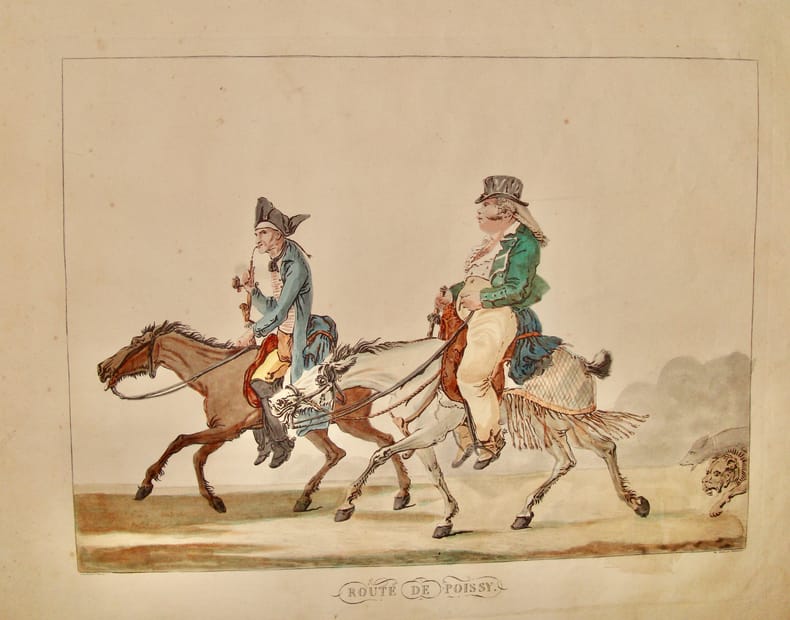
1817Best.-Nr. 18811Paris: chez l'Auteur & chez Ch. Bance 1817. Oblong folio. 15 3/8 x 20 1/2 inches. 4 hand-coloured aquatint plates by Debucourt after Vernet. Light foxing to one plate. Provenance: A. B. contemporary ink initials in the upper right corner of each plate A fine large-scale series of hand-coloured plates exhibiting Debucourt and Vernet's mastery of the genre print. The series consists of four views of scenes glimpsed "on the road." As usual with Vernet the human figures are slightly caricatured whilst the horses in three of the prints are beautifully observed. The plates are titled: Les Aveugles The Beggars. Fenaille 407; Route de St. Cloud The St. Cloud Road. Fenaille 405; Route de Poissy The Poissy Road. Fenaille 404; and Route de Poste The Post Road. Fenaille 406. According to Fenaille the series was eventually extended to include 12 large caricatures published by Bance & Aumont between 1816 and 1823. Fenaille Catalogue de l'oeuvre gravé de Debucourt 404-407. chez l'Auteur & chez Ch. Bance unknown books
1814Best.-Nr. 4369Paris Ch Bance 1814 Une belle gravure coloriée à la main par Debucourt d'après Carle VERNET. Premier état, avec le 1er en haut à gauche de la planche, et le No. 1 en haut à droite. Cette gravure a été conçue comme la première de la série "COLLECTION DE COSTUMES", qui devait être une collection de 56 planches accompagnées d'un texte montrant les costumes des nations. Cette planche a été déposée à la Bibliothèque par Aumontle le 2 novembre 1814 en même temps que la "Marche des officiers anglais". Les Anglais sont représentés de manière assez brutale, comme c'est souvent le cas dans les estampes françaises de l'époque. Il s'agit d'une estampe de bonne qualité, avec des couleurs originales attrayantes. Il y a des rousseurs modérées à fortes sur l'ensemble de la plaque. La surface de la plaque est de 36cm x 27cm. La feuille fait 39cm x 28cm.
1986Best.-Nr. 10500JC Lattès 1986 1986, JC Lattès, in-8 broché de 264 pages, couverture illustrée d'une photo couleurs par John Foley. | Etat : Bon état général (Ref.: Ref5489)
Best.-Nr. c2866Paris, Hotel Drouot, 1923 ; grand in-8°,broché de 32pp.;couverture beige imprimée en noir; trace de mouillure bord inférieur des feuillets.
1798Best.-Nr. 87502Au Bureau du Journal des Dames, Rue Montmartre, N° 183, au coin du Boulevart | A Paris s.d. (1798-1808) | 10.80 x 17.60 cm | 52 planches en feuilles montées sous marie-louise, en étui
1827Best.-Nr. 87629chez l'éditeur, boulevard Montmartre, no 1 Vassal et EsslingImprimeurs | Paris [1801-1827] ; 1827 (pour le texte) | 41.20 x 27.80 cm | relié
1930Best.-Nr. 37405Paris, Léon Ullman Laboratoires Paris, Léon Ullman Laboratoires Le Brun Vers 1930. In-4 carré broché non paginé, illustré. Tache à la couverture sinon Bon état
Best.-Nr. 11856Paris, au Bureau du journal des dames, 1798 s. d. (1798 - 1808). 1 vol. in-8. Cartonnage brun d’époque, pièce de titre de maroquin rouge.
1933Best.-Nr. 19179paris Publications Willy Fischer 1933 in-12 broché une programme, broché (agraphé) blanc (paperback) in-douze Editeur(18 x 13,6 cm), dos muet, couverture illustrée en couleur par BARJANSKI , toutes tranches lisses (all edges smoothes), orné de portraits d'Artistes hors-texte en noir (Yvonne PRINTEMPS, Charles BOYER, Michel SIMON et Jean DEBUCOURT) + illustrations publicitaires en noir, sans pagination (24 pages), 1933 à Paris Willy Fischer Editeur,
1820Best.-Nr. 24099A Paris, chez Rolland, s.d. [circa 1800]. Dimensions à vue : 444 x 328 mm + passe-partout + cadre.
1957Best.-Nr. 53521Paris, Rombaldi, coll. « Costumes et Modes d’Autrefois », n° 4 1957 In-folio 39 x 28 cm. En feuillets sous couverture rempliée et illustrée et étui carton, 12 ff. de texte, 24 planches en couleurs hors texte sur papier vélin des papeteries Aussedat. Exemplaire en très bon état.
1817Best.-Nr. 17910Précédés d'un Discours sur l'élégie héroïque, par M. Treneuil (1763-1818). Ses élégies héroïques sont d'inspiration religieuse et monarchique.Sommaire : Discours sur l'Élégie héroïque. Poêmes Élégiaques : Les Tombeaux de l'abbaye royale de Saint-Denis - L'Orpheline du Temple - L'Héroïsme de la piété fraternelle, ou l'Oratoire de la Barrière du Trône - La Captivité de Pie VI - Le Martyre de Louis XVI.Édition originale. A Paris, chez Firmin Didot, Imprimeur du Roi, et de l'Institut Royale de France - 1817 - 319 pages. Frontispice de Deveze et Debucourt. Envoi autographe de l'auteur sur la page du faux titre "offert à Monsieur Audry(?) par l'auteur".Reliure plein veau blond glacé de l'époque. Dos lisse orné et doré avec pièce de titre maroquin rouge. Roulette dorée sur les coupes. Tranches jaspées bleues. Pas de rousseur. Très bon état. Format in-8°(21x13).
Best.-Nr. GF15110Dessin original à l'encre de chine sur calque signé - format 13,5 x 10,5 cm -
Best.-Nr. 7221Société pour l'étude de la gravure française, Paris, 1920. In-8, broché, 127 pp. Avertissement - Philibert-Louis Debucourt, par Emile Dacier - Bibliographie - Catalogue des Peintures. - Catalogue des Dessins, par Albert Vuaflart et Jacques Hérold - Les procédés de gravure - Catalogue des gravures par Debucourt - Catalogue des gravures d'après Debucourt ...
Best.-Nr. 4503Editions de la R.M.N., Paris, 1985. In-8, broché sous couverture illustrée en noir, 126 pp. Préface - Introduction - Cochin le Fils - Les Saint-Aubin - Les Moreau - Janinet - Descourtis - Debucourt - Index des graveurs - Index des architectes, sculpteurs, peintres et dessinateurs - Dessins et peinture sur porcelaine du cabinet des ...
Best.-Nr. 7775Hôtel Drouot, Paris, avril 1921. In-4, agrafé, 22 pp. [53 n° décrits]Catalogue des Miniatures anciennes par Charlier, Cosway, Dumont, De Gault de Saint-Germain, Guérin, Nolet, Périn, etc. - Importante miniature, par Laurent. - Gravures anciennes imprimées en couleurs, par Debucourt. - Très beau dessin, par Aug. de Saint-Aubin. - ...
1899Best.-Nr. 4519Tirage à 315 exemplaires : un des 300 sur papier vélin à la forme. Superbe ouvrage. 1/2 chagrin violet, dos à nerfs orné, filets dorés sur les mors, covertures conservées. Reliure Seigneur Paris Morgand 1899 1 volume grand in-4°
1798Best.-Nr. 5449Retirage par Goupil à la fin du XIXè de cette fameuse planche. Elle est coloriée aux pochoirs. (Fenaille ) Cadre moderne et passe-partout. 520 x 385 1798
Best.-Nr. 5450Célèbre gravure de la série de 12 des “Routes”.Retirage sur vergé d’Arches. En feuille très bon 340 x 415