352 résultats
1748réf. 28557N.p. Paris 1748. Avec des Notes de M. Goupy Architecte Expert Bourgeois. 1 vols. 8vo. In very attractive contemporary mottled calf head chipped joints cracked but holding soundly marbled endpapers; interior slightly toned and title a little soiled else very good. Avec des Notes de M. Goupy Architecte Expert Bourgeois. 1 vols. 8vo. Building Code Paris 1748. unknown books
1753réf. 20316London: C. and J. Ackers 1753. First Edition. Hardcover. Very good. 11.25 x`9.25 inches pp 14 v 78 1 ad with 13 leaves of plates one folding. Illustrations engraved by Pierre Fourdrinier after Francis Price. Contemporary calf boards rebacked with new spine with raised bands original black leather spine label. Armorial bookplate of British civil engineer and architect W.C. Mylne 1781-1863 on front pastedown. Boards show moderate scuffing and general wear rear board has staining to the lower quadrant near the spine. Binding sound text and plates very clean though slightly rippled. Price was an architectural surveyor who held the position of "surveyor and clerk of the fabric of Salisbury Cathedral" for seventeen years. This was one of the first serious architectural studies of a Gothic building. C. and J. Ackers hardcover books
1723réf. 044453London: James Cole 1723. First Edition. Hardcover Full Leather. Very Good Condition. Original paneled calf recently and neatly rebacked and recornered endpapers refreshed. Scattered light foxing browning to a few pages and plates worming to the bottom corner of a few pages in volume 1; generally quite clean and with fine impressions of the plates. 2 engraved frontispieces 1 folding; mezzotint portrait of John Dart; 7 plates of subscribers' coats of arms; 126 engraved plate including images numbered 1-142 many with multiple images per plate. Size: Folio. 2-volume set complete. Quantity Available: 1. Shipped Weight: Over 3 kilos. Category: Architecture; Religion & Theology. Inventory No: 044453. James Cole hardcover books
1774réf. 042251London: The Authors 1774. First Edition. Hardcover Half Leather. Very Good Condition. 2 volumes in contemporary half calf rubbed and worn at corners hinges cracked but bindings intact. Tear to the corner of the title page scattered foxing and offsetting but generally quite clean. Old ownership marks a few marginal notes in an early hand possible Charles Davies whose ownership inscription on front pastedown notes that he bought the book at "the Sale of Mr. Lloyd Williams Esqr." in 1838. Pencil marks to pastedown. Volume 2 endpaper detached with 185 plates dated 1774-1778 it was originally issued in parts from 1774-1778 1 colored numerous folding depicting a wide variety of design elements houses inns libraries etc. The first volume forms a Builder's Dictionary A-Z. 345pp 98pp plus 185 plates. Size: Quarto 4to. 2-volume set complete. Quantity Available: 1. Shipped Weight: Over 3 kilos. Category: Architecture; Antiquarian & Rare. Inventory No: 042251. The Authors hardcover books
1737réf. 123537Two vols. Paris: C.A. Jombert 1737-8. Two vols. 4to title page in red and black vi Dedication a Monsieur Turgot Avis au relieur Approbation xvi 198 pp.; vii i Avis au relieur 180 pp. Numerous head- and tail-pieces. Vol. 1 with engraved frontispiece by Cochin and 44 plates 42 folding; Vol. 2 with 111 plates 15 folding. Most of the plates drawn and engraved by Blondel. All text-pages printed within a borderline. Original cats-paw calf rather worn joints repaired vol. 1 with new labels internally some browning and soiling a good solid set for reference not in "collector's condition". § First edition second issue without half titles errata slips and with Jombert's address as "Rue Dauphine". A handsomely illustrated work of the 18th century French architect and writer Jacques-François Blondel 1705-1774. The plates in Vol. I includes many architectural designs for houses and those in Vol. II depict both interior and exterior ornaments as well as garden plans. See Weinreb: "Arts Applied" #326 £240!: "an important source book of rococo designs of the mid eighteenth century surveys most aspects of the country house in an effort to point out the rights and wrongs of proportion composition and interior planning." Fowler 49. Berlin Cat. 2400. Graesse 1:441. Brunet 9800. C.A. Jombert unknown books
1720réf. 006730Paris: Jean Mariette 1720. 3/4 Morroco Marbleized Board. VG. Two volumes in original mottled calf: the end of the rear board of volume 1 has been expertly recovered with dyed calf to match corners polished to blend in. Some reveal to hinge volume 1 and wear to the raised bands gilt compartments on both volumes cords partially revealed and holding. Internals unfoxed clean crisp plates and text. In volume 1 there is a shaved edge to rear leaves resulting in shallow loss to last bundle of chairs at midsection outer margins not affecting text block or plate. A very nice unspohisticated copy. Volume 1: frontispiece title 4 3 13 6 8 40 4 w/ double plate xii w/ 3 plates 355 w/ 103 plates some double page or foldout . Volume 2: frontispeice title 357 - 920p. Jean Mariette unknown books
1737réf. 4025Turin:: Gio. Battista Chais 1737. FIRST EDITION. Folio: . 35.8 x 24 cm. Engraved frontis. XXXVII p. XVII p. 14 plates. A-G2 A-D2 E1 Bound in contemporary marbled boards worn and soiled rebacked in later sheep. An unusually nice copy internally with just the slightest toning to some plates a few spots clean tear to center of one plate at fold no loss and light finger-soiling in the margins. Magnificent engraved ornamental frontispiece by Prenner with the arms of the house of Savoy. Fourteen etched and engraved plates including the folding fireworks plate. Title page in red and black. Text in Italian and French. One of the most beautiful 18th c. Italian festival books and of the Piemontese Baroque. Both the festival and the book commemorating it occupied the combined efforts of some of the most important artists and architects of the period. The decorations of the buildings the apparatus the fireworks and the machines were invented by the architects Borra Massone Piovani Bernardi Agliaudi and Bernardo Vittone. The plates were etched and engraved by Daudet Belmondo Bianchi Maltese Prenner and Hérisset. The ten double-page and four full page plates depict scenes of the festivities held on the occasion of the wedding of Carlo Emanuele III Duke of Savoy and King of Sardinia 1701-1773 and Elisabeth Therese of Lorraine 1711-1741 on April 21st 1737. The images include numerous illuminations as well as a large fireworks display over an allegorical grotto richly decorated with statuary the arms of the bride and groom and an elaborate central fountain. A brief account of the display of the Turin's famous shroud for the King and his subjects on 4 May is also included as is a plate illustrating the crowd gathered at the Royal Pavilion to view the relic. The plates: 1. View of the Porta del Po designed by Guarino Guarini. 2. View of the Contrada del Po with illuminations. 3. View of the Castello Reale 4. The enormous fireworks "macchina" with scenes representing the marriage of the personified river Po and Hymenaeus the God of marriage. The fireworks show was held upon the arrival of the royal couple. 5. View of the Castello illuminated. 6. View of the royal pavilion with illumination. 7. View of the courtyard of the Palazzo Reale. 8. View of the Piazza San Carlo and the Porta Nuova. 9. Façade of the Palazzo Reale decorated and illuminated. 10. Façade of the Basilica of Corpus Domini. 11. View of the ghetto. 12. Displaying of the Shroud of Turin to the assembled crowd in the royal pavilion. 13. The vineyard and villa of Santa Maria la Regina Villa della Regina. 14. Garden of the Veneria Reale. Cicognara 1504. Vinet 600. Lipperheide 2761. Peyrot I 151. Berlin 3072. Ruggieri 848. Watanabe 1545 Gio. Battista Chais, unknown books
1740réf. 4004Augsburg:: Andreas Pfeffel 1740. FIRST EDITION. Folio:. 39.5 x 30 cm. 5 folding lvs. 1 letterpress leaf 4 engraved lvs. title dedication frontis. and portrait 50 engraved plates divided into 5 series of 10 plates each. Bound in contemporary German quarter vellum with label “Kupferbuch”. The binding has minor wear and there is evidence that these 5 suites of plates were once bound with another work. This is a fine complete copy with only very minor cosmetic blemishes: some light dust soiling to the folds of a few plates scattered finger-soiling to some plate margins blank versos of some plates dusty a few minor marginal tears or marginal creases not affecting the images. Very nice. Bibiena. First edition of this richly illustrated work on architecture and perspective. The finely engraved plates show brilliant baroque compositions for catafalques theatrical scenes a series for the Passion of Christ in elaborate architectural settings and the decoration of the Riding School at Vienna for the marriage of the Archduchess Mariana with Prince Charles of Lorraine. The publication of “Architetture e prospettive” made a major contribution to the modernization of the theater establishing the so-called ‘scena ad angolo’ curved backdrops on Europe’s stages. The second son of the Italian architect Ferdinando Galli Bibiena Giuseppe Galli da Bibiena was to become a distinguished artist and designer of elaborate festivals parties funerals open-air theatrical performances and all manner of ceremony for the Habsburg rulers. He proved himself an excellent illusionistic painter with a deep theoretical understanding of perspective. These attributes coupled with an extraordinary imagination allowed Giuseppe to produce innovative often fantastic imagery. Among his early independent works were decorations for the festivities celebrating the birth of Archduke Leopold of Austria 1716 and an imperial wedding in Munich 1722. In 1727 Emperor Charles V appointed Giuseppe to be “His Majesty's First Theatrical Engineer”. Galli Bibiena also designed altars and pulpits for churches constructed a decorative arch in Prague and with his younger brother Antonio designed decorations for theaters. After Charles V’s death Giuseppe served the late monarch’s daughter Maria Theresia. Among his notable achievements in this period Giuseppe transformed the stables at the Hofburg in Vienna into a ballroom for the wedding of Charles Alexander of Lorraine to Marianna of Austria. In 1747 he was commissioned to design Margrave Frederick of Bayreuth’s opera house considered his magnum opus. At the time of his death at Berlin in 1757 Galli Bibiena was in the employ of Peter the Great. “Architetture e prospettive” dedicated to and with a portrait of Charles V was printed in the year of Emperor’s death and at the height of Galli Bibiena’s career. The work is comprised of five series of plates with ten plates each depicting funerary apparatus religious scenery “teatri sacri” and fantastic architectural views. “The range of motifs and views embraces topics that were of great interest at the end of the baroque era such as fantasy-laden reconstructions of classical ruins. In his designs the artist made use of various methods to make the architecture monumental working above all with views from below and cropped sections. In many designs he used the ‘scena ad angolo’ technique and in others in particular for the depiction of festive decorations for imperial ceremonies he used a central perspective as a dignified form… “One of the sets of engravings shows the decoration of the Cavallerizia the riding arena which was transformed in 1744 into a ballroom. The plates were made by Lorenzo Zucchi the engraver at the court of the Elector of Saxony in Dresden. The ‘theatro sacro’ and the stage decorations for the theater festival to mark the marriage of the future Elector of Saxon Frederick Augustus II are also his work. However most of the copperplates are by the imperial printer Andreas Pfeffel d. 1748… “The fusion of architecture and decoration in the two-dimensional medium of drawing is characteristic of Giuseppe Galli Bibiena’s designs… Giuseppe’s father Ferdinando in his book on architecture had also made an attempt to unite painting and architecture from the point of view of perspective using the special art form of scenography. In ‘Architettura e Prospettive’ Galli Bibiena elevated this synthesis of painting architecture and scenography to a form of art in its own right which had its greatest effect in the ‘staging’ of architecture in the service of absolutist power.” Biermann Grönert Jobst and Stewering “Giuseppe Galli Bibiena” in “Architectural Theory from the Renaissance to the Present” p. 156 ff. Fowler 136; Kat. Berlin 4152; not in Millard; not in Vagnetti Andreas Pfeffel, unknown books
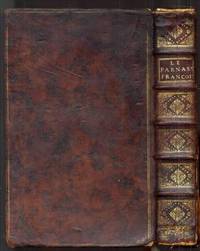
1732réf. 034597Paris: Jean-Baptiste Coignard 1732. First Edition. Hardcover Full Leather. Very Good. 2 volumes: Volume 1 1732 832pp xciii vol 2 1760 122pp in two parts. 13 plates plus plates of the author and a frontis. 12 plates of medallions 49 medallions in the first volume and 16 plates the first 12 identical in volume 2 1760. The latter volume also has the frontis. Front hinge splitting on vol I but still firmly attached by all cords boards more or less detached but present on the second volume. Original full calf light chipping to spine on vol 1 heavy and spine strip loose on 2. Heavy edgewear both volumes with armorial bookplates of M. Titon de Villotran Titon de Tillet's great nephew and the second with that of "General J. Doreau". The first volume has scattered light stains and marks but is generally VG at least internally. Corrigé par l'auteur on half title with a dozen or so manuscript corrections in margins to text. There are also a few marginal additions typed and added on paper at margins as well as a few marginal repairs. The second volume shows moderate foxing heavy to title and frontis but generally clean. A scarce copy of a book important to French culture and a lovely production. There were three supplements to the 1732 work in 1743 1755 and 1760 as luminaries either died or gave up their art an initial abbreviated volume Description du Parnasse François was published in 1727 in 12mo. Titon du Tillet originally conceived of this project as an immense sculpture garden honoring the great poets musicians and artists of Louis XIV's reign. The estimated cost of over 2 million livres forced him to terminate the project and commence this more manageable monument in print. Size: Folio. 2-volume set complete. Quantity Available: 1. Shipped Weight: 2-3 kilos. Category: Antiquarian & Rare; Architecture. Inventory No: 034597. Jean-Baptiste Coignard hardcover books
1797réf. 2604Dublin: P. Wogan 1797. First Edition . Cloth. Very Good. 8vo - over 7¾" - 9¾" tall. Light blue boards.34-489p17. Uncut pages. Thin split on spine Very minor age spotting interior First edition has no map Second edition calls for maps P. Wogan hardcover
1747réf. ARCHITEC005944Giambatista Albrizzi Venezia. 1747. Second Venice edition. Small octavo. pp 44 213 30. Engraved frontispiece and twelve engraved plates. Period quarter vellum parchment boards leather title label.Some foxing to endpapers. Title label chipped. Very good indeed. Giambatista Albrizzi, Venezia. hardcover
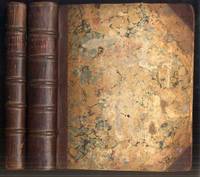
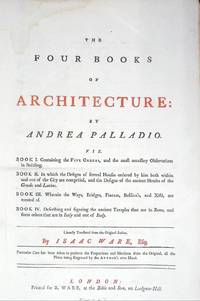
1738réf. 3029London: R Ware; Isaac Ware. G : in good condition. Front lower hinge cracked. Occasional light staining. Some inner hinge cracking. 1738. First edition thus. Brown hardback leather cover. 420mm x 270mm 17" x 11". vi 110pp 208 plates. 208 b/w plates. Heavy book extra shipping needed for overseas. . R Ware; Isaac Ware hardcover
1748réf. 28557N.p. Paris 1748. Avec des Notes de M. Goupy Architecte Expert Bourgeois. 1 vols. 8vo. In very attractive contemporary mottled calf head chipped joints cracked but holding soundly marbled endpapers; interior slightly toned and title a little soiled else very good. Avec des Notes de M. Goupy Architecte Expert Bourgeois. 1 vols. 8vo. unknown
1768réf. BB0853London: printed for J. Robson Bookseller to the Princess Dowager of Wales at the Feathers in New Bond Street 1768. First Edition. Paper-Covered Boards. Fine. First Edition of the first standard guide on print collecting in England including detailed commentary on Hogarth's Rake's Progress. Crown 8vo 171 x 102mm: 2iv4224913pp pp. 44-45 and 81-96 misnumbered 45-46 and 77-92 respectively; this copy as most wanting the 17 plates. Rebound to style by Fitterer in marbled paper-covered boards printed paper labels on spine and upper covera splendid presentation. Copper-engraved book plate of Rev. William. Thomas. Bree 17861863 vicar of All Saints' church in Allesley reaffixed to front paste-down. An excellent copy tightly bound and clean throughout. Barbier pp. 24-27. Lowndes II 895. Published anonymously Gilpin's authorship was only revealed with the third edition in 1781 reaching a fifth edition in 1802. On the continent this essay's influence spread through German French and Dutch translations. Gilpin's "aim as the title-page indicates was to outline the Principles of picturesque Beauty the Different Kinds of Prints and the Characters of the most noted Masters. . . . The Essay defines picturesque as a term expressive of that peculiar kind of beauty which is agreeable in a picture Essay on Prints 2 but does not develop the definition." ODNB Among prints singled out for detailed consideration are Salvator Rosa's "Death of Polycrates" Waterloos "Tobias" and Hogarths "Rakes Progress." N. B. With few exceptions always identified we only stock books in exceptional condition carefully preserved in archival removable polypropylene sleeves. All orders are packaged with care and posted promptly. Satisfaction guaranteed. printed for J. Robson, Bookseller to the Princess Dowager of Wales, at the Feathers, in New Bond Street unknown
1720réf. 653FKG01U79OVerona 1720. Contemporary stiff paper wrappers. Folio 38.5 x 25.5 cm. With 4 architectural drawings 3 double-page ca. 37 x 50 cm at a scale of about 1:60 and 1 loosely inserted full-page 24 x 35 cm at a scale of about 1:107 skillfully drawn in brown ink and several shades of grey watercolour. Two of the double-page drawings are elevations 1 partly in cross-section the other 2 drawings are floor plans each plan with a folding flap tipped on showing the plan of a higher level. The original designs for the alterations to the chapter library at Verona situated in the Church of St. Helena abutting the famous Cathedral of San Zeno the common wall appears in the drawings. The alteration was ordered by Scipione Maffei 1675-1755 and Jacopo Muselli and executed by the architect Lodovico Perini; it was finished in 1726. In 1713 Maffei a leading scholar poet and man of letters had made a remarkable discovery in the library: in its old cupboards he found late-classical and early Christian manuscripts from the 5th to 9th century stored there centuries earlier apparently to protect them against danger of flooding of the river Adige. On the basis of these old manuscripts and helped by the Canon Carlo Carinelli Maffei formulated a completely new and epoch-making theory regarding the development of the Latin script in three variants: the Roman majuscule the minuscule and the cursive hand showing an uninterrupted evolution from Roman Antiquity to the Renaissance. Maffei published the results of his studies in his Istoria diplomatica 1727 and Verona illustrata 1742. The rediscovery of these old manuscripts also resulted in a revival of Patristic studies and many new editions of the works of the Church Fathers.With some faint stains near the fore-edges an one edge of the loosely inserted drawing and a couple rust spots in the paper but still in very good condition. unknown
1719réf. 56262Cedar Falls IA & Tigard OR: Wagner Manufacturing Co.; Orlo R.W. Hossack Architect & Salesman for H.F. Bonesteele 1917-1927. 1st - 4to. Approx. 150 pp sections separately paginated inserts. w/ four linen-backed silver gelatin photos sized 6.5 x 7 in. up to 8 x 10 in. 3 mounted on white linen hinges w/ whole punches at gutter margin colour inserts mimeographed price lists & order forms over 100 text illustrations & diagrams blue printed softcovers all preserved in limp leather 3-ring binder gilt lettering stamped on front cover minor shelfwear rubbing; 2nd - 4to. 15 1 pp. With text illustrations photos self-printed colour softcovers cover art of garage door being opened minor shelfwear; 3rd - 4to. 32 pp unpaginated. colour-printed title numerous text illustrations Gray-green illustrated softcovers split-pin binding yapp edges minor rubbing edgewear creasing to couple corners; 5th -- 2 copies. 16mo. 8 pp unpaginated. printed leporello accordion-style format illustrated & printed in red & black minor shelfwear; 6th - Folio. 9 x 16 in. 4 pieces. 2 pp unpaginated. broadsides text illustrations photos fold creases still VG; 7th -- 8vo. Approx. 100 leaves mostly carbon copies of orders all written in manuscript most located dated and signed at lower right corner by Hossack salesman limp red leatherette covers silk moire endpapers gilt stamping front cover some chipping edgewear rubbing; together with 8th -- Salesman Sample Case containing garage door sliding Model No. 58 from quarter-sawn oak featuring full-sized hardware sized 18.5 x 18 in. two Wagner rolling garage door & elevator door sets steel brackets all preserved in hardshell sample case sized 20 x 30.25 x 5 in. fitted w/ nickel-plated corners bosses on bottom handle and clasps khaki-coloured cloth lining and pockets scuffing edgewear still VG exemplar originally owned and used by Orlo Ray William Hossack 1891-1937 a Portland architect real estate developer and salesman for Bonesteele to his clients. First editions thus of these catalogues and exceedingly rare complete salesman sample kit for the Wagner Manufacturing garage door hardware in the 1920s. After World War I the explosion and popularity of automobile ownership in the United States created a desperate need to house these often cantankerous and essential machines for homes businesses and commercial fleets. By quickly adapting their hardware sets for elevator doors first introduced before World War I Wagner was able to quickly capitalize on the market growth and need for door hardware to retrofit existing garages as well as new construction. Often coupled with doors produced by Johnson Fimbel Hartford Barber-Colman Overhead and Crawford the Wagner hardware sets proved durable and popular. In addition this sample kit features the specialized steel stud brackets developed by Wagner to help brace garages and sheds adapted for garage doors to hold automobiles as the weight of the doors could damage existing construction as Americans were interested in rolling doors and sectional garage doors rather than traditional swing-out barn-type doors. Wagner 1871-1937 originally founded his company in Cedar Falls IA in 1904 to manufacture children’s sleds coaster wagons and hay rack fixtures with a variety of door hardware. They merge with Star Elevator Doors before World War I and later with Boardman Elevator Control of Chicago with primary customers as Otis Elevator and Westinghouse. In 1934 Wagner began producing the iconic Wagner Overhead Garage Door and by the 1950s had become one of the largest garage door manufacturers in the country. Worldcat locates 1 copy of No. 25 Harvard; and 1 of Wagner-Star Elevator Door Cat Univ. of Kansas; no copies of the other catalogues or examples of the Salesman Sample Model in case. Wagner Manufacturing Co.; Orlo R.W. Hossack, Architect & Salesman for H.F. Bonesteele, paperback
1800réf. 47665Prague: Franz Gerzabkischen 1800. Folio. 14.25 x 10.25 in. vi 102 pp. Woodcut device on title tables 58 large folding many double-page or larger copper plates couple w/ minor closed tears at fold. Contemporary quarter calf over painted boards raised bands tan & gilt spine labels heavy rubbing & wear to spine corners fore-edges front & rear hinges starting but sewing sound occasional foxing and a couple leaves w/ minor ink marks still a good copy w/ VG- plates w/ ownership signature Louis Moulin. First edition of this very scarce and impressive treatise on 18th-century Austro-Hungarian architecture structural civil and mechanical engineering. Brust was the Royal Architect in Prague at the end of the 18th century and intended this treatise to aid architects and builders in Central Europe during the Napoleonic era. Reflecting the heavy influences of Baroque and Classicism styles at the time he has included numerous detailed plans and instructions on building trusses for roofs from the simple to incredibly large and elaborate. He has even included the spread sheet for materials and costs for constructing the truss and roof to a large public or private building plate 6. There are numerous different church steeples bell towers and even domes with detailed designs and instructions. In addition he has included instructions for building a large industrial wine press; well-drilling equipment; construction cranes for lifting trusses and stone; Japanese gardens; pile driving equipment; constructing bridge piers and timber bridges; the gates for locks in irrigation canals and transportation canals; and finally a detailed plate for water wheels and equipment -- 1 of which using an Archimedes screw. Of particular interest is plate 43 showing plans for the design and ornament of the roofs of Turkish mosques. Worldcat locates 5 copies; Engelmann Bibliotheca mechanico-technologica p. 55. Franz Gerzabkischen, hardcover
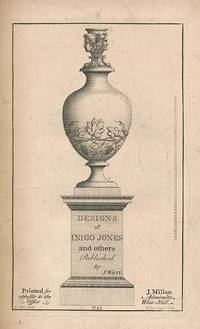
1743réf. h2151London: J Millan. G : in good condition. Cover rubbed. Occasional slight marks. 1743. Second Edition. Brown hardback half-leather cover with marbled boards. 240mm x 150mm 9" x 6". 100pp. 49 b/w plates 6 fold-out. . J Millan hardcover
1784réf. 001777GIOVANNI ZEMPEL PRESSO MONTE GIORDANO Rome 1784. Hardcover. Very Good. Very Good copy of edition in Italian from 1784. Completely square and tight parchment binding with four 4 nerves. Gilt title and floral motifs on light brown leather spine; all crisp bright and fully visible. Greenish covers with leathered corners. Title page with letterpress mark in woodcut. Marble end papers decorative red end pages. Size: 290 x 219 mm. Some light watermark like stains on covers. Short inscription in pen and adhesive sticker inside front cover. Small stamp in ink on title page slight foxing on some pages towards the end; otherwise remarkably preserved copy. First XXVI pages with dedication approval and information on the life of Alberti followed by 565 pages of author's text and 33 folded figure drawings at the end. Heavy and/or oversized book which CANNOT be EXPEDITE shipped for the quoted shipping price. Contact us prior to purchasing if you require EXPEDITE US or any type of INTERNATIONAL shipping. Full translation of title page text: THE TEN BOOKS OF ARCHITECTURE BY LEON BATTISTA ALBERTI TRANSLATED INTO ITALIAN BY COSIMO BARTOLI - NEW EDITION DILIGENTLY CORRECTED AND COMPARED WITH THE ORIGINAL LATIN GIOVANNI ZEMPEL PRESSO MONTE GIORDANO, Rome hardcover
1730réf. 17627London. Very Good with no dust jacket. First Edition. Engraving. This engraving is in very good condition full borders as published fine detail unfoxed uncolored as published verall size 9.5" x 7" image size 4.25" x 6" images available.; 9.5" x 7.5" . c1730. unknown
1790réf. 10386London: Alexander Hogg. Very Good with no dust jacket. Engraving. This charming engraving by Hogg shows six panels each within a floral border each depicts a church in London. It is in very good condition printed on lightweight paper edges lightly chipped full borders as published a lovely engraving - images available.; 15.5" x 10" . 1790. Alexander Hogg unknown
1790réf. 10385London: Alexander Hogg. Very Good with no dust jacket. Engraving. This charming engraving by Hogg shows six panels each within a floral border each depicts a church in London. It is in very good condition printed on lightweight paper edges lightly chipped full borders as published a lovely engraving - images available.; 15.5" x 10" . 1790. Alexander Hogg unknown
1800réf. 00286320London: Printed For G. G. And J. Robinson Pater-Noster-row; and J. Cumming 40 Holborn Hill 1800 Contempory calf five raised bands gilt tooling boards tight speckled fore-edges no markings or tears. The Fifth Edition with Corrections and Additions. First published in 1776. mild foxing. 2 Letter to William Cullen M. D. Professor of the Practice of Physic in the University of Edinburgh and First Physician to His Majesty in Scotland ect. ect. Monk Hill Aug. 1776. vii Preface. xvi Advertisment xviii 1 Contents xxiii B Essay First. Inclosures and Fences. 200 pgs. Essay Second. On Draining Bogs and Swampy Grounds. Introduction Mr. Elkington pp346. Illustration woodcuts Essay III. on the Proper Method of Levelling High Ridges. Essay VI. on Quick - Lime as a Cement and as A Manure. Advertisment 591 pgs. Quite Rare OCLC finds 19 copies. of this Fifth Edition. Size: 8vo - over 7¾" - 9¾" tall. Fifth Edition. Full-Leather. Very Good. Printed For G. G. And J. Robinson, Pater-Noster-row; and J. Cumming, 40, Holborn Hill hardcover
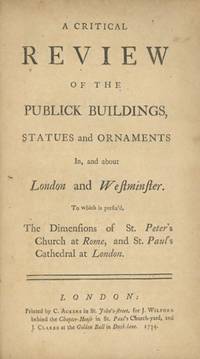
1734réf. 29117London: Printed by C. Ackers for J. Wilford and J. Clarke 1734 1734. First edition. ESTC T56391; NCBEL II 798: "Doubtfully attributed to Ralph. Text a little foxed; fine copy. 8vo recent panelled calf period style by Phil Dusel red morocco spine label gilt lettering. viii viii 119 1 pp. Folding table. With half-title. A detailed travel guide to London's architecture monuments fashionable squares and statues from "mere Gothic heaps of stone without form or order" to the stately works of Inigo Jones Christopher Wren and the influence of Venetian Andrea Palladio. The entertaining narrative begins in the center of London and meanders out to Westminster Abbey and further still to the recently built Grosvenor Square. In the Poet's Corner at Westminster the narrator comments on the absence of John Milton and William Shakespeare and of Grosvenor Square he writes that "there is no harmony or agreement in the parts which compose it." The Critical Survey has traditionally and convincingly been attributed to American James Ralph who was born in Philadelphia around 1700 and in 1725 moved to London with his friend Benjamin Franklin. Ralph was an erudite and prolific Grub Street author pamphleteer playwright and poet who had a wide range of interests that is reflected in the variety of subjects he wrote about. According to Franklin he "was ingenious and shrewd genteel in his manners and extremely eloquent . . ." His guide to the architecture of London went through several subsequent revised editions. One could easily read it on a walking tour through London today. London: Printed by C. Ackers for J. Wilford and J. Clarke, 1734 unknown
1792réf. BB0995London: printed for R. Blamire in the Strand 1792. Early Reprint. Quarter-Morocco. Near Fine. Fourth Edition so stated of the first standard guide on print collecting in England including detailed commentary on Hogarth's Rake's Progress. 8vo: xiii3174xi1pp. Contemporary quarter black morocco over marbled boards flat spine in six compartments between gilt rules gilt urn stamped in each but second titled in gilt. An excellent copy tightly bound and generally clean and bright with only the occasional minor smudge and handling mark and a few stray spots of foxing. Barbier pp. 24-27. Lowndes II 895. First published anonymously in 1768 Gilpin's authorship was only revealed with the third edition in 1781. On the continent its influence spread through German French and Dutch translations. Gilpin's "aim as the title-page indicates was to outline the Principles of picturesque Beauty the Different Kinds of Prints and the Characters of the most noted Masters. . . . The Essay defines picturesque as a term expressive of that peculiar kind of beauty which is agreeable in a picture but does not develop the definition." ODNB Among prints singled out for detailed consideration are Salvator Rosa's "Death of Polycrates" Waterloos "Tobias" and Hogarths "Rakes Progress." The collector is "cautioned against indulging a desire of becoming possessed of all the works of any master. . . . against a superstitious veneration for names. . . . against making the public taste our standard. . . against rating prints' value by their scarceness. . . against buying copies for originals" and against acquiring poor impressions. N. B. With few exceptions always identified we only stock books in exceptional condition carefully preserved in archival removable mylar sleeves. All orders are packaged with care and posted promptly. Satisfaction guaranteed. Fine Editions Ltd is a member of the Independent Online Booksellers Association and we subscribe to its codes of ethics. printed for R. Blamire, in the Strand unknown