GETSUSEN (or GESSEN) 月泉Biblio.com

10 321 résultats
réf. 9707Five full-page woodcuts. 51; 58 folding leaves. Two vols. 8vo orig. semi-stiff wrappers orig. block-printed title labels on upper covers new stitching. Japan: 1737 An illustrated record of the truly gruesome sacrifices made by the Pure Land monk TaijÅ 1685-1731. He began studying Buddhism in 1715 and in 1719 decided to become a monk leaving his wife and child as well as his elderly mother. Following the example of the master who initiated him to Buddhism TaijÅ in 1720 severed his penis and took the tonsure. Among his other exploits we note the writing of the name of Amitabha Buddha on 5000 sheets of paper and the burning of two fingers of his right hand in a ceremony. He continued with the other fingers. In 1731 in front of monks and laymen TaijÅ sacrificed his body to send it to Buddhist sites. He gouged his eyes out cut off his tongue both ears cheeks lips his twelve toes and other parts of his mouth abdomen and legs and placed the pieces on a table. They were then placed in boxes and sent out to 87 locations. TaijÅ died from his wounds. The biography was written by Getsusen 1691-1760 who studied with the same master as Taijo. The book was collated by HÅshū 寶洲 d. 1738. The book has a Preface by HÅshū dated 1734 and one by Getsusen 月泉 dated 1733. The colophon is dated 1734. Our book does not contain an imprint but Biography of Taijo was first published by KÅshÅdÅ å‘æ¾å ‚ in Kyoto in 1734. It was reprinted in that city in 1736 by KÅto shorin 皇都書林. The first edition contains two woodblock illustrations in its first volume: one of a mountain and one of TaijÅ reciting the Buddha’s name with burning candles on his fingerless hands and head. In the second volume there is an illustration of TaijÅ climbing onto the roof to recite the Buddha’s name underneath the moon and one of him reciting it for seven days submerged in a river in winter. The KÅto shorin edition contains only the illustration of the mountain. There is also a printing from 1737 with an unclear relationship to the two aforementioned editions. Our book contains all four illustrations gathered in the first volume plus a fifth woodcut. It might be a later printing of the 1734 edition with the material somewhat rearranged. Fine and fresh set. References Sekiguchi Shizuo é–¢å£éœé›„ and Miyamoto Hanae 宮本花æµ. “Dewa TaijÅ hÅshi ningyÅ nenbutsu den jÅ honkoku to kaitai” 『出羽待定法師å¿è¡Œå¿µä»ä¼ä¸Šã€ç¿»åˆ»ã¨è§£é¡Œ. Gakuen 学苑 852 2011: 15-75. unknown
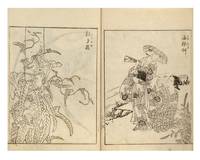
réf. 974339 leaves. Two parts in one vol. 8vo orig. patterned semi-stiff wrappers wrappers a little wormed new stitching. Osaka: Kashiwabaraya Seiemon 1764. First edition. SekkÅsai was an artist active in Osaka ca. 1740-50. He illustrated books and theater programs and also designed a number of prints. This is “the best of SekkÅsai’s sumi-printed books consisting of a wide range of miscellaneous pictures some in KanÅ or even ItchÅ style. The profile drawing of a girl wearing a kimono patterned with white hares and drooping willow wands is unusually winning.”–Hillier The Art of the Japanese Book p. 299. A fresh copy with some worming occasionally repaired touching images. We do not find it offensive. References Brown Louise Norton. Block Printing & Book Illustrations in Japan. London: 1924 p. 64. unknown
réf. DADAX1683246748New unknown
1899réf. 0001206WASHINGTON DC LEIPZIG LEIPSIC. Very Good. 1899. On offer is the original 1899 manuscript diary handwritten by Rebecca P. Warner known by one and all as Bess or Bessie who was 26 at the time. Bess the oldest of 9 children offers the reader a unique view of how a prominent wealthy Washington DC family the lived at the end of the 19th century but even more important is the very intimate interesting view of Germany during one of the country's most fascinating eras of historical development pror to World War I. Bess' father was Brainard Warner Sr. who was a lawyer but made his fortune in banking real estate and land development. His company was responsible for the oversight or building of over 1000 buildings and homes in the Washington DC area. Bess's mother was Mary Jacobs Parker Warner who was descended from Edward Doty a Pilgrim and indentured servant who sailed over on the Mayflower signed the Mayflower Compact and helped to settle Plymouth Colony. This diary describes Bess' trip with her sister Anna and brother Brainard Jr. to Leipzig Germany where Brainard Jr. was the US Consul. Bess does a super job of detailing setting up house in Leipzig and also about their daily lives there. They also did a lot of traveling within Germany and she describes that as well. Research notes that the Warner family endured a lot of sadness. They lost three children at birth or very early in life. They lost their mother Mary Jacobs after the birth of Lucy who then died. They lost their son and brother Southard who committed suicide at age 33 by shooting himself while stationed as a consul in China. Then Brainard Warner Sr died two years after the death of Southard. Here are some snippets and observations from a casual reading: They went to the motette at St Thomas Kirche which was very beautiful. The church was crowded. Students belonging to a club were there. They stayed after the service and thought they might see a German wedding. They have them nearly every Saturday after motette. They got caught in the middle of a religious service. They were sitting right in front of the minister and Bess was afraid they'd get called up to do something In the evening Mrs Young telephoned to ask them over. Brainard had an engagement but Bess and Anne went. They left Leipzig for Chemnitz and went directly to the consulate where they had supper. They went with Mr Monaghan to Schellenburg where his family was summering. "This was a queer little town located on the top of a mountain" There is a beautiful castle and some old walls. Aside from that Bess thought it was an uninteresting place to spend a summer. They left on Monday. They went to a parade in honor of the King of Saxony. About 5000 men were received. They expected to see the King on horseback but he was on foot with other officers. They met Professor Gregory who showed them around some parts of the University. In the afternoon Brainard Anne and Bess called on Mrs Monroe. Brainard went out in the evening with friends. "Today is the Emperor's birthday and all the flags are out. We stood for a long time to watch the Lieut General review the officers. It was a fine sight. what little we could see though the crowd But we were nearly frozen it was so cold" Bess practiced and then went for a lesson with Herr Krause only he wasn't in. She went again at 4 pm. "He was very discouraging and said I had no independence of fingers" Bess thought it would take her several lessons to get the right finger position and that there was no royal road to piano playing. "Hard work is the only road to success in anything". She went home. They had letters from Mamma and Pa. Then they went over to hear the St Thomas Kircke choir practice such beautiful voices. They had a number of people who stopped by for visits." We actually had a count call on us Graf Laisher who was very bright and interesting. He is studying medicine at the University" He said he couldn't speak English but he was very fluent. He proceeded to show them some of his feats of exercise and they were petrified because of their rented furniture. But everything was whole when he left. In the evening Bess and Anne went to the home of Mrs Morris. They danced but it was more of a lesson for the young grandson. He fancied Bess as a teacher and so they whirled around in a circle for 2 hours. Bess wrote that dancing on the ship over was "nothing compared to my feelings after dancing in the mad German fashion" Bess Anne and Lucy went to the Catholic Church which the royal family attended. "I must say I was thoroughly disappointed in royalty as exhibited here. The king queen and two other members of the family sat in boxes on a level with the gallery of the church and just to the left of the altar. Princess Matilda is one of the coarsest people I have ever seen. She spent most of her time yawning. She must weigh at least 200 lbs. We only stayed while the King and Queen were there." The diary has approximately 141 pages of entries from January 1 1899 to August 2 1899 with some gaps in this 4" x 6 ½" diary. Overall G.; English; 12mo - over 6¾" - 7¾" tall; MAYFLOWER GENDER STUDIES TRAVEL PRE WORLD WAR I BRAINARD WARNER DOTY WOMEN'S STUDIES GERMAN ROYALTY DEUTSCHLAND ANTI SEMITISM GERMANY AUTOGRAPH HANDWRITTEN MANUSCRIPT Gründerzeit Emperor William II antiquité contrat vélin document manuscrit papier Antike Brief Pergament Dokument Manuskript Papier oggetto d'antiquariato atto velina documento manoscritto carta antigüedad hecho vitela documento Manuscrito HANDWRITTEN MANUSCRIPT DOCUMENT LETTER AUTOGRAPH DIARY JOURNAL LOG KEEPSAKE WRITER HAND WRITTEN DOCUMENTS SIGNED LETTERS MANUSCRIPTS HISTORICAL HOLOGRAPH WRITERS DIARIES JOURNALS LOGS AUTOGRAPHS PERSONAL MEMOIR MEMORIAL PERSONAL HISTORY . unknown
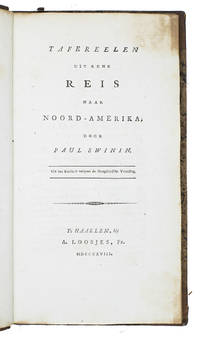
1818réf. ABC_45491Haarlem 1818. Large 8vo. A. Loosjes Pz. Contemporary half calf marbled sides. 4 IV 127 pp. Very rare first and only edition of the only Dutch translation of a Russian description of the United States of America. The title-page notes that it is translated from the German translation 1816 and the preface notes that the first edition in Russian appeared in 1815. A second Russian edition appeared at St. Petersburg in 1818 and has sometimes been described as the first.The great Russian author Pavel Petrovic Svinyin or Svin'in here westernized to "Paul Swinin" is best known for his Sketches of Russia published in the West under the name "Suinine". The identity of the Dutch translator of the present work is unknown. It gives an interesting "picturesque" travel account of the United States spanning the year 1813 and provides five main accounts covering different subjects: a statistical survey; a religious overview with descriptions of the several Christian communities naming Methodists Quakers Shakers Baptists and more; a description of the different types of steamboats used in North America; a biography of the French general Jean Victor Moreau who lived in exile in the United States from 1805 to 1812; and a description of the dancing rituals of indigenous American "Indians" naming the Osage Arkansas Sioux and Saki tribes which the Russian author interestingly compares with tribes in the Caucasus.With the bookplate of the society Doctrina & Amicitia on the front paste-down. Some browning on the first and last few pages. Covers very slightly rubbed. Otherwise in very good condition.l NCC; Sabin 93997; WorldCat 10553560 & 656756512; not in Howgego. ABE CAT Anthropology & Ethnography unknown
réf. a66736Paris 1564 1565 Ex officina Gabrielis Buoni in clauso Brunello. In Latin with much Greek. Two volumes. Sm4to. Attractive c. 1850 binding in 3/4 brown leather red and brown marbled boards and orange spine labels and gilt trim. All edges rouged. Tiny neat owner signature in each volume on front end paper. Volume 1: 6 240pp. 3 errata 27pp. index; bound with Ad Expositionem Disputationis de Methodo contra Thessalum Ossatum Academiae Parisiensis methodium responsio. Iacobi Carpentari Claromontani Bellouaci. 6 31p. Volume 2: 6 304pp. 3 errata 24pp. index. A few small ink notations and brown spots in text. A bit of pitting in leather on spine of vol 2. Spine labels lightly chipped on edges . Good plus light wear. 2 volumes. Very Scarce early first edition. Pictures available on request. Attractive set. . hardcover
réf. 2111902160200807Nagamatsu Do kura-ban N.A. Soft Cover. Fine. Volume: 1 Nagamatsu Do kura-ban paperback
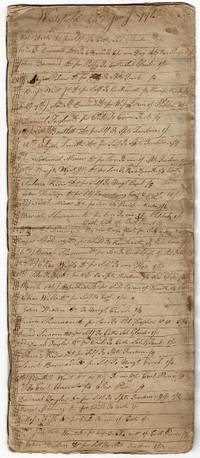
1805réf. 59752Waitsfield Vermont 1805. Narrow tall folio approx. 15½" x 6¾" 112 pp. in ink five separately sewn signatures; a few pages loose some pages darkened or chipped at edges; some entries faint. This account book is the record of the practice of either Stephen Pierce or Simeon Stoddard practicing in Waitsfield Vermont between 1795 and 1806. These were the second and third physicians to have settled and practiced in Waitsfield. Most likely it is the record of Pierce who is supposed to have settled in Waitsfield in 1795. The first physician in Waitsfield Moses Heaton remained there only between 1793 and 1796. Depending on the source Pierce was the third physician to practice in Waitsfield and/or the first to practice in Moretown a settlement to the northeast of Waitsfield. He farmed as well as doctored and his farm lay mostly in Moretown his office in Waitsfield. He was a respected and successful physician who served the community in other capacities: as selectman representative delegate to the Constitutional Convention of 1814 and Assistant Judge of the County Court. One source claims that he succeeded Judge Kinne December 1 1814 and served one year and that he was a justice of the peace in Waitsfield. He died either in 1854 after living in Waterbury and Berlin Vermont or he died in Barnard in 1864. See: History of the Town of Waitsfield Vermont 1782-1908 by Matt Bushnell Jones Boston 1909 p. 182. Simeon Stoddard on the other hand was born December 12 1761 either in Saybrook Connecticut or in Waitsfield. On August 19 1784 he married Abiah Thompson who had been born in 1763 in Waitsfield. Some sources state that he moved to Waitsfield from Saybrook in 1794. He served the southwestern area of Waitsfield and died in 1841. This account book records each date of visit the householder's name the relationship of patient to householder the medicine prescribed and its price and the cost of the doctor's visit. The doctor whether it be Stoddard or Pierce treated thirty to forty patients each month and as many as fifty-six in December of 1801. He charged as little as 4 pence and as much as 42 shillings 10 pence for his services. As a comparison the tax on an acre of land in Waitsfield was 2 pence an acre. The poll tax list of 1795 showed fifty voters so the doctor seems to have treated the members of nearly every family. The diseases treated are not stated in the entries made but he seems to have prescribed antimonium tartaricum in many instances and also digitalis. Waitsfield was founded by Col. Benjamin Wait or Waite and others who were granted a charter on February 25 1782. Wait had served under Gen. Jeffery Amherst in the French and Indian Wars and had fought in the Revolutionary War. Both Waitsfield and Moretown are now somewhat renowned as the areas around Mad River a popular ski resort. Mad River has been remarkable from the settling of the area as the source of numerous sudden destructive and deadly floods. The Green Mountains the northern extent of the Appalachians rise just to the west of the town. The doctor records having treated members of the Wait family including Benjamin's wife Martha d. April 3 1804 Ezra Thomas and Gilbert. The family names of the community are listed making this a good source for early settlement history and genealogical research. Among the householders who required the doctor's services are Smolly Skinner Taylor Spalding Hitchcock Parkhurst Carpenter the family had a tannery and potash works Heaton Burdick Johnson Rider Fuller Symonds McNight Chamberlain Atherton Lyon Butterfield Barnave Osgood Foster Hobson Robinson Brun Latimer and Sherman. Many of the names appear often. unknown
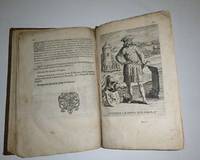
réf. 51-5902Antwerp: colophon dated 1599. Small folio. 19 x 29.5cm. Mottled goatskin binding by the artisan binder Sasha Mosalov. Some pages stained and repaired.Lacking the title page and the engraved arms of Albert and Isabel on verso of title-page and the 1 double-page map of Brabant. 35 copper-engraved protraits by Phillipe Galle or his students after drawings by Antonio de Succa Otto Vaenius Jan Woutneel and Jan Collaert II.OCLC Number / Unique Identifier:310908849 for the 1603 edition Antwerp: colophon dated 1599 unknown
réf. 6709233Edition: First . Good Condition. No Hassle 30 Day Returns Ships Daily Underlining/Highlighting: NONE Writing: NONE Publisher: Technical Department of Editorial Escudo De oro Pub Date: 7/1/1983 Binding: Paperback Pages: 95 paperback
réf. Z1-J-012-02192SAGE Publications Inc. Used - Good. Ships from UK in 48 hours or less usually same day. Your purchase helps support Sri Lankan Children's Charity 'The Rainbow Centre'. Ex-library so some stamps and wear but in good overall condition. 100% money back guarantee. We are a world class secondhand bookstore based in Hertfordshire United Kingdom and specialize in high quality textbooks across an enormous variety of subjects. We aim to provide a vast range of textbooks rare and collectible books at a great price. Our donations to The Rainbow Centre have helped provide an education and a safe haven to hundreds of children who live in appalling conditions. We provide a 100% money back guarantee and are dedicated to providing our customers with the highest standards of service in the bookselling industry. SAGE Publications, Inc unknown
réf. Z1-F-077-00242SAGE Publications Inc. Used - Acceptable. Used - Acceptable. Sticker on cover. Ships from UK in 48 hours or less usually same day. Ex-library with wear - may contain significant amounts of highlighting and underlining in pen or pencil. Your purchase helps support Sri Lankan Children's Charity 'The Rainbow Centre'. 100% money back guarantee. We are a world class secondhand bookstore based in Hertfordshire United Kingdom and specialize in high quality textbooks across an enormous variety of subjects. We aim to provide a vast range of textbooks rare and collectible books at a great price. Our donations to The Rainbow Centre have helped provide an education and a safe haven to hundreds of children who live in appalling conditions. We provide a 100% money back guarantee and are dedicated to providing our customers with the highest standards of service in the bookselling industry. SAGE Publications, Inc unknown
réf. Z1-C-007-01492Human Kinetics. Used - Good. Used - Good. Volume 1. Ships from UK in 48 hours or less usually same day. Ex-library with wear - may contain significant amounts of highlighting and underlining in pen or pencil. Your purchase helps support Sri Lankan Children's Charity 'The Rainbow Centre'. 100% money back guarantee. We are a world class secondhand bookstore based in Hertfordshire United Kingdom and specialize in high quality textbooks across an enormous variety of subjects. We aim to provide a vast range of textbooks rare and collectible books at a great price. Our donations to The Rainbow Centre have helped provide an education and a safe haven to hundreds of children who live in appalling conditions. We provide a 100% money back guarantee and are dedicated to providing our customers with the highest standards of service in the bookselling industry. Human Kinetics unknown
réf. Z1-C-007-01503Human Kinetics. Used - Acceptable. Used - Acceptable. Volume 1. Crack in binding exposing spine. Ships from UK in 48 hours or less usually same day. Your purchase helps support Sri Lankan Children's Charity 'The Rainbow Centre'. Ex-library with wear and barcode page may have been removed. 100% money back guarantee. We are a world class secondhand bookstore based in Hertfordshire United Kingdom and specialize in high quality textbooks across an enormous variety of subjects. We aim to provide a vast range of textbooks rare and collectible books at a great price. Our donations to The Rainbow Centre have helped provide an education and a safe haven to hundreds of children who live in appalling conditions. We provide a 100% money back guarantee and are dedicated to providing our customers with the highest standards of service in the bookselling industry. Human Kinetics unknown
réf. DADAX1591144590New unknown
1947réf. 0001605ASHLAND DAYTON ORRVILLE OHIO OH. Good. 1947. On offer is an original very intriguing 1947 manuscript diary and journal of a terrible post World War II child custody case and divorce. Unique for the times this was handwritten by an unidentified rural Ohioan who may have been either a Myers or Garver as he identifies 2 uncles. The author tells of his daily life which usually revolved around his large extended family the churches he attended and automobiles which he repaired and worked on all the time though he did do other work including farming. But right from the start the reader sees a pattern begin: the first entry is January 5th where he writes he has loaded up his car went to Ashland by 6:30 pm and then slept on his mother's davenport. He is also sick with a cold that never seems to end. Other entries mention more family travels large amounts of cash buying a car selling a house long and late hours weather reports and concerns and social observations. Yet all the while in the background are his health and the ups and downs of his divorce. He appears to be ill a lot perhaps the stress he sees the doctor many tests different shots and so on. In July he is in trouble with the law who seem only too glad to give him a hard time even though he has legal counsel. A part of the diary tells of his struggles with his own child custody case in which he is trying to get custody of his child. He notes trial dates of which he was never informed. The custody case and visitation get very dramatic as his ex-wife or girlfriend tries hiding the child from him in Alabama. He travels to Jacksonville to talk to the Mayor who took him to the High School where he had traced his daughter Sylvia. He also travels to Alabama and Florida searching for his high school age daughter Sylvia. Later he went to Birmingham to enlist the help of the Sherriff. This whole case would have been very unusual for the time. He does a super job recording each and every visitor companion and family member: Uncles Charles Myers Uncle Newton Garver Woodford Howard Leroy Reynolds Glen McFern Paul Sharpe heard Dr. Davis missionary 35 years in India at a lecture sleeps at the church one night Joe Bagelys Chippewa Lakes Park Lattasburg downtown Dayton Mansfield Perrysville Jeromeville plus dozens of places on his travels. The 7 1/2" x 5" book is has a broken rear hinge but is overall G.; 16mo - over 5¾" - 6¾" tall; KEYWORDS: HISTORY OF RAILROAD RAILWAYS FIREMAN ENGINEER WYOMING STEWARTSVILLE STOKER AMERICANA HANDWRITTEN MANUSCRIPT DOCUMENT LETTER AUTOGRAPH DIARY JOURNAL LOG KEEPSAKE WRITER HAND WRITTEN DOCUMENTS SIGNED LETTERS MANUSCRIPTS HISTORICAL HOLOGRAPH WRITERS DIARIES JOURNALS LOGS AUTOGRAPHS PERSONAL MEMOIR MEMORIAL PERSONAL HISTORYantiquité contrat vélin document manuscrit papier Antike Brief Pergament Dokument Manuskript Papier oggetto d'antiquariato atto velina documento manoscritto carta antigüedad hecho vitela documento manuscrito papel. . unknown
réf. DADAX096378207XNew unknown
réf. First Edition (?) of thisColophon on m7r: Basel: Joannes Oporinus March 1551. 2 Parts in 1 with separate titles. 8vo. pp. 188 4incl final blank; 90 30index. woodcut initials. 17th century vellum title backed repairing 2 marginal holes resulting from erasures light dampstaining in first gatherings some light foxing & a few underlines [Colophon on m7r:] Basel: Joannes Oporinus, March 1551 hardcover
réf. 59282 p.l. 280 pp. 8vo cont. green sheep-backed marbled boards spine lettered in gilt. Paris: A. Labitte 1873. The first and most important private collection ever formed exclusively devoted to festivities; this sale catalogue has remained an indispensable work of reference to the present day. The 1200 lots are arranged under the sixteen different countries in which these festivities took place except for two amazing special sections: the first catalogues thirty-eight books published between 1515 and 1559 describing festivities and solemnities in honor of Emperor Charles V. The second describes almost 400 pieces concerning festivities held during the French Revolution offered in one lot but catalogued separately on pp. 259-277. Ruggieri d. 1885 was the last of a long line of Royal and Government “artificers” i.e. pyrotechnists which had been founded in 1730 when five Ruggieri brothers transferred themselves from Bologna to Paris. Fine and attractive copy. Original printed upper wrapper bound-in. ⧠Blogie col. 126. unknown
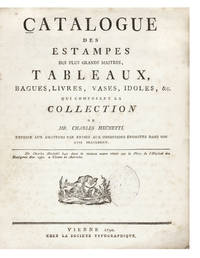
réf. 6413viii 120 pp. 4to cont. pale blue paper wrappers spine defective. Vienna: La Société Typographique 1790. The uncommon sale catalogue of the collections formed by the founder of the famous Viennese music publisher. Originally from Lucca Mechetti c. 1745-1811 encountered financial troubles and was forced to sell his collection of thousands of items primarily Italian prints and paintings. In the introduction Mechetti highlights certain pieces in his collection which was apparently not for sale by auction but rather private contract. Pages 113-20 describe a large library rich in books on the arts and history. Nice copy. This copy was inscribed on the inside front wrappers to the amateur geologist Baron de Beroldingen see Zittel. From the library of His Serene Highness Prince Fürstenberg at Donaueschingen with his stamp on title. ⧠Cicognara 4548. unknown
1720réf. 540914London: Printed for E. Curll 1720. Hardcover. Good. First edition. Octavo. xix 5 320 8pp. eight-page publisher’s catalogue at the back. Illustrated with an engraved frontispiece portrait and three engraved plates one of which shows images of sign language. In the original calf with blind tooling on both covers neatly re-backed in 19th century calf with a red spine label and wove endpapers. The boards are darkened and worn at the corners four text leaves are slightly creased some intermittent toning about very good. The author of this popular account of an enterprising deaf-mute has been attributed both to William Bond and Daniel Defoe and has yet to be resolved in favor of one or the other. A scarce copy of the first edition in the original boards ESTC T69700. OCLC locates only two copies. Printed for E. Curll hardcover
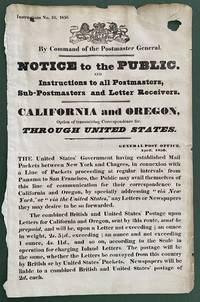
1850réf. List2416Great Britain 1850. Broadside measuring 9 ⅞ x 15 ⅜ inches. Some chipping and wear to edge ink number written in corner two small section of loss due to improper mounting very good overall. Coat of arms of the United Kingdom above printed text. Very Good. A scarce broadside relating to British postal rates across the Panama Route through the Chagres River which supplied mail to California and Oregon beginning in 1848 before eventually being replaced by the Overland route in 1860. The service was characterized by long delay times as steamships on either side of the isthmus were often not coordinated causing major delays in the delivery. Several different steamship companies operated privately some carrying express mail. The letters were transported by canoe or pack animal across the isthmus. Postmaster General Cave Johnson began establishing post offices in California in 1848. Johnson also oversaw the transition to the prepaid delivery system. The broadside here of which we find no other records does state that postage must be prepaid and that the route can be accessed by writing “via New York” on the letters. A scarce postal history item relating to the expansion of mail services to California. We find no other records of this institutionally or in the trade. unknown
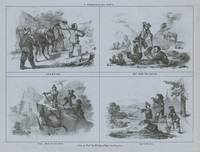
1850réf. List1315Britton and Rey 1850. Single sheet measuring 8 ¼ x 10 ¾ inches on blue wove paper. Small chip to corner not affecting image some older tape repairs verso at margins else fine very good plus overall and quite attractive. Very Good. A series of four illustrations telling the story of a mining party that heads out with a pack mule only to fail to find gold and lose their mule before returning to a new prospect with their clothes in shambles. This is entry 209 in Baird’s California’s Pictorial Letter Sheets in which he sets the publication date as being prior to 1855. The series possibly illustrates scenes from a song. A particularly fine example on the classic blue wove paper of the period. unknown
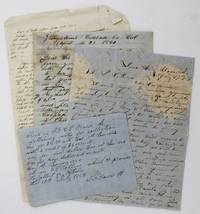
1860réf. 4301Eldorado & Iowa Hill 1860. Good. Four manuscript documents including three letters totaling six pages. Old folds moderate toning minor edge wear a few tears a small hole in one letter. A neat group of four manuscript letters and documents all related to the mining activities of L.D. Davis of Georgia over a four-year period during the latter years of the California Gold Rush. Davis appears to be a lawyer living somewhere back east and may have been an investor in California mines or managing the financials for some mining concern from afar. The documents include an 1856 promissory note regarding "noted for collection" a long undated letter likely from California to Davis detailing amounts of gold taken from an unspecified mine and the mine's ownership situation and two letters overtly datelined from California -- the first from Iowa Hill in 1859 and the second from Georgetown in El Dorado County in 1860. Each document presents a unique set of concerns for Davis. Notable details of the three letters are as follows: 1 Autograph Letter Signed from A.J. Huff to Mr. L.D. Davis. Iowa Hill Ca. April 17 1859 2pp. The text reads in part "I have been very very sick for the last three weeks but am at this time improving.the disease is caused by the exposure of this last winter having worked continually in the rain and snow preparing my claim for the season. Times are very hard in this country now everyone has to work hard and is in big luck if he makes a decent living. A great many are making money very fast but in comparison not one in ten to the number than used several years back to make money or in other words the chances are about one in ten when they were one in fifty two and three in this country. If a man can get a good claim he can make more clear money out of it than he could then owing to the fact that everything is cheaper and experience has taught the People of California a great deal in respect to saving the gold and expediting the work. I think I have a very good claim which will last for a long time three or four years. It has been very expensive opening it but that is pretty well all over with now." 2 Autograph Letter Signed from J.D. Arranaut to L.D. Davis. Georgetown Eldorado County Ca. April 28 1860 2pp. Here a colleague of Davis's in California seems to be struggling and writes thanking Davis for a loan. The text reads in part with spelling normalized: "I was glad to hear from you and to.learn that you would comply with my request by letting my wife have $25 worth of corn for her use and please find enclosed a bank draft. I take it as a great favor as I am far from home. Let me know how my wife is getting along and if she stands in need of anything." 3 Autograph Letter Signed from J.H. Worley to L.D. Davis Esq. N.p. n.d. 1p. The letter concerns percentage ownership in an unspecified mine and opens with a four-line listing of the "amt. of gold taken from mine 513.51.1 while under my control." The author then writes in part: "The rent and expenses were take out of the above account and after the gold was sold one half after paying expenses. I know you are too well positioned in law to know that I dare not have settled with any other person unless I had been so instructed according to law. When Mr. Findley returned from Burke County he stated to me that one half the mine was for Mr Adams and myself and the other was for himself and his friends but did not say who they were. unknown
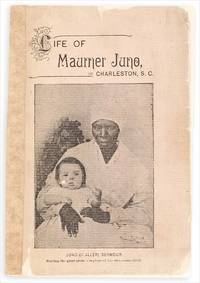
réf. 3733512Atlanta: Foote & Davies 1892. Small 8vo. Frontis. 41 1pp. Pictorial wraps with later tape reinforcement to spine small tears and light soil. With a two-page introduction by William Tertsh Whilden Williamston Female College professor. Written through the lens of the “Lost Cause” ideology this life sketch of Juno Waller Seymour d. 1883 was crafted by a member of the Whilden family of Charleston South Carolina—possibly Ellen Ann Whilden 1822–1895 or W.G. Whilden to whom she was enslaved as a domestic servant. While presented as a memorial tribute to Seymour’s life its text blends plantation and evangelistic literature folklore and perhaps occasional kernels of biographical truth. According to the narrative Seymour’s given name was Cumba and she claimed her lineage as a member of West Africa’s Fula tribe and the daughter of a king. She was captured by slavers as a child and initially brought to the French colony of St. Domingue now Haiti. Amidst the tumultuous backdrop of Toussaint Louverture’s Revolution she was sold and transported to Charleston in 1800 where she came under the ownership of Bayfield Waller a city merchant. Seymour was subsequently given to the prominent Whilden family with Joseph Whilden Bayfield Waller’s stepson and co-founder of the City Gazette and Advertiser in 1816 serving as the family patriarch. To the Whildens she became known as “Maumer Juno” or “Maum Juno.” Apart from tending to her daily domestic duties Seymour looked after the growing family’s children and continued to do so across several generations. The front wrapper and frontispiece of the Life of Maumer Juno feature an identical image of Maumer Juno gently cradling a baby in her arms accompanied by the caption “Minding the great great-daughter of her first owner 1853.” Known as the “chattel Madonna formula” this visual motif was employed by 19th-century photographers to portray enslaved African American women as the benevolent care-takers to the children of their enslavers. Matthew Fox-Amato Support for this construct is found in elsewhere in the text but in words not images. In one passage Seymour is found to be “surprised and delighted when for the first time a tiny white babe was placed in her arms.” Seymour’s exuberant expression of joy is juxtaposed with a passage elsewhere in the text that underscores the fact that she never bore any children with her enslaved husband. Enlarging the “Madonna formula” further Seymour is posthumously labeled by the author as being a “saint of African birth” on the day of her funeral. This resonates with the author’s intention of depicting this faithful yet enslaved servant as deeply religious truly Christian and in fact purified as exemplified in an earlier passage where Seymour declares “I am black outside but inside I am white for every day my heart is washed in blood.” Following the primary text there is an additional seven-page profile of Seymour penned by “Mrs. J.C.H.” The reliability of this white woman’s observations seem questionable as when she writes: “She Seymour told me that when first dressed in our clothing she thought she was being prepared for sacrifice and fled away hiding in an outhouse while she took off her garments tearing them almost into ribbons in her fright.” p30 Still at least one observation may be deemed reliable such as this passage: “Of her native land she talked often and as the days of her pilgrimage lengthened her memories grew more bright and strong of her life in the far-away land. The customs of her people their worship of the new moon the wearing of cloth their method of preparing food all seemed vivid mental pictures…” p30 LCP Afro-Americana 5921. See the image “Old Maumer selling Groundnut candy in the Streets of Charleston” taken by G.N. Barnard 1819–1902 South Carolina photographer. unknown