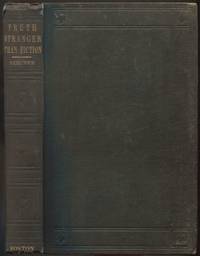
1850réf. 542023Boston: Phillips Samson & Co 1850. Hardcover. Near Fine. First edition. Small octavo. Brown cloth stamped in blind and gilt. Small nicks on the cloth at the spine ends small finger pressure mark on front gutter tiny ink spot on foredge and some scattered foxing but a nice and fresh near fine copy. An attempt by the important educator reformer and sister of Harriet Beecher Stowe to promote the cause of her pupil author Delia Bacon in the aftermath of a matrimonial breach of promise suit and her prosecution in the court of public opinion by the authorities at Yale whom Beecher felt had thwarted her case. Bacon would seek solace in her research popularizing the notion that Shakespeare's works were actually written by a group of writers including Francis Bacon and Walter Scott. A very nice copy seldom found thus. Phillips, Samson & Co hardcover books
1932réf. 008076New York 1932. First Edition. Wraps. Very Good. A souvenir for a High Society event that also involved the cream of the architectural field. Held at the brand new ultra-luxe Waldorf Astoria which had opened its doors at its new address on October 1 1931. Scarce -- no copies listed on OCLC First Search. 4to. 30 by 22 cm. 112 pp. plus wraps. With many advertisements especially for architectural firms and developers and these include often photographs and drawings of recently completed buildings or ones in the offing which were to become iconic -- the RCA Building as an example. Virtually all the ads relate to the building trades in one way or another including ads for brick companies heating or furnaces etc. Art Deco is the salient design although there are photos of private mansions in a range of styles found in upper crust suburbs to this day. The event itself was comprised of four "Episodes" in New York history. These were skits two of the Episodes having more than one scene in which the players drawn from the Upper Crust of New York Society both Old Knickerbocker and newer moneyed members surnames such as Pennoyer Schieffelin de Peyster van Alen a few descendants of the characters van Rensselaer but also at least one famous actress that being Beatrice Lillie with were decked out in period costume. The scenes re-enacted the arrival of the Half Moon in 1609 the purchase of Ma-na-ha-ta by Peter Minuet in 1626 Captain Kidd in New York in 1696 the Declaration of Independence as announced in City Hall Park July 9 1776 Washington's Inauguration in 1789 and the Inaugural Ball following. We would also mention that Tony Sarg was one of the people who put together the skits! Finally as befitting a Society event program there are copious lists of members of the various organizations and/or contributors to the event. Unlike today these lists provide the addresses of the listees many of whom were among the wealthiest New Yorkers of the day. First half dozen leaves have a distinct crease mark diagonally by the front corner. Front cover has light soiling and the like. Spine extremities with closed tears and wear. Clean within and overall a VG copy. unknown books
1778réf. JC14437Liege: F. J. Desoer 1778. First Edition. Hardcover. Very Good. 12mo. 303pp. Contemporary French mottled calf. Traité d'éducation morale qui a remporté le prix de la Société des sciences de Harlem sur cette question : Comment on doit gouverner le coeur & l'esprit d'un enfant pour le rendre heureux & utile. Par M. Formey. auquel on a ajouté quelques pensées relatives à ce sujet. Formey was professor of philosophy at Berlin who authored several books on the writings of Rousseau. This work on education is quite scarce. F. J. Desoer hardcover books
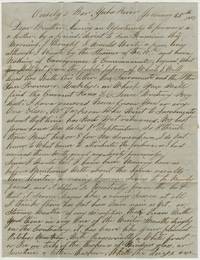
1851réf. BK0070Owsley's Bar Yuba River California 1851. 2 pp. 7 ½ x 9 ½ inches. Folded for mailing and postmarked San Francisco February 1 with red-orange circular datestamp and matching "40" rate handstamp. Minor wear with small pale spot to address panel. A Gold Rush letter from Thomas J. Dabline at Owsley's Bar on the Yuba River giving a detailed report on a dispersed community of Maine emigrants in the California diggings. Dabline names roughly a dozen acquaintances recording their locations occupations and in several cases their financial success while also describing the effects of an exceptionally dry winter on mining along the Yuba. Dabline begins by noting that he has continued mining "with about the same results" and then describes the winter season which had brought remarkably little rain. The shortage of water had begun to interfere directly with mining in the dry ravines: "The very small quantity of rain which has fallen has operated unfavorably for those who are engaged in mining in the dry ravines and hundreds who have been throwing out dirt for washing have been obliged to leave it for want of water. But should it continue as it has it will be very favorable for an early season up the mountains." He compares the weather to a pleasant October in Maine with occasional frost and thin ice and remarks on the relative health of the surrounding mining population estimating only six or eight deaths during the season among roughly 1500 to 2000 miners living within several miles. The strongest portion of the letter is Dabline's account of what he calls "the other Maine boys" who were dispersed across the northern California diggings: "I cannot tell you much about the other Maine boys. They are scattered about the country in the various diggings. I have learned that F. McLeod has gone home with about 3000 dollars and Mr. Sholl with 5000 or 6000 dollars. Fitch Demey is over on the American River in the Express business. Mr. Vinton & Upton are down on the McCormic or dry Creek. Mr. Carpenter with the two Johnsons of Waterville are over on the Feather River. Mr. G. is I believe at Sacramento City. The Trumbulls are up about Nevada City and Dr. Anderson was sometime back down at the little village of Nicholas which is about 55 miles above Sacramento." The passage offers a compact picture of a Maine migration network after its arrival in California with members spread among the Yuba American and Feather River regions Nevada City Sacramento and other settlements. Dabline records both the mobility of the group and their varying outcomes including men who had already returned home with several thousand dollars and another who had entered the express business rather than mining. He closes by mentioning current excitement over reports of a rich new discovery at Gold Bluff though adding that "very little credit is given to the tale here." A useful firsthand account of the social geography of the Gold Rush documenting a community of Maine emigrants across the mining regions while remaining connected through news of one another's whereabouts and fortunes. . unknown books
réf. 720220 pp. 8vo 198 x 125 mm. modern aubergine cloth head of spine a little worn title on upper cover. Paris: Félix & Regnault-Delalande 1822. An extremely rare auction catalogue inventorying the collection of an obscure painter active at the turn of the century. A contemporary annotator has written in the surname for this anonymous sale on the title-page corroborating Lugt’s attribution. An 1817 almanac of Paris records a painter with the same surname working at rue de Rohan 6. Viglianis also exhibited a landscape at the 1814 Salon — no. 948 in the exhibition livret. 184 lots consisting primarily of prints lots 1-132 by artists such as Bartolozzi Bervic Bloemaert Cochin Le Bas Desnoyers Earlom Green Ingouf Massard Morghen Strange Wille Woollett etc. We then find original engraved plates by a number of contemporary artists. The final section of drawings includes the work of Bruandet S. Gessner H. Robert and “Joseph Pascal Viglianis” presumably the seller. With the list of vacations on the final page. A very rare catalogue in fine condition. In the characteristic binding of the Bibliothèque Heim. ⧠Lugt 10220. unknown books
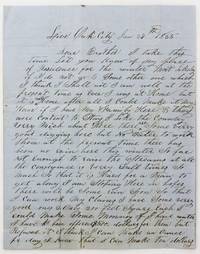
1855réf. 5504Live Oak City Ca: January 27 1855. Still very good. 4pp. on a bifolium. Previously folded with manuscript docketing on lower half of second leaf verso. Minor wear along old folds with a couple of short separations. Minor soiling and dampstaining somewhat heavier to addressed area. A detailed mid-1850s California Gold Rush letter from Elias Hunt Jr. to his brother in the tiny of Poolville New York southeast of Hamilton. Hunt was camped in Live Oak north of Yuba City when he wrote this letter home on January 27th 1855. He tells his brother that he has good claims but that a lack of rain has not allowed him to work them: "It is hard for a man to get along. I am stopping here in hopes there will be some rain soon so that I can work my claims. I have some very good ones 2 only 200 feet square each. I could make some money if I had water. I have been offered $500 dollars for them but I refused it -- I think I can make an ounce per day; I know that I can make ten dollars for I have done that before." There is talk of irrigating the area but Hunt is not sure that it will be finished before he wants to return east: "There is a ditch coming in here to suply sic the place with water but it will not be completed until Spring some time in April & I should like to come home in June. I shall stay until there is water in the ditch then I can wash a part of my claims & sell the rest to a good advantage for they are situated immediately on the line of the ditch." Continuing upon his plans to return he writes: "I have had a very good offer to come home across the plains by a man in Sacramento. He is from Utica; his name is Hamilton. He is going to cross with four hundred Spanish horses or mares. He has offered me good money to come with him as I have been over to Carson Valley this last season. It will take some sixty days to do it if I should get through with my claims by the time time that he gets ready to start. I think I shall come with him if the Indians are not to hosstille sic. They were very bad this last season; they got possession of one of Uncle Sam's forts." Hunt continues writing about local hunting prospects and family in New York before delivering a Crockett-esque farewell -- "Please give my respects to all may inquire for me & let the rest go to Hell for all that I care." A good letter from one of the less trafficked areas of the California Gold Rush. January 27 unknown books
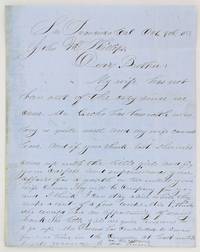
1852réf. 2473San Francisco: October 4 1852. Very good. 2pp. with integral address leaf. Old folds mild staining and soiling three-inch closed tear to address leaf. An interesting letter documenting the family side of the California Gold Rush in which a San Francisco man writes to his brother offering to send his wife and daughters to Placerville as helpers. Interestingly at first Phillips addresses the letter to his brother in Ohio then scratches it out and writes in "Cal;" this most likely indicates the Phillipses hailed from Ohio and trekked to California along with scores of others in hopes of untold riches in the California gold fields. In his letter Phillips writes that his wife who has long been in San Francisco looking after a sick friend can now leave as he is better "And if you think best she will come up with the little girls and fix your carpets and superintend your affairs for a month or two untill your wife comes." The formerly sick friend Mr. Gardner could also accompany them apparently as "He is coming up to P. and he wants you to give him work for a short time. Mr. G. is a good sailsman sic having been in the dry goods business." While not overtly concerned with gold mining the correspondence is nevertheless interesting for providing details on family routines during the Gold Rush era when numerous families uprooted their lives and moved not only to places like San Francisco and Placerville but between such locations during the years of speculation. A nice example of history from below particularly notable for its domestic implications during the time of the great California Gold Rush. October 4 unknown books
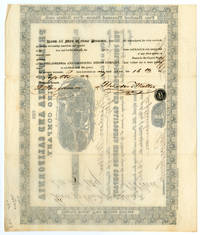
1618réf. 51617Philadelphia. Sept. 16 1852. Invest in California Gold Mines! A certificate for stock in the Philadelphia and California Mining Company completed on Sept. 16 1852 granting one Theodore Walter fifty shares in the venture and signed by the Secretary L. Alter and the President Pearson Serrill. The central woodcut depicts a mining scene representing the company's California operations. The Philadelphia and California Mining Company was founded in the same year on the basis of a land lease from John Fremont in the area of the Mariposa River. A rare piece of mining ephemera: OCLC records only one other example of a stock certificate from this company held by the California Historical Society. Previously folded with small chip at edge of a fold line. Printed form completed in manuscript by several hands. With a woodcut mining vignette. Near fine. OCLC 828929436. unknown books
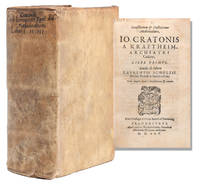
1609réf. 27318Frankfurt Hanover & Hanover: Apud Andrea Wecheli heredes Claudium Marnium & Joann Aubrium; Parts 2 & 3 Typis Wechelianis apud Claudium Marnium & Heredes Joan. Aubrii 1609. First published 1591-94. 1 vols. Sm. 8vo. Three parts in one volume. Vellum. Some soiling and browning of vellum and text ties lacking else a very good copy with bookplate of Alfred Jerome Brown. First published 1591-94. 1 vols. Sm. 8vo. This work was ultimately completed in seven parts. 'The Polish-German physician was the personal physician to both Emperor Ferdinand and Maximilian II in Austria. He wrote several medical works and was a follower of the Galenic school of medicine. He was one of the first to study the contagiousness of certain diseases. "Sixteenth Century Books in the National Library of Medicine" 1077 for the 1591-94 edition; Osler 2387 & 2388 earlier editions Apud Andrea Wecheli heredes, Claudium Marnium & Joann Aubrium; [Parts 2 & 3] Typis Wechelianis, apud Claudium Marnium & Heredes unknown books
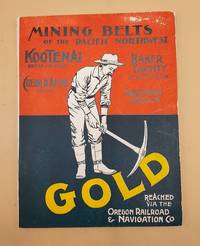
1897réf. 63736Portland OR: Issued by the Passenger Department of the Oregon Railroad and Navigation Company 1897. First edition. Good. 68pp. With Map. Covers detached but present map still attached to rear wrap. There is a small abraded area in the top fore-edge corner of the title page. The map has a handful of small closed tears. Scarce. The map entitled "Oregon Railroad and Navigation Co. Map of Principal Mining Districts of the Pacific Northwest" has an inset of the "Baker City Mining Region." From the opening of the text- "What the typical easterner never read or heard or imagined of that vast and varied empire vaguely characterized as The West includes about all there is to be told or written of it. Half the world- a mighty hemisphere incomparable in grandeur incomputable in riches and illimitable in possibilities- lies west of all their geographies. Their maps are all too narrow their ideas all too small. 'Having eyes they see not and having ears they hear not; neither do they understand' that all the boundless productive powers and possibilities of the new-world republic lie in the matchless region which they in their arrogant ignorance stigmatize as 'the wild and wooly west.' Issued by the Passenger Department of the Oregon Railroad and Navigation Company unknown books
1958réf. 38938Tel Aviv: Edition "Olamenu 1958. First edition. Hardcover. g to vg. Folio. 12172 82281pp. Original red paper-covered boards decorative paper-covered board of deluxe edition of volume two with gilt lettering on cover and spine in original photo-illustrated dustjackets. Illustrated title page in vol. 1 color reproduction of a painting tipped-in on title page of vol. 2. Comprehensive history of the Jews in the administrative division of the Habsburg Monarchy known as the Bukovina an area now spilt between Romania and the Ukraine. Contributions by Dr. Samuel Josef Schulsohn Dr. Manfred Reifer Dr. N. M. Gelber and Dr. Leon Arie Schmelzer give a detailed account of the Jewish migration after the destruction of the first temple and the erection of the second temple tracing Jewish presence in the area north and northwest of the Black Sea Schulsohn the era of the Moldavian Counts from 1360-1774 Reifer the Habsburg Monarchy until 1914 Gelber and the time from 1914-1919 Schmelzer. Additional contributions by various historian cover the whole spectrum of the Jewish culture in Moldavia through the ages. Illustrated with numerous additional plates with b/w photographs mostly portraits groups and relevant architecture. Text in German. Dustjackets rubbed with light sunning of spines. Very light age toning of blocks. Dj in overall good binding and interior in very good condition. Edition "Olamenu hardcover books
1976réf. 122182Milano: Rizzoli Editore 1976. Hardbound. VG/VG in VG slipcase. A large weighty book. Red maroon cloth with color pictorial glossy dustjacket all contained in a custom slipcase. Appx. 217 pp. 138 mostly color plates tipped-in to the text portion and 50 full sheet 13.5" x 16" color plates. A most impressive book both by it's content and it volumetric displacement. Vital in the study of Caravaggio. Another version of this appears to have been printed in 1971 and this edition has a few extra illustrations at least and likely some additional or revised text. Text is in Italian. Transit mass would be 272 ounces. A stunning production. Rizzoli Editore hardcover books
1827réf. 177815New York: Imprint whereof is at New-York 1827. VG few foxing spots but remarkably clean and tight. No evidence of page removal between pages xxx and xxv as mentioned in research. Original boards with cloth spines and remnants of affixed paper labels. Untrimmed uncut. Volume 1: irregular pagination. 2 blanks tp copyright iii iv-xx xxv-xvii blank 29 30-263. There is ample evidence of three sheets having been excised after pp. xviii and that a sheet numbered xix/xx has been inserted and glued after these three remnants. The text from page xx to the following page xxv appears to be continuous indicating a re-working of the text from the original printed sheets for pages xix-xxiv. An 1877 book auction catalogue lists this publication which was indicated to be 2 volumes as Very Scarce having been suppressed by the author. No auction or sales records found. A copy of part 2 was sold in 1904 as an odd volume as part of aa larger lot. A 1911 auction catalogue notes the following: "2 vols. 12° boards uncut. A caustic satire on New York's Four Hundred in 1827 which led to the prosecution of its author for libel and the mutilation of all copies of the work by the removal of pp. xxi.-xxiv. of A Short Proem its most vitriolic portion." It can be noted that the copy in the American Antiquarian Society lacks 3 sheets xix-xxiv. Their copy was printed in Boston and not New York. Shoemaker R.H. Checklist of American imprints for 1820-1829 29389 Blanck J. Bibliography of American literature 11021 Wright L.H. American fiction 1774-1850 2nd ed. 1510 Hebrew Union College-Jewish Institute of Religion. Jewish Americana 76 Singerman R. Judaica Americana 0448. Imprint whereof is at New-York hardcover books
1992réf. 12838E. J. GOLD'S GUIDE TO THE GALAXY AND BEYOND THE UNKNOWN Sirius Science Fiction 1992 first edition as new without dust-wrapper as issued. Of 125 copies this is 1/20 of the deluxe edition with an original SIGNED serigraph by E.J. Gold acting as frontispiece. Illustrated. Collects stories by Fred Pohl Robert Sheckley Damon Knight & Daniel Galouye. Quite scarce. This copy SIGNED by Pohl at his contribution. Rare thus. Sirius Science Fiction 1992 unknown books
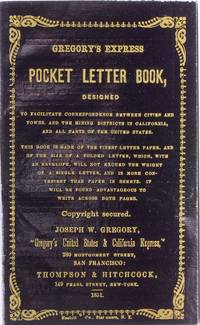
1851réf. 320912San Francisco: Joseph W. Gregory 1851. 20 blank leaves. 24mo. Original dark purple wrappers printed in gilt. Minor ink stains on inner wrappers otherwise a near fine copy with the original unused plain paper envelope. 20 blank leaves. 24mo. A lovely example of an unused Gold Rush letter book intended to advertise Joseph Gregory's California and New York Express Line by means of a convenient way for gold seekers in California to communicate with friends and family back home. According to the wrapper "this book is made of the finest letter paper and of the size of a folded letter which with an envelope will not exceed the weight of a single letter and is more convenient than paper in sheets Joseph W. Gregory unknown books
1851réf. 58179San Francisco: Thompson & Hitchcock 1851. Lovely Unused California Gold Rush Letter Book A lovely example of an unused Gold Rush letter book intended to advertise Joseph Gregory's California and New York Express Line as a convenient way for gold seekers in California to communicate with friends and family back home. Gregory's California Express according to the wrapper is "one of the oldest established in the business dispatch messengers BY EVERY STEAMER leaving New-York and San Francisco in charge of Letters Parcels Packages Gold Dust and valuables for distribution throughout the United States and California." Also according to Gregory's text "this book is made of the finest letter paper and of the size of a folded letter which with an envelope will not exceed the weight of a single letter and is more convenient than paper in sheets." The inside rear wrapper prints two testimonials from the PANAMA STAR praising the express line's speed and volume. Gregory also published a pamphlet titled GREGORY'S GUIDE FOR CALIFORNIA TRAVELLERS; VIA THE ISTHMUS OF PANAMA 1850 primarily to promote his business. A scarce and well-preserved piece of Gold Rush ephemera here with the original unused envelope. 24mo. Original dark purple wrappers printed in gilt. Very minor wear to wrapper edges. Near fine with the original unused plain paper envelope. unknown books
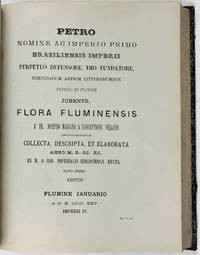
1881réf. 45183Flumine Januario / Rio de Janeiro: Typ. Economica 1881. First complete edition. Half black morocco over marbled boards gilt spine title. A very good copy boards rubbed repaired tear and closed tear on Volume V half title and title page. xii vii 467 1 pp. 4to. Published in and taking up the entire volume of Archivos do Museu Nacional do Rio De Janeiro. Volume V. 1880 1881. Added title page: Petro nomine ac imperio primo Brasiliensis imperii perpetuo defensore . jubente Flora fluminensis a' fr. Josepho Mariano a Conceptione Vellozo Ordinis monorum collecta descripta et elaborata anno M.D. CC. XC. Ex M.S. cod. Imperialis bibliothecæ eruta nunc primo etitur. Flumine Januario A.D.M. DCCC. XXV imperii IV. José Xavier Veloso 1742-1811 born in what is now Minas Gerais Brazil was ordained in 1766 in the convent of St. Anthony in Rio de Janeiro where he studied philosophy and theology later geometry in San Paulo and finally natural history. He collected plants animals and minerals in the Rio de Janeiro area from 1783 to 1790 at which time he moved to Lisbon where he worked at the Royal Academy of Sciences while preparing Florae Fluminensis his greatest work for publication. Using the Linnaeus’ system of sexual classification of plants he prepared very highly detailed texts and 1700 prints many of them of new species. But the publication of the work was beset by problems. First sent to Venice the plates were never completed. Later the French invasion of the Iberian peninsular sent the Portuguese government then Veloso and his manuscripts into exile in Brazil where he died in 1811. In 1825 an abbreviated version of the text was published followed by the eleven volumes of the Icones in 1827 of which few copies survive. The complete text was not published until this edition in 1881. Bound with and proceeded by Archivos do Museu Nacional do Rio De Janeiro. Volume IV. 1879. Rio 1881. viii 151 1 pp vii plates. Folded color plate split at fold. Volume subtitle: Insectologia. Includes Müller Fritz: A metamorphose de um insecto diptero among other works. Rodrigues 2473. Sabin 98833n. For the shorter version of 1825 see: Barba de Moraes II p. 343. Pritzel 468. Jackson 377. Innocencio V.5 4258; V.13 p.122. Also see Nissen BBI 2046. Typ. Economica hardcover books
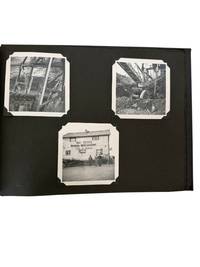
1949réf. 240621949. Alaska Photograph album documenting a young man's travels principally in Alaska circa 1949-1950 with substantial coverage of gold mining in the Fairbanks region. The mining sequence records the industrial methods that sustained extraction beyond the early gold rushes when large dredges and powerful hydraulic jets worked extensive gravel deposits and removed overburden. Photo album containing 62 silver gelatin photographs approximately 3½ x 3½ inches mounted with corners on black paper leaves. Album measures 12½ x 8⅞ inches bound in embossed black covers with cord ties and gilt "Photographs" lettering. Detailed views show a floating gold dredge's articulated bucket chain cutting into a gravel bank its substantial framework and the tailings surrounding its working pond. Another sequence follows large water pipes across brush-covered ground to a hydraulic nozzle discharging a forceful stream over stripped terrain. Men pose beside timber water-control structures and balance on pipelines; other photographs show muddy access roads and utilitarian camp buildings. A particularly strong view records three men outside "Max Rede's General Merchandise / Fox. Alaska." Additional scenes include travelers wearing insect netting glacier landscapes and a railway station marked "Seward." Coastal photographs depict a docked steamship fishing boats beside waterfront warehouses and children standing on a wooden boardwalk. Earlier pages show Greyhound bus travel and playful portraits outside the Idaho State Capitol in Boise. The close machinery studies and views of disturbed ground document both the engineering and environmental consequences of placer mining alongside the settlements and transport routes encountered during the journey. Front cover mostly loose with rubbing to the binding and edge wear to album leaves. Photographs generally well preserved. Overall in very good condition. unknown books
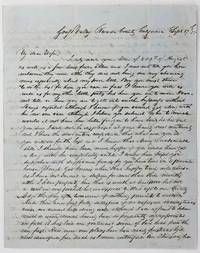
1855réf. 4791Grass Valley Ca: September 17 1855. Very good. 4pp. on a folded folio sheet. Old fold lines minor wear. An intimate letter from a gold seeker in Nevada County California. Theodore Shaw writes to his wife about mixed luck in California a terrible fire his concern for their children and his great anxiety about the future. He writes in part: "I have property here that is worth at least $1000 but not a cent in my pocket but we expect to start up to our quartz ledge the day after tomorrow if nothing prevents to errect a mill up there. And now our plans have been nearly frustrated by a most dreadful fire such as I never witnessed. On Thursday last about 11 o'clock p.m. an alarm of fire was heard and by about half past 12 some 350 stores dwellings and buildings were consumed with a large portion of their contents our hotel included. . The entire business part of the town is in ruins.we have been sleeping under an old shed in the suburbs. This fire has injured us in this way several who had taken stock in our company have lost their means still we intend going on in a smaller way. We had formed a company with a Capital Stock of $50000 divided into 50 shares of $1000 each. Do you know Lydia I have more anxiety about your health than anything else as I know you work hard; only think what would happen to our dear children if anything serious should happen to your health and I away here in California. September 17 unknown books
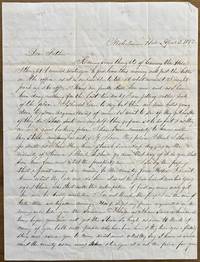
1852réf. 4789Mokilomni Hill Ca: April 3 1852. Very good. 2pp. plus integral address leaf. Quarto on a folded folio sheet. Old fold lines minor wear. In a highly legible script. An interesting letter from a disillusioned fortune-seeker in Calaveras County advising his father not to come west as all the easy pickings are gone. He writes "Times are pretty dull here now and as I have been doing nothing for the last two weeks I am getting rather sick of the place. I should leave today but there are some holes going down by some acquaintance of mine & I want to see if they get anything. If they do I shall sink one myself they go from 50 to 60 feet & as they are in a good looking place I have some curiosity to know whether they strike anything or not. If I leave this place I think I shall go south as I hear they have struck some deep diggings in the vicinity of Sonora & think I shall go down that way. I see by the papers that a great many are coming to the country from Boston. I do not know what they all will do here it is not the place here it was two years ago & those who start with the anticipation of finding money easily got here will be badly mistaken. April 3 unknown books
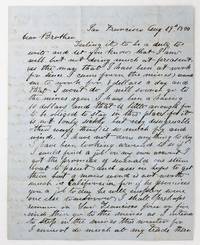
1850réf. 6357San Francisco: August 29 1850. Very good. 3pp. on a folded folio sheet. Old folds some light wear and soiling. Letter from a disillusioned painter living in San Francisco to his family back home in New Bedford Massachusetts. Currently in San Francisco proper Allen finds the town quite disagreeable with fog and wind and very little work. He writes that he isn't working at present because his employer will only pay him $8 a day which "won't do." He says "I will sooner go to the mines again. I have been a haveing 10 dollars and that is little enough for to be obliged to stay in this place for it is not only sickly but very disagreeable other ways." He's had little success in his job hunt with a glut of painters in town. "I have been looking around to see if I could find a job on my own account. I got the promise of several & one steamboat to paint and am in hopes of getting them but a man's word is not worth much in California for if he promises you a job today he will employ some one else tomorrow." He notes that he will go back to the mines in the winter: "Men enjoy much better health in the mines than do in this place as a general thing but mining is rather uncertain though I am determined to give it a good try this winter and then quit the country that is to say this section of it." He complains about a lack of correspondence and closes with a statement about the terrible plague of fleas he is currently suffering. A candid and grim look at life in San Francisco in 1850. August 29 unknown books
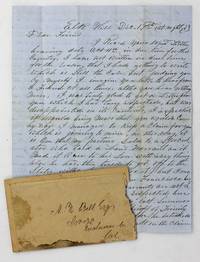
1853réf. 4788Elk Hill Ca: December 17 1853. Very good. 3pp. on a folded folio sheet. Old folds light wear and soiling. With original mailing envelope. An informative letter sent from a miner in Gold Rush-era California to a friend in Tuolumne County primarily concerning a mining claim but also providing many interesting local details. The author writes "I managed to keep a claim for you which is joining to mine in this way it is one that my partner sold to a speculator who laid a land warrant on it." He discusses the process of the land warrants and how he made the man title the claim properly in San Francisco. "This claim was jumped last summer by W.H. Dixon first sheriff of Trinity City who died the day before he intended to occupy the house he built on the claim. He shot himself accidentally and never spoke." The author immediately stepped in and nabbed it for his friend but it was short-lived. "The claim is cheap at $2000 as soon as I made it known that I should not administer it was jumped by 3 in one day before 9 o'clock. So much for your not coming as I told you I could not keep them off any longer and you would not come if I had." He further mentions that he is digging potatoes which he deems the finest in the world discusses issues with the crop and further talks about new arrivals in the area. December 17 unknown books
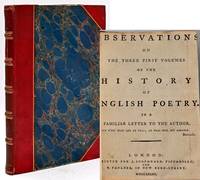
1782réf. 298728London: J. Stockdale; R. Faulder 1782. First Edition. Half Leather. Very Good binding. 8vo.; in an attractive later binding of red half-goat over marbled boards with raised bands with morocco label lettered vertically; with marbled endpapers; 2 49 1 pages.~~A note on this rather interesting binding: we assume that the binder was charged with binding a group of different books to a uniform size -- the title page is trimmed and mounted and all the other leaves are folded neatly to fit the bottom edge and then the leading edge over it. Rather astonishing actually.~~This is Ritson’s first book in which he attacks Thomas Warton’s History of English Poetry in such vitriolic tones -- Warton is a pretender a cheater and a liar -- as to cause quite a contretemps in late 18th century English literary circles. One assumes this actually pleased Ritson as he went on the next year to attack Samuel Johnson and George Steevens. Eventually Ritson went complete mad barricading himself in his rooms at Gray’s Inn and setting fire to a pile of manuscripts. Very Good binding. J. Stockdale; R. Faulder unknown books
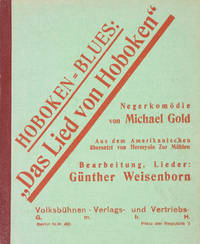
1929réf. 19326Berlin: Volksbünen-Verlags- und Vertriebs-G.m.b.H. 1929. Softcover. vg. 8vo. 100pp. Maroon cloth spine over green wraps with red lettering. Sunning to top edge of front- and rear wraps. Translated from the English into German by Hermynia zur Mühlen. "Bearbeitung Lieder: Günther Weisenborn." The News Playwrights' Theatre production of "Hoboken Blues" in 1928 was a bold experiment that failed with audiences and critics because it appeared to be racist although the playwright wrote it to expose the injustice done to African-Americans. Michael Gold wanted African-Americans to play the parts but director E. Massey cast white actors wearing black make-up. Fascinating piece of American Theatre history. Mimeographed typescript. Wraps in very good interior in near fine condition. Rare German edition. Volksbünen-Verlags- und Vertriebs-G.m.b.H. unknown books
1689réf. 16034London: Printed by Edw. Jones for Abel Swall.and Henry Bonwicke. 1689 Second English edition of an important history of the Reformation. Contemporary reverse calf ruled in blind. Folio. Title-page printed in black and red. The Bohun work with separate title-page. With six engraved portrait plates. Joints starting to crack but sound. Armorial bookplate of Cobbold of Ipswich later ownership annotation dated 1980 on front pastedown. A good clean copy. Johannes Sleidanus 1506-66 was born in Schleidan Luxembourg and studied ancient languages and literatures at Liège and Cologne and law and jurisprudence at Paris and Orléans. At Lièges he encountered humanist scholars and developed an interest in Protestant ideas. He went to work for Cardinal du Bellay and was employed in the futile negotiations of the French court to make an alliance with the German Protestants against the Emperor Charles V. In 1542 he settled in Strassbourg. He was in the habit of copying all papers that had any bearing on the Reformation to which he had access and Martin Bucer who had seen his papers suggested that Philip of Hesse appoint him historian of the Reformation giving him a salary and access to all necessary documents. Thus began his great work the first volume of which appeared in 1545. That same year he traveled to England in a French embassy to Henry VIII and there he collected further materials for his work. He later went to Marburg to view the archives of Philip of Hesse. In 1551 he attended the Council of Trent. He finished his history in 1554 despite financial problems. He died in poverty the following year. Printed by Edw. Jones, for Abel Swall...and Henry Bonwicke.. unknown books