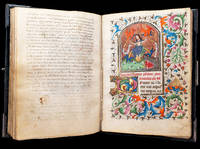
1450Best.-Nr. 0226BOOK OF HOURS USE OF SARUM In Latin and French illuminated manuscript on parchment. Bruges Flanders c. 1450 with substantial additions made in France in the late fifteenth and sixteenth centuries. Five miniatures by the Masters of the Gold Scrolls subgroup of the Master of Berlin Kunstbibliothek MS Grisebach 4 and one later French miniature in the artistic milieu of Antoine de Lonhy fl. c. 1446–1490. 193 × 134 mm. vi 124 leaves. Written principally in textualis formata in brown ink with rubrics in red and numerous initials in burnished gold blue and rose with penwork and foliate decoration. FIVE HALF-PAGE MINIATURES from the original Bruges campaign set within burnished-gold arches and surrounded by elaborate borders of scrolling vines acanthus flowers gold ivy leaves and bezants. ONE THREE-QUARTER-PAGE MINIATURE of the Mass of Saint Gregory was added in France at a later date. Made in Bruges around 1450 for the English market as demonstrated by its calendar for the Use of Sarum. The five surviving original miniatures depict the Massacre of the Innocents f. 7 Virgin and Child f. 13v Funeral Mass f. 38v Adoration of the Magi f. 57v and Resurrection f. 73. Gregory T. Clark attributes the illumination to a refined subgroup of the Masters of the Gold Scrolls centered around the Book of Hours Berlin Kunstbibliothek MS Grisebach 4. After reaching France the manuscript was extensively personalized. A striking miniature of the Mass of Saint Gregory with a kneeling female patron and impaled arms was added to the front of the volume. Stylistically it belongs to the immediate artistic milieu of Antoine de Lonhy and may possibly be by the artist himself. Additional French and Latin prayers protective texts healing charms and two versions of the Obsecro te—one for a female supplicant and another for a male—document its continued use by successive owners. Offsets from former pilgrimage badges preserved between its pages provide particularly evocative evidence of medieval devotional practice. An early ownership inscription appears most likely to read "I. Damas" or "H. Damas" while a later red-wax armorial seal appears to correspond with the heraldic tradition of the Damas family suggesting a possible long or recurring association with the family although continuous ownership cannot presently be demonstrated. The manuscript contains the Calendar Use of Sarum; Hours of the Virgin imperfect; Short Hours of the Cross; Mass of the Virgin; Seven Penitential Psalms; Litany; Office of the Dead; and substantial supplementary devotional material. Several leaves and miniatures are lacking particularly within the Hours of the Virgin. Nineteenth-century black silk velvet binding over pasteboards fitted with four pierced silver corner pieces and an elaborate silver clasp depicting the Agnus Dei beneath the Banner of the Resurrection. Housed in a twentieth-century red cloth clamshell box. Parchment generally sound with occasional stiffness and cockling moderate soiling and staining and occasional rubbing to initials and marginal decoration. The five original Bruges miniatures remain exceptionally fresh retaining brilliant color and crisp execution. The later Mass of Saint Gregory miniature has significant rubbing and wear to the background with minor modern interventions and restoration. PROVENANCE: Produced in Bruges for the English market c. 1450; unidentified female French patron later fifteenth century; Damas family late fifteenth or early sixteenth century and possibly later; subsequent female and male users documented by added prayers; private collection Switzerland. FOR FULL DESCRIPTON PLEASE SEE MY WEBSITE Illuminated Manuscript / Book of Hours
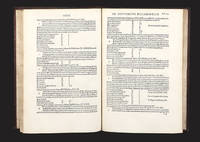
1494Best.-Nr. 55951494. 148 leaves including the final blank Roman letter except for the two-line title in gothic type 51 lines & headline capital spaces with guide letters. Folio 290 x 188 mm. late 17th-cent. panelled English speckled calf rebacked with the orig. spine laid-down minor staining to a few leaves in blank upper margins. Basel: J. Amerbach 1494. First edition of the “first bibliography to be compiled as a practical work of reference.”–Grolier Club Bibliography 7. Tritheim 1462-1516 one of the leading polymaths of his age was appointed the 25th abbot of the monastery at Sponheim in 1483. “One of the first of his many self-imposed tasks was the reorganization and cataloguing of the monastic library if one can call reorganization the process of transforming forty-eight mongrel volumes into a splendid collection of 2000 printed books and manuscripts many of great importance and rarity… “It was during the progress of this work no doubt as his exceptional knowledge of books caused inquiries frequently to be addressed to him that he conceived the notion of compiling a new and ambitious bibliography of ecclesiastical writers. He began work in 1487 and by the spring of 1492 he was able to send the complete manuscript to the bishop of Worms. He then revised it and in 1494 the Liber de scriptoribus ecclesiasticis a folio of nearly 300 pages issued from the Basle press of Johann Amerbach… “From Alexander bishop of Cappadocia down to himself Tritheim sets out in chronological order nearly a thousand writers largely but not exclusively ecclesiastical giving a short account of each followed by a list of his or her writings. Nor are these lists merely perfunctory: it is obvious from such a heading as that for St. Augustine under which he enumerates 277 works that Tritheim must have lavished an immense amount of genuine research on his bibliography. In all about 7000 books are recorded. An alphabetical index of authors arranged of course by Christian names is added. The contrast between the feeble theological bibliographies of the manuscript age and this first attempt in the printing era is very striking.”–Besterman The Beginnings of Systematic Bibliography pp. 7-8. The title of the book is somewhat misleading since the work is not restricted to ecclesiastical writers but also includes authors such as Dante Poggio and Sebastian Brant. A fine and crisp copy of a book which has become uncommon on the market preserved in a box. Bookplate of the Society of St. John the Evangelist Cowley Oxford. With a note on the rear paste-down referring to “Derby” the Earls of Derby and a shelf-mark. ⧠Goff T-452. unknown
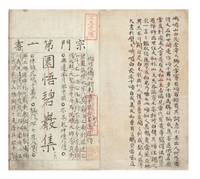
Best.-Nr. 7036Printed in Chinese with Japanese reading marks. 11 columns per page 21 characters per column. 79; 59; 51; 49; 67 folding leaves. Ten parts in five vols. 8vo 240 x 149 mm. orig. brown wrappers new stitching. Japan: mid-Muromachi ca. 1440-50. An extremely rare and important “mid-Muromachi” Gozan-ban edition of The Blue Cliff Record in Chinese: Pi yen lu a collection of Chan Buddhist koan. These were verbal tests used to practice or test a student’s progress in Zen compiled in the Song Dynasty and expanded by the great Northern Song Chan master Yuanwu Keqin 1063-1135 abbot of Tianning Wanshou Chan Monastery in Beijing. The text was first printed in China in 1125 or 1128 and has long been celebrated for both its startling beauty and profound complexity. Around 1140 one of Yuan Wu’s successors Ta Hui destroyed the printing blocks and copies of the Pi yen lu because the work’s rapid and widespread popularity made him fear that its beauty of expression would distract its readers from seeking enlightenment directly within themselves. The text was brought back from China by Dogen 1200-53 the Japanese Buddhist priest who was a founder of the Soto school of Zen in Japan. He had studied in China for four or five years and returned to stay at the Kenninji temple where he introduced many texts. This text was first printed in Japan about 1336-50 early-Nanbokucho by Gyokuho Shorin at the Kenninji; there is a copy at the National Diet Library. Our edition is a reprint of that first Japanese edition using the same woodblocks with minor changes. A later edition appeared in the Donald and Mary Hyde sale lot 65. “For some time Chan monks had been in the habit of extracting snippets from the ‘records’ yulu of past masters isolated them as ‘ancient precedents’ and commenting on them sometimes in verse sometimes in prose. By the mid-eleventh century the core situation was known as a ‘case to be investigated’ or a gong’an. The process was incremental and difficult to stop. Yuanwu’s Emerald Cliff Record for example took a previous eleventh-century collection entitled Master Xuetou’s verses on a hundred old cases and added an introduction and extensive commentary to each ‘case’ sometimes also dropping in comments on the appositeness or more usually inappositeness of the relevant verse so becoming in his turn ‘magistrate.’ A gong’an collection therefore reveals many layers all of them dedicated to undercutting the stability of language while at the same time playing a complex game of competing authorities. Herein lies their fascination.”–Richard Bowring The Religious Traditions of Japan Cambridge U.P. p. 301. “Gozan-ban is a general term embracing all those books published by monks of the Zen sect chiefly at the five Zen monasteries at Kamakura and the five at Kyoto over a period of more than 200 years between mid-Kamakura and late Muromachi. The appearance of the printed page in most Gozan editions follows a distinctly Chinese style. The effect is somewhat dense and crowded caused by packing the Chinese characters tightly together with more regard for economy of space than for aesthetic effect. In this the Gozan editions differ markedly from all other early Japanese printed books which are more generously spaced. The reasons for this are twofold: the books tend to be chiefly reprints of Chinese song and Yuan editions and during the fourteenth century many Chinese blockcutters came over from the continent and practised their craft of a semi-commercial basis and on a fairly large scale.”–K.B. Gardner “Centres of Printing in Medieval Japan: late Heian to early Edo period” in British Library Occasional Papers 11. Japanese Studies ed. by Yu-Ying Brown London: 1990 p. 164. PROVENANCE: This copy has the seals of Hirokata Yashiro 1758-1841 “Shinobazu Bunko”; Awa no Kuni Bunko; and Goroza Uchino b. 1873 “Kyotei Bunko”. It later belonged to the great collector and bibliographer of early Japanese books Kazuma Kawase 1906-99 and has his seal. The chitsu has Kawase’s manuscript title label stating in trans.: “Gozan-ban. Hekiganroku. Mid-Muromachi edition. Shinobazu Bunko provenance. Kazuma put the title on this label” also with his seal. There are four Prefaces: the first is undated the second dated 1300 the third dated 1305 and the fourth is dated 1304. Two leaves of manuscript probably written by Yashiro have been inserted at the beginning of Vol. I. They provide a commentary and a sort of title-page the work was issued without a title. Following Part I there are another two leaves of manuscript relating to this text. Following the tenth part are five Afterwards dated 1125 undated 1302 1317 and 1317. In fine condition all contained in a modern wooden box. The top of the box has been covered in a most attractive silk brocade. A few natural paper flaws and minor staining. Berkeley has an edition of this text but because of the very vague WorldCat cataloguing it is impossible to tell which exact edition it is. ⧠Kornicki Language Scripts and Chinese Texts in East Asia p. 245. unknown
1630Best.-Nr. 5226Bracciano: Privately Printed by Andreas Phaeus 1626 to 1630. SOLE EDITION. Hardcover. Fine. An excellent copy. Bound in contemporary vellum lacking ties a few wormholes to the lower cover small puncture and a little rumpling along the fore-edge of the upper cover. Complete with the errata leaf and blanks F4 R6 & 4I6 b3 bound after c2 few small tears a some scattered toning and foxing a few inconsequential blemishes. With an early German manuscript shelf label - "M.W." 19th-century bookplate with coronet. Illustrated with an engraved allegorical frontispiece fine engraved portrait of Paolo Giordano Orsini Duke of Bracciano with dedication engraved vignette on printed title & many fine engraved illustrations in the text many full-page depicting the author's observations of sunspots his observational platform with his assistants busily working his telescopes and helioscopes of his own design. Scheiner's greatest work. This magnificent book along with Hevelius' lunar atlas "Selenographia" is one of the two most richly and superbly illustrated astronomy book published in the first half of the 17th century. It describes and depicts Scheiner's observations of sunspots and showcases his instruments including his Keplerian telescope and his helioscope. In 1611 Scheiner constructed a telescope with which he began to make astronomical observations and in March of that year he detected the presence of spots on the sun. Scheiner's claim to the discovery of sun spots independently of Galileo was the origin of one of the most famous and heated controversies in the history of science. This book contains the summation of Scheiner's observations of the sun the fruit of many years of observation and study. He confirmed his method and criticized Galileo for failing to mention the inclination of the axis of rotation to the plane of the ecliptic. Yet he finally agreed with Galileo that sunspots are on the Sun's surface or in its atmosphere rather than satellites that they are often generated and perish there and that the Sun is therefore not perfect. Scheiner further advocated a fluid heavens against the Aristotelian solid spheres and he pioneered new ways of representing the motions of spots across the Sun's face. Because shortly after the appearance of Rosa Ursina sunspot activity decreased drastically the so-called Maunder Minimum ca. 1645-1710 his work was not superseded until well into the eighteenth century. Scheiner was responsible for many advances and innovations in the design of telescopes and related instruments. Of great importance is Scheiner's creation of a special helioscope described here the first Keplerian telescope in use consisting of two convex lenses; it was also the first to use colored glass in the eyepiece Kepler himself had only considered the telescope theoretically. Scheiner is also known for having invented the pantograph and for establishing the retina as the seat of vision. The quality of the engravings in this book is exceptional. Not only the complete instruments but also their component parts lenses fittings etc. are depicted in these engravings. Rosa Ursina sive Sol was costly to produce. Scheiner originally sought the support of Cardinal Alessandro Orsini 1592-1626 who was close to the Jesuits and after Alessandro's death that of his brother Paolo Giordano II Duke of Bracciano a great patron of astronomy. Rosa Ursina sive Sol was thus published at Bracciano on the Duke's private press though over several years 1626-30 due to financial difficulties. The book starting with its title is replete with references to the Orsini family whose heraldry included the rose and the bear orsus = ursus = bear. Given the strained relations with Paolo Giordano II who was unwilling to pay for the book these references to the Orsini family quickly became obsolete. Depicting the Astronomical Observatory and Methods of Observing Sunspots: On page 150 there is a remarkable full-page engraving with two scenes of astronomers at work. The first shows a viewing terrace outfitted with two obelisks and a number of figures using astronomical instruments including a helioscope and a telescope. Three figures may be identified as Jesuits from their distinctive birettas. One is at the foot of the obelisk measuring the position of the reflected sunspot against a plumb line at M with a compass. The second image an interior scene shows Scheiner and his assistant at work in his study which has astrolabes and a quadrant on the walls. This plate illustrates seven methods of observing sunspots: 1 the simplest and most natural way of observation is to let the Sun at F shine through a bare opening of a ball at G into a dark place where a paper is held perpendicularly and on which a figure is formed at H. 2 another simple form of observation is to let the Sun at Q shine through a convex glass at R onto a chart at S. 3 the simplest and most natural way of observation is with the naked eye at P when the Sun is at the horizon at I. 4 observation of the Sun at E through a helioscope at D. 5 observation of the Sun at B behind a cloud at C through a telescope at A. 6 observation of the Sun at I by a reflection at LN by a plane mirror at K. This is a method that Scheiner initially used at Ingolstadt. 7 observation of the Sun where its ray V through a helioscopic tube at X is projected onto paper in the circle Y contained in the perimeter cfdg. This method is described as 'the most excellent the most secure and the easiest' method of observation which Scheiner used at Ingolstadt from 1612 as well as at Rome. The Christogram 'IHS' adopted by the Jesuits as their emblem may be seen at the top of one of the obelisks and the rose of the Orsini family may be found on the edge of the roundel and elsewhere. On the side of a stool on which a telescope and sundial rest is the signature of the engraver Daniel Widman. The quotation at the top of the image is from Pliny the Elder's Naturalis historia II.112 where Eratosthenes's estimate of the circumference of Earth is described as 'an audacious venture but achieved by such subtle reasoning that one is ashamed to be sceptical.'. [Privately Printed by] Andreas Phaeus, 1626 to hardcover
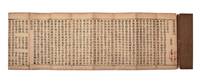
Best.-Nr. 8663Trans. by Xuanzang 玄奘 in 650 CE. 70 pages six columns per page 30 columns per sheet 17 characters per column. 14 sheets average sheet length: 570 mm. five pages per sheet. Accordion format 305 x 7980 mm. print surface from top border to bottom border: 245–250 mm. Single woodcut borders at top & bottom of text. Orig. sutra binding of semi-stiff paper wrappers. Woodblocks carved by Ge Fang & Ma Qing & others in Sixi present day Huzhou printed between 1110s/40s–1276. This fascicle in its original sutra binding was printed in the 12th or 13th century in northern Zhejiang China as part of an extremely rare edition of the Buddhist canon variously known as the Yuanjue Canon Zifu Canon or Sixi Canon. Examples very rarely appear on the market. This edition of the Buddhist canon was for a long time largely unknown in China until the famous Chinese book collector and scholar Yang Shoujing 1839-1915 brought a set back from Japan in the late 19th century. Now in a Chinese library this is the only near-complete set as far as we know the rest being single sutras. Yuanjue Zifu or Sixi Canon: The three names refer to some or all of the imprints of the Chinese Tripitaka made from a set of blocks that were carved in a place called Sixi present-day Huzhou in what was then Songting township Guian county Hu prefecture part of the Circuit of the eastern and western Zhe of the Southern Song. Sixi one of the names retrospectively used for this edition was the location of Yuanjue Meditation Hall founded in 1119-25 where the printing blocks were housed and perhaps carved. Sometime after 1239 the hall’s name may have changed to Fabao Zifu lit. “Dharma jewel supplying happiness” Meditation Temple whence Zifu Canon. Bibliographic scholarship has dated certain imprints of this canon to either the period of Yuanjue Meditation Hall or that of Fabao Zifu Meditation Temple calling imprints dating from the earlier period Yuanjue Canon or “first Sixi canon” qian Sixi jing and imprints from the later period Zifu Canon or “second Sixi canon” hou Sixi jing. On the basis of a comparison of two catalogues of the canon — one claiming to be of the Yuanjue Canon and one of the Zifu Canon — it was believed that a substantial amount of re-carving had taken place between the Yuanjue and Zifu canons. However the catalogue purportedly of the Zifu Canon has been shown in fact to have been based not on an inventory of a set of the Zifu Canon but on another unrelated catalogue. Thus there is no reason to assume that a substantial amount of re-carving of the blocks took place after the temple changed its name and ipso facto there is no reason to posit the existence of two Sixi canons. Printings ascribed to the Yuanjue and Zifu canons belong to the same edition of the Chinese Tripitaka printed at various times during a period that stretched over a century. Blocks were repaired and replaced during this period but not to the extent that would justify calling them two editions. The Timing of Carving and Printing: The sources are ambiguous as to when carving of the blocks began. Li Fuhua and He Mei state that the carving began in 1126 whereas Wang Chonglong says it began before 1110 and thus not at the Yuanjue Hall which had not yet been founded and agrees with others that it likely had finished in 1132. It has also been proposed however that carving only began in 1132. Finally 1140 has been proposed as another completion date. Therefore we can say with confidence that the initial set of blocks was carved sometime between the 1110s and 1140s. Once the blocks were carved they were used for printing for a long time. Some printings can be dated because they contain colophons. Liu Yuantang has documented three instances of blocks being mended buban: in 1238 1248 and 1250. The blocks were burned by the invading Mongols in 1276 which is thus the terminus ante quem for prints from the Yuanjue Canon. Our Copy and the Yuanjue / Zifu Canon: Benshi jing is marked with the ordinal character shen 甚 in five editions of the Chinese Tripitaka. Of these five only the Yuanjue Canon also known as the Zifu or Sixi Canon is a possible candidate. More precisely our copy appears to be from a late printing of the Zifu Canon dating from sometime in the latter portion of the period 1110s/1140s-1276. The vast majority of extant sutras from this edition of the canon are late printings. They have the following characteristics: 1. Sheets folded into five pages with six columns per page 30 per sheet and 17 characters per column. 2. Glosses appended to the end of the volume. 3. Single woodcut borders at top and bottom of text. For earlier printings of this edition one source specifies that the borders go around on all four sides but for the later printings the same source simply says “single-lined margin frame” danxian biankuang 單線邊框. This would appear to suggest borders also at the beginning and the end of each sheet. 4. No empty column before the beginning of the text on the first page. 5. Small-script numerals marking the number of the sheet are printed at the beginning of every sheet as opposed to in the crease between pages for example except for the first sheet. 6. Printed area of roughly 570 mm. long and 250 mm. wide. The sutra has a total of seven fascicles juan of which we have fascicle six. The upper cover and the first line of the first page both have the character shen in manuscript on the cover which is here used as an ordinal drawn from Qianzi wen åƒå—æ–‡ The Thousand Character Essay to arrange the sutras of the Chinese Tripitaka. Layout and Appearance of Our Copy: Unsurprisingly for a very large printing project that took many years not all the sutras of the Yuanjue Canon have the same appearance. Yet the dimensions of our copy agree with other known copies: five pages per woodblock six columns per page 17 characters per column. Other non-official Song editions of the Buddhist canon Chongning and Pilu have six pages per block but the same number of columns per page and characters per column. The measurements of our copy accord with copies of other sutras from the same edition of the canon held by the Gansu Provincial Library in Lanzhou the National Palace Museum in Taipei and the Gotoh Museum outside of Tokyo. The layout of our copy accords with that of a different sutra from the same canon that has been reprinted in facsimile in unknown