19 544 résultats
1930réf. 5319DBParis, La Pleiade, 1930. 154 S., (1) Bl. mit Lithografien von R. Ben Sussan. Dreiviertel Lederband mit marmorierten Deckeln.
réf. SONG3805599684Used: Good unknown
réf. 0309F088366Very Good. Very good decorative brown cloth top edge gilt bright gilt lettering elaborate black stamped floral cover and spine. Boston: No reader's marks. Remarkably Tight bright. 40 illustrations/frontispiece all VG; 388 pages plus 8pps publisher's ads. Philadelphia: Lippincott 1876. Salt water; or The sea life and adventures of Neil D'Arcy the midshipman "With Illustrations". Illus. frontis and title page VG tissue guard at least 3 other handsome engraved full page illus. Top textblock some soiling; book slightly cocked. hardcover
réf. DADAX0399207597New unknown
réf. 013507021X-8-1Pearson College Div. Study Guide. Very Good. It's a well-cared-for item that has seen limited use. The item may show minor signs of wear. All the text is legible with all pages included. It may have slight markings and/or highlighting. Pearson College Div unknown
réf. 720220 pp. 8vo 198 x 125 mm. modern aubergine cloth head of spine a little worn title on upper cover. Paris: Félix & Regnault-Delalande 1822. An extremely rare auction catalogue inventorying the collection of an obscure painter active at the turn of the century. A contemporary annotator has written in the surname for this anonymous sale on the title-page corroborating Lugt’s attribution. An 1817 almanac of Paris records a painter with the same surname working at rue de Rohan 6. Viglianis also exhibited a landscape at the 1814 Salon — no. 948 in the exhibition livret. 184 lots consisting primarily of prints lots 1-132 by artists such as Bartolozzi Bervic Bloemaert Cochin Le Bas Desnoyers Earlom Green Ingouf Massard Morghen Strange Wille Woollett etc. We then find original engraved plates by a number of contemporary artists. The final section of drawings includes the work of Bruandet S. Gessner H. Robert and “Joseph Pascal Viglianis” presumably the seller. With the list of vacations on the final page. A very rare catalogue in fine condition. In the characteristic binding of the Bibliothèque Heim. â§ Lugt 10220. unknown
réf. 720220 pp. 8vo 198 x 125 mm. modern aubergine cloth head of spine a little worn title on upper cover. Paris: Félix & Regnault-Delalande 1822. An extremely rare auction catalogue inventorying the collection of an obscure painter active at the turn of the century. A contemporary annotator has written in the surname for this anonymous sale on the title-page corroborating Lugt’s attribution. An 1817 almanac of Paris records a painter with the same surname working at rue de Rohan 6. Viglianis also exhibited a landscape at the 1814 Salon — no. 948 in the exhibition livret. 184 lots consisting primarily of prints lots 1-132 by artists such as Bartolozzi Bervic Bloemaert Cochin Le Bas Desnoyers Earlom Green Ingouf Massard Morghen Strange Wille Woollett etc. We then find original engraved plates by a number of contemporary artists. The final section of drawings includes the work of Bruandet S. Gessner H. Robert and “Joseph Pascal Viglianis” presumably the seller. With the list of vacations on the final page. A very rare catalogue in fine condition. In the characteristic binding of the Bibliothèque Heim. â§ Lugt 10220. unknown books
1894réf. 71028Washington: United States Geological Survey 1894-1900. First edition of all seven folios. 21 2/4 x 18 1/2 inches each. Folio 3 Placerville. 3 maps. 1894. Folio 5 Sacramento. 2 maps. 1894. Folio 29 Nevada City Special. 9 maps. 1896. Folio 41 Sonora. 4 maps. 14x4" portion of rear wrapper torn off affecting lettering on inside rear wrapper; plates and text fine. 1897. Folio 51 Big Trees. 3 maps & 1 plate reproducing 5 photographs. 1898. Folio 63 Mother Lode District. 8 maps. 1900. Folio 66 Colfax. 3 maps. 1900. All in original printed wrappers and cloth spines. Cursive stamp of Chas. S. Sawyer to each volume. Bit of soiling ad corner wear but altogether a very good collection of this attractive group of atlases. United States Geological Survey hardcover
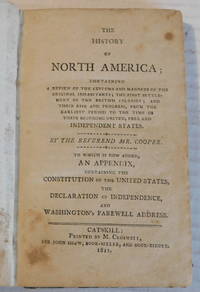
1811réf. 98077Catskill NY: Printed by M. Croswell for John Shaw Book-seller and Book-binder 1811. 1811. Fair. RARE MACKAY CROSWELL CATSKILL NEW YORK IMPRINT - Octavo 6-10/16 inches high by 4-2/16 inches wide. Hardcover bound in original marbled paper covered boards backed with a tan calf spine titled "American Revolution" in gilt on the spine. The covers are heavily rubbed and chipped and the front cover is detached. Pages i-xii 1 and pages 14-264. There is evidence of early worming to the top front corner of the first 2 leaves. There is some scattered foxing and staining throughout with occasional pencil annotations. An internally good copy of this rare imprint. RARE CATSKILL NEW YORK IMPRINT. Although for many years attributed to the Reverend William Cooper see Howes C-761 modern scholarship has identified the author as being Richard Johnson 1733 or 1734-1793 He wrote the text for Elizabeth Newbery who published the first edition in 1789. M.J.P. Weedon "Richard Johnson and the Successors to John Newbery" The Library 1949 pp. 25-63. Richard Johnson also wrote an adaptation for children of several stories of the "Thousand and one nights" under the pseudonym Reverend J. Cooper. It appeared under the title "The Oriental moralist or the beauties of the Arabian nights entertainments" accompanied with suitable reflections adapted to each story in 1790. Mackay Croswell 1765-1847 was an important early printer in the Hudson Valley who started the first Catskill New York newspaper "The Catskill Packet" in 1792. Together with his brother Thomas he opened a book and print shop in Catskill in 1790. Mackay was soon joined in the the business of journalism by his brother Harry Croswell. In 1800 the paper was renamed "The Western Constellation" in 1800 and was co-edited by Mackay and Harry. For a brief period the brothers mentored a well-known future journalist Thurlow Weed who worked in their print shop. Catskill, [NY]: Printed by M. Croswell, for John Shaw, Book-seller, and Book-binder, 1811. hardcover
1911réf. 64719New York NY: Dodd Mead & Co. 1911. 8vo. xi 1 514 pp. Frontisp. 3 plates. Olive-gray decorated publisher’s cloth olive-green locked hearts white lettering front cover & spine w/ d.j. embossed illustrated cover art featuring raised embossed gold nugget floating above silhouette grasping hands light shelfwear very minor creasing still a NF/NF copy. First edition of the noted British-Canadian poet’s daring tragedy set against the backdrop of the Klondike Gold Rush the madness of the stampede of gold-seekers to Alaska and the hero’s deprivations struggles and conflicts in the gold fields and finally finding love with an abandoned young Jewish-American woman only to lose her at the end. At the time this was one of the best-selling novels of the Alaska Gold Rush and was later the first “Talkie” movie on the Klondike featuring Harry Carey and Dolores Del Rio released by M-G-M in their short-lived widescreen process with a synchronized musical score and sound effects. Exceedingly scarce in original dustjacket. Dodd, Mead & Co., hardcover
1851réf. 83020London: John Van Voorst 1851. First edition. Hardcover. Very Good. 23 x 14.5 cm. Slim octavo. viii 74pp 2 ads. Small stamp on page vii. Complete with 6 lithographs of flies by Paul Jerrard of which 5 are vibrantly hand colored and one that is not in color of other tackle. Bound in original brown cloth. Spine is faded and head and tail of spine are chipped. ~ 8 cm closed tear to front free endpaper. With sections on salmon white trout trout pike grayling sea fly-fishing and lengthy appendix including a section on angling in America. Authorship is unattributed internally but various sources give either Mrs. Hutchinson or Richard Bowden-Smith as the author. Uncommon work. References: Heckscher 1075. Westwood & Satchell p 95. John Van Voorst hardcover
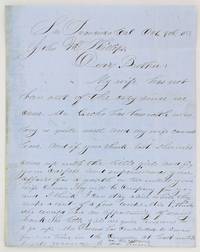
1852réf. 2473San Francisco: October 4 1852. Very good. 2pp. with integral address leaf. Old folds mild staining and soiling three-inch closed tear to address leaf. An interesting letter documenting the family side of the California Gold Rush in which a San Francisco man writes to his brother offering to send his wife and daughters to Placerville as helpers. Interestingly at first Phillips addresses the letter to his brother in Ohio then scratches it out and writes in "Cal;" this most likely indicates the Phillipses hailed from Ohio and trekked to California along with scores of others in hopes of untold riches in the California gold fields. In his letter Phillips writes that his wife who has long been in San Francisco looking after a sick friend can now leave as he is better "And if you think best she will come up with the little girls and fix your carpets and superintend your affairs for a month or two untill your wife comes." The formerly sick friend Mr. Gardner could also accompany them apparently as "He is coming up to P. and he wants you to give him work for a short time. Mr. G. is a good sailsman sic having been in the dry goods business." While not overtly concerned with gold mining the correspondence is nevertheless interesting for providing details on family routines during the Gold Rush era when numerous families uprooted their lives and moved not only to places like San Francisco and Placerville but between such locations during the years of speculation. A nice example of history from below particularly notable for its domestic implications during the time of the great California Gold Rush. October 4 unknown
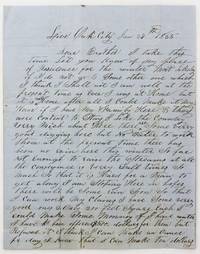
1855réf. 5504Live Oak City Ca: January 27 1855. Still very good. 4pp. on a bifolium. Previously folded with manuscript docketing on lower half of second leaf verso. Minor wear along old folds with a couple of short separations. Minor soiling and dampstaining somewhat heavier to addressed area. A detailed mid-1850s California Gold Rush letter from Elias Hunt Jr. to his brother in the tiny of Poolville New York southeast of Hamilton. Hunt was camped in Live Oak north of Yuba City when he wrote this letter home on January 27th 1855. He tells his brother that he has good claims but that a lack of rain has not allowed him to work them: "It is hard for a man to get along. I am stopping here in hopes there will be some rain soon so that I can work my claims. I have some very good ones 2 only 200 feet square each. I could make some money if I had water. I have been offered $500 dollars for them but I refused it -- I think I can make an ounce per day; I know that I can make ten dollars for I have done that before." There is talk of irrigating the area but Hunt is not sure that it will be finished before he wants to return east: "There is a ditch coming in here to suply sic the place with water but it will not be completed until Spring some time in April & I should like to come home in June. I shall stay until there is water in the ditch then I can wash a part of my claims & sell the rest to a good advantage for they are situated immediately on the line of the ditch." Continuing upon his plans to return he writes: "I have had a very good offer to come home across the plains by a man in Sacramento. He is from Utica; his name is Hamilton. He is going to cross with four hundred Spanish horses or mares. He has offered me good money to come with him as I have been over to Carson Valley this last season. It will take some sixty days to do it if I should get through with my claims by the time time that he gets ready to start. I think I shall come with him if the Indians are not to hosstille sic. They were very bad this last season; they got possession of one of Uncle Sam's forts." Hunt continues writing about local hunting prospects and family in New York before delivering a Crockett-esque farewell -- "Please give my respects to all may inquire for me & let the rest go to Hell for all that I care." A good letter from one of the less trafficked areas of the California Gold Rush. January 27 unknown
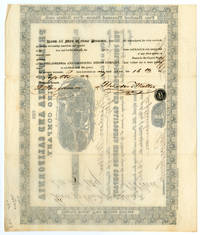
1618réf. 51617Philadelphia. Sept. 16 1852. Invest in California Gold Mines! A certificate for stock in the Philadelphia and California Mining Company completed on Sept. 16 1852 granting one Theodore Walter fifty shares in the venture and signed by the Secretary L. Alter and the President Pearson Serrill. The central woodcut depicts a mining scene representing the company's California operations. The Philadelphia and California Mining Company was founded in the same year on the basis of a land lease from John Fremont in the area of the Mariposa River. A rare piece of mining ephemera: OCLC records only one other example of a stock certificate from this company held by the California Historical Society. Previously folded with small chip at edge of a fold line. Printed form completed in manuscript by several hands. With a woodcut mining vignette. Near fine. OCLC 828929436. unknown
1855réf. 5504Live Oak City Ca: January 27 1855. Still very good. 4pp. on a bifolium. Previously folded with manuscript docketing on lower half of second leaf verso. Minor wear along old folds with a couple of short separations. Minor soiling and dampstaining somewhat heavier to addressed area. A detailed mid-1850s California Gold Rush letter from Elias Hunt Jr. to his brother in the tiny of Poolville New York southeast of Hamilton. Hunt was camped in Live Oak north of Yuba City when he wrote this letter home on January 27th 1855. He tells his brother that he has good claims but that a lack of rain has not allowed him to work them: "It is hard for a man to get along. I am stopping here in hopes there will be some rain soon so that I can work my claims. I have some very good ones 2 only 200 feet square each. I could make some money if I had water. I have been offered $500 dollars for them but I refused it -- I think I can make an ounce per day; I know that I can make ten dollars for I have done that before." There is talk of irrigating the area but Hunt is not sure that it will be finished before he wants to return east: "There is a ditch coming in here to suply sic the place with water but it will not be completed until Spring some time in April & I should like to come home in June. I shall stay until there is water in the ditch then I can wash a part of my claims & sell the rest to a good advantage for they are situated immediately on the line of the ditch." Continuing upon his plans to return he writes: "I have had a very good offer to come home across the plains by a man in Sacramento. He is from Utica; his name is Hamilton. He is going to cross with four hundred Spanish horses or mares. He has offered me good money to come with him as I have been over to Carson Valley this last season. It will take some sixty days to do it if I should get through with my claims by the time time that he gets ready to start. I think I shall come with him if the Indians are not to hosstille sic. They were very bad this last season; they got possession of one of Uncle Sam's forts." Hunt continues writing about local hunting prospects and family in New York before delivering a Crockett-esque farewell -- "Please give my respects to all may inquire for me & let the rest go to Hell for all that I care." A good letter from one of the less trafficked areas of the California Gold Rush. January 27 unknown books
1852réf. 2473San Francisco: October 4 1852. Very good. 2pp. with integral address leaf. Old folds mild staining and soiling three-inch closed tear to address leaf. An interesting letter documenting the family side of the California Gold Rush in which a San Francisco man writes to his brother offering to send his wife and daughters to Placerville as helpers. Interestingly at first Phillips addresses the letter to his brother in Ohio then scratches it out and writes in "Cal;" this most likely indicates the Phillipses hailed from Ohio and trekked to California along with scores of others in hopes of untold riches in the California gold fields. In his letter Phillips writes that his wife who has long been in San Francisco looking after a sick friend can now leave as he is better "And if you think best she will come up with the little girls and fix your carpets and superintend your affairs for a month or two untill your wife comes." The formerly sick friend Mr. Gardner could also accompany them apparently as "He is coming up to P. and he wants you to give him work for a short time. Mr. G. is a good sailsman sic having been in the dry goods business." While not overtly concerned with gold mining the correspondence is nevertheless interesting for providing details on family routines during the Gold Rush era when numerous families uprooted their lives and moved not only to places like San Francisco and Placerville but between such locations during the years of speculation. A nice example of history from below particularly notable for its domestic implications during the time of the great California Gold Rush. October 4 unknown books
1618réf. 51617Philadelphia. Sept. 16 1852. Invest in California Gold Mines! A certificate for stock in the Philadelphia and California Mining Company completed on Sept. 16 1852 granting one Theodore Walter fifty shares in the venture and signed by the Secretary L. Alter and the President Pearson Serrill. The central woodcut depicts a mining scene representing the company's California operations. The Philadelphia and California Mining Company was founded in the same year on the basis of a land lease from John Fremont in the area of the Mariposa River. A rare piece of mining ephemera: OCLC records only one other example of a stock certificate from this company held by the California Historical Society. Previously folded with small chip at edge of a fold line. Printed form completed in manuscript by several hands. With a woodcut mining vignette. Near fine. OCLC 828929436. unknown books
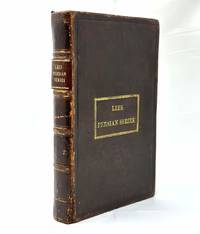
réf. O17First edition. Octavo ca. 235x165 cm. With two title pages in English and Farsi. 348 pp. numbered in Eastern Arabic system. Text in Farsi. With numerous ink and pencil written commentaries in English Arabic and Farsi on verso of the title page and in text. Period brown full sheep with gilt lettered title “Lees. Persian Series” on the front board and a gilt lettered title label on the spine; marbled endpapers bookseller’s paper label Arthur Probsthain Oriental Bookseller London in the left lower corner of the front pastedown endpaper. Binding slightly rubbed paper slightly age toned otherwise a very good copy. Very rare Indian imprint with only four paper copies found in Worldcat. Second unaltered edition was published under the same title in 1871. “The Iqd-I Gul” or “The Rose Necklace” is a collection of short stories aphorisms and parables from the famous “Gulistan” by Sa’adi Shirazi and “Anwar-I Sohail” or “The light of Canopus” by Ḥosayn WÄÊ¿eẓ KĚefī b. 1502. “Gulistan” is Sa’adi’s second major work after the “Bustan” “Garden”. It consists of small stories of aphoristic character with elegant intricate plots expressed in precise and exact lines. This “multi-layered” poem led to the creation of an Iranian saying: “Every line of Sa’adi has 72 meanings”. Gulistan contains hidden context of Sufi character and is deeply connected with the teachings of as-Suhrawerdi. b. 1155. “Anwar-I Sohail” is a book of fables inspired by the classical Indian moral stories of “Kalila wa Dimna” and early Arabic works of Ibn al-Muqaffa’ 724-760; it consists of fourteen chapters “commissioned by and dedicated to the Timurid amir NeẓÄm-al-Din Sheikh Aḥmad Sohayli whose name is alluded to in the title” Encyclopaedia Iranica online. The collection was assembled by the principal of the Calcutta Madrasa and a noted orientalist William Nassau Lees 1825-89. “He was for some years principal of the Madrásá or Mohammedan College Calcutta averaging four hundred students in which institution he was also professor of law logic literature and mathematics. He was likewise secretary to the college of Fort William Persian translator to the government and government examiner in Arabic Persian and Urdu for all branches of the service besides being for some years part proprietor of the ‘Times of India’ newspaper and was an incessant contributor to the daily press on all Indian topics political military and economical. In 1857 the university of Dublin conferred on him the honorary degree of LL.D. and he was also a doctor in philosophy of Berlin. He became a member of the Royal Asiatic Society London in 1872”. The “Iqd-I Gul” consists of several parts titled “Dervish’s Morals” “Padishah’s Lessons” etc. Our copy is interspersed with period ink marginalia apparently made by a student of the Calcutta Madrasa among which are translations of specific words and expressions remarks on the stories dates when a particular story was read mainly in 1875 et al.: “grazing fields of Paradise” p. 114 “Bravo!” p. 118 “Story of the Raven & the Serpent” p. 205 “Story of the Hare and the Wolf” p. 210 et al. unknown
réf. 44028501Edo n.d. ca 1830-40's. A group of 12 color woodblock print sheets: ca. 12.3 x 9 cm.;prints: ca.11.9 x 8.4 cm.all clean showing age excellent impression & registry no marks very nice examples in old album. AN OBSCURE SHUNGA ALBUM . . . EROTIC PRINTS FROM TWO SERIES MOST LIKELY THE ART WORK . . . OF EITHER KUNISADA I OR TOYOKUNI II . . . UNSIGNED AS USUAL . The book consists of pages from two series of Shunga erotic books:. As usual no Shunga erotica or Harubon erotic books were ever signed by the author as these were banned by the Shogunate. Nevertheless there was a proliferation of these 'contraband' books & prints printed through the Edo period 1604-1868 that were commonly distributed throughout Japan. . Three prints from JUNI KA GETSU NO UCHI TWELVE MONTHS OF THE YEAR and YON SHIKI NO UCHI THE FOUR SEASONS. The second to last print has no title. All of the above are clearly Edo period color prints. The second to the last print has no title but is clearly an Edo period item. The very last color print is a Meiji period work ca. 1870's. . We believe the two series originally consisted of 12 prints in all showing the erotic scenes of each of the twelve months. The same for the Four Seasons showing three prints for each of the four seasons. . Each print is clean more than likely from an accordion folded album or a usual printed book. All but 2 have the series title cartouche and a title cartouche indicating the season or month. The last two have no titles. . Each print is gently mounted to the book using typical Ace corners in white from the 1940-1950's period. . THE ARTISTS: Being unsigned by stylistic analysis and research we believe this book to be the artistic work of the two artistes cited below. . The book consist of the works of two famous woodblock print artists: of the period KUNISADA I & TOYOKUNI II. Because Kunisada I 1786-1864 was the star pupil of Toyokuni II since age 15 his works naturally are very similar to his master's style. In 1844 he took the name Toyokuni III therefore Kunisada I is the same person. He specialized in story books & portraits. He is well collected by world libraries & museums. See Roberts below. . Toyokuni II 1777-1835 may be the artist of one of the series. He also was a star pupil of Toyokuni I. He was a Ukiyo-e painter illustrator Bijin Ga pictures of B-beauties He is well collected by world libraries & museums. See Roberts below. . The last print clearly a Meiji 1968-1912 period work was again unsigned and unattributed. . EX-LIBRIS THOMAS K. TINDALE. Tindale was a famous author of the comprehensive book THE HANDMADE PAPERS OF JAPAN concerning Japanese Washi papers. The first fly leaf of this book has his embossed "Mon" or Japanese crest blind-stamped. See our book #360633 on our website. . This was among his collection which we acquired in the 1970's now being offered for the first time. . CONDITION: The book is in excellent condition it is an accordion folding album with brown silk cloth covers containing stiff Washi paper. . The front covers have a bit of old either worming or silverfish evidence of nibbled cloth in two places. It is minor and has been colored the same as the cloth so it is not a major issue with no damage to the interior pages. There is a small amount of loss to the cloth and the cover title slip is also a bit nibbled on the right edge again of no impact to the book or the prints. . The prints are clean polychrome woodblock printed in several colors with excellent impression & registry. Lovely miniature treasures. Each print is gently inserted in American "NewAce" white paper mounting corners. The prints can be easily removed from these corners. . There is one single print mounted to the right hand side of the book. The versos of the prints are clean the rectos fronts are also clean no damage marks or issues. The colors are vivid the red made from iron has nicely oxidized into a mellow brown-rust color indicating at least 100 years old. It takes 100 or more years for this color transition to happen this is a good sign of genuine Edo period examples. . Each print has excellent impression & registry indicating an early printing off the woodblocks printed in a high quality from expert printers/publishers again lacking any identifying seal as usual. . The last print Meiji period has been re-backed folded twice and old tear mended. . Please review the color photos posted to our website for more details. . THE ARTIST & BANNED BOOKS: . During the Edo period the Shogun banned books that were not inspected and or sanctioned. Erotic books were again contraband and never showed the true name of the artist nor publisher printers seals or logos. Therefore these Shunga Harubon are difficult to attribute any artist. The only way is an "educated guestimate" based on the artist's painting style. At best it is a close of an attribution as possible. Few are listed in Shibui or other bibliographies containing Harubon. . It our best estimate that these two books were the work of either Kunisada I and or Toyokuni II based on our over 55 years of tenure and experience. . Color photos are posted to our website. . REFERENCE: . ROBERTTS Laurence P.: A DICTIONARY OF JAPANESE ARTISTS: PAINTING SCULPTURE CERAMICS PRINTS LACQUER. For Kunisada see pp. 96-97. For Toyokuni II see pp. 186-187. SHIBUI Kiyoshi: ESTAMPS EROTIQUES PRIMITIVES DU JAPON: GENROKU KOHANAGA SHU-E. . --. UKIYO-E NAISI. BIBLIOGRAPHY OF JAPANESE EROTIC ILLUSTRATED WOODBLOCK PRINTED BOOKS. HAYASHI Yoshikazu: ENBON KENKYU: RESEARCH ON EROTIC JAPANESE WOODCUT BOOKS. ILLING Richard: JAPANESE EROTIC ART: And The Life Of The Courtesan. UHLENBECK Chris. ed. et al.: JAPANESE EROTIC FANTASIES: Sexual Imagery Of The Edo Period. WINZINGER Franz: MEISTERWERKE DER EROTISCHEN KUNST JAPANS. LANE Richard: EROTIC THEME IN JAPANESE PAINTING: THE EARLY SHUNGA SCROLL. UKIYOE SHUNGA MEI HIN SHU SEI.THE COMPLETE UKIYO-E SHUNGA: The Foreign Image. An Anthology Of Writings. GROSBOIS Charles: SHUNGA IMAGES OF SPRING: Essay On Erotic Elements In Japanese Art. MANDEL Gabriele: SHUNGA: Erotic Figures In Japanese Art. EVANS Tom. et al.: SHUNGA: The Art of Love in Japan. UTAMARO Utagawa. Kitagawa: THE MERRY DRINKERS A Translation Of The EHON WARAI JOGO: A PICTURE BOOK SERIES OF SHUNGA EROTICA. . NOTE: Many of the above reference books are in our inventory please see visit our website for details search by author or title. . . unknown
réf. a891651684 first edition. no place or publisher given. square 12mo . later plain wraps. "Nopende het belaagen der Vryheyt. Mitsgaders een verhaal van de swackheyt der Spaanse Mogentheyt Philips de Tweede. Triangle floral vignette on title page. Name "Boccalin" printed at end of text. 8p. Good no wear some light toning throughout. . paperback
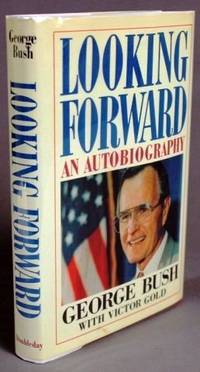
1987réf. 018589New York: Doubleday & Company Inc. 1987. First Edition. hardcover. Fine in a Fine dustwrapper. Illustrated with photographs. INSCRIBED and SIGNED by the former President on the front free endpaper in December 1987: "To ---------/with Friendship/Respect and Lasting/Appreciation for helping/me 'Look Forward'/George Bush." Advance Review Copy with a letter from the publisher laid in. Doubleday & Company, Inc. hardcover
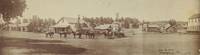
réf. FRE67Original gelatin silver photograph 11 × 40 cm 4⅜ × 15¾ in. mounted on original card 17.5 × 47.5 cm 6⅞ × 18¾ in. Contemporary manuscript caption in lower right: “Mt. Bullion / Mariposa Co. / 1905.” Photograph good and clear; a couple of small areas of emulsion loss at lower right not affecting the image. Mount chipped with small pieces missing from the corners. A panoramic view of Mount Bullion the historic Mariposa County gold-mining settlement formerly known as Princeton showing its commercial center with wooden buildings townspeople numerous horses and horse-drawn vehicles. prominent sign identifies the “Princeton Boarding House” preserving the older name closely associated with the settlement and its principal mine. The photograph occupies an interesting place in the limited early photographic record of Mount Bullion. Other documented images include a ca. 1900 view of the Princeton Mine a 1914 view of the Princeton Quartz Mine in the California State Library and a 1926 photograph of the historic Marre Store preserved in the Library of Congress as part of the Historic American Buildings Survey. Unlike these images which concentrate on individual mines or buildings the present panorama records Mount Bullion as a functioning community providing a broad view of the settlement during its early twentieth-century revival. No other example of this 1905 panoramic view has been located in the institutional collections photographic databases or market records consulted. unknown
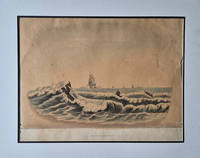
réf. 415RARE ORIGINAL HANDCOLOURED LITHOGRAPH CATAMARANS AND MUSLALAS CHARLES GOLD 1806 SHIPPING MOUNTED SHEET SIZE 10 X 13 INCHES The identification of the illustration Madrassan men surfing detail above by Charles Gold by the curators of the ANMM is a significant contribution to the history of surfing. Known to be based on his personal observation and dated 1800 it is currently the earliest known image of wave riding; similar images from Hawaii were not published until the 1830s. To the left it shows one man riding a three-log catamaran shore ward on a considerable wave. He rides upright with his feet parallel and holding a paddle while at the illustratAs a surfriding craft the catamaran falls somewhere between a surfboard and an outrigger canoe and the combination of a standing paddling and riding position is a unique. At the turn of the 20th century this riding technique was replicated with the development of stand-up paddle-boards SUPs.ion's centre two men are seen on a similar craft in the second line of breakers. A masula also known as masoola or masulah a local surf boat with a crew of six is heading through the outside breakers transporting freight for the ships of the East India Company awaiting off-shore at the Madras Roads.
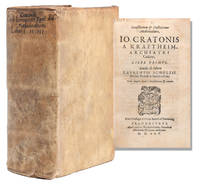
1609réf. 27318Frankfurt Hanover & Hanover: Apud Andrea Wecheli heredes Claudium Marnium & Joann Aubrium; Parts 2 & 3 Typis Wechelianis apud Claudium Marnium & Heredes Joan. Aubrii 1609. First published 1591-94. 1 vols. Sm. 8vo. Three parts in one volume. Vellum. Some soiling and browning of vellum and text ties lacking else a very good copy with bookplate of Alfred Jerome Brown. First published 1591-94. 1 vols. Sm. 8vo. This work was ultimately completed in seven parts. 'The Polish-German physician was the personal physician to both Emperor Ferdinand and Maximilian II in Austria. He wrote several medical works and was a follower of the Galenic school of medicine. He was one of the first to study the contagiousness of certain diseases. "Sixteenth Century Books in the National Library of Medicine" 1077 for the 1591-94 edition; Osler 2387 & 2388 earlier editions Apud Andrea Wecheli heredes, Claudium Marnium & Joann Aubrium; [Parts 2 & 3] Typis Wechelianis, apud Claudium Marnium & Heredes unknown
1609réf. 27318Frankfurt Hanover & Hanover: Apud Andrea Wecheli heredes Claudium Marnium & Joann Aubrium; Parts 2 & 3 Typis Wechelianis apud Claudium Marnium & Heredes Joan. Aubrii 1609. First published 1591-94. 1 vols. Sm. 8vo. Three parts in one volume. Vellum. Some soiling and browning of vellum and text ties lacking else a very good copy with bookplate of Alfred Jerome Brown. First published 1591-94. 1 vols. Sm. 8vo. This work was ultimately completed in seven parts. 'The Polish-German physician was the personal physician to both Emperor Ferdinand and Maximilian II in Austria. He wrote several medical works and was a follower of the Galenic school of medicine. He was one of the first to study the contagiousness of certain diseases. "Sixteenth Century Books in the National Library of Medicine" 1077 for the 1591-94 edition; Osler 2387 & 2388 earlier editions Apud Andrea Wecheli heredes, Claudium Marnium & Joann Aubrium; [Parts 2 & 3] Typis Wechelianis, apud Claudium Marnium & Heredes unknown books