GOLD, HerbertABAA
19.040 risultati
1981rif. 577460New York: Arbor House 1981. Softcover. Fine/Very Good. Uncorrected proof in proof jacket. Fine in printed wrappers in a moderately worn very good or better proof jacket with a bit of sunning at the edges. The jacket is printed only on the spine and cover panel and is about ¼" taller than the book. Arbor House unknown books
1985rif. 197567First edition. Oblong 4to 8 1/2" x 11". Illustrated with 26 lino and wood-cut drawings by Clarke. Printed yellow pictorial board; spiral bound. Fine fresh. No signatures or bookplates. #9/50 numbered copies the entire edition. An attractive alphabet book. The Author hardcover books
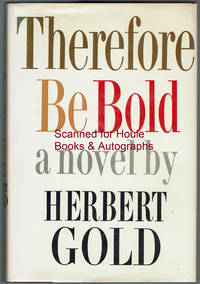
1977rif. 300530First edition. Octavo. Dust jacket designed by Judith Leeds unclipped; few nicks. Fine. 234 pages. No other signatures or bookplates. Signed and inscribed by Herbert Gold in black on the title page: "For Sheila - to us in the future! we'll reunite the past at leisure Herb." Novel set in San Francisco concerning a prostitute's efforts to unionize her colleagues. Arbor House hardcover books
1960rif. 300531First edition. Octavo. Dust jacket designed by Paul Bacon price clipped. Very good. 256 pages. No signatures or bookplates. The Dial Press hardcover books
1971rif. 208037London: Weidenfeld and Nicolson 1971. hardcover. very good-/good. 305 pages 8vo pink boards dust wrapper large slit on front cover. London: Weidenfeld and Nicolson 1971. A very good- copy in a good dust wrapper. Inscribed on the front free endpaper by the author: "To James Murray this English edition of a San Francisco novel for the San Francisco version of a British diplomat Greetings Herbert Gold 17 May 1971." Weidenfeld and Nicolson unknown books
1951rif. 57269New York: Viking Press 1951. Hardcover. Very Good/Good. First edition. A little fraying at the crown thus very good in good price-clipped dustwrapper which is spine-faded and with a number of small chips and tears. Scholar and author R.P. Blackmur's copy with his embossed ownership stamp repeated three times on the first two blank pages. Viking Press hardcover books
1541rif. 6509Luguduni sic: Lyon: Seb. Gryphium Sebastian Gryphius 1541. Early reprint. Leatherbound. Good. 12mo. Pp. 314 13. Early 18th-C. tree calf five raised bands with gilt tooled decorations and lettering piece edges trimmed and dyed red. Decorative initial caps italic text with roman titles table of Latin and Greek chapter titles marginal notes index following text followed by a tail-piece that of a gryffin in reference to printer Gryphius. Includes Appendicula de condituris varijs ex Ioanne Damasceno a section of fourteen recipes for "condimenta" and "condituræ" between De Re Culinaria and Facultatibus alimentorum. Spine ends chipped edges rubbed endpapers stained marginal annotations in ink tight binding. Presents four culinary and health texts as called for appearing together with Torinus' introduction the same year as a nearly identical Basel edition but in smaller format for a different market. The collection of Roman recipes De Re Culinaria attributed to Apicius first appeared in this form in the fifth century AD. Torinus' sources were "codexes" found in Maguelone and Transylvania. Bartolomeo Sacchi Platina's De Honesta Voluptate given an alternate title by Torinus was the first movable-type cookbook based on Maestro Martino da Como's recipes. Paul of Aegina was a Byzantine Greek physician. Gryphius learned printing from his father in Germany then in Venice moving to Lyon around 1520. By the 1540s he had the city's largest printing establishment and reputation for a high standard of editing and impression specializing in Humanist works in small format modeled on Aldus Manutius. DURLING Sixteenth Century Printed Books in the National Library of Medicine 232. . Seb. Gryphium [Sebastian Gryphius] unknown books
rif. 5361Denver: Henrietta Bromwell. Original Painting. Oil on Canvas Framed. Painting Fine within a Very Good Ornate Frame. Original oil painting framed depicting a disused pioneer cabin amid a forest clearing blue sky and pink clouds overhead. Exposed painting measures 9.75 x 8 inches; frame measures 14 x 11 inches. Bromwell neglected to sign and date many of her paintings; this work is signed "H. E. Bromwell" and features the "July 25 192unintelligible". On the back of the period frame is the remnant of a store label for Chain & Hardy Book Stationery and Art Co. Denver with only the address 1609-1615 Arapahoe St. and "Art Department" remaining. The painting is in Fine condition with three small chips to the gilded Victorian frame please see photos. Born in Illinois in 1870 Henrietta Elizabeth Bromwell 1859-1946 moved to the Colorado Territory when her father Henry Pelham Holmes Bromwell joined the territorial legislature. She studied art at the University of Denver and with Anne Evans daughter of John Evans Colorado's second territorial governor founded the Denver Artists Club also known as the Artists' Club of Denver. By 1923 that organization evolved into the Denver Art Museum. The subject of the painting is typical of Bromwell's oeuvre utilizing mountain streams rustic settings and pioneer life as her subjects. In an 1899 article Bromwell credited Monet as influencing her landscape painting as the lighter color palette and loose brushstrokes attest. Critics have suggested the influence of Henry Durrie and Jasper Francis Cropsey. Interest in Bromwell fluctuates with articles appearing periodically. In 1997 an issue of Colorado Heritage featured just that with the cover boasting a Bromwell painting akin to this offering. . Henrietta Bromwell unknown books
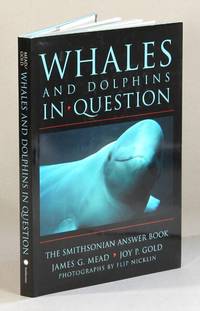
2002rif. 60855Washington DC & London: Smithsonian Institution Press 2002. First edition 8vo pp. xv 1 200; illustrations throughout much in color; fine copy in the dust jacket. This is Mead's personal copy but without signature or bookplate. He is the Curator Emeritus of Marine Mammals at the Smithsonian. Smithsonian Institution Press unknown books
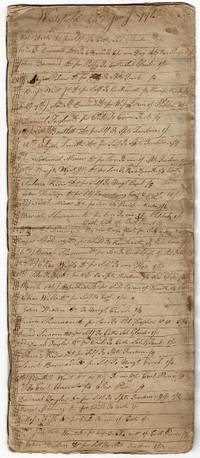
1805rif. 59752Waitsfield Vermont 1805. Narrow tall folio approx. 15½" x 6¾" 112 pp. in ink five separately sewn signatures; a few pages loose some pages darkened or chipped at edges; some entries faint. This account book is the record of the practice of either Stephen Pierce or Simeon Stoddard practicing in Waitsfield Vermont between 1795 and 1806. These were the second and third physicians to have settled and practiced in Waitsfield. Most likely it is the record of Pierce who is supposed to have settled in Waitsfield in 1795. The first physician in Waitsfield Moses Heaton remained there only between 1793 and 1796. Depending on the source Pierce was the third physician to practice in Waitsfield and/or the first to practice in Moretown a settlement to the northeast of Waitsfield. He farmed as well as doctored and his farm lay mostly in Moretown his office in Waitsfield. He was a respected and successful physician who served the community in other capacities: as selectman representative delegate to the Constitutional Convention of 1814 and Assistant Judge of the County Court. One source claims that he succeeded Judge Kinne December 1 1814 and served one year and that he was a justice of the peace in Waitsfield. He died either in 1854 after living in Waterbury and Berlin Vermont or he died in Barnard in 1864. See: History of the Town of Waitsfield Vermont 1782-1908 by Matt Bushnell Jones Boston 1909 p. 182. Simeon Stoddard on the other hand was born December 12 1761 either in Saybrook Connecticut or in Waitsfield. On August 19 1784 he married Abiah Thompson who had been born in 1763 in Waitsfield. Some sources state that he moved to Waitsfield from Saybrook in 1794. He served the southwestern area of Waitsfield and died in 1841. This account book records each date of visit the householder's name the relationship of patient to householder the medicine prescribed and its price and the cost of the doctor's visit. The doctor whether it be Stoddard or Pierce treated thirty to forty patients each month and as many as fifty-six in December of 1801. He charged as little as 4 pence and as much as 42 shillings 10 pence for his services. As a comparison the tax on an acre of land in Waitsfield was 2 pence an acre. The poll tax list of 1795 showed fifty voters so the doctor seems to have treated the members of nearly every family. The diseases treated are not stated in the entries made but he seems to have prescribed antimonium tartaricum in many instances and also digitalis. Waitsfield was founded by Col. Benjamin Wait or Waite and others who were granted a charter on February 25 1782. Wait had served under Gen. Jeffery Amherst in the French and Indian Wars and had fought in the Revolutionary War. Both Waitsfield and Moretown are now somewhat renowned as the areas around Mad River a popular ski resort. Mad River has been remarkable from the settling of the area as the source of numerous sudden destructive and deadly floods. The Green Mountains the northern extent of the Appalachians rise just to the west of the town. The doctor records having treated members of the Wait family including Benjamin's wife Martha d. April 3 1804 Ezra Thomas and Gilbert. The family names of the community are listed making this a good source for early settlement history and genealogical research. Among the householders who required the doctor's services are Smolly Skinner Taylor Spalding Hitchcock Parkhurst Carpenter the family had a tannery and potash works Heaton Burdick Johnson Rider Fuller Symonds McNight Chamberlain Atherton Lyon Butterfield Barnave Osgood Foster Hobson Robinson Brun Latimer and Sherman. Many of the names appear often. unknown books
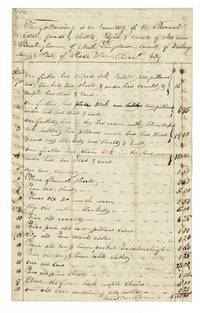
1833rif. 57649V.p. 1833. A dozen or so items over half of which seem inconsequental. Ezbon or Esbon Sanford 1765-1846 was born in Newport worked in Washington County. He was a storekeeper innkeeper and cabinetmaker and is cited in various articles about Rhode Island furniture making. One receipt is from the "estate of Abigail Congdon" his mother-in-law which details payment for molasses and gin as well as a coffin for herself at $6.00. A detailed inventory May 15 1833 is included of the estate of Anna Buckingham of North Kingstown Washington County. All her belongings are listed including furniture: "eleven old fiddleback maple chairs" at $5. This type of chair is described in an article by Kathleen E. Johnson in Art & Antiques Magazine Sept/Oct 1981 as "an intentional translation of the elements of the carved mahoghany or walnut cabriole legged Queen Anne- style chair into the vocabulary of the turned chair tradition." A large floor plan for a house with its footprint neatly laid out is one of the more interesting documents with a detailed list of supplies joists ranging timber furing laths doors & frames roof boards shingles and nails each with prices. Ezbon Sanford held a local court office as Judge of the Court of Common Pleas and nother interesting document is dated 1830 from the state to the sheriff concerning the warrant for the arrest of George Young charging him as the father of Margaret Mitchel's "bastard child." The paper was signed by John H. Green Deputy Sheriff. Other names mentioned in his storekeeper receipts are Robert Hosford Robert Northrup Charles Douglas Weighty Underwood and Paul Austin. unknown books
1971rif. 18176New York: Random House 1971. First edition 8vo. fine in like jacket. Random House unknown books
1966rif. 18177New York: Random House 1966. First edition 8vo. spine soiled; near fine. Random House unknown books
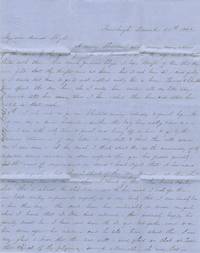
1849rif. BK0018Ferrisburgh Vermont 1849. Autograph letter signed "Anne R. M." to her husband Lloyd Minturn in San Francisco "Upper California." 8 pp.; approximately 1700 words. With stampless cover bearing a black "NEW-YORK / 40" datestamp of January 17 and manuscript routing "per Cherokee. Significant edge wear and central vertical crease; text generally clear and complete. An intimate Christmas letter from Anna Robinson Minturn of Ferrisburgh Vermont to her husband Lloyd then engaged in the hotel and real estate business at Pueblo San José during the California Gold Rush. Writing on the anniversary of his departure Anna describes the four-month-old son Lloyd had never seen questions whether California's speculative "mania" could last and repeatedly urges him to return home. Lloyd Minturn had traveled to California in January 1849 with David Lion Gardiner and other eastern emigrants. By November Gardiner reported that Minturn was "at Pueblo San Jose keeping a hotel and speculating in real estate."1 Anna's references to Lloyd's hotel and stables their rental and the uncertain recovery of his investment relate directly to his California business. He later appears in San Francisco as a member of the Committee of Vigilance of 1851 with his place of business on California Street and his residence at the Mansion House.2 Anna begins writing late on Christmas day imagining a future holiday spent with Lloyd "by thy quiet fire-side in Vermont-with thy wife and darling child with thee." Returning to the letter three days later she reflects on the year since his departure: "Oh how much I think about thee as the anniversary of thy departure comes round . When I think of thee my dearest ask then what a weary dreary time it seems . Our little darling improves so rapidly is so very lovely that I can hardly bear to have thee away." News that another California emigrant Dr. Stone had returned safely made Lloyd's absence still more painful. Although she understood that "the object of thy pilgrimage" at last appeared attainable Anna wondered why the management of his property could not be entrusted to an agent asking why "Mr. Ruckle" cannot "receive the rents & pay the former owner and send thee thy portion of the profits." However she immediately checks her own advice with an observation on marriage and gender: "You men know so much more how these things work than we so that it is rather labor wasted to advise much and I do hate to see a woman trying to rule her husband-don't thee" Anna feared that Lloyd might remain away sacrificing his domestic life only to lose the anticipated reward. Her skepticism extends to the Gold Rush itself: "I do hope though that the man who has taken your property will be able to pay you-that would be so bad to stay away so long-sacrificing so much & lose thy reward entirely-don't thee suppose this mania in California will end much as the land speculation did here seems to me it must. I hope thee won't get drawn in." Much of the letter is devoted to their infant son whose birth Lloyd may initially have learned of from another returning emigrant because of the "shamefully neglected" Pacific mails. At four months the boy weighed eighteen and one-quarter pounds and had "cheeks as hard as little apples." Anna encloses a lock of his hair explaining that she had kissed it before sending it. The contrast between California and the Vermont household runs throughout the letter. Anna describes the snow distant mountains sleighing baked apples and buckwheat cakes while Lloyd remains in a place known to her mainly through contradictory reports and unreliable correspondence. She cites Bayard Taylor's account of portions of California as suitable wheat country while noting that other observers claimed wheat could not be grown there at all remarking on the "contradictory accounts about California" that make it hard to "tell what to believe." Her anxiety was heightened by reports of cholera progressing toward California. She closes by asking Lloyd to protect his health and praying that he might be restored to her "in sound health both body & soul." Anna was a daughter of Rowland Thomas and Rachel Robinson of Rokeby the prominent Ferrisburgh Quaker family whose home later became known for its role in the Underground Railroad. Other letters from Anna to Lloyd during his California absence survive at the Bancroft Library and the Smithsonian.3 Overall a substantial and affecting account of the Gold Rush from the perspective of a wife left behind. 1 David Lion Gardner Letter to Juliana McLachlan Gardiner November 30 1849 David Gardiner Letters BANC MSS 2006/127 box 1.The Bancroft Library University of California Berkeley. 2 Anna Robinson Minturn Letters to Lloyd Minturn 1849-1851 Warshaw Collection of Business Americana Subject Categories: Steamboats box 1 folder 6 J-L Archives Center National Museum of American History Smithsonian Institution Washington DC. 3 Anna R. Minturn "Anna R. Minturn to Mr. Lloyd Minturn Ferrisburgh December 2 1849" California Gold Rush Letters BANC MSS C-B 547 box 5 The Bancroft Library University of California Berkeley. . unknown books
1830rif. 1418413Wien: Commission der Ulons Doll'fchen 1830. Umgearbeitet und mit vielen Zusaken versehen von Dr. J.C. Stark; von neuem bearbeitet und mit Zusaken vermehrt von Dr. J.F. Diessenbach. Hardcover. Octavo vii 540 pages 38 leaves of plates. In Fair condition. Ex-library with library stamps on endpapers. Spine is brown faded print green title label. Boards in brown paper; worn and chipping spine caps and corners worn hinges rubbing/shelfwear. Text block has owner stamp on front flyleaf foxing throughout uncut pages. Illustrated: b&w plates drawings some folded. Text in German gothic/fraktur font. NOTE: Shelved in Netdesk Column F ND-F . 1418413. FP New Rockville Stock. Commission der Ulons Doll'fchen hardcover books
1970rif. 12255Crestline CA: Institute for the Development of the Harmonius Human Being 1970. Reprint. Original Wraps. Very Good. Reprint. Original Wraps. Printed in 1970 by the Institute for the Development of the Harmonius Human Being the book explore fascinating concepts and ideas on mysticism the occult and spirituality. The commentary is followed by a facsimile reprint of the text itself taken from Crowley's 1903 satire featuring an original introduction connecting the contents to the rituals of the Hermetic Order of the Golden Dawn and the sex magic of the Ordo Templi Orientis. Toning and light shelfwear else tight bright and unmarred. Staplebound in tan wrappers. 8vo. xii 32pp. [Institute for the Development of the Harmonius Human Being] unknown books
1952rif. 192842Beijing 1952. Hardbound. Good- portfolios highly scuffed scratched; edge-worn w/ loose threads; masking tape repair & pencil notations to labels; interior linings peeling & chipped. print mats will have instances of chips tears smudgingrubbing & foxing. prints will have instances of tanning foxing smudging & occasional dampstaining; chips & tears to corners & edges. some tissue-guards present & will be of similar conditions. plates remain loose beneath the mats. two oversized navy blue textured portfolios w/ white title labels. vol1: 23 color & black woodblack prints. vol2: 39 color & black woodblack prints. 62 prints total. Interior portfolio flaps have original print listings intact. Both Parts one and two are incomplete. Part two has an incomplete set of supplements. There are also 6 random color prints with no identifaction; a few unmatted. A few prints appear to have been placed in unnumbered mats with handwritten pencil numbers so it's difficult to authentic if that is the acutal assigned print. Contents as follows with indentififers of hand-written numbering color or black printing whether a second copy of slight variation is present and other notable conditions; Part I: Print Number 5 Hand-Written Number HW Color; 11 C 12 C 15 Black with chipping 22 C 25 C with dense foxing 32 HW C 40 HW C 41 C and severely torn 45 C 49 HW C 57 two copies present with slight variations in design/printing HW C 60 C 71 HW C 73 HW C 78 HW C 88 Black and torn at lower corner/edge 89 B 92 B two copies present with slight variations in design/printing 93B two copies present with slight variations in design/printing. Part Two Contents: 114 B 123 two copies present with slight variations in design/printing C and B 124 C 129 two copies present with slight variations in design/printing C and B 135 C two copies of variations 141 C 142 C two copies of variations 144 C 146 C two copies of variations 148 C 155 C two copies of variations 159 C. Part Two Supplemental all prints Black printing: S1 S2 S10 two copies of variations S11 S12 S12 S14 S15 two copies of variations S16 with heavy tanning/foxing or dampstaining S19 S20 with creased chipped edges and dampstaining/foxing S21 HW S22 S23 and S24. Approximately 22lbs of shipping. hardcover books
1923rif. 240826Hollywood CA: Paramount PIctures 1923. Stapled Pamphlet. Very Good binding. The Covered Wagon" is considered the first great Western epic in movie history establishing a number of cliches that became staples. Very nice copy of the booklet that "has been prepared to present to the public some interesting facts in connections with the production of this Paramount picture" price 25 cents. Interesing item for the Teddy Roosevelt completist as the Paramount dedicated the movie to his memory; it so states on the verso of the front panel. Very Good binding. Paramount PIctures unknown books
1967rif. 73165Warehouse Point: National Railway Historical Society 1967. Hardcover. Very good. Hardcover. 38pp. Very good hardback in a lightly rubbed jacket. National Railway Historical Society hardcover books
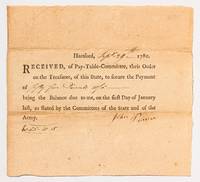
1780rif. 423856Hartford Connecticut 1780. Unbound. Near Fine. Approximately 7" x 6. 5" on laid paper with a deckled edge. Old folds near fine. Receipt of payment from the Pay-Table Committee of 55 pounds to John Pearce or Pierce Signed as received by him as Pearce. Docketed as received on the verso as Pierce. unknown books
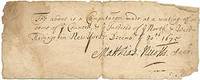
1675rif. 407229North & West Ridings Long Island New York 1675. Unbound. Good. Manuscript document. A single paragraph possibly removed from a larger document Signed at the conclusion by Matthias Nicolls. Approximately 8" x 3". Old fold some age-toning and small nicks and tears a little fragile but good. The document reads in full: "The above is a computacon made at a meeting of some of ye Councell & ye Justices of ye North & West Ridings in New York. Decembr. ye 30th 1675. Matthias Nicolls. secr." Matthias Nicholls 1626-1687 was the Provincial Secretary of New York. Born in Plymouth England he was selected to serve as secretary by Samuel Maverick who was one of the Royal Commissioners investigating conditions in New England. Accompanying the commission to New England which was headed by appointed Governor Richard Nicolls they were assigned the task of wresting the province of New York from the Dutch. Matthias held the position of provincial secretary continuously until 1680 except for the short period of 1674-75 when the Dutch briefly reoccupied New York. He was the Secretary of the Commission that accepted the Dutch surrender of New York. He served as the sixth Mayor of the city of New York in 1672-73. He is widely known as "the principal author of the legal code known as the 'Duke's Laws'." He was at least partially responsibility for religious tolerance in New York and founded the town of Plandome around his estate of the same name. unknown books
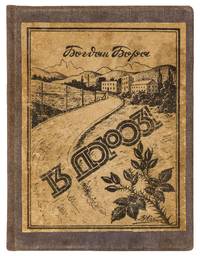
1946rif. 423496Rimini Italy: Zyttia w tabori 1946. Hardcover. Very Good. Limited edition one of 280 copies. Mimeographed. Octavo. pp. 1-4 i-iv v-vi 1-104. Illustrated with a portrait of Bogdan and four other full-page illustrations. Bound in original army linen over boards with mimeographed illustration mounted on the front cover. Small contemporary name in ink on front free endpaper slight staining and rubbing to the boards small marginal tears to endpapers very good. A very scarce book of poetry by the Ukrainian poet Bogdan Bora 1920-97 written and published at a prison camp in Rimini Italy about one year after World War II. Bora had been captured by British forces and sent to the prison camp in Rimini where he spent the following two years and published three books of poetry including this collection the title of which translated as “On the Road.” Bora’s poems written in Ukrainian are moving works evocative of the turbulent era. The cover design and a full-page portrait of Bogdan Bora were made by fellow inmate Volodimir Kaplun. In 1947 Bora was moved to Britain where he was given his freedom and lived out the rest of his days. Very scarce. OCLC locates only six copies in institutional holdings worldwide. Zyttia w tabori hardcover books
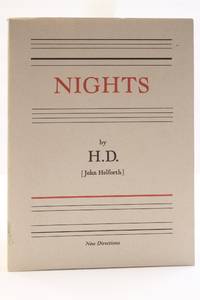
1986rif. 1418152New York: New Directions Publishing 1986. First Edition Thus First Printing. Softcover. Octavo 106 pages. In Very Good condition with a Very Good dust jacket. Dust jacket spine tan with black lettering protected in mylar covering price uncut: "$19.95". Mild general shelf wear. Mild tearing to head of dust jacket. Scuffing to back of dust jacket cover near tail of dust jacket spine and bottom edge of textblock. Shelved in Fiction. 1418152. Shelved Dupont Bookstore. New Directions Publishing unknown books
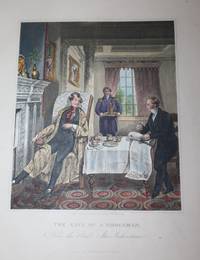
1825rif. 007994London: George Henderson. Printed by George Dawe who also was engraver 1825. First Edition. Full Morocco. Near Fine. Suite of nine hand-colored aquatint plates depicting the louche hedonistic and self-destructive life of a young aristocrat. Bound by Riviere & Son in full red morocco with ruled border raised bands other gilt decoration including turn-ins marbled endpapers. N.d. circa 1820s. 4to. 31 by 25 cm. No title page -- this was issued as a suite of plates not in a book form. A blank sheet in front two in back and tissue guards between plates. Each plate is depicting a scene and basically a step in the descent to self-destruction by the young buck aristocrat. Scenes are The Inheritance The First Party The Night House in other words the bordello The Betting Booth at the racetrack The Gambling House The Usurer The Mess Room clearly the dining room of an elite military unit The Duel and finally The Sick Room. We would note that the Usurer has the casual anti-Semitic trope so prevalent throughout history of the hook-nosed lender. The artwork has a pleasant slightly naive quality with the loosest of adherence to perspective. The settings are generally quite resplendent capturing Regency England grandeur perfectly. Scarce. Yale has several copies. Only two other complete sets held by institutions according to OCLC First Search one at Harvard and one somewhat later and published by Tegg at the Art Institute in Chicago. The Henderson version clearly the first was issued without color we would add. The Harvard Hollis catalogue gives no indication whether the copy at Houghton has hand-coloring -- something that Hollis generally will denote if it does. No copies found in commerce on date of this description was prepared. Light wear to binding. Light soiling in the margins of the plates. Pictorial elements consistently bright and attractive. George Henderson. Printed by George Dawe, who also was engraver unknown books
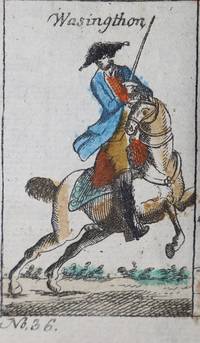
rif. 006887Nürnberg: Trautner. Hardcover. Paper pastedown on slightly limp boards. Very Good. Early depiction of General Washington in Germany -- possibly the first such. N.d. circa late 1780s. We can date these generally to the late 1780s because Frederick the Great's death in 1786 is noted but Joseph II is still presented as alive but he died in early 1790. Folio 32 by 20 cm. 33 pages with mounted content including 15 double paged plates measuring 32 by 38.5 cm or thereabouts. The sixteenth plate is double paged half the page height -- this plate was somewhat crudely cut probably in half. In these plates there are about 345 separate images or cells -- the cell count is not hard and fast as there are instances in which two cells can be regarded as a single illustration or cell. The vast majority of the cells or illustrations relate to military men and many of these are equestrian images with the commander or officer mounted on horse. We also find rows of soldiers that can be viewed as if on parade or alternatively like cells in a movie. Military costume and regalia isn't the only subject however. Two of the plates are devoted mostly to the hunt and shooting. In these hunters are shown holding up firearms to various prey. And one plate depicts biblical scenes or subjects. In these plates brief captions can identify the subject. Thus we know that one of the pictures is of Washington who certainly would have been an international celebrity in the late 1780s. The hand-coloring of the prints is a fairly crude stencil and the palette of colors is not extensive. Dominating are blues oranges greens and golds. Not to be slighted is the first page in this album which is an entirely different sort of artwork and seemingly bears no relation to the rest of the contents. This page presents a depiction of Saint Catherine with the saint and her executioner depicted in a printed oval set as a centerpiece surrounded by foliate tracery intricately cut out like lacework. Surrounding all of this is a paper frame all from the same sheet as far as we can discern. The paper and the center oval are mounted onto the album leaf and thus the lacework given the whole thing some dimensionality. The coloring of this specimen of folk art is also richer and more refined than applies to the stenciling of the prints to follow. Scarce -- we could no other examples of Trautner's military prints not to speak of collection of this size on OCLC First Search or elsewhere. Condition: the cover has considerable wear with some crinkling of the paper pastedown some surface loss to the paper and soiling. Spine has a fair amount of paper pastedown loss. The first page with the Saint Catherine artwork has some loss to the tracery but we would also assert that it is remarkable that so much of it has survived intact. The paper framing is considerable soiled with some running of the coloring onto that paper and elsewhere in the artwork. The Trautner prints have light soiling comprised of margin smudging and a light dampstain affecting a few of the prints but overall these read as mostly clean. We noted that the last print is partial. Trautner hardcover books