17.480 risultati
1934rif. 49165Berlin Springer 1934. 8vo. In contemporary halv cloth with gilt lettering to spine. In "Zeitschrift für Physik" Bd. 87 1934. Entire volume offered. Stamp to front free end-paper and titlepage otherwise fine and clean. Pp. 633-46. Entire volume: VIII 822 pp. First printing of Wang's Ph.D thesis on beta decay spectrum under the supervision of Lise Meitner. Wang was one of the initiators of research in China in nuclear physics cosmic rays and particle physics and figured among the top leaders pioneers and scientists of the Chinese nuclear deterrent program. Wang 1907 - 1998 a nuclear physicist from China went in 1930 to study at the University of Berlin in Germany. As soon as he arrived in Berlin hearing the Bothe report relating the emission of a new type of high-energy neutral radiation which was non-ionizing but even more penetrating than the hardest gamma rays derived from radium induced by the bombardment of beryllium with particles from a radioactive polonium source therefore wrongly presumed to be gamma rays Wang first suggested the use of a cloud chamber to study it. Lacking the support of his supervisor Lise Meitner the experiment was nonetheless conducted one year later by the English physicist James Chadwick thus discovering a new type of particle the neutron allowing him to win the 1935 Nobel Prize in Physics.In 2000 the Chinese Physical Society established five prizes in recognition of five pioneers of modern physics in China. The Wang Ganchang Prize is awarded to physicists in particle physics and inertial confinement fusion. hardcover
1840rif. 47213Paris Bachelier 1840. 4to. No wrappers. In: "Comptes Rendus Hebdomadaires des Séances de L'Academie des Sciences" Tome XI No.18. Pp. 667- 716. Entire issue offered. Becquerel's paper:pp. 702-703. Some marginal brownspots margins slightly soiled light browning an creasing. First printing of an importent paper in the history of photochemistry as he here discovered some effects of coloured rays of the solar spectrum."Edmund Becquerel seems to be the first person to observe in 1840 in the paper offered that the latent daguerreotype image which had been underexposed could be intensified if re-exposed to the yellow and red rays of the spectrum and then developed with mercury. Explaining this phenomenon Becquerel called the yellow-red continuing rays "rayon continuateurs" in contrast to the primary rays which exicited or produced the light image and which he called exiciting rays "rayons excitateurs". They are dependent on the wave lenght of the light."Eder "History of Photography" pp. 265 ff."Becquerel was an early experimenter in photography. In 1840 he discovered that the silver halides natively insensitive to red and yellow light became sensitive to that part of the spectrum in proportion to their exposure to blue violet and ultraviolet light allowing Daguerreotypes and other photographic materials to be developed by bathing in strong red or yellow light rather than by chemical treatment. In practice this technique was rarely used." Wikipedia. unknown
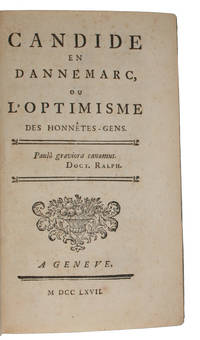
1767rif. 45831Geneve 1767. Original blue cardboard binding with contemporary handwritten paper title-label to spine. Pencil-numbering to inside of boards. A very nice and clean copy. Woodcut vignette to title-page. With the ex-libris of the notes Danish book collector K.F. Plesner to inside of front board. Rare first edition of this interesting anonymously written continuation of Voltaire's Candide which wraps up the adventures of the hero. "Turning his back on both Voltarian satire and scepticism the novelist proposes a moralistic fable - the focal point of which is a rehabilitation of Leibniz's Theory of Optimism. The main body of the novel tells the story of Candide and his new wife the noble Zénoïde in their sumptuous Copenhagen townhouse. Before achieving this happy state however the couple endures various trials and tribulations reminiscent of the newly minted gothic genre. "Candide au Dannemarc" also features a satirical portrait of Jean-Jacques Rousseau." Éduard M. Langille from the introduction to the new edition of "Candide au Dannemarc" edited by him. Voltaire's "Candide" had inspired a sequel that appeared in 1760 which is attributed to Charles-Claude-Florent de Campigneulles but which might be by Henri-Joseph du Laurens. The present work is a direct continuation of that sequel although it ignores the happy ending of the previous work but evidently from the preface it is not written by the same author. It has still not been determined who the actual author is.The part on Rousseau pp. 148-167 in the present work has become quite famous portraying him satirically as trying to make a living in Copenhagen from copying music while plotting to escape to America. The novel ends with Candide leaving Denmark to be the Danish ambassador in Russia.A secoond edition appeared in 1769. paperback
1889rif. 49414Leipzig Johann Ambrosius Barth 1889. 8VO. Contemp. hcalf. Raised bands gilt spine. Top of spine worn and some wear to upper compartment. In "Annalen der Physik und Chemie. Hrsg. von G. Wiedemann." Neue Folge Bd. 37. VIII680 pp. a. 7 folded plates. Pockels' paper: pp. 144-172 269-305 372-394. Small stamp to htitle title-page and verso of. Internally fine. First printing of Pockels' paper in which he announced the discovery of the effect which bears his name. He shows that the optical property is changed by a change in the dieelectric function induced by electric deformation of a solid. The discovery became to have a wide use in semiconductor technology.The volume contains further notable papers ELSTER & GEITEL "Ueber die Electricitätserregung beim Contact verdünnter Gase mit galvanisch glühende Drähten" pp. 315-329. - HEINRICH HERTZ "Ueber die Fortleitung electrischer Wellen durch Drähte" pp. 395-407. - W. HALLWACHS "Ueber den Zusammenhang des Elektricitätsverlustes durch beleuchtigung mit der Lichtsabsorption" The photo-electric effect ! pp. 666-674 papers by Lenard Ferdinand Braun 2 papers etc. hardcover
1847rif. 47222Paris Bachelier 1847. 4to. No wrappers. In "Comptes rendus hebdomadaires des séances de l’Académie des sciences" Vol. 25 No 17. Pp. 561- 608. Entire issue offered. Niepce de Saint-Victor's paper: pp. 579-589. First appearance of this milestone paper in the histroy of photography in which Niepce de Saint-Victor describes his invention of photography on glass or "glass negatives"."Early in 1847 Niepce de Saint-Victor experienced with the use of starch paste on his glass plates as a binding substratum for the iodide coating but he soon found that albumen was preferable; he also tried gelatine but laid it aside because it came off in the aceto-silver nitrate bath. By a mixture of honey syrup or whey with the albumen he oncreased later the sensivity. He published his process on October 25 1847 in the Comp. rend. the paper offered and soon had many followers. He also made many modifications Annexe to the memoir." Eder "History of Photography" Dover Publ. pp. 338 ff. unknown
1973rif. 036013Cambridge: MIT Press 1973. 1st Edition 1st Printing. Hardcover. Near Fine/Very Good DJ. Photographs; Figures In Text. . Xxii Xxiv 428 Pp. Red Cloth Stamped In Black. True First Printing Hardcover 1973 Prior To All Soft Cover Printings. Proceedings Of The First International Conference On Communication With Extraterrestrial Intelligence. Book Is Near Fine No Wear But A Little Bumping At Ends. Top Edge Of Page Block With Some Tiny Black Dots And A Very Faint 1" Diameter Damp Spot. Dj Priced $10.00 Light Wear Mostly At Corners 1/8" Closed Tear At Top Of Spine Showing A Few Small Red Damp Spots On Inside Of Dj But No Traces Of Damp Staining To Outer Dj Surface Or To Boards Of Book. MIT Press hardcover
1938rif. 036007London: The Wireless World / Iliffe And Sons 1938. 3rd Edition 1st Printing. Hardcover. Near Fine/Very Good. Photographs Diagrams Maps Charts Throughout. Xi 803 Pp. Blue Cloth Gilt. Greatly Revised And Enlarged To Update To 1938. Scarce Worldcat Shows Only Four Institutional Holdings And Only One Institutional Holding Each For The 4Th And 5Th Printings Of 1947 And 1949; And Very Scarce In Dust Jacket As Is Present Here. Very Near Fine Covers Entirely Clean And Bright Gilt Brilliant Touches Of Rubbing At Corners Hinges Tight No Names Or Marks. Green Dj Priced 25S Light Wear Slight Browning To Spine 2" Closed Tear At Top Of Front Panel A Few Minor Edge Losses. The Wireless World / Iliffe And Sons hardcover
2001rif. 147885New York: Hyperion 2001. First edition. Softcover. Advanced Reading Copy. Gold's very well received debut novel a thriller about magician Charles Joseph Carter. A tight very good copy in French style wrappers with some slight creasing to the foredge of the first few pages and a small stain to the bottom of the page edges. Signed by Gold on the title page. Additionally this copy has been signed by Gold's wife the dedicatee author Alice Sebold on the dedication page. Uncommon thus. Hyperion unknown
rif. 6357321934Springer . Papeback. New. pp. 523 Springer unknown
rif. 62019Mesorah Pub. New York.2000 Hardcovers. Very Good Lite use. Delivery is Courier Mesorah Pub. New York.2000 hardcover
rif. 6358499429Springer . Papeback. New. pp. 456 Springer unknown
rif. 6142315771Springer . Papeback. New. pp. 540 Springer unknown
rif. 6142286103Springer . Papeback. New. pp. 176 Springer unknown
rif. 6142288547Oxford University Press OUP . Papeback. New. pp. 304 Oxford University Press OUP unknown
rif. 6131682656Digital Scanning Incorporated . Papeback. New. pp. 460 Digital Scanning, Incorporated unknown
rif. 6131683065Digital Scanning Incorporated . Papeback. New. pp. 440 Digital Scanning, Incorporated unknown
rif. 6131690127Digital Scanning Incorporated . Papeback. New. pp. 432 Digital Scanning, Incorporated unknown
rif. 6131521032Read Books UK . Papeback. New. pp. 310 Read Books (UK) unknown
rif. DADAX3423093250New unknown
rif. 6142279165Columbia University Press . Hardback. New. pp. 336 Columbia University Press hardcover
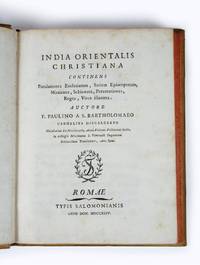
1794rif. 3703905Rome: Typis Salomonianis 1794. Three works bound together quarto the first main work with folding map 2 plates and an engraved portrait vignette with two shorter pamphlets 24 & 26 pp.; an attractive copy in contemporary patterned vellum boards spine banded red morocco spine label faded. Three works by Paulinus including his important India Orientalis Christiana a study of and introduction to the Carmelite missions in India in the late eighteenth century in a particularly attractive contemporary binding. The work is illustrated with two plates and a fine map of India as well as a smaller vignette portrait of Paulinus himself. Paulinus of St Bartholomew 1748-1806 also known as Johann Philipp Werdin or Wesdin was a missionary and orientalist. A member of the Carmelite Order in 1774 he was sent to India Malabar where he was appointed vicar general of his order. In 1789 he was recalled to Rome in order to report on the mission and given the task of preparing books for the use of missionaries. One of the first Orientalists to note and work on the close relationship between Indian and European languages Paulinus was the author of many learned studies on the east and is best known for having published the first Sanskrit grammar. As an antiquarian who worked from original sources he was fortunate to have the patronage of Cardinal Stefano Borgia 1731-1804; a good Borgia whom he served as private secretary and who financed many of his publications. Both men served long periods on the Congregatio de Propaganda Fide a body preoccupied with exotic languages insofar as they impacted on spreading the christian gospels but also in understanding exotic theologies. In this context the Propaganda Fide was a central recipient of missionary collecting in the field which gave Paulinus exceptional advantages which enabled him to undertake extensive linguistic studies. After Borgia's death his remarkable library and museum were gradually distributed with the important biblical manuscripts mostly being added to the Vatican libraries after the secular materials had chiefly made their way to the national library of Naples. The two rare pamphlets bound in here are both concerned with Borgia's museum: Scitismo Sviluppato. del Museo Borgiano Rome c. 1793 and Lettera. del Museo Borgiano Rome same period both written in Italian not Latin and both discussing the Museo Borgiano. Borgia was particularly expert on Coptic relics but here Paulinus discusses early Brahmanic and other Indian manuscripts in his collection. All of these works are rare although as often the pamphlets are the scarcer. Worldcat lists some 10 copies of the India Orientalis Christiana 2 copies of the Scitismo and only 1 of the Lettera. . Typis Salomonianis unknown
rif. DADAX0333744829New unknown
rif. DADAX0333529588New unknown
rif. DADAX0415464161New unknown
rif. DADAX0415653843New unknown