Michael Stettler; Mechthld LembergMareMagnum

15 698 résultats
1973German Text. Bern, 1973; bound, pp. 262, b/w and col. ill. deutsch 3-7272-920 bound
1975réf. 270761San Mateo: Advocate Publications 1975. Newspaper. 40p. folded tabloid newspaper mild toning and wear misfolded else good on newsprint. Cover stories on Portland and Boston. W. Dorr Legg article. Loretta Lotman takes over from Ron Gold with photos! Prison Rap. MCC Minister in Africa. Editorial announcing that The Advocate was changing publishers Liberation Pub. would take over issue 156 and editors John Preston was supposed to take the helm. Advocate Publications unknown books
Lisboa, Biblioteca Nacional, 1983. Folio; XXII pp., 122 pp., 2 hs. y cinco láminas con retratos. Alguna corrección en tinta del anterior propietario. Cubiertas originales.
PB, 330 x 255 mm, 424 pages, 480 illustrations, ENG edition. ISBN 9789462302310. This book deals in three parts with the complete Gillion Crowet Collection, which with its approximately three hundred pieces forms a reference collection in the field of the parures of the Moroccan Berber women. The collection, which focuses on the production of silver from the countryside, paints a broad panorama of the creative centers, drawing on pieces of exceptional quality not found in any other public collection today. The first part explores the historical continuity of Berber culture from the Neolithic on and examines the - still topical - issue of a Saharan culture forced to settle elsewhere by desertification. In response to this historical approach, the second part highlights the close relationship that makes the parures the "screen image" of the Berber woman. The third part explores the places where the parures were produced. The jewels are reduced to a topography of creation that runs from North to South and from East to West, with a fundamental anchorage in the southeast of Morocco.
1550réf. 5044Rome: ca 1550. SECOND STATE of three with the addition of "Romae" incised at lower right. Hardcover. Fine. A very fine example with high contrast of this rare print. This is the first published engraving dedicated to Michelangelo's Moses and one of only two made in the 16th century. The funerary monument of Julius II occupied Michelangelo in various phases from 1505 to the 1540s. Prints of the entire monument are few. In them the figure of Moses is necessarily reduced in size and imperfectly executed. Later prints of the statue in isolation such as that by the Netherlandish artist Jacob Matham 1571-1631 in which the figure is shown in reverse fail to match the standard set by this early engraving. The inscription reads: Moysis ingens ex marmore simulacrum in Julij Secundi/ Pontificis Maximi ad petri in Exquilijs uincula sepulcro / præstanti Michaelis Angeli Bonarotae manu fictum. The immense marble statue of Moses in the Church of San Pietro in Vincoli on the Esquiline Hill sculpted by the hand of Michelangelo Buonarroti for the tomb of Pope Julius II. Michelangelo's design for the tomb of Pope Julius II with the master's iconic figure of Moses was originally intended for St. Peter's but was ultimately installed in the church of San Pietro in Vincoli in Rome. The work was commissioned by Pope Julius in 1505 at which time Michelangelo received an initial payment of 100 gold ducats but was not completed until March 1545. Michelangelo re-worked his initial design numerous times first in 1513 after Julius' death and again in 1516 1525/1526 1532 and 1542. The final monument includes three figures carved by Michelangelo: the aforementioned Moses and Leah and Rachel symbols respectively of the active and contemplative life. Michelangelo's sculptures of the dying and rebellious slaves now in the Louvre and the Genius of Victory Palazzo Vecchio Florence were not used in the final design. On the second tier of the monument as it stands is an effigy of the reclining Julius II attributed to Tommaso di Pietro Boscoli 1503-1574 but with the face possibly the work of Michelangelo watched over by the Madonna and Child carved by Alessandro Scherano di Settignano after a model by Michelangelo and flanked by a sibyl and a prophet; these last two sculptures were carved by Michelangelo's pupil Raffaello da Montelupo ca. 1504-ca. 1567. "The engraving reproduces accurately in the same direction and without substantial variations the sculpture of the tomb of Julius II identifying the light source at the top left. The work attributed by Bottari to Beatrizet Heinecken 1768 was treated as anonymous by Heinecken in the Nachrichten of 1768 but later included by him in the list of Beatrizet's works Dictionnaire 1788. Nagler recorded it both under the monogram of Cornelis Bos and as the work of Beatrizet. Appearing in the Hollstein repertoire as Bos it was subsequently treated among works of doubtful attribution both of Bos Schéle 1965 and of Beatrizet Bianchi 2004. "Due to the fact that copies of this print are found in volumes of Roman composition on the model of the Speculum Romanae Magnificentiae El Escorial; Madrid Biblioteca Nacional; both datable between the mid-1580s and the 1590s one would be led to believe that the plate was engraved in Rome where in the last decade of the 16th century it was acquired by Van Aelst. This does not however exclude Cornelis Bos as a possible author since more than one of his plates is known to bear a Roman address in late editions even if it makes it more likely -in our opinion- the identification with a Flemish engraver active in Italy. In the sparse and luminous texture and in the clean geometries one could also perceive the burin of Niccolò della Casa."Alberti Rovetta and Salsi "D'après Michelangelo"2015 p. 219 ff. ca hardcover
1550réf. 5044Rome: ca 1550. SECOND STATE of three with the addition of "Romae" incised at lower right. Hardcover. Fine. A very fine example with high contrast of this rare print. This is the first published engraving dedicated to Michelangelo's Moses and one of only two made in the 16th century. The funerary monument of Julius II occupied Michelangelo in various phases from 1505 to the 1540s. Prints of the entire monument are few. In them the figure of Moses is necessarily reduced in size and imperfectly executed. Later prints of the statue in isolation such as that by the Netherlandish artist Jacob Matham 1571-1631 in which the figure is shown in reverse fail to match the standard set by this early engraving. The inscription reads: Moysis ingens ex marmore simulacrum in Julij Secundi/ Pontificis Maximi ad petri in Exquilijs uincula sepulcro / præstanti Michaelis Angeli Bonarotae manu fictum. The immense marble statue of Moses in the Church of San Pietro in Vincoli on the Esquiline Hill sculpted by the hand of Michelangelo Buonarroti for the tomb of Pope Julius II. Michelangelo's design for the tomb of Pope Julius II with the master's iconic figure of Moses was originally intended for St. Peter's but was ultimately installed in the church of San Pietro in Vincoli in Rome. The work was commissioned by Pope Julius in 1505 at which time Michelangelo received an initial payment of 100 gold ducats but was not completed until March 1545. Michelangelo re-worked his initial design numerous times first in 1513 after Julius' death and again in 1516 1525/1526 1532 and 1542. The final monument includes three figures carved by Michelangelo: the aforementioned Moses and Leah and Rachel symbols respectively of the active and contemplative life. Michelangelo's sculptures of the dying and rebellious slaves now in the Louvre and the Genius of Victory Palazzo Vecchio Florence were not used in the final design. On the second tier of the monument as it stands is an effigy of the reclining Julius II attributed to Tommaso di Pietro Boscoli 1503-1574 but with the face possibly the work of Michelangelo watched over by the Madonna and Child carved by Alessandro Scherano di Settignano after a model by Michelangelo and flanked by a sibyl and a prophet; these last two sculptures were carved by Michelangelo's pupil Raffaello da Montelupo ca. 1504-ca. 1567. "The engraving reproduces accurately in the same direction and without substantial variations the sculpture of the tomb of Julius II identifying the light source at the top left. The work attributed by Bottari to Beatrizet Heinecken 1768 was treated as anonymous by Heinecken in the Nachrichten of 1768 but later included by him in the list of Beatrizet's works Dictionnaire 1788. Nagler recorded it both under the monogram of Cornelis Bos and as the work of Beatrizet. Appearing in the Hollstein repertoire as Bos it was subsequently treated among works of doubtful attribution both of Bos Schéle 1965 and of Beatrizet Bianchi 2004. "Due to the fact that copies of this print are found in volumes of Roman composition on the model of the Speculum Romanae Magnificentiae El Escorial; Madrid Biblioteca Nacional; both datable between the mid-1580s and the 1590s one would be led to believe that the plate was engraved in Rome where in the last decade of the 16th century it was acquired by Van Aelst. This does not however exclude Cornelis Bos as a possible author since more than one of his plates is known to bear a Roman address in late editions even if it makes it more likely -in our opinion- the identification with a Flemish engraver active in Italy. In the sparse and luminous texture and in the clean geometries one could also perceive the burin of Niccolò della Casa."Alberti Rovetta and Salsi "D'après Michelangelo"2015 p. 219 ff. ca hardcover books
2014réf. x-965758910XKIP - Kotarim International Publishing Ltd. 2014. Paperback. New. 306 pages. 10.00x8.00x0.90 inches. KIP - Kotarim International Publishing, Ltd. paperback
1987LATERZA 1987 LIEVI SEGNI DEL TEMPO, VOLUME INTONSO, MAI SFOGLIATO. «Uno dei tanti meriti che vanno riconosciuti a Michele Viterbo, storico appassionato e operoso meridionalista, è la tenacia con cui ha cercato di spiegare nelle sue feconde ricerche storiografiche, e fuori da ogni retorico preconcetto, quanto fosse abusata, contorta e contraddittoria l’idea di un Sud arretrato e sottosviluppato, un Sud piagnone, col cappello in mano, sempre dedito all'antico esercizio della questua. Per decenni, complice una rappresentazione mediatica interessata e fuorviante, la storia del Mezzogiorno d’Italia ha coinciso con la «questione meridionale», con il perdurante divario Nord-Sud, la sua endemica diversità e arretratezza. Una storia densa di giudizi e pregiudizi svalutativi, stereotipi e immagini retoriche. Per molto tempo, il Sud è stato raccontato non come un territorio ricco di articolazioni e differenze interne, non come una storia lunga e larga di genti e di borghi che con stenti e fatica seppero vestire la vita nuda di dignità e di virtù, non come un Mezzogiorno caleidoscopico e vitale; bensì come l’immutabile Sud legato al palo delle proprie malefatte, metafora rinsecchita e livida del degrado e del regresso, un male oscuro, la patria lussuriosa e indolente del Gattopardo. Se c’è, quindi, un filo rosso che lega tutta l’attività di ricerca e di studio di Michele Viterbo è proprio da rintracciare nella sua continua consapevolezza che la Storia del Sud non è "una storia a sé", ma appartiene in tutto e per tutto all'esperienza del nostro paese, dell’Europa e dell’Occidente». Parole e frasi comuni 15 maggio allora Altamura austriaci avevan avrebbe Bandiera Barese Benedetto Musolino bisognava Boldoni borbonico brigantaggio briganti c'era calabresi Calabria Carboneria Carlo Alberto Carlo Poerio Castromediano Cattaneo Cavour certo ch'era comenta contadini conto costituzione Cozzoli Crispi d'Italia deputato diceva dinastia Don Liborio economico erano Ferdinando Francesco furono Garibaldi garibaldini generale Giacinto Albini giorno giovane Giovine Italia Giuseppe Giuseppe Massari governo Guardia nazionale guerra innanzi invece italiana l'insurrezione l'Unità Lucania Luigi Massari Mazzini mazziniana meridionali Mezzogiorno Mignogna Milano ministro Molfetta Murat Musolino Napoleone napoletana napoletano Nicola Mignogna Nisco nuovo paese Parlamento patrioti peraltro Petruccelli Piemonte piemontese Pisacane Poerio politica polizia popolo poteva problema proprio province provincia di Bari pubblica Puglia pugliesi purtroppo Regno di Napoli Risorgimento rivoluzionario rivoluzione sarebbe sbarco scriveva senso setta Settembrini Sicilia sociale specie storia Terra di Bari Torino truppe unitario uomini v'erano vecchio Viterbo Vittorio Emanuele
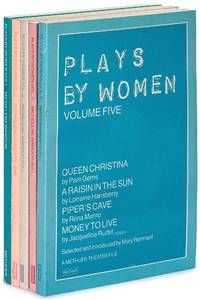
1982réf. 617629London: Methuen 1982. Softcover. Near Fine. First collected editions. Volumes One - Five paperback originals. Edited with an introduction by Michelene Wandor Volume Five by Mary Remnant with afterwords by the authors. Octavos. Very light wear and a tiny bit of foxing and soil three volumes with lightly sunned spines and one slightly cocked a near fine set. Volume One Signed by Michelene Wandor and Caryl Churchill and briefly Inscribed by Louise Page. Volume One prints the plays Vinegar Tom by Caryl Churchill; Dusa Fish Stas and Vi by Pam Gems; Tissue by Louise Page; and Aurora Leigh by Michelene Wandor. Volume Two prints the plays Rites by Maureen Duffy; Letters Home by Rose Leiman Goldemberg; Trafford Tanzi by Claire Luckham; and Find Me by Olwen Wymark. Volume Three prints the plays Aunt Mary by Pam Gems; Red Devils by Debbie Horsfield; Blood Relations by Sharon Pollock; and Time Pieces by Lou Wakefield and The Women's Theatre Group. Volume Four prints the plays Objections to Sex and Violence by Caryl Churchill; Rose's Story by Grace Dayley; Blood and Ice by Liz Lochhead; and Pinball by Alison Lyssa. And Volume Five prints the plays Queen Christina by Pam Gems; A Raisin the Sun by Lorraine Hansberry; Piper's Cave by Rona Munro; and Money to Live by Jacqueline Rudet. Issued as "Methuen Theatrefiles" five more volumes in the Plays by Women series were published through 1994. Methuen unknown
1982réf. 617629London: Methuen 1982. Softcover. Near Fine. First collected editions. Volumes One - Five paperback originals. Edited with an introduction by Michelene Wandor Volume Five by Mary Remnant with afterwords by the authors. Octavos. Very light wear and a tiny bit of foxing and soil three volumes with lightly sunned spines and one slightly cocked a near fine set. Volume One Signed by Michelene Wandor and Caryl Churchill and briefly Inscribed by Louise Page. Volume One prints the plays Vinegar Tom by Caryl Churchill; Dusa Fish Stas and Vi by Pam Gems; Tissue by Louise Page; and Aurora Leigh by Michelene Wandor. Volume Two prints the plays Rites by Maureen Duffy; Letters Home by Rose Leiman Goldemberg; Trafford Tanzi by Claire Luckham; and Find Me by Olwen Wymark. Volume Three prints the plays Aunt Mary by Pam Gems; Red Devils by Debbie Horsfield; Blood Relations by Sharon Pollock; and Time Pieces by Lou Wakefield and The Women's Theatre Group. Volume Four prints the plays Objections to Sex and Violence by Caryl Churchill; Rose's Story by Grace Dayley; Blood and Ice by Liz Lochhead; and Pinball by Alison Lyssa. And Volume Five prints the plays Queen Christina by Pam Gems; A Raisin the Sun by Lorraine Hansberry; Piper's Cave by Rona Munro; and Money to Live by Jacqueline Rudet. Issued as "Methuen Theatrefiles" five more volumes in the Plays by Women series were published through 1994. Methuen unknown books
1976Br. c/risv., cm16x22, pp 163 (11) + tavole; 43 fig. in nero ft. Raro volumetto dedicato all'estrazione aurifera a Bessa e sulla Serra d'Ivrea.
2012Pisa, 2012; br., pp. 114, ill. b/n e col., cm 21,5x28.
réf. 67005Seated woman working at a spindle looking towards the right. Signed on the bottom right: ""A:S:"". Black chalk and pencil on paper; total: 185 x 268 mm; in great condition. unknown
réf. 67007Two sketches in one sheet on the left the Laocoon and on the right the study of a head of a soldier with a helmet. Signed on the bottom left: ""A:S:"". On verso other small studies of heads. Black chalk and pencil on paper; total: 207 x 321 mm; in great condition. unknown
réf. 67004A young woman seated with crossed legs seen from the front and from the side. Signed on the bottom right: ""A:S:"". Black chalk and pencil on paper; total: 185 x 268 mm; in great condition. unknown
réf. 67006A young man with a stick seen from behind and from the front. Signed on the bottom right: ""A:S:"". Black chalk and pencil on paper; total: 158 x 268 mm; in great condition. unknown
Hardcover, 1048 pages, Texte en Francais, Nouveau !, 340 x 250 x 95 mm, Reliés cartonnés sous coffret illustré , 2400 illustrations en couleur / n/b , Trois volumes, Volume 1 : 264 pages / Volume 2 : 392 pages / Volume 3 : 392 pages, . ISBN 9782878443219. Dans ces trois volumes de catalogue raisonné sont étudiées les oeuvres en argent, en or, en plaqué et doublé d'argent exécutées de 1500 à 1800 en France et en Europe : au total 891 oeuvres réparties chronologiquement en 477 notices. La collection d'orfèvrerie du Louvre s'impose ainsi par son ampleur exceptionnelle. Sa lente constitution, opérée générations après générations, fait d'elle sans aucun doute la plus belle collection au monde. L'orfèvrerie du XVIIe siècle y est la mieux représentée, avec de nombreuses pièces de vaisselle des grands services de table royaux et princiers de l'Ancien Régime, mais le catalogue comprend également des objets de toilette, des accessoires mobiliers (flambeaux, miroirs, coffrets) et de l'orfèvrerie religieuse, en particulier celle issue du trésor de l'ordre du Saint-Esprit constitué à la fin du xvie siècle. Ses chefs-d'oeuvre, comme le coffre d'or des pierreries de Louis XIV, proviennent des collections personnelles du roi de France, mais aussi de celles des grands princes de la famille royale, comme le duc de Penthièvre et des souverains européens qui, comme Joseph Ier de Portugal, George III d'Angleterre ou Catherine II de Russie, furent les clients des plus célèbres orfèvres parisiens. A ces pièces exceptionnelles, dons ou legs des plus grands collectionneurs depuis le XIXesiècle, s'ajoutent celles de la collection Puiforcat entrée au Louvre en 1955, qui forme aujourd'hui, par le nombre de ses couverts et couteaux, une collection d'étude unique au monde. Aboutissement de trente ans de recherches, le catalogue en renouvelle totalement la connaissance en livrant au public de nombreuses découvertes inédites sur les techniques, le style, les provenances, l'héraldique, l'iconographie... Toutes les notices, abondamment illustrées, sont référencées par des sources d'archives, une bibliographie, les images et l'identification des poinçons relevés sur les objets ; elles décrivent et analysent les formes et les ornements et développent leurs aspects historiques et stylistiques. En annexe, un index, une table héraldique et 262 biographies d'orfèvres facilitent l'usage de cet ouvrage conçu pour devenir une référence pérenne.
1976réf. BN395974Futura Publications 1976. 1976. Rock on the Road Rock on the Road Mick Gold Futura Publications unknown
réf. 440483Futura Publications. Paperback. Fair. this text focuses on several rock bands in the 1976 and their life on the road. Each segment contains articles interviews and a large selection of photographs of performers such as Pink Floyd Led Zeppelin and many others. In fair condition blunting tot he corners and wear to the book edges. Futura Publications paperback
1987réf. 043680Book Club Associates and Bantam Press 1987. Hardcover. Near Fine/Very Good. Almost like new hardcover in very good dust jacket. Solid binding. No marks or names inside. Small tear to top of front dust jacket. Book Club Associates and Bantam Press hardcover
1987réf. 323597New York: Simon & Schuster 1987. First Edition; First Printing. Hardcover. Very Good in a Very Good price clipped dust jacket. Bookplate on FEP.; 272 pages. Simon & Schuster hardcover
1987réf. Q-0671547712Simon & Schuster 1987-05-15. Hardcover. New. New. In shrink wrap. Looks like an interesting title! Simon & Schuster hardcover
réf. 010236Londres, Paris Barrois - Desenne 0 fort in-8 Reliure d'époque
Madrid, Imprenta de Ayguals de Izco Hermanos, 1852. Folio; 272 pp. y 10 láminas litográficas. Ejemplar con manchas antiguas de humedad y leve abarquillamiento. Encuadernación de época en media piel.
1863Mm 115x180 Seixième édition. Volume cartonato, bella legatura non editoriale in mezza pelle nera, quattro nervature e titoli in oro al dorso, piatti telati e sguardie marmorizzate, XXIII-463 pagine. Esemplare in buone condizioni. Testo in lingua francese - french text. SPEDIZIONE IN 24 ORE DALLA CONFERMA DELL'ORDINE.