KAFILAH, GOLDBiblio.com

18.810 risultati
rif. 3844396136.Gpaperback. Good. Access codes and supplements are not guaranteed with used items. May be an ex-library book. paperback
rif. 6203502057.Gpaperback. Good. Access codes and supplements are not guaranteed with used items. May be an ex-library book. paperback
rif. 6203502073.Gpaperback. Good. Access codes and supplements are not guaranteed with used items. May be an ex-library book. paperback
2009Mm 240x280 Catalogo della mostra di Pavia, Castello Visconteo-Musei Civici, 9 ottobre 2009 - 10 gennaio 2010. Volume nella sua brossura originale, 168 pagine profusamente illustrate in nero e a colori lungo l'intero testo. Condizioni del libro: nuovo-new. Spedizione in 24 ore dalla conferma dell'ordine.
rif. 6812Eight full-page drawings & one illus. in the text. 17 folding leaves. 8vo 243 x 165 mm. orig. blue semi-stiff wrappers some dampstaining to upper portion of each leaf. Japan: mid-Edo. Kagawa 1683-1755 a member of the medical family dynasty studied in Kyoto with Ryozan Goto and Jinsai Ito from whom he learned moxibustion and the therapeutic value of the waters of hot springs. Kagawa established the successful Ippondo medical school and was one of the most enthusiastic practitioners of moxibustion of his time. There is another manuscript of this text at Kyoto University attributed to Kagawa. Some of the illustrations are very different. The introductory remarks describe the importance of the precise placement of the moxa on the skin how to measure the placements based on distance from certain bones or joints of the body and the various techniques and occasions for moxibustion applications. Following this the text precisely describes the moxibustion locations on the body and how to locate each one with references to Simiao Sun’s classic text Qian jin fang Essential Prescriptions Worth a Thousand Gold Pieces compiled in 650-59. Kagawa lists many diseases and injuries for which moxibustion is appropriate. There is a most interesting section on how to treat unsuccessful moxibustion procedures application of certain ointments etc. The attractive illustrations depict moxibustion loci on an osteological background and loci on the stomach arms legs and feet. As mentioned above there is dampstaining to the upper fifth of each leaf but all the characters remain completely legible. unknown
rif. 6812Eight full-page drawings & one illus. in the text. 17 folding leaves. 8vo 243 x 165 mm. orig. blue semi-stiff wrappers some dampstaining to upper portion of each leaf. Japan: mid-Edo. Kagawa 1683-1755 a member of the medical family dynasty studied in Kyoto with Ryozan Goto and Jinsai Ito from whom he learned moxibustion and the therapeutic value of the waters of hot springs. Kagawa established the successful Ippondo medical school and was one of the most enthusiastic practitioners of moxibustion of his time. There is another manuscript of this text at Kyoto University attributed to Kagawa. Some of the illustrations are very different. The introductory remarks describe the importance of the precise placement of the moxa on the skin how to measure the placements based on distance from certain bones or joints of the body and the various techniques and occasions for moxibustion applications. Following this the text precisely describes the moxibustion locations on the body and how to locate each one with references to Simiao Sun’s classic text Qian jin fang Essential Prescriptions Worth a Thousand Gold Pieces compiled in 650-59. Kagawa lists many diseases and injuries for which moxibustion is appropriate. There is a most interesting section on how to treat unsuccessful moxibustion procedures application of certain ointments etc. The attractive illustrations depict moxibustion loci on an osteological background and loci on the stomach arms legs and feet. As mentioned above there is dampstaining to the upper fifth of each leaf but all the characters remain completely legible. unknown books
1981406 pages. Index. Many dozens of black and white illustrations. "The story of a hearty breed of coiner is told in these pages." - from dust jacket. Above-average wear. Binding open at each board. Usual library markings. Still a worthy reference copy. Book
1923rif. 30251HARDBACK NODUSTJACKET 1926 ON TITLE PG First Illustrated Edition. 1923 ON COPYRITE PG TITLE TO SPINE COVER Hardcover. patterned gold foil paper-covered boards w/ red device on front cover Owner inscription on the front free endpaper; moderate wear to covers. Near Fine in a Near Fine- Slipcase LITE RUB. Parchment-backed decorated gold boards LITE WEAR 7-1/4" x 10" in a possible later slipcase with a large GOLD & RED label on the front as well as a label on the spine. The First Illustrated Edition of this popular title with 12 plates reproduced from drawings by the author. Printed by the Southworth Press Portland Maine. The artist Rodin compared Gibran to William Blake. An attractive early edition of this modern classic. Cover w/ COLLOTYPE Illustrations by Author Collector's Edition PRINTING PLATE Made by Exposing a Sensitive Gelatin Plate to Action of Light Thru Photographic Negative a collection of philosophical spiritual mystical and inspirational poetic essays that have been treasured by generations around the world Alfred A. Knopf hardcover
1897rif. 016222Paris Mercure de France 1897 Demi-reliure à coins Dédicacé par l'auteur
2014rif. 500248203Stock 2014 288 pages 21x13x3cm. 2014. Broché. 288 pages.
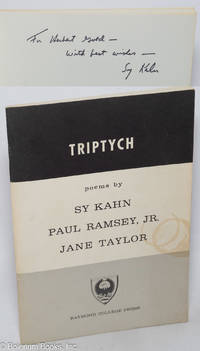
1964rif. 321250Stockton CA: Raymond College Press 1964. 32p. 6x8.5 inches personal inscription to Herbert Gold signed by Kahn poetry poet bios coffee rings on cover else good first edition booklet in stapled printed wraps. From Gold's personal library. The poets were English Faculty members at Raymond. Raymond College Press unknown books
2019rif. 500182181Fayard 2019 240 pages 13 6x1 6x21 2cm. 2019. Broché. 240 pages.
1999rif. 18421New York: Harry N. Abrams 1999. 1st. Hardcover. Fine/Fine. 11.3x9.7x1.2in. Dust jacket in clear protector. Edgar Brandt 1880-1960 was a leading force during a period of great achievement in French decorative arts and design creating an entirely new aesthetic for the medium of wrought iron. At the height of his career Brandt operated a large atelier and showroom at 101 Boulevard Murat in Paris and ran a successful gallery that featured his own work as well as that of his contemporaries. This book the first to document the life and work of Brandt has 232 illustrations including 60 plates in full color. 240pp 3.75lb 11.3x9.7x1.2in Harry N. Abrams hardcover
1965rif. Ancient world 790Ancient world 790 Thrace. Kakourē or Kakouri Katerina I. Dionysiaka; aspects of the popular Thracian religion of today. Athens Greece: G.C. Eleftheroudakis 1965 xix 174p notes bib index illus number of pages with photographs. It appears that the book was originally published with a stiff paper binding and has now been further bound in a hardcover case with the original wraps bound in. A publicity wrapper also is with the book as well as a leaflet referring to the book. Also laid in is a card "with the author's compliments". Kakoure's thesis is that Dionysian/bacchic rites were still being practiced in the hills of Thrace. Interesting stuff. The book arts could be better a few pages have a wrinkle plates are faint in some places. Very scarce and very interesting. $60.00 shelf a G.C. Eleftheroudakis hardcover
2013Testo Italiano e Inglese. Bologna, 2013; br., pp. 200, ill. col., tavv. col., cm 17x21,5.
Lleida, 2001. 4to. mayor; 539 pp. Cubiertas originales.
1995276 pages including index. A thorough and up-to-date resource for making decisions about hormone replacement therapy. Unmarked. Minimal wear. Very nice copy. Book
1998rif. Q-1881394204Commune-A-Key 1998-04-01. Paperback. New. New. In shrink wrap. Looks like an interesting title! Commune-A-Key paperback
194866 pages. Fourth printing of the 1948 first edition. "An attack on the ADL and the Non-Sectarian Anti-Nazi League to Champion Human Rights" - SINGERMAN 741. Original order form for numerous related publications laid-in (a mini-bibliography in itself). Average wear. Unmarked. A quality vintage copy of this uncommon Kamp publication. Book
1995Gebunden ,145 x 215mm., 316S. und 140 Abbildungen auf Tafeln. Monstranzen des 17. und 18. Jhrdts sind eingehen beschrieben und uberwiegend abgebildet. Zum ersten Mal werden in der vorliegenden Publikation die im 17. und 18. Jahrhundert im nordlichen Rheinland entstandenen eucharistischen Monstranzen ausfuhrlich dargestellt - ein bislang wenig bekannter Bereich der rheinischen Goldschmiedekunst. Dorothea Kampmann beschreibt in ihrer Arbeit umfassend den ganzen Reichtum der rheinischen Monstranzen und dokumentiert sorgfaltig ihre Entwicklung. In guter Zustand.
21,5 x 15,5 cm. 316 Seiten und 140 Abb. auf Tafeln. Pappband (wie neu, noch original verschweißt). Bücher de
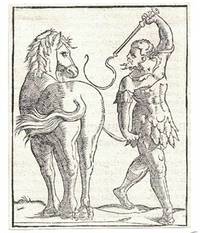
rif. 16-3972Basel: Sebastian Heinrich-Petri 1552. . Woodcut with Latin text. 12 x 9 cm. Possibly clipped from: Sebastian Münster 'Cosmographia' Basle: Heinrich Petri 1550. c.1547-50Verso is text about Alexander the Great from MacedoniaLiber V. Bucephalus page 1071These leaves from Book V of one of the earliest editions of Cosmographia the Latin edition from the Basel printing house of Sebastian Heinrich-Petri 1552 are devoted to Asia "De terris Asiae maioris" and more specifically to India. In his text Münster clearly follows Strabo relying heavily on his Geography Book XV: On India.PAGE 1071 and PAGE 1072 are devoted to Bucephalus the most famous horse of ancient times. Bucephalus whose name means "ox-head" was called that because of his wide forehead and slightly "dished-shaped" face marked by a white star. A black stallion only 15 hands high he achieved fame carrying his master Alexander the Great. The story is that Alexander met Bucephalus for the first time when he was only twelve years old. When Alexander's father Philip was looking at horses to buy Bucephalus was brought out but proved dangerously unruly. Alexander noticed that Bucephalus was frightened by his own shadow so he turned the excited horse to face the sun then vaulted onto the young stallion's back and rode him successfully. Alexander and Bucephalus rode thousands of miles and fought in many battles together winning an enormous empire. Bucephalus finally died at the advanced age of 30 of wounds received in the battle against Porus on the Hydaspes in 326 BCE. Alexander honored him with a large formal funeral which he himself led and named a city "Bucephala" in his honour Basel: Sebastian Heinrich-Petri, 1552. unknown
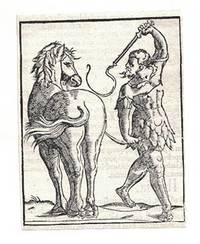
rif. 16-3973Basel: Heinrich Petri 1552. . Woodcut with Latin text. 12 x 9 cm. Possibly clipped from: Sebastian Münster 'Cosmographia' Basle: Heinrich Petri 1550. c.1547-50Verso is text about Colchis and Iberia.Liber V. Bucephalus page 1071These leaves from Book V of one of the earliest editions of Cosmographia the Latin edition from the Basel printing house of Sebastian Heinrich-Petri 1552 are devoted to Asia "De terris Asiae maioris" and more specifically to India. In his text Münster clearly follows Strabo relying heavily on his Geography Book XV: On India.PAGE 1071 and PAGE 1072 are devoted to Bucephalus the most famous horse of ancient times. Bucephalus whose name means "ox-head" was called that because of his wide forehead and slightly "dished-shaped" face marked by a white star. A black stallion only 15 hands high he achieved fame carrying his master Alexander the Great. The story is that Alexander met Bucephalus for the first time when he was only twelve years old. When Alexander's father Philip was looking at horses to buy Bucephalus was brought out but proved dangerously unruly. Alexander noticed that Bucephalus was frightened by his own shadow so he turned the excited horse to face the sun then vaulted onto the young stallion's back and rode him successfully. Alexander and Bucephalus rode thousands of miles and fought in many battles together winning an enormous empire. Bucephalus finally died at the advanced age of 30 of wounds received in the battle against Porus on the Hydaspes in 326 BCE. Alexander honored him with a large formal funeral which he himself led and named a city "Bucephala" in his honour Basel: Heinrich Petri, 1552. unknown
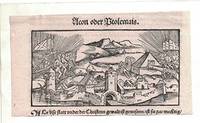
rif. 16-3971Basel: Sebastian Heinrich-Petri 1552. Woodcut with German text. 9.5 x 16.5 cm. Likely clipped from: Sebastian Münster 'Cosmographia' Bael: Heinrich Petri 1550. c.1547-50A maritime city of Galilee Acts 21:7. It was originally called "Accho" and received the name Ptolemais from Ptolemy Soter when he was in possession of Coele-Syria. Basel: Sebastian Heinrich-Petri, 1552. unknown
1959rif. 010769New York: Random House 1959. First Edition . Decorative Cloth. Very Good/No Jacket. 8vo - over 7¾" - 9¾" tall. From the Library of Sir John Mills and Mary Mills. Signed and inscribed by Garson Kanin with a personal message to John and Mary Mills "This one is for Mary and John with a wish that I were a third of these two. Such Love. Garson NYC 1959" First Edition stated first printing. Size 8¼" x 5½" 337 pages. Black cloth covered boards with silver spine section. Black and grey titles on the spine burnt orange pastedowns and endpapers. Book condition very good/near fine corners and spine edges very slightly rubbed spine ever so slightly grubby else fine. Random House hardcover