Gold, JeffBiblio.com
17 248 résultats
réf. 158423640X.Gpaperback. Good. Access codes and supplements are not guaranteed with used items. May be an ex-library book. paperback
2012réf. 103394Gingko Press. New. Hardcover. FREE UPGRADE to Courier/Priority Shipping Upon Request - IN STOCK AND IMMEDIATELY AVAILABLE FOR SHIPMENT - Flawless copy brand new pristine never opened -- 260 pages; over 300 illustrations most in color. -- with a bonus offer-- . 2012. 1584234881 . Gingko Press hardcover
1998réf. 2111902153101754Mainichishinbunsha 1998. Soft Cover. Fine. Volume: 1 Mainichishinbunsha paperback
réf. Claus Hagedorn-OlsenIn Pristine Condition. unknown
2017Paris, Musée Guimet, June 22 - September 4, 2017. French Text. Cinisello Balsamo, 2017; clothbound, pp. 216, 150 b/w and col. ill., cm 24,5x29.
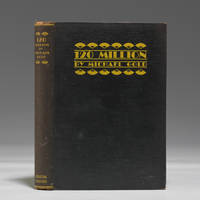
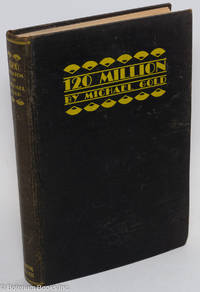
1929réf. 1161981929. First Edition. Signed. GOLD Mike. 120 Million. New York: International 1929. Octavo original black cloth. $1650.First edition of the first book by controversial radical Mike Gold published at the cusp of the Great Depression an outstanding presentation/association copy inscribed by him to influential New York publisher and editor Albert ""Pete"" Gross inscribed by Gold along an entire page ""To Pete GrossÑLion Tamer Father Author's Friend New Yorker Book Maker Philosopher Gin Drinker and Puritan from a fellow bum Mike Gold"" featuring 20 early passionate writings by Gold on Black Americans the I.W.W. immigrants miners strikers and more.Born Itzok Isaac Granich Jewish American Mike Gold was a ""radical's radical. born to poverty reared in poverty and educated by poverty"" Folsom Education of Mike Gold 224. A founding co-editor of New Masses in 1926 before becoming its sole editor Gold made a major impact that was early and unusually noted by Time magazine which declared: ""40 times he has been chased by cops for taking part in street demonstrations; 20 strikes have had his help."" Confrontational and controversial Gold was at the forefront of an emerging literary tradition that launched works by Richard Wright Tillie Olsen Henry Roth John Fante H.T. Tsiang Claude McKay and many more. His own writings were pivotal in arguing for art as a ""class weapon"" Rideout Radical Novel 165Ñworks that helped launch a movement ""nurtured by the cultural politics of the left"" the impact of racism poverty and the rise of fascism and fiction that was also often propelled by the ""heroes plots and language of pulp fiction."" To Lionel Trilling ""the importance of the radical movementÉ cannot be overestimated. It may be said to have created the American intellectual class as we now know it"" Denning Cultural Front 240 3. The 20 works in 120 Million his first book includes Gold's writings on Black Americans immigrants the I.W.W. and strikers and miners along with short fiction dramatic prose and select poems. First edition first printing: with ""Copyright 1929 by International Publishers Co. Inc/""; no statement of edition or printings. Without very elusive dust jacket. Hanna 1443. The recipient Albert ""Pete"" Gross was a highly influential publisher and editor who co-founded International Publishers in 1924 before becoming am editor at Boni & Liverright in 1924. Text very fresh faint edge-wear to spine ends of original cloth. An impressive about-fine inscribed copy. hardcover
1929réf. 28801New York: International Publishers. Very Good. c.1929. Unstated edition. Hardcover. no dust jacket light shelfwear age-toning to edges of text block small indentation in top of text block with minor damage to the top edges of a few pages non-authorial gift inscription dated 1934 on front endpaper. Short fiction and non-fiction pieces drama and verse by this New York-born Jewish writer 1894-1967 who during the 1930s and 1940s was one of the most prominent and outspoken Communist writers on the American literary landscape. The first section of the book consists of a dozen "Proletarian Sketches" a mix of short stories essays and reportage with evocative titles like "The Damned Agitator" "Death of a Negro" "On a Section Gang" "Love on a Garbage Dump" etc. The second section is entitled "Proletarian Chants and Recitations and contains ten pieces of varying types; most are in a blank verse format although one entitled "Strike!" subtitled "A Mass Recitation" is more or less a one-act play. One of the other recitations is entitled "Vanzetti in the Death House." . International Publishers hardcover
1929réf. 1161981929. First Edition. Signed. GOLD Mike. 120 Million. New York: International 1929. Octavo original black cloth. $1650.First edition of the first book by controversial radical Mike Gold published at the cusp of the Great Depression an outstanding presentation/association copy inscribed by him to influential New York publisher and editor Albert ""Pete"" Gross inscribed by Gold along an entire page ""To Pete GrossÑLion Tamer Father Author's Friend New Yorker Book Maker Philosopher Gin Drinker and Puritan from a fellow bum Mike Gold"" featuring 20 early passionate writings by Gold on Black Americans the I.W.W. immigrants miners strikers and more.Born Itzok Isaac Granich Jewish American Mike Gold was a ""radical's radical. born to poverty reared in poverty and educated by poverty"" Folsom Education of Mike Gold 224. A founding co-editor of New Masses in 1926 before becoming its sole editor Gold made a major impact that was early and unusually noted by Time magazine which declared: ""40 times he has been chased by cops for taking part in street demonstrations; 20 strikes have had his help."" Confrontational and controversial Gold was at the forefront of an emerging literary tradition that launched works by Richard Wright Tillie Olsen Henry Roth John Fante H.T. Tsiang Claude McKay and many more. His own writings were pivotal in arguing for art as a ""class weapon"" Rideout Radical Novel 165Ñworks that helped launch a movement ""nurtured by the cultural politics of the left"" the impact of racism poverty and the rise of fascism and fiction that was also often propelled by the ""heroes plots and language of pulp fiction."" To Lionel Trilling ""the importance of the radical movementÉ cannot be overestimated. It may be said to have created the American intellectual class as we now know it"" Denning Cultural Front 240 3. The 20 works in 120 Million his first book includes Gold's writings on Black Americans immigrants the I.W.W. and strikers and miners along with short fiction dramatic prose and select poems. First edition first printing: with ""Copyright 1929 by International Publishers Co. Inc/""; no statement of edition or printings. Without very elusive dust jacket. Hanna 1443. The recipient Albert ""Pete"" Gross was a highly influential publisher and editor who co-founded International Publishers in 1924 before becoming am editor at Boni & Liverright in 1924. Text very fresh faint edge-wear to spine ends of original cloth. An impressive about-fine inscribed copy. hardcover books
1929réf. 8486New York: International Publishers 1929. Hardcover. 192p. first edition black cloth boards with titling in yellow previous owner's name and inscription on front blank end paper lacking dust jacket spine lightly faded boards somewhat rubbed else good condition. Hanna 1443. "Proletarian sketches and poetry" Hanna. International Publishers hardcover books
1929réf. 28801New York: International Publishers. Very Good. c.1929. Unstated edition. Hardcover. no dust jacket light shelfwear age-toning to edges of text block small indentation in top of text block with minor damage to the top edges of a few pages non-authorial gift inscription dated 1934 on front endpaper. Short fiction and non-fiction pieces drama and verse by this New York-born Jewish writer 1894-1967 who during the 1930s and 1940s was one of the most prominent and outspoken Communist writers on the American literary landscape. The first section of the book consists of a dozen "Proletarian Sketches" a mix of short stories essays and reportage with evocative titles like "The Damned Agitator" "Death of a Negro" "On a Section Gang" "Love on a Garbage Dump" etc. The second section is entitled "Proletarian Chants and Recitations and contains ten pieces of varying types; most are in a blank verse format although one entitled "Strike!" subtitled "A Mass Recitation" is more or less a one-act play. One of the other recitations is entitled "Vanzetti in the Death House." . International Publishers hardcover books
1985Assisi, 1985; br., pp. 222, ill. b/n, tavv., cm 20x29. italiano br.
2023réf. __1927338832RuveneCo Inc 2023. Paperback. New. 384 pages. 10.83x8.39x1.26 inches. RuveneCo Inc paperback
réf. BN703848Tettnang Förderkreis Heimatkunde u. Erzeugergemeinschaft Hopfen Baden-Württemberg 1994. 150 Jahre Hopfenanbau in Tettnang 150 Jahre Hopfenanbau in Tettnang Grünes Gold Tettnang, Förderkreis Heimatkunde u. Erzeugergemeinschaft Hopfen Baden-Württemberg 1994. unknown
1995réf. Q-094374847XAlfred Music 1995-01-01. Paperback. New. In shrink wrap. Looks like an interesting title! Alfred Music paperback
1995réf. 2490190629035Alfred Music 1995-01-01. Paperback. Like New. Nice looking book has minor edge wear. Alfred Music paperback
réf. 036569150X.Gpaperback. Good. Access codes and supplements are not guaranteed with used items. May be an ex-library book. paperback
réf. 0365691534.Ghardcover. Good. Access codes and supplements are not guaranteed with used items. May be an ex-library book. hardcover
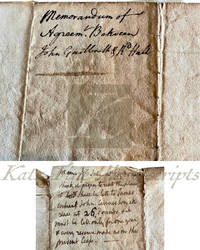
1763réf. 0001650On offer is a pre-Revolutionary plantation rental agreement between a Philadelphia shopkeeper and a Springfield millwright featuring notes that connect multiple family and business ties in late 18th-century Philadelphia and Chester counties. The rental memorandum is the work of Philadelphia-based lawyer Paul Isaac Voto whose office was located at "the corner of Black Horse Alley in Second Street." The agreement was drafted between Mr. John Gailbreath often spelled Galbreath or Gilbreath in other historical documentation c. 1717–1766 a shopkeeper whose store was located "in Second Street between Market and Chestnut streets" and the prospective renter millwright Richard Hall of Springfield Chester County. Historical documents show that Hall also owned property in the region. Dated May 1763 the rental memorandum indicates that John Gailbreath ".letts his house and plantation in Springfield… for one year from the date hereof to… Richard Hall paying the rent of twenty seven pounds…" The agreement lays out several rules of tenancy including the following examples: "The Tenant is to have Liberty to reap his Corn and Thrash it in the Barn after the time is over leaving the Thaw and Chatt…" ".the Tenant agrees not to take any Hay Straw or Dung off the Premises…" ".the Tenant agrees to… keep the House… and Premises in repair as good as now… shall not keep more fires in the House but only one in the kitchen and one in another room and… not to cut any timber or wood But in the Back Field joining to Crosiers Croziers Plantation…" A caveat on the verso of the lease agreement states that ".If John McCoy do not think it proper to rent the place it shall be lett to James Cochran John Cairnes son in law at 26 pounds…" According to historical news documents Galbreath was traveling in 1763 and appears to have entrusted a Chester County contact with the final decision on the rental in his absence. The document is signed by Hall but not Galbreath. Its delivery was witnessed by Paul Isaac Voto and Elyha Taylor and the original seal is present. This document provides not only insight into property rights legal agreements and plantation rentals in pre-Revolutionary Pennsylvania but it also offers genealogical data to support research on the still-incomplete history of early Pennsylvania families. These include the Cairnes Voto Hall Cochran and Crozier or Crosier families among others. While some 18th-century newspaper data exists digitally to assist with ongoing research these being the sources used to find the location of the subjects' businesses this document remains an invaluable primary source for those interested in 18th-century life movement and genealogical links. Condition: Significant age toning folding and micro-tears with significant tearing in one corner. The document is written in ink with a clear legible hand and remains in good condition for its age. Overall: Fair to Good.
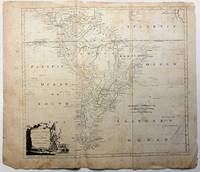
réf. H9044Sheet measures 17x15 inches light wear and a few short tears have been neatly mended on the verso a few small stains some lengthwise creases but a handsome map. unknown
1986réf. LFA-126749978Une plaquette de 40 pages, format 150 x 205 mm, illustrée, brochée couverture couleurs, publiée en 1986, Nouvel Atelier du Livre, bon état
1802réf. 0009162BETHEL TOWNSHIP LEBANON COUNTY PENNSYLVANIA. Good. 1802. On offer is an interesting document of early 19th century education an original handwritten note book covering a myriad of subjects related to mathematics. The owner and creator of this book was a man named Henry Snevely also written as Snavely and the book dates from 1802 - 1803. It seems Snevely was born in the United States and lived his whole life in Southeastern Pennsylvania. At the time of the creation of the book Snevely was almost 50 years old an established land owner in Bethel Township Lebanon County. Why he had a book of mathematics is unknown however I have found records of a Henry Snavely who taught at a school in Bethel Township from 1797 onwards. It may be likely that this book is actual not for Henry himself but for the instruction of his students. Either way the book presents a fantastic overview of early 18th century knowledge. The book covers a very large range of topics however Math pertaining to financial matters is dominant throughout. As well there are conversions of Irish and British currency. The primary immigrants to the area at the time of the book were indeed Scotch-Irish so teaching Irish and British currency conversions wouldnt be too far off. Currency exchange in particular is a primary focus owing to the large amount of immigrants to the area. Individual page headings in the book include Exchange many pages Exchange of Arbitrations Barter Profit and Loss Fellowship Fellowship with Time Allegation Media Alternate Partial and Total Square Root Cube Root Arithmetical and Geometric Progression Compound Interest Single and Double Position Reduction Addition Subtraction Multiplication and Division of Fractions and Vulgar Fractions Rule of Three in Fractions and Questions for Exercise. There is a later manuscript memorandum on rear endpaper dated 1829 bearing the names of additional members of the Pennsylvania Snavely clan Molly George and John. The name Martin Rupp also appears in memorandum and our research confirms various Martin Rupps residing in southeastern Pennsylvania during this time. The book is in fair to good condition. The volume is bound in the original stiff paper wraps. The cover is very worn and the spine is torn and partially detached. There is mild age-toning and occasional staining but the internal pages are generally clean. The black ink is still bold and easily legible throughout. The book contains about 85 pages of manuscript entries and the book itself is approximately 90 pages. It measures 12.5 x 8 inches. Biography: Henry Snavely was born on August 2 1755 in Bethel Township Lebanon County Pennsylvania. .Henry Snavely was a Lutheran. At that time he was considered a good scholar and is said to have been a hard student obtaining his knowledge principally by his own exertion. He taught the school from 1797 to 1807.; A report from 1773 shows his farm had 150 acres 5 horses 4 cattle and no servants. OVERALL: G; Manuscript; Folio - over 12" - 15" tall; KEYWORDS: HISTORY OF HENRY SNEVELY HENRY SNAVELY EARLY 19TH CENTURY KNOWLEDGE SCIENTIFIC REVOLUTION MATHEMATICS GEOMETRY TRIGONOMETRY FINANCIAL CALCULATIONS BARTERING INTEREST TEACHER'S BOOK BETHEL TOWNSHIP LEBANON COUNTY SOUTHEASTERN PENNSYLVANIA COMPLEX MATHEMATICS ALGEBRA MARTIN RUPP PRACTICAL MATH FOR FARMERS 19TH CENTURY AMERICA EARLY 1800S IN THE MID-ATLANTIC STATES CYPHER BOOK AMERICANA HANDWRITTEN MANUSCRIPT DOCUMENT LETTER AUTOGRAPH WRITER HAND WRITTEN DOCUMENTS SIGNED LETTERS MANUSCRIPTS HISTORICAL HOLOGRAPH KEEPSAKE WRITERS AUTOGRAPHS PERSONAL MEMOIR MEMORIAL ARCHIVE DIARY DIARIES JOURNAL LOG ANTIQUITÉ CONTRAT VÉLIN DOCUMENT MANUSCRIT PAPIER ANTIKE BRIEF PERGAMENT DOKUMENT MANUSKRIPT PAPIER OGGETTO D'ANTIQUARIATO ATTO VELINA DOCUMENTO MANUSCRITTO CARTA ANTIGÜEDAD HECHO VITELA DOCUMENTO MANUSCRITO PAPEL . paperback
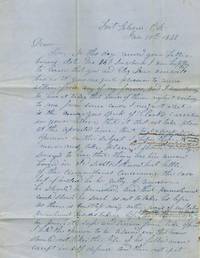
1849réf. BK0028Fort Gibson Cherokee Nation 1849. Autograph letter signed "Benj. Wingate" three pages with integral address leaf to Arba L. Hardy Lexington Scott County Indiana bearing manuscript "Fort Gibson C.N." postmark dated January 8 and manuscript "Paid 10." 7 ¾ x 10 inches. Light toning and edge wear otherwise very good. A substantial letter by Benjamin Wingate Mexican-American War veteran and future namesake of Fort Wingate New Mexico written during his frontier service at Fort Gibson in the Cherokee Nation. Responding to news that the execution of a man named Clark had been delayed Wingate launches into a lengthy and forceful rejection of capital punishment: "You speak of Clark's execution in your letter that it did not take place at the appointed time but to express an opinion on the subject I hope that it never did take place; do not understand me to say that I want him to go unpunished. I should be very sorry to hear that there has been a man hanged in old Scott. I know but little of the circumstances concerning the case but if indeed he be guilty of murder he should be punished and that punishment should be such as to not take his life as there is doubtless many other ways of inflicting punishment besides taking life . I hold the opinion to be a sound one that man should not take the life of his fellow man except in self defense and then not if it could be avoided. I look upon the law of punishing capital offences as being barbarous and savage in the extreme. It is a subject that the attention of the law making or legislating power should be called to act on." Living amid the Indigenous nations of Indian Territory Wingate makes a comparison with the customs around him: "The present law is more barbarous if possible than the laws and customs of the Indians in this part of the country. If a rich Indian kills a poor Indian he can make atonement for the crime by paying a certain sum of money but if one Indian kills another Indian and is not able to pay for him they kill him in return." Fort Gibson established within Cherokee country was one of the principal U.S. military posts in Indian Territory and Wingate's comments come from a young Army officer living within that environment. The comparison is striking precisely because he uses what he understands as Native retaliatory justice as the measure by which to criticize American law. The letter then turns to family gossip and politics. Wingate jokes that the election of Zachary Taylor meant "that the Whigs are as badly whipped as they was when they elected J. Tyler" anticipating that Taylor would "doubtless have to take a trip up salt river if he is not burnt in effigy by the Whigs before that time." More appealing personally was the news then pouring out of California. In January 1849 with the Gold Rush only beginning to transform American migration westward Wingate was already considering abandoning the Army: "I have been thinking very strong for some time of resigning and going to California but I am not off yet nor I don't know that I will get off soon if at all. But whether I should or should not go it is certainly a very great opening for a young man to make a fortune in a short time if there is any confidence to be placed in reports." He remained instead in military service. Wingate had fought in Mexico at Cerro Gordo and subsequently served on the frontier in Oklahoma Texas Utah and New Mexico. He was mortally wounded at the Battle of Valverde during the Civil War; Fort Wingate established in New Mexico later in 1862 was named in his honor. The Filson Historical Society preserves correspondence of Wingate and the allied Hardy family including Arba L. Hardy the recipient here.1 An appealing early Wingate letter combining an extended argument against capital punishment with observations from Indian Territory and the immediate lure of California at the opening of the Gold Rush. 1 "Wingate Hiram 1778-1875 Papers 1833-1914" Filson Historical Society Mss. A W769. . unknown
1849réf. BK0028Fort Gibson Cherokee Nation 1849. Autograph letter signed "Benj. Wingate" three pages with integral address leaf to Arba L. Hardy Lexington Scott County Indiana bearing manuscript "Fort Gibson C.N." postmark dated January 8 and manuscript "Paid 10." 7 ¾ x 10 inches. Light toning and edge wear otherwise very good. A substantial letter by Benjamin Wingate Mexican-American War veteran and future namesake of Fort Wingate New Mexico written during his frontier service at Fort Gibson in the Cherokee Nation. Responding to news that the execution of a man named Clark had been delayed Wingate launches into a lengthy and forceful rejection of capital punishment: "You speak of Clark's execution in your letter that it did not take place at the appointed time but to express an opinion on the subject I hope that it never did take place; do not understand me to say that I want him to go unpunished. I should be very sorry to hear that there has been a man hanged in old Scott. I know but little of the circumstances concerning the case but if indeed he be guilty of murder he should be punished and that punishment should be such as to not take his life as there is doubtless many other ways of inflicting punishment besides taking life . I hold the opinion to be a sound one that man should not take the life of his fellow man except in self defense and then not if it could be avoided. I look upon the law of punishing capital offences as being barbarous and savage in the extreme. It is a subject that the attention of the law making or legislating power should be called to act on." Living amid the Indigenous nations of Indian Territory Wingate makes a comparison with the customs around him: "The present law is more barbarous if possible than the laws and customs of the Indians in this part of the country. If a rich Indian kills a poor Indian he can make atonement for the crime by paying a certain sum of money but if one Indian kills another Indian and is not able to pay for him they kill him in return." Fort Gibson established within Cherokee country was one of the principal U.S. military posts in Indian Territory and Wingate's comments come from a young Army officer living within that environment. The comparison is striking precisely because he uses what he understands as Native retaliatory justice as the measure by which to criticize American law. The letter then turns to family gossip and politics. Wingate jokes that the election of Zachary Taylor meant "that the Whigs are as badly whipped as they was when they elected J. Tyler" anticipating that Taylor would "doubtless have to take a trip up salt river if he is not burnt in effigy by the Whigs before that time." More appealing personally was the news then pouring out of California. In January 1849 with the Gold Rush only beginning to transform American migration westward Wingate was already considering abandoning the Army: "I have been thinking very strong for some time of resigning and going to California but I am not off yet nor I don't know that I will get off soon if at all. But whether I should or should not go it is certainly a very great opening for a young man to make a fortune in a short time if there is any confidence to be placed in reports." He remained instead in military service. Wingate had fought in Mexico at Cerro Gordo and subsequently served on the frontier in Oklahoma Texas Utah and New Mexico. He was mortally wounded at the Battle of Valverde during the Civil War; Fort Wingate established in New Mexico later in 1862 was named in his honor. The Filson Historical Society preserves correspondence of Wingate and the allied Hardy family including Arba L. Hardy the recipient here.1 An appealing early Wingate letter combining an extended argument against capital punishment with observations from Indian Territory and the immediate lure of California at the opening of the Gold Rush. 1 "Wingate Hiram 1778-1875 Papers 1833-1914" Filson Historical Society Mss. A W769. . unknown books
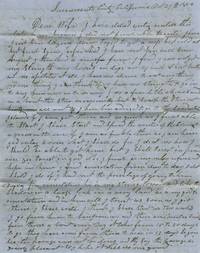
1850réf. BK0017Sacramento City California 1850. Autograph letter signed "Sam'l Locke" to his wife in Belfast Maine. 6 pp. Stampless folded letter with clear circular "SACRAMENTO CITY / CAL." postmark and "40" rate handstamp; manuscript notation recording receipt in Maine on December 19 1850. Light soiling; very good. A bleak California Gold Rush letter written during the 1850 Sacramento cholera epidemic by Samuel Locke a Maine emigrant suffering from prolonged fever and unable to regain his strength. Surrounded by sickness failed mining ventures violent crime and men too poor or ill to return home Locke plans to seek recovery in the Sandwich Islands while relying upon his religious faith for consolation. Locke had been ill since August and was now so weak that ordinary work exhausted him: "My limbs or legs are very weak short breath and no appetite at all. I have no desire to eat anything not one thing I can think of. I have no strength to go into any business or to do any. I do a few little chores round or about the store occasionally but to sweep the store it beats me all out . O how I long to get out of this place. Can't get any strength don't know as I can anywhere but I long to try." Friends advised him to spend the winter in the Sandwich Islands. He expected to travel first to San Francisco and then make the fifteen- to twenty-day passage to Hawaii though he feared that continued illness might leave him unable either to support himself there or return to Maine. He states that he will "trust in providence yes trust in God who I feel is my only refuge". Locke gives a grim account of California's climate and the spread of cholera through Sacramento claiming that the climate in California prevented the sick from recovering their strength as the "air is very light & bad middle of the day very hot and nights very cool." The previous week's report had stated forty dead but "nothing near all the cases were reported" with Locke himself knowing of several unreported cases personally. A local blacksmith died overnight after his companions borrowed Locke's syringe and "We can hardly see a healthy looking individual in the streets." The letter also records the uncertain fortunes of men from Locke's home region scattered through the mines. William Beckett and his partners had spent the summer constructing a mining dam had struck gold on the first day and then immediately "the dam was washed away so they lost all their summer's labor." Other acquaintances had moved to Kelsey's Bar the southern mines or Oregon or were preparing to return east by way of Panama. Some remained convinced that California would reward perseverance while others had "seen enough" after accomplishing nothing. Locke regarded success as largely accidental: "Thousands are here and in the mines who want to get home and cannot-not able to do seamen's duty and no money to pay but they have got to stay in the mines and do the best they can. Some it is true have been lucky. It is all luck. If they happen to hit a good place they do well." News that cholera had entered the mining districts increased his alarm. Locke feared especially for men living in tents as the rainy season approached with poor food and little protection from exposure. Sacramento itself was marked by nightly violence: "There are murders or robberies about every night. One man killed in front of our house a few nights ago. We heard him holler and heard the blows. Next morning he died. His head was dreadfully mangled." Locke closes with an emotional message to his wife and children. His health finances and prospects all appeared uncertain and he repeatedly asked his family and church to pray for him: "Tell the dear Children to be good and if they never see me again when I am gone they will have the satisfaction . of knowing they acted as thy Father requested . Pray for me ask the Church to pray for me indeed I know I have your prayers and you have mine often." A particularly bleak account of the human cost of the California Gold Rush documenting epidemic disease physical collapse failed mining schemes violent crime religious faith and the predicament of emigrants unable to escape California after their health and resources were exhausted. . unknown
1850réf. BK0017Sacramento City California 1850. Autograph letter signed "Sam'l Locke" to his wife in Belfast Maine. 6 pp. Stampless folded letter with clear circular "SACRAMENTO CITY / CAL." postmark and "40" rate handstamp; manuscript notation recording receipt in Maine on December 19 1850. Light soiling; very good. A bleak California Gold Rush letter written during the 1850 Sacramento cholera epidemic by Samuel Locke a Maine emigrant suffering from prolonged fever and unable to regain his strength. Surrounded by sickness failed mining ventures violent crime and men too poor or ill to return home Locke plans to seek recovery in the Sandwich Islands while relying upon his religious faith for consolation. Locke had been ill since August and was now so weak that ordinary work exhausted him: "My limbs or legs are very weak short breath and no appetite at all. I have no desire to eat anything not one thing I can think of. I have no strength to go into any business or to do any. I do a few little chores round or about the store occasionally but to sweep the store it beats me all out . O how I long to get out of this place. Can't get any strength don't know as I can anywhere but I long to try." Friends advised him to spend the winter in the Sandwich Islands. He expected to travel first to San Francisco and then make the fifteen- to twenty-day passage to Hawaii though he feared that continued illness might leave him unable either to support himself there or return to Maine. He states that he will "trust in providence yes trust in God who I feel is my only refuge". Locke gives a grim account of California's climate and the spread of cholera through Sacramento claiming that the climate in California prevented the sick from recovering their strength as the "air is very light & bad middle of the day very hot and nights very cool." The previous week's report had stated forty dead but "nothing near all the cases were reported" with Locke himself knowing of several unreported cases personally. A local blacksmith died overnight after his companions borrowed Locke's syringe and "We can hardly see a healthy looking individual in the streets." The letter also records the uncertain fortunes of men from Locke's home region scattered through the mines. William Beckett and his partners had spent the summer constructing a mining dam had struck gold on the first day and then immediately "the dam was washed away so they lost all their summer's labor." Other acquaintances had moved to Kelsey's Bar the southern mines or Oregon or were preparing to return east by way of Panama. Some remained convinced that California would reward perseverance while others had "seen enough" after accomplishing nothing. Locke regarded success as largely accidental: "Thousands are here and in the mines who want to get home and cannot-not able to do seamen's duty and no money to pay but they have got to stay in the mines and do the best they can. Some it is true have been lucky. It is all luck. If they happen to hit a good place they do well." News that cholera had entered the mining districts increased his alarm. Locke feared especially for men living in tents as the rainy season approached with poor food and little protection from exposure. Sacramento itself was marked by nightly violence: "There are murders or robberies about every night. One man killed in front of our house a few nights ago. We heard him holler and heard the blows. Next morning he died. His head was dreadfully mangled." Locke closes with an emotional message to his wife and children. His health finances and prospects all appeared uncertain and he repeatedly asked his family and church to pray for him: "Tell the dear Children to be good and if they never see me again when I am gone they will have the satisfaction . of knowing they acted as thy Father requested . Pray for me ask the Church to pray for me indeed I know I have your prayers and you have mine often." A particularly bleak account of the human cost of the California Gold Rush documenting epidemic disease physical collapse failed mining schemes violent crime religious faith and the predicament of emigrants unable to escape California after their health and resources were exhausted. . unknown books