14 402 résultats
réf. 56433Leipzig: Arkstee und Merkus 1749. A copper engraved view on laid paper uncoloured from Volume 4 of Schwabe's Allgemeine Historie der Reisen 1747 - 1774. Image size is 28cm x 19cm. Text in German. Verso blank. At upper right: "No. 11." At lower right: "F. de Bakker fecit 1748". Original folds clean very good condition trimmed very slightly into the plate area on the lower right side. This view possibly by Bellin engraved by de Bakker first appeared in Prevost's Histoire Generale des Voyages. A view of Cape Coast Castle Swedish name: Carolusborg at Cabo Corso "Short Cape" in Portuguese later "Cape Coast" in English on the coast of Ghana West Africa. Built in 1653 by the Swedish Africa Company later occupied by the Dutch and taken by England in 1664 this fort was a key element of the British possessions on the Gold Coast of Africa. Now a designated UNESCO site this fort was one of the notorious "slave castles" of Ghana which were used in the trans-Atlantic slave trade. Following the construction of large subterranean dungeons the fort was used to hold slaves before they were loaded onto ships and sent to the Americas and the Caribbean. This last stop before crossing the Atlantic was known as the gate of no return. This is a view of the fort from the East based on one by William Smith "East Prospect of Cape Corse or Coast Castle" as printed in John Green & Thomas Astley's "A New General Collection of Voyages." London: Astley 1745 Volume 2. Leipzig: Arkstee und Merkus, 1749. unknown
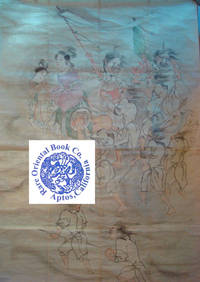
réf. 36023801Japan 1860 n.p. Large sheet 96 x 1m 44 cm. gouachevery clean work no worming or other condition issues painted on 16 joined sheets of Washi paper to make one large sheetfine water-color painting. THIS IS AN ORIGINAL PAINTED ART WORK . . . AM ORIGINAL COLOR PAINTING IN GRAND SIZE . . . FROM JAPAN'S OLDEST MYTHOLOGY: . . . THE KOJIKI & NIHON SHOKI PANTHEON . . . THE ORIGINS OF THE EMPEROR . . . OTOHIME GYO RETSU ZU: . . . THE PROCESSION OF OTOHIME DAUGHTER OF THE SEA GOD . . A stunning color painting by Kyosai. Probably done for a temple donation or as an expression of his faith to Japan's historic heroine. . OTOHIME is a goddess in Japanese mythology and is featured in the Kojiki as well as Nihon Shoki. Also known as "Luminous Jewel". A Japanese goddess the beautiful daughter of the sea-king Ryujin. She married Hoori and gave birth to a son after which she turned into a dragon. . Per the Japanese text brushed on the verso upper left corner: "239 ban dated Ansei 7th Kanoe-Saru-doshi 2 gatsu jojun end of February OTOHIME GYO RETSU ZU" . English: "#239 dated Ansei 7th monkey zodiac year end of Feb.: 1860 . PAINTING TITLE PER VERSO: "THE FIGURE OF PRINCESS OTOHIME'S PROCESSION THE DAUGHTER OF THE SEA GOD" . "Toyotama-hime" Japanese for "Lady Bountiful Soul" better known as Otohime is a goddess in Japanese mythology and is featured in the Kojiki as well as Nihon Shoki. She is the beautiful daughter of Ryujin the "God of the Sea." . A STUNNING ORIGINAL POLYCHROME GOUACHE PAINTING: . This original color watercolor painting shows the lively procession of OTOHIME and her hand maid. She is followed by a flag and umbrella bearer. Also following is a man with a pair of deer antlers good omen a man with a small red offering table with peaches the Wind God and his thunder-drum. Another flag bearer his helper followed by two others one holds a staff the other an offering of golden egg. . The items carries are symbolic good fortune and wealth in terms of deer antlers peaches and the golden egg represent ancient Chinese also used by the Japanese of omens of good fortune and good luck. . THE PAINTING: . Per the Japanese brushed text on the verso there is a number found meaning this panel of several was part of a larger work per the chronology found in Clark see below. . This panel of several paintings was part of a restoration of Zojo-ji temple in Shiba. In 1859 KANO Toei & Kyosai "participates in a repair project at the Zojo-ji temple." See Clark. . Although Kyosai had officially left the Kano school in 1854 by participating in the restoration of Tokugawa's family temple in Shiba he was showing loyalty to the Tokugawa family a good reason to volunteer his skills to the temple. It is also noteworthy that his mentor Kano Toei also participated in the restoration and in all likelihood Kyosai joined his master in a sign of respect and loyalty to him. . Based on this chronology it is clear Kyosai was one of the painters who worked at Zojo-ji temple along with his mentor and master teacher Kano Toei. It was not uncommon at this time for schools to volunteer teachers and students to do temple restoration and art work painting replacing or enhancing paintings and large murals. . This item's date matches the restoration dates for the Zojo-ji temple which began in 1859 and continued into 1860. . This panel was unused in the restoration it may have been a precursor to the final painting which was actually used in the restoration project. It matches the scenes found in Zojo-ji temple restoration. The work is the exact style of others painted by Kyosai and his genre. The caricatures of the people in this painting reflect Kyosai's style exactly the theme of his eccentric humor expressing his love for creativity and the joy of painting. . It is entirely within Kyosai's bizarre character to undertake and devote himself to such a project as illustrating the famous myth of OTOHIME in more than 200 deluxe extra-large-size format paintings. . This restoration project could also have been a 'paying job' for Kyosai as at that time he did not seem to be employed but in 1858 he began to design "Kyoga crazy pictures. It was in 1857 he married Okyo the daughter of a Rimpa painter Suzuki Kiitsu but Okyo died in 1859 and he remarried Tose who died in 1860. . It is more than likely Kyosai being a Buddhist he felt it was his religious obligation to do pennants by contributing to and drawing Buddhist or such traditional images as a way to placate the loss of his wife. . THE STORY OF OTOHIME DAUGHTER OF THE SEA GOD: . Because this work was part of the Zojo-ji temple restoration it cannot be considered a commercial painting one that was casually drawn and put on the market for sale. This was part of a commissioned restoration financed by some benefactor to the temple and most likely supported by the Tokugawa family. . ONE OF JAPAN'S EARLIEST AND MOST FAMOUS MYTHS: . The story of OTOHIME DAUGHTER OF THE SEA GOD is one of Japan's oldest and most famous myths known to all Japanese. Treasured as one of the most important in the ancient pantheon it is found in the earliest writing about the origin of Japan and the Emperor in the KOJIKI and the NIHON SHOKI. . This kind of larger paper illustrated story would take months to complete by It would also take devotion to the subject and focus with responsibility to produce a good number of paints daily. This was something Kyosai could and would do ! . THE ARTIST/PAINTER: This work is unsigned which is expected as part of a larger series of paintings. If this was the work of Kyosai it falls entirely within the dates during his period of work produced when he was 29 years old. . The caricature in the faces and fluid bodies in motion the "flowing" style are his. Although there is no signature and it is a true reflection of Kawanabe's work we are attributing it to him. . Another convincing point is that this kind of painting and meticulous style is also found in his famous instructional showing various 'schools' of painting in his KYOSAI GADEN. See below. . WHO WAS KAWANABE GYOSAI/KYOSAI: 1831-1889: Kawanabe Kyosai was a superb artist in the words of a critic "an individualist and an independent perhaps the last virtuoso in traditional Japanese painting". . Living through the Edo period to the Meiji period Kyosai witnessed Japan transform itself from a feudal country into a modern state. Born at Koga he was the son of a Samurai. His first aesthetic shock was at the age of nine when he picked up a human head apart from a corpse in the Kanda river. . After working for a short time as a boy with Utagawa Kuniyoshi he received his artistic training in the Kano school but soon abandoned the formal traditions for the greater freedom of the popular school. During the political ferment which produced and followed the revolution of 1867 Kyosai attained a reputation as a caricaturist. His very long painting on Makimono" scroll The battle of the farts" may be seen as a caricature of this ferment. . He was arrested three times and imprisoned by the authorities of the Shogunate. Soon after the assumption of effective power by the Emperor a great congress of painters and men of letters was held at which Kyosai was present. . He again expressed his opinion of the new movement in a caricature which had a great popular success but also brought him into the hands of the police this time of the opposite party. After this time he changed his name from Kyo crazy or wild to any one of 19 other "Go" studio names he used. However after the police jailed him he avoided use of "Kyo" but returned back to it with three other "GO" that used the same character "Kyo" crazy & wild such as #7 "Baiga Kyosha" #10 "Kyosai #12 Kyosha Gaishi #16 "Shosho Kyosai" Quoted from Roberts below see that reference for more details. . Kyosai is considered by many to be the greatest successor of Hokusai as well as the first political caricaturist of Japan. His work mirrored his life in its wild and undisciplined nature and occasionally reflected his love of drink. . Color photos are posted to our website. . REFERENCE: . More on OTO HIME: heon-org/articles/o/otohime-html KAWANABE Gyosai later known as Kyosai: Is well collected by world museums I GADAN: 1887 4 vol. set: In this work he outlines and exhibits a wide variety of "styles" of painting. In this work there are several examples of this kind or school of painting. Wikipedia stated about this book: "The most important work about Kyosai's art and life was written by himself: Kyosai Gadan or "Kyosai's Treatise on Painting" half autobiography and half painting manual. WESTERN APPRECIATORS: Many westerners came to visit Kyosai and their memoirs about the artist are valuable. The two important ones both rare were: Emile Etienne Guimet Promenades Japonaises Paris 1880. Josiah Conder: "Paintings and Studies by Kawanabe Kyosai" Tokyo 1911. Conder was a serious student of Japanese art; after some initial rejections he was accepted as Kyosai's pupil and accompanied him for ten years until the master's death. Timothy Clark Demon of painting: the art of Kawanabe Kyosai p.186 chronology and the drawing #21 p.58 is very similar to the pose found in our painting of OTOHIME Toyotama-hime both in pose facial quality hair style and the general perspective. ROBERTS Laurance P.: A DICTIONARY OF JAPANESE ARTISTS: PAINTING SCULPTURE CERAMICS PRINTS LACQUER p.100 stated of him: Kyosai ".was marked by a wild eccentric humor.caricatures of full of fantasy and invention." KAWANABE KYOSAI MEMORIAL MUSEUM. KAWANABE KYOSAI DOKU HON. OTOHIME: Nihon Jinmei Daijiten Toyotama-hime. Tokyo: Shogakukan. 2012. . . unknown
1920réf. 262307Tel Aviv: Hanakdon 1920s. Wrapper. Good. Number 1 pp. 1-16 Number 2 pp. 17-32 Hanakdon unknown
1903réf. 051627Istanbul: Manuscript - Autograph letter / Letterhead 'Sura-yi Devlet'. H.: 1319 1903. Soft cover. Very Good. 4to - over 9¾ - 12" tall. Original manuscript autograph document signed by Mehmed Said Pasha sent to Trabzon Vilayat Ordu Kaza Hasbamane Nahiya local manager faziletlu 'Mehmed Ali Sevki Beyefendi'. 335x20 cm. Folded. 1 p. In Ottoman script. Mehmed Said Pasha was an Ottoman monarchist senator statesman and editor of the Turkish newspaper Jerid-i-Havadis. He supported the CUP the political party which came to power after the Ottoman coup d'état of 1913. His origin comes from 'Sebazâde family' from Ankara. He became first secretary to Sultan Abdul Hamid II shortly after the Sultan's accession and is said to have contributed to the realizations of his majesty's design of concentrating power in his own hands; later he became successively minister of the interior and then governor of Bursa reaching the high post of grand vizier in 1879. He was grand vizier seven more times under Abdul Hamid II and once under his successor Mehmed V. He was known for his opposition to the extension of foreign influence in Turkey. n 1896 he took refuge at the British embassy in Constantinople and though then assured of his personal liberty and safety remained practically a prisoner in his own house. He came into temporary prominence again during the revolution of 1908. On 22 July he succeeded Mehmed Ferid Pasha as grand vizier but on the 6 August was replaced by the more liberal Kâmil Pasha at the insistence of the Young Turks. Also during 1908 Mehmed Said Pasha bought the famed Istanbul arcade in the Beyoglu Pera district today known as Çiçek Pasaji "Flower Passage". The modern name became common in the 1940s; during Mehmed Said Pasha's ownership in the 1900s and 1910s the arcade was known as Sait Pasa Pasaji "Said Pasha Passage". During the Italian crisis in 1911-12 he was again called to the premiership. He was again removed from power by the Savior Officers who backed the Freedom and Accord Party Liberal Union against the Committee of Union and Progress and replaced by a new cabinet supported by the Officers and the Freedom and Accord Party. The CUP would return to power however the next year after the Ottoman coup d'état of 1913. Source: Wikipedia. Seven lines on special paper with watermark 'Joynson Superfine'. Letter of request to provide teaching for some students in the region. Manuscript - Autograph letter / Letterhead 'Sura-yi Devlet'., [H.: 1319] paperback
réf. 51-4248Château d'Aiglemar: 1891-1900. Oublie-t-on Nouvelle. 17 octobre 1900. Incomplet p. 17-32. 16 feuillets in-8°. Corrections manuscrites. .Provenance: Bibliothèque Rohan-Chabot.Fonds Jean Stern et Maria Star.Birthdate:December 08 1854;Birthplace:Trieste Friuli-Venezia Giulia Italia Italy;Death: May 07 1926 Roquebrune-Cap-Martin Provence-Alpes-Côte d'Azur France;Immediate Family: Daughter of Leone Hierschel and Clementina de MinerbiWife of Baron Louis Stern.Mother of Jean Stern; Lucie Ernesta Henriette Girot de Langlade; Pierre Charles Ernest Louis Stern; Marie Louise Fanny Clémentine Thérèse de Chasseloup Laubat and Léon Stern.Sister of Gioacchino / Joachim van Hier / Hierschel de Minerbi; Graf Caleb Filippo Oscar Hierschel-Minerbi; Oscar Hierschel de Minerbi; Elodia Rachele Hulda Claudia de Hierschel and Clara Zoe Lea de Morpurgo. Ernesta Stern 1854-1926 known under the pseudonym Maria Star was a French woman of letters and philanthropist. She held a salon in her private mansion at 68 rue du Faubourg-Saint-Honoré reputed to be one of the most brilliant in Paris before the First World War: she hosted Marinetti and Marcel Proust among others. It is there that she wrote many tales and stories of Venetian inspiration. In 1874 she married banker Louis Stern 1840-1900; from this union was born Jean Stern 1875-1962 who also became a banker but also owner-breeder of racehorses; a remarkable fencer he was also the author of historical works as well as many pieces of circumstance that have become rare.P.Ernesta Stern 1854-1926 connue sous le pseudonyme de Maria Star est une femme de lettres et une philanthrope française. Elle tient un salon dans son hôtel particulier du 68 rue du Faubourg-Saint-Honoré réputé l'un des plus brillants de Paris avant la Première Guerre mondiale : elle y accueille notamment Marinetti ou Marcel Proust. C'est là qu'elle écrit de nombreux contes et récits d'inspiration vénitienne. Elle épouse en 1874 le banquier Louis Stern 1840-1900 ; de cette union naîtra Jean Stern 1875-1962 qui devint également banquier mais également propriétaire-éleveur de chevaux de course ; remarquable escrimeur il fut aussi l'auteur d'ouvrage historiques ainsi que de nombreuses pièces de circonstances devenues rares. Château d'Aiglemar: 1891-1900 unknown
réf. 51-4247Château d'Aiglemar: 1891-1900. - Oublie-t-on Nouvelle. 17 octobre 1900. 28 feuillets in-4°. Corrections manuscrites. Signé.Provenance: Bibliothèque Rohan-Chabot.Fonds Jean Stern et Maria Star.Birthdate:December 08 1854;Birthplace:Trieste Friuli-Venezia Giulia Italia Italy;Death: May 07 1926 Roquebrune-Cap-Martin Provence-Alpes-Côte d'Azur France;Immediate Family: Daughter of Leone Hierschel and Clementina de MinerbiWife of Baron Louis Stern.Mother of Jean Stern; Lucie Ernesta Henriette Girot de Langlade; Pierre Charles Ernest Louis Stern; Marie Louise Fanny Clémentine Thérèse de Chasseloup Laubat and Léon Stern.Sister of Gioacchino / Joachim van Hier / Hierschel de Minerbi; Graf Caleb Filippo Oscar Hierschel-Minerbi; Oscar Hierschel de Minerbi; Elodia Rachele Hulda Claudia de Hierschel and Clara Zoe Lea de Morpurgo. Ernesta Stern 1854-1926 known under the pseudonym Maria Star was a French woman of letters and philanthropist. She held a salon in her private mansion at 68 rue du Faubourg-Saint-Honoré reputed to be one of the most brilliant in Paris before the First World War: she hosted Marinetti and Marcel Proust among others. It is there that she wrote many tales and stories of Venetian inspiration. In 1874 she married banker Louis Stern 1840-1900; from this union was born Jean Stern 1875-1962 who also became a banker but also owner-breeder of racehorses; a remarkable fencer he was also the author of historical works as well as many pieces of circumstance that have become rare.P.Ernesta Stern 1854-1926 connue sous le pseudonyme de Maria Star est une femme de lettres et une philanthrope française. Elle tient un salon dans son hôtel particulier du 68 rue du Faubourg-Saint-Honoré réputé l'un des plus brillants de Paris avant la Première Guerre mondiale : elle y accueille notamment Marinetti ou Marcel Proust. C'est là qu'elle écrit de nombreux contes et récits d'inspiration vénitienne. Elle épouse en 1874 le banquier Louis Stern 1840-1900 ; de cette union naîtra Jean Stern 1875-1962 qui devint également banquier mais également propriétaire-éleveur de chevaux de course ; remarquable escrimeur il fut aussi l'auteur d'ouvrage historiques ainsi que de nombreuses pièces de circonstances devenues rares. Château d'Aiglemar: 1891-1900 unknown
réf. 51-425629 décembre 1902. - Chaînes de fleurs. Paris Gazette des Beaux-Arts 1902. In-8 3 f. 32 p. bon à tirer sommairement broché qq. rousseurs. Corrections manuscrites.Provenance: Bibliothèque Rohan-Chabot.Fonds Jean Stern et Maria Star.Birthdate:December 08 1854;Birthplace:Trieste Friuli-Venezia Giulia Italia Italy;Death: May 07 1926 Roquebrune-Cap-Martin Provence-Alpes-Côte d'Azur France;Immediate Family: Daughter of Leone Hierschel and Clementina de MinerbiWife of Baron Louis Stern.Mother of Jean Stern; Lucie Ernesta Henriette Girot de Langlade; Pierre Charles Ernest Louis Stern; Marie Louise Fanny Clémentine Thérèse de Chasseloup Laubat and Léon Stern.Sister of Gioacchino / Joachim van Hier / Hierschel de Minerbi; Graf Caleb Filippo Oscar Hierschel-Minerbi; Oscar Hierschel de Minerbi; Elodia Rachele Hulda Claudia de Hierschel and Clara Zoe Lea de Morpurgo. Ernesta Stern 1854-1926 known under the pseudonym Maria Star was a French woman of letters and philanthropist. She held a salon in her private mansion at 68 rue du Faubourg-Saint-Honoré reputed to be one of the most brilliant in Paris before the First World War: she hosted Marinetti and Marcel Proust among others. It is there that she wrote many tales and stories of Venetian inspiration. In 1874 she married banker Louis Stern 1840-1900; from this union was born Jean Stern 1875-1962 who also became a banker but also owner-breeder of racehorses; a remarkable fencer he was also the author of historical works as well as many pieces of circumstance that have become rare.P.Ernesta Stern 1854-1926 connue sous le pseudonyme de Maria Star est une femme de lettres et une philanthrope française. Elle tient un salon dans son hôtel particulier du 68 rue du Faubourg-Saint-Honoré réputé l'un des plus brillants de Paris avant la Première Guerre mondiale : elle y accueille notamment Marinetti ou Marcel Proust. C'est là qu'elle écrit de nombreux contes et récits d'inspiration vénitienne. Elle épouse en 1874 le banquier Louis Stern 1840-1900 ; de cette union naîtra Jean Stern 1875-1962 qui devint également banquier mais également propriétaire-éleveur de chevaux de course ; remarquable escrimeur il fut aussi l'auteur d'ouvrage historiques ainsi que de nombreuses pièces de circonstances devenues rares. 29 décembre 1902 unknown
réf. 37867S.l., Stad Oudenaarde, 1994 Softcover met flappen, 191pp., 22x28cm., rijkelijk geillustr. in kleur en z/w., als nieuw.
Softcover met flappen, 191pp., 22x28cm., rijkelijk geillustr. in kleur en z/w., als nieuw. Ter gelegenheid van de gelijknamige tentoonstelling Lakenhalle-Stadhuis OUdenaarde. 27 augustus-30 oktober 1994.
2015réf. 500180846Fayard 2015 216 pages 13 4x2x21 4cm. 2015. Broché. 216 pages.
réf. 201221453Paris, Editions g.p, 1962 ; in-12, 251 pp., cartonnage de l'éditeur. Illustrations de henri dimpre.
réf. 50973006like new. unknown
réf. A9781165028603Hardback. New. hardcover
réf. 0365192163.Ghardcover. Good. Access codes and supplements are not guaranteed with used items. May be an ex-library book. hardcover
2010réf. DADAX1165028603Kessinger Publishing 2010-09-10. hardcover. New. 6.00x0.88x9.00. Buy with confidence. Excellent Customer Service & Return policy. Kessinger Publishing hardcover
réf. 1024290166.Ghardcover. Good. Access codes and supplements are not guaranteed with used items. May be an ex-library book. hardcover
1966réf. 29804HBDJ 1966 1ST EDITION EARLY ISSUE REPRINT LARGER FORMAT Boards are clean. Content is clean. BK VG VG- DJ with some edge wear toning and marks. BACK OF DJ SAYS FEW OF 500 AUTHORS LARGER FORMAT SMALL STAIN ON DJ SPINE 779 PGS NO ADS IN BACK PURPLE CLOTH CVR WITH GOLD GILT N SPINE CVR estranged from all except his faithful employees Mr and Mrs Boffin. By his will his fortune goes to his estranged son John Harmon who is to return from where he has settled abroad possibly in South Africa to claim it on condition that he marries a woman he has never met Miss Bella Wilfer. The implementation of the will is in the charge of the solicitor Mortimer Lightwood who has no other practice. he son and heir does not appear though some knew him aboard the ship to London. A body is found in the Thames by Gaffer Hexam rowed by his daughter Lizzie. He is a waterman who makes his living by retrieving corpses and taking EVERYMAN’S LIBRARY DENT DUTTON PRINTED IN GB hardcover
1957réf. 184300New York: Doubleday & Company Inc 1957. Hardcover. Fine/Very Good. First edition. Cover corners and bottom spine end bumped else fine in a Very good dust jacket corners and spine ends worn with a few tiny tears on top spine end lightly browned spine a few insignificant stains on covers. Doubleday & Company, Inc hardcover books
1965réf. 1523Oregon: Published by the author 1965. First edition. Hardcover. Very Good. Green leatherette with gilt titles signed by the author on the title page "Best Wishes Margie." A very good copy - lacking dustjacket. Minor wear at the corners and spine tips and two small light spites to the front cover appear to be the only blemishes. Interior is clean and tight with the author's signature being the only marking. 55 numbered pages a list of sources loosely credited and a frontispiece of "Indian Dan" in black and white. An unusual local history - Oregon residents will recognize the name Archie Knowles from a lovely campground on the 126 corridor. Published by the author hardcover
1111[1938] 178 pages. All 200 picture cards present and in place. Wear to top/base and joints of spine, some wear and marks to covers. Some text pages a little wavy, Occasional light foxing marks in the text. This book is extra heavy, and may involve extra shipping charges to some countries
réf. 41901054-nnew. unknown
réf. 41901054like new. unknown
2021réf. x-1501370022Bloomsbury Academic USA 2021. Hardcover. New. 220 pages. 8.50x5.50x0.75 inches. Bloomsbury Academic USA hardcover
1895réf. BOOKS009456INew York: Charles Scribner's Sons. Good/No Dj. 1895. 1st Edition. Hardback. 8vo Rubs to cover/spotting. Text is clean and complete . Charles Scribner's Sons hardcover
1938réf. DEMO016032INew York: Random House 1938 . First American edition. Hardcover. Fine /very good. 8vo 389 pages two-tone cloth inked name; dj lacks thin nick at head Classic story of life on a plantation in Kenya Random House hardcover