14.402 risultati
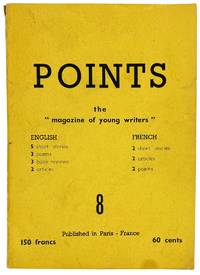
1950rif. 37924Paris: Points 1950. Very Good -. Paris: Points 1950-1951. First Edition. Octavo; 95pp. Printed wraps. Wear to wraps with a tear to top of spine rubbing and spotting and curling to corners. Binding sound. Pages toned with a few spots and chips but overall legible and about Very Good. 8th issue of Bisiaux and Vail's literary magazine and includes "Shades of Darkness Three Impressions" an early work by Mordecai Richler. Points unknown books
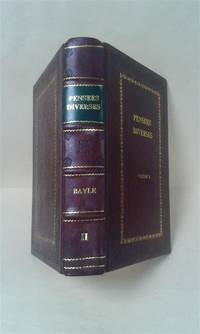
2025rif. BIBSD0069709152025. Full Leather Bound. NEW. Size: 22.22x 29.21 cms A Unique Premium Leather-Bound book for elite readers/collectors of old rare books. An Original Leather is being used for binding this book with Golden Leaf Printing and designing on Spine front and Back of the book with edge gilding. WE HAVE MULTIPLE OPTIONS IN COLOR OF LEATHER RED GREEN BLUE MAGENTA TAN PURPLE DEEP BROWN BLACK AND WITH DIFFERENT COLOR LABELS. YOU MAY CHOOSE ANY COLOR OF YOUR CHOICE AND MAIL US. This service is chargeable. Original edition was published in 1754 and this unique edition is Reprinted in 2025 with the help of original edition. Black & white printing on high quality natural shade paper with sewing binding for longer life professionally processed without changing its contents. As these are old books we processed each page manually on computer and make them readable. We give our best to give you the best book but in some cases we have to adjust few pages which are blur or missing or black spots. If it is multi volume set then it is only single volume. We hope that you understand these issues in these old treasure. This is an important book for the readers who want to know more about our old treasure. Our dedicated team is trying to bring these rare books back to the shelves. We are also giving service of printing the hard-to-find books which are not listed in our store. Hope you will like it and give your comments and suggestions. Lang: - French Pages 224. Product Disclaimer: Please be aware that because leather is a natural material slight discoloration or change in texture may be visible. FOLIO EDITION Size 12x19 Inches IS ALSO AVAILABLE ON REQUEST. Please Note:- 101 Colour images hardcover
Zaragoza, 1984. Folio; 122 pp. Transcripciones. Cubiertas originales.
Zaragoza, IFC, 1986. Folio; 144 pp. Transcripciones musicales. Cubiertas originales.
Zaragoza, IFC, 1985. Folio; 112 pp. Transcripciones musicales. Cubiertas originales.
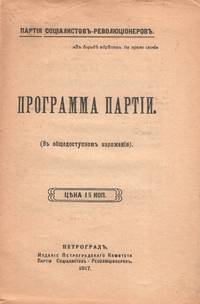
rif. P5946Petrograd: Izdanie Petrogradskogo komiteta partii sotsialistov-revoliutsionerov 1917. Octavo 20 × 14 cm. Original staple-stitched printed self-wrappers; 32 pp. Wrapper lightly chipped else about very good. Scarce brochure that seeks to educate a literate but not highly educated audience about the program of the Socialist Revolutionary Party SR breaking down basic principles of capitalist and socialist systems and proposing a program of action. The party won the Constituent Assembly election of 1917 November 25 1917 generally considered to be the first free Russian election taking about 40% of the popular vote. SR was the primary competitor of Russian Social Democratic Labor Party RSDLP the party of Lenin until its name was changed to the All-Russian Communist Party following the October Revolution of 1917. While the Bolshevik RSDLP won the majority of the vote in urban centers and from soldiers on the western front they lost the overall election to the SRs whose candidate list had been printed prior to the split between the left and right wings of the SRs with the left wing forming a coalition with the Bolsheviks. The Bolsheviks had hoped that this election would provide them the popular mandate to govern. Lenin criticized the Constituent Assembly saying that it failed to represent the Russian people because the ballot had not indicated the split between the SRs right wing and the pro-Bolshevik left. SRs held power for two weeks before the Bolsheviks disbanded the Assembly and gained the upper hand. As ideologically hostile literature as well as documentation of an alternative path of development after the February Revolution the publications of the Socialist-Revolutionaries were subject to destruction in the years after the October coup. KVK and OCLC only show copies at LOC Stanford Staatsbibliothek zu Berlin and Bayerische Staatsbibliothek and State Library of NSW Sydney. unknown
2018rif. 2-6202023317LAP LAMBERT Academic Publishing 2018. Paperback. New. 60 pages. 8.66x5.91x0.14 inches. LAP LAMBERT Academic Publishing paperback
1989Arezzo, Sottochiesa di San Francesco, 9 settembre - 22 ottobre 1989. Arezzo, 1989; br., pp. 198, ill. col., tavv. col., cm 23,5x30. italiano
rif. 6630380096.Gpaperback. Good. Access codes and supplements are not guaranteed with used items. May be an ex-library book. paperback
rif. ria9786630380095_inpPaperback. New. New Book; Fast Shipping from UK; Not signed; Not First Edition; Kwestia tradycyjnego lowiectwa i jego skutków stanowi wyzwanie dla rozwoju obszarów wiejskich. Ta podstawowa dzialalnosc przechodzi od ponad dwóch dekad znaczace przemiany. W rzeczywistosci przeksztalcila sie ona z spolecznej i kulturow paperback
Alcalá de Henares, 2004. 4to. mayor; 826 pp. Cubiertas originales.
rif. 009613Mario Pirone Falanga Edizioni Pompeiane broché Bristol illustré Pompei 48 pages en format 19 - 24 cm - photographeis en couleurs et en noir
1980rif. 124467Couverture souple. Broché. 48 pages. Rousseurs, odeur d'humidité.
1980rif. 88713Pompéi Falanga Edizioni Pompeiane 1980 1 vol. broché gr. in-8, broché, couv. illustrée, 48 pp., photos en noir et en couleurs par Mario Pirone des objets et peintures érotiques de Pompéi. Très bon état.
1980rif. 88713Pompéi Falanga Edizioni Pompeiane 1980 1 vol. broché gr. in-8, broché, couv. illustrée, 48 pp., photos en noir et en couleurs par Mario Pirone des objets et peintures érotiques de Pompéi. Très bon état.
1526rif. 4610Florence: Per haeredes Philippi Iuntae 1526. SECOND GIUNTA EDITION 1st 1519. Hardcover. Fine. A tall unsophisticated copy in its original limp vellum binding vellum stained lacking ties short split to upper hinge. The text is in very good condition with intermittent foxing heavier in some gatherings. A compendium of ancient geographical texts including descriptions of the known world by Pomponius Mela Dionysius Periegetes and Gaius Julius Solinus. Shorter texts include a catalogue of the regions within the city of Rome "De regionibus urbis Romae" by "Publius Victor". The work is possibly a literary forgery of the 15th century presented as the work of a newly-discovered author. The name was coined by Pomponius Leto of the Roman Academy. The volume was edited by Antonio Francino 1480- after 1537 a scholar of great talent who taught in the households of important Florentines and who produced starting in 1517 numerous editions of Greek and Latin authors for the Giunta firm. Francino's opening letter in this volume is addressed to the twenty-year old Pietro Vettori who would himself become a philologist of great renown. Pomponius Mela's Description of the World: "A generation earlier than the work of the natural historian Pliny under the reign of Claudius or Caligula we find the first Latin author whom to the best of our knowledge we can call a pure geographer and whose work has come down to us complete. This is Pomponius Mela a Spaniard from Tingentera near Gibraltar whose Chronographia "Description of Places" in three books is preserved. The Chronographia describes the world taking the Mediterranean as its basic point of reference. It proceeds counterclockwise from the Strait of Gibraltar whither it returns at the end of the description."Conte "After a short prooemium in which he dwells upon the importance and difficulties of his undertaking he proceeds to define the cardinal points and to explain the division of the world into two hemispheres and five zones. The northern hemisphere is that portion of the Earth which is known and is separated by the impassable torrid zone from the southern hemisphere which is altogether unknown and is the abode of the Antichthones. The northern known hemisphere is completely surrounded by the ocean which communicates with the four great seas: one on the north the Caspian; two on the south the Persian and the Arabian; and one in the west The Mediterranean with its subdivisions. Next follows a description of the three continents: Asia Europe and Africa and an enumeration of its inhabitants. These preliminaries being discussed the author enters upon more minute details and makes a complete circuit of the known world. "Thus commencing at the straits of Hercules with Mauritania he passes on in regular order to Numidia Africa Proper the Cyrenaica Egypt Arabia Syria Phoenicia Cilicia Pamphylia Lycia Caria Ionia Aeolis Bithynia Paphlagonia the Asiatic nations on the Euxine and the Palus Maeotis European Scythia Thrace Macedonia Greece the Peloponinesus Epirus Illyricum Italy from the head of the Adriatic round by Magna Graecia to the Ligurian Gulf Gallia Narbonnensis and the eastern coast of Spain. Hispaniae ora citerior. The tour of the Mediterranean being now completed a chapter is devoted to its islands. Passing beyond the Straits we stretch along the western coast of Spain Hispaniae ora exterior the western coast of Gaul Galliae ora exterior the islands of the Northern Ocean Germany Sarmatia the shores of the Caspian the Eastern Ocean and India the Mare Rubrum and its two gulfs the Persian and Arabian Aethiopia and those portions of Aethiop a and Mauritania bordering upon the Atlantic which brings him round to the point from which he started. It will be seen from the above sketch that the existence of the northern countries of Europe and of the northern and eastern countries of Asia were unknown it being supposed that these regions formed part of the ocean which in like manner was supposed to occupy the whole of Central and Southern Africa."Smith Dictionary of Greek and Roman biography Solinus: "Gaius Julius Solinus who probably lived between the middle and the end of the third century was concerned with geography though not in the modern sense of the term. His work is entitled Collectanea Rerum Memorabilium but in the Middle Ages when it was widely read it was also known as Polyhistor to emphasize the great number of curiosities that were collected there. The work is a careful compilation from many literary sources chiefly Pliny the Elder but also Pomponius Mela and Suetonius along with various other geographical treatises that are no longer extant. Solinus noted down all the unusual things he came across when reading these works about peoples and their customs animals and plants. "The work opens with a full treatment of Rome and Roman history from the kings to the principate of Augustus. The area examined is then extended to Italy and then to Greece and the Black Sea Germany Gaul Britain and Spain; this counterclockwise tour ends with Africa Arabia Asia Minor India and the kingdom of the Parthians in accordance with a systematic geographical plan that is one of the most characteristic features of the work. It enjoyed considerable success in the Middle Ages when it was also read and studied as a summary of the excessively vast Naturalis Historia of Pliny the Elder. It did not however altogether replace it with the result that it enjoyed so to speak a success parallel to that of its more illustrious predecessor."Conte "Referring to the reading of Pliny and Solinus in the Middle Ages and Renaissance Anthony Grafton writes: 'Generations of readers thrilled like Desdemona listening to Othello at these tales of strange creatures foods and burial customs - and were no doubt stimulated by them to see the inhabitants of strange lands as literally outlandish less than civilized or even less than human.' Charles Raymond Beazley has made note of this remarkable appeal: 'The compilation of Solinus. became so fashionable in the Middle Ages and exercised so powerful an influence on the geographical imagination that it cannot be passed over. It is simply a collection of marvels chiefly of natural history brought together apparently on the principle 'Credo' or at least 'Lego quia impossibile.'. no one ever influenced Christian geography more profoundly or mischievously." "References to and borrowings from Solinus can be found in a wide variety of medieval texts stretching though the whole of the medieval period. Readers of Solinus ranged from Augustine to Bede to Dante and Solinus' influence can be seen in examples as varied as the Hereford Mappa mundi ca. 1300 and Fazio degli Uberti's verse epic 'Dittamondo' 14th c. in which Solinus in the place of Dante's Virgil guides a pilgrim on a tour of the known world. The interest in Solinus had not waned by the fifteenth century. While geography was not a primary area of interest for the humanists Solinus Pliny and authors like them were widely read and commented upon by Renaissance scholars. The strong interest in antiquity that characterized the Renaissance continued the medieval curiosity for the Roman compilers who seemed to have succeeded in encapsulating the entire world and all the knowledge in it."Dover and McDonough. Per haeredes Philippi Iuntae hardcover books
rif. 0243207565.Gpaperback. Good. Access codes and supplements are not guaranteed with used items. May be an ex-library book. paperback
2010A cura di Paolo Peri. Pistoia, 2010; br., pp. 224, ill. col., cm 22x27. (Arte Storia Territorio. 8).
1969Features: New instantaneous fire extinguisher for car, boat or home; Build PM's graceful grandfather's clock; What's new in snowmobiles and outboards; Dan Gurney's column; 1970's cars - in colour!; and more. Moderate wear. A quality copy. Magazine
2017rif. 500084811Flammarion 2017 240 pages 13 4x21 8x2cm. 2017. Broché. 240 pages.
Sin datos de lugar de impresión, impresor, ni año, pero: Valladolid, hacia 1640. Folio; 10 folios numerados, rubricado el último con la firma autógrafa del Licenciado Arzedo. Cubiertas modernas en papel de aguas. El padre del litigante Don Francisco de Garnica fue Contador Mayor de Felipe II y miembro del Consejo de Hacienda, y fue quien inició ya entre 1573 y 1585 una agria pugna por el control del Consejo de Cruzada.
Sin lugar de impresión, impresor ni año, pero: Madrid, 1697. Folio; portada con pérdida de la parte superior que contendría un grabado de caracter religioso, 59 hojas numeradas. Cubiertas mudas en cartulina. Un raro pleito sobre la facultad de heredar los "oficios" de altos cargos de la Administración dentro de un ámbito estrictamente familiar y de sus evidentes consecuencias económicas.
Sin lugar de impresión, impresor, ni año, pero: Madrid, hacia 1690. Folio; 9 hojas foliadas. Cubiertas mudas en cartulina.
Granada, s.a. (hacia 1750) [y] Madrid, s.a. (hacia 1760). Dos documentos en folio; 49 hojas foliadas, firmadas por los Licenciados Don Joseph Cayetano de Lindoso y Don Manuel de Meruelo + 103 pp. numeradas, firmadas por el Licenciado Don Diego de la Fuente y Vargas. Cubiertas mudas en cartulina.
Sin datos de lugar de impresión, impresor, ni año, pero: Madrid, hacia 1690. Folio; 26 folios numerados. Cubiertas mudas en cartulina. Un pleito de alto bordo, por el importante mayorazgo cuya posesión se litiga y por la correlativa importancia de los personajes que litigan. Y por la no menor importancia del letrado que firma el presente documento alegatorio, Don Diego Holguin de Figueroa, Decano de la Congregación y Colegio de Abogados de la Corte de Madrid, durante las dos últimas décadas del Siglo XVII. - -