17.709 risultati
Mit den Beschau- u. Meisterzeichen der Gold- u. Silberschmiede von Goldingen, Mitau, Narva, Reval, Riga usw. Extrem selten.
rif. 6952Scroll 420 x 12000 mm. with elaborate silk brocade endpaper at beginning. Japan: 1880-86. This beautifully rendered scroll of natural history paintings was executed with one exception by Akio or Keigu Yamamoto 1827-1903 Confucian scholar doctor botanist and highly gifted artist. He was born in Kyoto the son of the prominent doctor and botanist Boyo Yamamoto 1778-1859 the direct disciple of Ono Ranzan 1729-1810 the famous professor of botany who wrote a series of classic botanical books. Keigu “continued his father’s work in his private school in Osaka and spent his time organizing meetings that were regularly attended by both honzogaku amateurs and Japanese biologists.”–Federico Marcon The Knowledge of Nature and the Nature of Knowledge in Early Modern Japan p. 301. Keigu travelled widely throughout Japan drawing plants and animals. He gave botanical instruction to the Meiji emperor and other members of the royal family. Keigu also wrote several standard works on materia medica and left many sketch books and scrolls which entered the Kyoto rare book trade in 1932; some of these were published only in the 1980s. All of his sketch books and scrolls offered valuable and unique information regarding native plants and animals as well as those that had been introduced into Japan. Our scroll contains 14 very finely executed color paintings of plants birds and animals. The paintings are quite unique in their remarkable spaciousness. For instance the image of the octopus is 1410 mm. long. The images include a most unusual morning glory three joined sheets and 1190 mm. long; an edible yellow lily two joined sheets 800 mm.; an ungei flower two joined sheets 795 mm.; a magnificent red toki a now-endangered crane species three joined sheets 765 mm.; a large akowa tsuru another species of crane three joined sheets 815 mm.; a young white crane three joined sheets 935 mm.; a sea lion umiuso painted in many shades of delicate black two joined sheets 545 mm.; a carp two joined sheets 597 mm.; an octopus four joined sheets; a chameleon three joined sheets 844 mm. dated “1880”; a deer antler two sheets 545 mm.; a “Dutch” dog two sheets 545 mm.; a lion seen at exhibitions in Tokyo and Kyoto two sheets 640 mm. with a seal and note stating this was the work of “Ariyoshi” dated “1886“; and two camels two sheets 545 mm. long. Four of the paintings have the signature and seal of Yamamoto and another painting — the final — has the seal only. Three of the paintings have additional text by Yamamoto regarding where seen and painted alternative regional names date etc. Very fine condition preserved in a new wooden box. All but the penultimate painting are the work of Yamamoto. unknown books
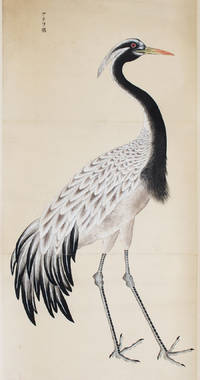
rif. 6952Scroll 420 x 12000 mm. with elaborate silk brocade endpaper at beginning. Japan: 1880-86. This beautifully rendered scroll of natural history paintings was executed with one exception by Akio or Keigu Yamamoto 1827-1903 Confucian scholar doctor botanist and highly gifted artist. He was born in Kyoto the son of the prominent doctor and botanist Boyo Yamamoto 1778-1859 the direct disciple of Ono Ranzan 1729-1810 the famous professor of botany who wrote a series of classic botanical books. Keigu “continued his father’s work in his private school in Osaka and spent his time organizing meetings that were regularly attended by both honzogaku amateurs and Japanese biologists.”–Federico Marcon The Knowledge of Nature and the Nature of Knowledge in Early Modern Japan p. 301. Keigu travelled widely throughout Japan drawing plants and animals. He gave botanical instruction to the Meiji emperor and other members of the royal family. Keigu also wrote several standard works on materia medica and left many sketch books and scrolls which entered the Kyoto rare book trade in 1932; some of these were published only in the 1980s. All of his sketch books and scrolls offered valuable and unique information regarding native plants and animals as well as those that had been introduced into Japan. Our scroll contains 14 very finely executed color paintings of plants birds and animals. The paintings are quite unique in their remarkable spaciousness. For instance the image of the octopus is 1410 mm. long. The images include a most unusual morning glory three joined sheets and 1190 mm. long; an edible yellow lily two joined sheets 800 mm.; an ungei flower two joined sheets 795 mm.; a magnificent red toki a now-endangered crane species three joined sheets 765 mm.; a large akowa tsuru another species of crane three joined sheets 815 mm.; a young white crane three joined sheets 935 mm.; a sea lion umiuso painted in many shades of delicate black two joined sheets 545 mm.; a carp two joined sheets 597 mm.; an octopus four joined sheets; a chameleon three joined sheets 844 mm. dated “1880”; a deer antler two sheets 545 mm.; a “Dutch” dog two sheets 545 mm.; a lion seen at exhibitions in Tokyo and Kyoto two sheets 640 mm. with a seal and note stating this was the work of “Ariyoshi” dated “1886“; and two camels two sheets 545 mm. long. Four of the paintings have the signature and seal of Yamamoto and another painting — the final — has the seal only. Three of the paintings have additional text by Yamamoto regarding where seen and painted alternative regional names date etc. Very fine condition preserved in a new wooden box. All but the penultimate painting are the work of Yamamoto. unknown
rif. 1737165325.Gpaperback. Good. Access codes and supplements are not guaranteed with used items. May be an ex-library book. paperback
rif. ria9781737165323_inpPaperback. New. New Book; Fast Shipping from UK; Not signed; Not First Edition; Sid Gold is the author of four previous collections: Working Vocabulary Washington Writers' Publishing House 1997 & 2021 The Year of the Dog Throwers Broadkill River Press 2010 Good With Oranges Broadkill River Press 2015 paperback
rif. 46615089like new. unknown
1990rif. 32393Ravensburg, Otto Maier Verlag, 1990. Broschiert
's-Gravenhague, Martinus Nijhoff, 1918. 4to.mayor; XII-190 pp., 1 h. Cubiertas originales.
Madrid, Establecimiento Tipográfico de Rafael Carracín, 1935. 4to.menor; 77 pp. Cubiertas originales.
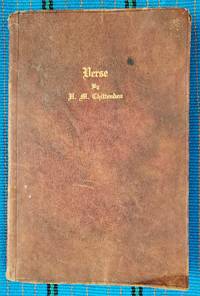
1916rif. 5005079Seattle: Jack Daniels 1916. First Edition. Soft cover. Fair. Small leather bound with front cover titles in gilt. 83pp. Untrimmed fore edges. Marbled endpapers. As the title states this is a book of verse. From a community library stamped on front papers; otherwise no library markings sleeves etc. Chittenden was a historian of the American West and has numerous books and papers credited to him. Among the books perhaps most notable a two volume history of the fur trade. This is a scarce item found only in a few libraries. Front hinge broken and lost of paper upper corner of front paste down. Photo shows corner of front cover peeled back a little. This has been archivally repaired. Fair to good copy thus that will reward a bit of professional conservation. Jack Daniels unknown
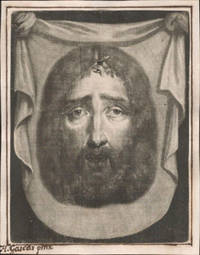
rif. 16-4852Circa late 17th- early 18th Century. Mezzotint.18 x 13cm. Slightly trimmed. Mounted on a support sheet. with a contemporary ink annotation: "H. Gascarpinx." Circa late 17th- early 18th Century. unknown
rif. 0761419411.Glibrary. Good. Access codes and supplements are not guaranteed with used items. May be an ex-library book. unknown
2010French Text. 2010; paperback, b/w and col. ill., col. plates. francaise 2-88012-05 paperback
Hardcover, 63 pages Illustrations contre-collées. Tirage limité à 2700 exemplaires. Cet exemplaire porte le n°2638. Grand in-4 carré. 31 x 30,2 cm. 1100g. Text in French and English. ISBN 9782880120535. Un somptueux ouvrage conçu avec la collaboration de J. Walter Thompson pour le Centre d'Information du Diamant et de Beers. / A sumptuous work conceived in collaboration with J. Walter Thompson for the Diamond Information Center and Beers.
rif. B9781501374098Paperback / softback. New. This open access book complicates and develops the notion of the vernacular. Understood in the linguistic sense as well as an element of the local the vernacular facilitates the exploration of local and global dynamics. Through exploring the unexamined active role of the local the indigenous and the periphery in international literary exchanges this volume argues that a coherent theorization of the vernacular will enable us to do so. The essays in Vernaculars in an Age of World Literatures present new critical approaches in the debate on world literature which has given priority to cosmopolitan movements global circulation of literatures and metropolitan centers. In nine case studies approaching narratives from the long 20th century from more or less marginal contexts—such as the Francophone Chinese diaspora multilingual regions in Spain West Africa and the Caribbean—the volume offers theoretical and methodological ways of putting the concept of the vernacular in practice and demonstrates how vernaculars operate within different literary critical cultural and political circumstances. The eBook editions of this book are available open access under a CC BY-NC-ND 3.0 licence on bloomsburycollections.com. paperback
rif. A9781501374050Hardback. New. hardcover
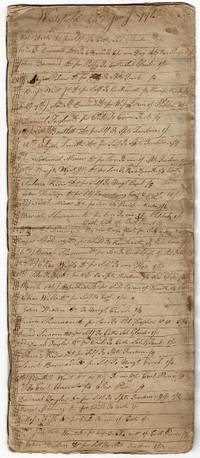
1805rif. 59752Waitsfield Vermont 1805. Narrow tall folio approx. 15½" x 6¾" 112 pp. in ink five separately sewn signatures; a few pages loose some pages darkened or chipped at edges; some entries faint. This account book is the record of the practice of either Stephen Pierce or Simeon Stoddard practicing in Waitsfield Vermont between 1795 and 1806. These were the second and third physicians to have settled and practiced in Waitsfield. Most likely it is the record of Pierce who is supposed to have settled in Waitsfield in 1795. The first physician in Waitsfield Moses Heaton remained there only between 1793 and 1796. Depending on the source Pierce was the third physician to practice in Waitsfield and/or the first to practice in Moretown a settlement to the northeast of Waitsfield. He farmed as well as doctored and his farm lay mostly in Moretown his office in Waitsfield. He was a respected and successful physician who served the community in other capacities: as selectman representative delegate to the Constitutional Convention of 1814 and Assistant Judge of the County Court. One source claims that he succeeded Judge Kinne December 1 1814 and served one year and that he was a justice of the peace in Waitsfield. He died either in 1854 after living in Waterbury and Berlin Vermont or he died in Barnard in 1864. See: History of the Town of Waitsfield Vermont 1782-1908 by Matt Bushnell Jones Boston 1909 p. 182. Simeon Stoddard on the other hand was born December 12 1761 either in Saybrook Connecticut or in Waitsfield. On August 19 1784 he married Abiah Thompson who had been born in 1763 in Waitsfield. Some sources state that he moved to Waitsfield from Saybrook in 1794. He served the southwestern area of Waitsfield and died in 1841. This account book records each date of visit the householder's name the relationship of patient to householder the medicine prescribed and its price and the cost of the doctor's visit. The doctor whether it be Stoddard or Pierce treated thirty to forty patients each month and as many as fifty-six in December of 1801. He charged as little as 4 pence and as much as 42 shillings 10 pence for his services. As a comparison the tax on an acre of land in Waitsfield was 2 pence an acre. The poll tax list of 1795 showed fifty voters so the doctor seems to have treated the members of nearly every family. The diseases treated are not stated in the entries made but he seems to have prescribed antimonium tartaricum in many instances and also digitalis. Waitsfield was founded by Col. Benjamin Wait or Waite and others who were granted a charter on February 25 1782. Wait had served under Gen. Jeffery Amherst in the French and Indian Wars and had fought in the Revolutionary War. Both Waitsfield and Moretown are now somewhat renowned as the areas around Mad River a popular ski resort. Mad River has been remarkable from the settling of the area as the source of numerous sudden destructive and deadly floods. The Green Mountains the northern extent of the Appalachians rise just to the west of the town. The doctor records having treated members of the Wait family including Benjamin's wife Martha d. April 3 1804 Ezra Thomas and Gilbert. The family names of the community are listed making this a good source for early settlement history and genealogical research. Among the householders who required the doctor's services are Smolly Skinner Taylor Spalding Hitchcock Parkhurst Carpenter the family had a tannery and potash works Heaton Burdick Johnson Rider Fuller Symonds McNight Chamberlain Atherton Lyon Butterfield Barnave Osgood Foster Hobson Robinson Brun Latimer and Sherman. Many of the names appear often. unknown books
1805rif. 59752Waitsfield Vermont 1805. Narrow tall folio approx. 15½" x 6¾" 112 pp. in ink five separately sewn signatures; a few pages loose some pages darkened or chipped at edges; some entries faint. This account book is the record of the practice of either Stephen Pierce or Simeon Stoddard practicing in Waitsfield Vermont between 1795 and 1806. These were the second and third physicians to have settled and practiced in Waitsfield. Most likely it is the record of Pierce who is supposed to have settled in Waitsfield in 1795. The first physician in Waitsfield Moses Heaton remained there only between 1793 and 1796. Depending on the source Pierce was the third physician to practice in Waitsfield and/or the first to practice in Moretown a settlement to the northeast of Waitsfield. He farmed as well as doctored and his farm lay mostly in Moretown his office in Waitsfield. He was a respected and successful physician who served the community in other capacities: as selectman representative delegate to the Constitutional Convention of 1814 and Assistant Judge of the County Court. One source claims that he succeeded Judge Kinne December 1 1814 and served one year and that he was a justice of the peace in Waitsfield. He died either in 1854 after living in Waterbury and Berlin Vermont or he died in Barnard in 1864. See: History of the Town of Waitsfield Vermont 1782-1908 by Matt Bushnell Jones Boston 1909 p. 182. Simeon Stoddard on the other hand was born December 12 1761 either in Saybrook Connecticut or in Waitsfield. On August 19 1784 he married Abiah Thompson who had been born in 1763 in Waitsfield. Some sources state that he moved to Waitsfield from Saybrook in 1794. He served the southwestern area of Waitsfield and died in 1841. This account book records each date of visit the householder's name the relationship of patient to householder the medicine prescribed and its price and the cost of the doctor's visit. The doctor whether it be Stoddard or Pierce treated thirty to forty patients each month and as many as fifty-six in December of 1801. He charged as little as 4 pence and as much as 42 shillings 10 pence for his services. As a comparison the tax on an acre of land in Waitsfield was 2 pence an acre. The poll tax list of 1795 showed fifty voters so the doctor seems to have treated the members of nearly every family. The diseases treated are not stated in the entries made but he seems to have prescribed antimonium tartaricum in many instances and also digitalis. Waitsfield was founded by Col. Benjamin Wait or Waite and others who were granted a charter on February 25 1782. Wait had served under Gen. Jeffery Amherst in the French and Indian Wars and had fought in the Revolutionary War. Both Waitsfield and Moretown are now somewhat renowned as the areas around Mad River a popular ski resort. Mad River has been remarkable from the settling of the area as the source of numerous sudden destructive and deadly floods. The Green Mountains the northern extent of the Appalachians rise just to the west of the town. The doctor records having treated members of the Wait family including Benjamin's wife Martha d. April 3 1804 Ezra Thomas and Gilbert. The family names of the community are listed making this a good source for early settlement history and genealogical research. Among the householders who required the doctor's services are Smolly Skinner Taylor Spalding Hitchcock Parkhurst Carpenter the family had a tannery and potash works Heaton Burdick Johnson Rider Fuller Symonds McNight Chamberlain Atherton Lyon Butterfield Barnave Osgood Foster Hobson Robinson Brun Latimer and Sherman. Many of the names appear often. unknown
1985rif. 19990Stuttgart, Müller und Schindler, [1985]. Gr. 4°, 1 montiertes, handvergoldetes Faksimileblatt mit 1 Seite Beschreibung. Orig.Pappmappe mit Goldprägung.
2002rif. 252735München : Callwey, 2002. 140 Seiten. Mit zahlreichen farbigen Abbildungen. 29 cm Originalpappband.
Madrid, Instituto Miguel de Cervantes, 1970. 4to. menor; XVI pp., 238 pp., 1 h. Cubiertas originales.
Madrid, Instituto Miguel de Cervantes, 1969 ["Biblioteca de Antiguos Libros Hispánicos"]. 4to. menor; XV pp., 321 pp., 2 hs. Cubiertas originales.
Sin datos de lugar de impresión, impresor, ni año, pero hacia 1701. 4to.; 28 pp. Encuadernación moderna en media tela.
1788rif. 23913Edinburgh 1788. Small octavo. 7 15/16 x 4 5/8 inches. Half-title. Blind stamp to half-title and E1 ink number stamp to foot of verso of half-title and foot of p.48. 20th-century half calf over marbled paper-covered boards remnants of library label on upper cover extremities lightly rubbed First edition. Concerns the claims of John Drummond eldest surviving son of Edward 6th Duke of Perth. ESTC T193208. unknown books
1788rif. 23913Edinburgh 1788. Small octavo. 7 15/16 x 4 5/8 inches. Half-title. Blind stamp to half-title and E1 ink number stamp to foot of verso of half-title and foot of p.48. 20th-century half calf over marbled paper-covered boards remnants of library label on upper cover extremities lightly rubbed First edition. Concerns the claims of John Drummond eldest surviving son of Edward 6th Duke of Perth. ESTC T193208. unknown