MOLINA, Tirso de.MareMagnum

15 703 résultats
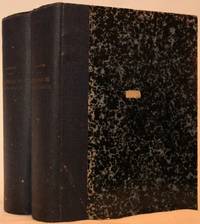
Madrid, Revista Estudios, 1973 - 1974. Dos volúmenes en folio.; CCCI - 2 hs. , 483 pp., 1 h y XII - 720 pp., 1 h. Ilustraciones entre el texto. Encuadernación original en símil piel.
Madrid, Imprenta y Librería de Gaspar y Roig, Editores, 1848-1851 ('Biblioteca Ilustrada de Gaspar y Roig'). Cinco volúmenes en folio; 6 hs., XI pp., 618 pp., 3 hs. + 679 pp., 3 hs. + 674 pp., 3 hs., + 4 hs., V pp., 615 pp., 5 hs. + 757 pp., 7 hs. y C pp. para el Apéndice. Con numerosas ilustraciones entre el texto y en láminas. Ejemplar falto de un trozo de la página 111/112. Encuadernación de la época, en media piel y tela; el tomo V presenta lomera diferente.
Barcelona, 1984. 4to.; 213 pp. Gráficos y mapas. Cubiertas originales.
Barcelona, 1999. 4to. alargado; 232 pp. Gráficos y mapas. Cubiertas originales.
Zaragoza, IFC, 2020. 4to. mayor; 1336 pp. Encuadernación original en cartoné.
Madrid, en la Imprenta de Pedro Marin, 1773. 4to.; XX-496 pp. Encuadernación en piel de la época con tejuelo.
Madrid. en la Oficina de Pantaleon Aznar, s.a. (1750). 8vo.; 4 hojas, 347 pp., 1 h. Con un mapa, un estado, una vista de Orán y otra de la ciudad de Argel, todos ellos plegados. Encuadernación de época en piel, con ligero desgaste en el canto exterior del plano superior.
Zaragoza, Institución Fernando el Católico, 1999. Tres volúmenes en gran folio (42x32 cm.). Facsímil: 728 pp. y 840 pp. Estudio: 232 pp. Ilustraciones y un mapa. Edición limitada de 500 ejemplares. Encuadernación original. Estuche en cartoné.
Madrid, Espasa - Calpe, 1946 [Austral]. 4to.; 167 pp. Cubiertas originales.
Barcelona, Librería de J. Oliveres y Gavarro, 1839. 4to.; 2 hs., 318 pp. y una lámina de Amills. Encuadernación de la época, en piel marbreada, con tejuelos.
Madrid, Imprenta de I. Sancha, 1821. 4to.; 343 pp., 1 h. Primera edición en español. Encuadernación de época, en piel marbreada, con tejuelos.
Madrid, Imprenta de I. Sancha, 1821. 4to.; 421 pp., 1 h. Primera edición en español. Encuadernación de época, en piel marbreada, con tejuelos.
Zaragoza, 2011. 4to.; 230 pp. Ilustraciones. Cubiertas originales.
Madrid, Espasa-Calpe, 1945 (Colección de Crónicas Españolas). 4to.; XCV pp., 619 pp. Encuadernación en piel, con tejuelos. Pérdida parcial de uno de ellos.
Madrid, por Andrés Ortega, 1768. Folio; 12 hojas, 1058 pp. Con 6 grabados con retratos entre el texto. Ejemplar carente de dos láminas. Fuertes trazas de polilla en portada, hojas preliminares y quince primeras páginas, así como en las últimas treinta. Taladros puntuales y mínimos en el resto del ejemplar, que no afectan al texto. Salvo estos aspectos excelente ejemplar. Encuadernación de época en piel, con lomera ornada y tejuelo.
Cádiz, Imprenta de la Revista Médica, 1863. Dos tomos en un volúmen en 4to.; XXIV-346 pp. + 314 pp. Encuadernación en media piel.
Madrid, Imprenta de Tomás Minuesa, 1892 [Colección de Libros Raros y Curiosos que tratan de América"]. 4to. menor; LXIX pp. que contienen el "Estudio biográfico y bibliográfico acerca de Don Fernando Colón", de Manuel Serrano y Sanz, más 275 pp., 1 h. Encuadernación moderna en media tela.
Zaragoza, 1976. 4to. mayor; 363 pp., 6 hs. Con numerosas ilustraciones fotográficas, reproducciones, planos y mapas. Cubiertas originales.
1916réf. BOOKS0059952 volumes. 867 pages; 826 pages. Octavo 8 3/4" x 6 1/2" bound in quarter blue cloth with gilt lettering to spine over marbled boards. Edited by Jeranimo Becker. Second edition. Pedro de Aguado was a Spanish Franciscan friar who spent around 15 years in the New Kingdom of Granada preaching to the Indians. During this time he collected source material for a history of the region and began a manuscript Recopilacion historial which he completed in Spain between 1576 and 1583 but was unable to publish. The manuscript was used by other historians but was not published until the twentieth century. De Aguado's date of birth is uncertain. He is believed by Juan Friede to have been baptized in Valdemoro on 26 January 1513 whilst Guillermo Morón argues for 16 February 1538. Arriving in the New World in 1560 or 1561 in Cartagena his movements are uncertain until his arrival in Bogota in 1571 although it is likely he soon left Cartagena to minister to the Muisca people. By around 1564 he was a pastor to the Muisca at Cogua and he was able to build two churches there. Cogua was considered the first Indian town in New Granada where all the Indians were converted to Christianity an achievement of Aguado's recognized by King Philip II. In 1571 de Aguado moved to Bogota and became a "minister provincial" of the local Franciscan Province. In 1575 de Aguado was sent by the Province on a mission to Spain to answer charges that the local monks were greedy and abusive. He was not able to leave Spain to return to Bogota¡ until 1583. During this time he developed a manuscript on the history of the region Recopilacion historial begun during his "idle hours" in Bogota¡ It is likely that Part I on Santa Marta and the New Kingdom of Granada was written in Bogota and Part II on Venezuela and Cartagena in Spain. De Aguado tried unsuccessfully to secure publication over a number of years. A series of bureaucratic hurdles around censorship were complicated by a change in the rules invalidating the royal license to print which de Aguado obtained in 1581 while a second license in 1582 was complicated by a new requirement to have the printed copy checked against the original manuscript signed off by the king's secretary. Financial difficulties also played a role but a definitive reason for publication failing to materialize is not known. A planned Part III appears to have been abandoned possibly in frustration at the difficulties with publication with the witness statements that would have been the source material left in Spain on his return to Bogota in 1583. Dates for de Aguado's death are even less certain than those for his birth; dates vary from 1589 1595 to 1608. After his death his work was used directly and indirectly by other authors notably by Fray Pedro de Simon who appears to have had access to a copy of Part II of the manuscript which de Aguado took with him on his return to Bogota The manuscript de Aguado left in Spain was obtained in the late eighteenth century by the historian Juan Bautista Munoz; his collection became part of the University of Valencia on his death and was transferred to the Real Academia de la Historia after the university was partly destroyed in 1812 during a French siege of Valencia. There the manuscript was discovered in 1845 by Joaquin Acosta and it was consulted by some historians in the latter part of the nineteenth century. However it was not published until 1906 Part I Historia de Santa Marta y Nuevo Reino de Granada and 1913 Part II Historia de Venezuela. Condition: Shelf wear with some rubbing to extremities spine gilt dulled else a very good copy. Real Academia de la Historia 1916-17 Madrid hardcover books
Madrid, en la Imprenta de Sancha, 1808. 4to. menor; 1 h., XXVI-475 pp., la última, de Indice, con pérdida de texto. Encuadernación en piel marbreada de la época, con tejuelo.
Madrid, Librería de Perlado, Páez y Compañía, 1904 ("Biblioteca Clásica"). 4to. menor; XXXIX-393 pp. Encuadernación original tela estampada.
Barcelona, Herederos de Juan Gili Editores, 1914. 4to.menor; XLIV-282 pp., 1 h. Cubiertas originales.
Málaga, 1997. 4to.; 439 pp., 1 h. Cubiertas originales.
Madrid, Manuel Aguilar Editor, s.a. (1944) ["España Misionera"]. 4to.; LII-396 pp. Encuadernación original en media tela y cartoné impreso.
Barcelona, Editorial Cisne, 1941. 4to. menor; 96 pp. Ilustraciones de Emilio Freixas. Cubiertas originales.