14.489 risultati
1893rif. 0803169Glasgow: A. Bryson & Co 1893. First edition / 1st Printing. Hard Cover. Good/No Jacket As Issued. 8vo - over 7¾" - 9¾" 7 books bound in 2 volumes. Covers the First throught Seventh tournaments from 1893 through 1899. First Edition / First Printing. Call's 149. Bound in 1/2 brown calf over brown cloth boards with red leather spine labels original covers not bound. Tournaments 1-4 in Vol. 1 5-7 in Vol. 2. Good spines faded but lettering still stron rubbing to leather edges bottom 3/4 inches of spine on Vol. 2 is unevenly chipped 1.5 inch split at top of front spine hinge chipped around top of spine. 14 x 21. hard cover. 63 63 70 100 72 80 & 80pp. B1903A. A. Bryson & Co unknown
rif. 0260239380.Ghardcover. Good. Access codes and supplements are not guaranteed with used items. May be an ex-library book. hardcover
1963rif. 354481New York: The Dial Press 1963. Hardcover. Fine/Near Fine. First edition. 254pp. Fine with very light browning at endpapers in a near fine dustwrapper with very gentle wear at extremities. With essays by Nelson Algren James Baldwin Saul Bellow Herbert Blau George P. Elliot Herbert Gold Paul Goodman Elizabeth Hardwick Seymour Krim Mary McCarthy Arthur Miller Warren Miller William Saroyan William Styron Harvey Swados and Gore Vidal. The Dial Press hardcover books
1963rif. 91455NY:: Dial Press. Very Good in Good dust jacket. 1963. Hardcover. Contributions by James Baldwin Saul Bellow Arthur Miller William Styron and Gore Vidal among others. First edition. Very good in a good edge worn with a few chips long closed edge tear on front panel dust jacket. . Dial Press, hardcover books
1963rif. 354481New York: The Dial Press 1963. Hardcover. Fine/Near Fine. First edition. 254pp. Fine with very light browning at endpapers in a near fine dustwrapper with very gentle wear at extremities. With essays by Nelson Algren James Baldwin Saul Bellow Herbert Blau George P. Elliot Herbert Gold Paul Goodman Elizabeth Hardwick Seymour Krim Mary McCarthy Arthur Miller Warren Miller William Saroyan William Styron Harvey Swados and Gore Vidal. The Dial Press hardcover
1910rif. 49-1261910 1910. 39p. Hardcover. White boards. Gilt edges. Roster of officicers. History of the Regiment. Color plates of flags & company badges. Covers soiled. Good Copy. Hardcover. Very Good. 1910 Hardcover
1564rif. 60128vo. 112 ff pages 2 and 110-112 are blank. Bound in modern paneled calf with gilt-stamped fleurons on front and back covers raised bands. Generally good. The first edition of this plague treatise by Paracelsus Theophrastus Bombastus von Hohenheim 1493-1541 the "Luther of Medicine" and one of the key figures in the history of medicine. Written originally in Nördlingen in 1529-1530 it remained unpublished during Paracelsus' lifetime and subsequently taken up and edited for publication by the Paracelsian scholar Adam von Bodenstein 1528-1577. The latter dedicated it to Johann Rudolph Stör von Störenberg Abbot of Murbach and Luders. In addition to the study on pestilence the text includes two short works by Paracelsus: "Vom Preservatiff durch den Schwebel" and "Von der Mummia." In the primary tract Paracelsus for the first time presents his complex theory on the origins of the plague which he believed were the result of astrological and corporeal events set in motion by human sins. "This anthropocentric view of an individual disease is in harmony with Paracelsus' whole philosophy and indeed with Renaissance philosophy in general" Pagel p. 179. Paracelsus also postulates the importance of the principle of sulphur the corresponding agent of the planet Mars in pestilence's causation. He believed that sulphur hidden in three minerals—antimony arsenic and marcasite—affected three corresponding organs: the groin the axillae and the ears. The chapters on causation are followed by sections on remedies. The doctor must cure the agent causing the disease rather than the symptoms of the disease Paracelsus writes. Humoral pathology and its insistence on diet is of no use. "Paracelsus' plague remedies include sulphur spirit of vitriol sulphur sublimate and metals also—for external treatment of boils—toads and decoctions of beetles designed to remove the evil of magnetic attraction but herbs and drugs as prescribed by Ficino and Agrippa are greatly amplified and still appear in a prominent place" Pagel pp. 180-181 n. 151. The editor of this volume Adam von Bodenstein was one of the key figures in the revival of Paracelsian ideas in the German lands in the middle of the sixteenth century. A son of a radical reformer he believed in transmutation of metals into gold and played a key role in the publication of over 80 works by Paracelsus. For his Paracelsianism he was excluded from the faculty and council of Basel University. OCLC records US copies at NYAM NLM Wash. U and UMn. Karl Sudhoff Bibliographia Paracelsica Berlin 1894 60; Walter Pagel Paracelsus: An Introduction to Philosophical Medicine in the Era of the Renaissance Boston 1982 2nd revised edition; Georgiana D. Hedesan "Alchemy Potency Imagination Paracelsus's Theories of Poison" in John Arrizabalaga Ole Peter Grell Andrew Cunningham eds. It All Depends on the Dose: Poisons and Medicines in European History. The History of Medicine in Context Series New York 2018 pp. 81-102; Peter J. Forshaw "'Paradoxes Absurdities and Madness:' Conflict over Alchemy Magic and Medicine in the Works of Andreas Libavius and Heinrich Khunrath" Early Science and Medicine vol. 13 no. 1 2008 pp. 53-81. Paul Messerschmidt hardcover books
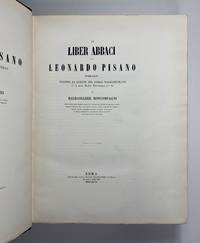
1862rif. 4120Rome: Tipografia delle Scienze Mathematiche e Fisiche 1862. Very good. 2 vols. folio. Numerous diagrams; occasional light spotting and foxing. Modern brown morocco uncut. In slipcases. EDITIO PRINCEPS OF THE WRITINGS OF FIBONACCI THE GREATEST MATHEMATICIAN OF THE MIDDLE AGES STILL THE ONLY COMPLETE EDITION PUBLISHED. IN THE HISTORY OF MATHEMATICS THIS UNABRIDGED EDITION OF THE LATIN TEXT IS ESSENTIAL AND WAS THE VEHICLE BY WHICH FIBONACCI'S WORKS WERE DISSEMINATED THROUGHOUT MODERN AND CONTEMPORARY CULTURE. Rare in private ownership. This copy which sold at Sotheby's forty years ago is the ONLY copy that has ever appeared at public auction according to Rare Book Hub which currently lists more than 15 million records in the Rare Book Transactions database; furthermore it is the only copy currently available on the market. Leonardo of Pisa ca. 1170-1250 a.k.a. Fibonacci is justly considered to be the most important mathematician of the Middle Ages if only for being the first Christian mathematician to systematically explain Arabic numerals. Indeed the mathematical renaissance in the West began with him according to George Sarton. The first volume contains the the 'Liber Abaci' devoted to problems of computation including algebraic quadratic problems; here Fibonnaci here introduces Arabic numerals the fraction bar and the numerical approach to square roots and cube roots. The second volume contains the 'Practica Geometriae' devoted to the application of algebra to geometric problems; 'Flos' written for Frederick II in answer to a number of mathematical problems posed by Magister Johannes; "Letter to Magister Theodorus" developing a general method for the solution of indeterminate problems; and finally the great "Liber quadratorum" described by Vogel as "a first-rate scientific achievement and showing Fibonacci as "a major number theorist." Vogel continues to assert correctly that Fibonacci was far ahead of his time without a successor until 1621 when Bachet made the text of Diophantus available which in turn stimulated Fermat in founding number theory. "In addition to the antique manuscripts there also undeniably exists however a vehicle that notwithstanding the inadequate and problematic access to the manuscript sources has spread the text of the Fibonaccian treatise throughout modern and contemporary culture: the well known Italian mathematician and historian of science Baldassarre Boncompagni Ludovisi in fact in his brilliant far-reaching project which brought into focus the personality of Fibonacci as well as his surviving works realized and published in Rome in 1857 i.e. THIS EDITION what can with ample justification be defined the editio princeps of the entire treatise." Germano. Despite the flaws in Boncompagni's work "it of course was a noteworthy editorial operation especially as it made available in print to a vast number of interested parties a work which had almost fallen into oblivion and that up to that time could be consulted only from its manuscript sources with all the difficulties and inconvenience which this could entail." Germano. It is fair to say that Fibonacci's contributions to mathematics languished unappreciated until the rediscovery of his texts and their presentation in the present -- surprisingly rare -- volumes. Despite its flaws Boncompagni's edition serves as the basis for only complete translation of the Liber Abici made into a modern language thus far namely Lawrence E. Sigler's "Fibonacci's Liber Abaci. A Translation into Modern English of Leonardo Pisano's Book of Calculation" 2002. Whereas Sigler corrected some errors he introduced many others usually on account of inability to understand and effectively translate the Renaissance Latin text. Before Boncompagni's edition only the "Prologus" and Chapter XV of Fibonacci's Liber Abaci had received a respectful circulation in print that was due to G. Libri's "Histoire des sciences mathématiques en Italie dépuis la renaissance des lettres jusqu'à la fin du dixseptième siècle" Paris 1838 vol. II respectively pp. 287-290 and 307-476. REFERENCES: Giuseppe Germano "The Modern Dissemination in Print of the 'Liber Abaci' and its Pitfalls" Part 3 of his New Editorial Perspectives on Fibonacci's Liber Abaci in: Reti Medievali Rivista 14:2 Firenze University Press 2013 pp. 161-163 and passim. George Sarton Introduction to the History of Science II p. 611 et seq. On Boncompagni see V. Cappelletti's in DBI XI pp. 704-709. M. Mazzotti "For Science and for the Pope-King: Writing the History of the Exact Sciences in 19th-century Rome" in: British Journal for the History of Science 33 2000 pp. 257-282 especially pp. 259-265. On the strengths and weaknesses of Boncompagni's edition see R.E. Grimm "The Autobiography of Leonardo Pisano" in: The Fibonacci Quarterly 11 1973 pp. 99-104. John D. Stanitz Sources of Science and Technology: an Exhibit of One Hundred and One Books and Documents Kent State 1972 no. 14 this copy. PROVENANCE: John D. Stanitz his sale Sotheby's New York 25 April 1984 lot 268 with with Sotheby's label on the slipcase of vol. II --> Messrs. Bernard Quaritch June 1984 Mathematics list $3000 --> James M. Vaughn 1939-2022 enigmatic American philanthropist and bibliophile who assembled the finest mathematics collection ever formed by a private individual: 125 rare and foundational books in the history of mathematics were donated to the Harry Ransom Center in 2021; our volume was kept in Vaughn's home in River Oaks Houston and sold to us by his estate. Vaughn funded the Mathematical Association of America and helped support the solution of the 300-year-old math puzzle Fermat's Last Theorem; it is therefore meaningful that he owned this copy of the Editio Princeps of the complete works of Fibonacci. With J.M.V. bookplate in each volume. Tipografia delle Scienze Mathematiche e Fisiche unknown books
1862rif. 4120Rome: Tipografia delle Scienze Mathematiche e Fisiche 1862. Very good. 2 vols. folio. Numerous diagrams; occasional light spotting and foxing. Modern brown morocco uncut. In slipcases. EDITIO PRINCEPS OF THE WRITINGS OF FIBONACCI THE GREATEST MATHEMATICIAN OF THE MIDDLE AGES STILL THE ONLY COMPLETE EDITION PUBLISHED. IN THE HISTORY OF MATHEMATICS THIS UNABRIDGED EDITION OF THE LATIN TEXT IS ESSENTIAL AND WAS THE VEHICLE BY WHICH FIBONACCI'S WORKS WERE DISSEMINATED THROUGHOUT MODERN AND CONTEMPORARY CULTURE. Rare in private ownership. This copy which sold at Sotheby's forty years ago is the ONLY copy that has ever appeared at public auction according to Rare Book Hub which currently lists more than 15 million records in the Rare Book Transactions database; furthermore it is the only copy currently available on the market. Leonardo of Pisa ca. 1170-1250 a.k.a. Fibonacci is justly considered to be the most important mathematician of the Middle Ages if only for being the first Christian mathematician to systematically explain Arabic numerals. Indeed the mathematical renaissance in the West began with him according to George Sarton. The first volume contains the the 'Liber Abaci' devoted to problems of computation including algebraic quadratic problems; here Fibonnaci here introduces Arabic numerals the fraction bar and the numerical approach to square roots and cube roots. The second volume contains the 'Practica Geometriae' devoted to the application of algebra to geometric problems; 'Flos' written for Frederick II in answer to a number of mathematical problems posed by Magister Johannes; "Letter to Magister Theodorus" developing a general method for the solution of indeterminate problems; and finally the great "Liber quadratorum" described by Vogel as "a first-rate scientific achievement and showing Fibonacci as "a major number theorist." Vogel continues to assert correctly that Fibonacci was far ahead of his time without a successor until 1621 when Bachet made the text of Diophantus available which in turn stimulated Fermat in founding number theory. "In addition to the antique manuscripts there also undeniably exists however a vehicle that notwithstanding the inadequate and problematic access to the manuscript sources has spread the text of the Fibonaccian treatise throughout modern and contemporary culture: the well known Italian mathematician and historian of science Baldassarre Boncompagni Ludovisi in fact in his brilliant far-reaching project which brought into focus the personality of Fibonacci as well as his surviving works realized and published in Rome in 1857 i.e. THIS EDITION what can with ample justification be defined the editio princeps of the entire treatise." Germano. Despite the flaws in Boncompagni's work "it of course was a noteworthy editorial operation especially as it made available in print to a vast number of interested parties a work which had almost fallen into oblivion and that up to that time could be consulted only from its manuscript sources with all the difficulties and inconvenience which this could entail." Germano. It is fair to say that Fibonacci's contributions to mathematics languished unappreciated until the rediscovery of his texts and their presentation in the present -- surprisingly rare -- volumes. Despite its flaws Boncompagni's edition serves as the basis for only complete translation of the Liber Abici made into a modern language thus far namely Lawrence E. Sigler's "Fibonacci's Liber Abaci. A Translation into Modern English of Leonardo Pisano's Book of Calculation" 2002. Whereas Sigler corrected some errors he introduced many others usually on account of inability to understand and effectively translate the Renaissance Latin text. Before Boncompagni's edition only the "Prologus" and Chapter XV of Fibonacci's Liber Abaci had received a respectful circulation in print that was due to G. Libri's "Histoire des sciences mathématiques en Italie dépuis la renaissance des lettres jusqu'à la fin du dixseptième siècle" Paris 1838 vol. II respectively pp. 287-290 and 307-476. REFERENCES: Giuseppe Germano "The Modern Dissemination in Print of the 'Liber Abaci' and its Pitfalls" Part 3 of his New Editorial Perspectives on Fibonacci's Liber Abaci in: Reti Medievali Rivista 14:2 Firenze University Press 2013 pp. 161-163 and passim. George Sarton Introduction to the History of Science II p. 611 et seq. On Boncompagni see V. Cappelletti's in DBI XI pp. 704-709. M. Mazzotti "For Science and for the Pope-King: Writing the History of the Exact Sciences in 19th-century Rome" in: British Journal for the History of Science 33 2000 pp. 257-282 especially pp. 259-265. On the strengths and weaknesses of Boncompagni's edition see R.E. Grimm "The Autobiography of Leonardo Pisano" in: The Fibonacci Quarterly 11 1973 pp. 99-104. John D. Stanitz Sources of Science and Technology: an Exhibit of One Hundred and One Books and Documents Kent State 1972 no. 14 this copy. PROVENANCE: John D. Stanitz his sale Sotheby's New York 25 April 1984 lot 268 with with Sotheby's label on the slipcase of vol. II --> Messrs. Bernard Quaritch June 1984 Mathematics list $3000 --> James M. Vaughn 1939-2022 enigmatic American philanthropist and bibliophile who assembled the finest mathematics collection ever formed by a private individual: 125 rare and foundational books in the history of mathematics were donated to the Harry Ransom Center in 2021; our volume was kept in Vaughn's home in River Oaks Houston and sold to us by his estate. Vaughn funded the Mathematical Association of America and helped support the solution of the 300-year-old math puzzle Fermat's Last Theorem; it is therefore meaningful that he owned this copy of the Editio Princeps of the complete works of Fibonacci. With J.M.V. bookplate in each volume. Tipografia delle Scienze Mathematiche e Fisiche unknown
1564rif. 60128vo. 112 ff pages 2 and 110-112 are blank. Bound in modern paneled calf with gilt-stamped fleurons on front and back covers raised bands. Generally good. The first edition of this plague treatise by Paracelsus Theophrastus Bombastus von Hohenheim 1493-1541 the "Luther of Medicine" and one of the key figures in the history of medicine. Written originally in Nördlingen in 1529-1530 it remained unpublished during Paracelsus' lifetime and subsequently taken up and edited for publication by the Paracelsian scholar Adam von Bodenstein 1528-1577. The latter dedicated it to Johann Rudolph Stör von Störenberg Abbot of Murbach and Luders. In addition to the study on pestilence the text includes two short works by Paracelsus: "Vom Preservatiff durch den Schwebel" and "Von der Mummia." In the primary tract Paracelsus for the first time presents his complex theory on the origins of the plague which he believed were the result of astrological and corporeal events set in motion by human sins. "This anthropocentric view of an individual disease is in harmony with Paracelsus' whole philosophy and indeed with Renaissance philosophy in general" Pagel p. 179. Paracelsus also postulates the importance of the principle of sulphur the corresponding agent of the planet Mars in pestilence's causation. He believed that sulphur hidden in three minerals—antimony arsenic and marcasite—affected three corresponding organs: the groin the axillae and the ears. The chapters on causation are followed by sections on remedies. The doctor must cure the agent causing the disease rather than the symptoms of the disease Paracelsus writes. Humoral pathology and its insistence on diet is of no use. "Paracelsus' plague remedies include sulphur spirit of vitriol sulphur sublimate and metals also—for external treatment of boils—toads and decoctions of beetles designed to remove the evil of magnetic attraction but herbs and drugs as prescribed by Ficino and Agrippa are greatly amplified and still appear in a prominent place" Pagel pp. 180-181 n. 151. The editor of this volume Adam von Bodenstein was one of the key figures in the revival of Paracelsian ideas in the German lands in the middle of the sixteenth century. A son of a radical reformer he believed in transmutation of metals into gold and played a key role in the publication of over 80 works by Paracelsus. For his Paracelsianism he was excluded from the faculty and council of Basel University. OCLC records US copies at NYAM NLM Wash. U and UMn. Karl Sudhoff Bibliographia Paracelsica Berlin 1894 60; Walter Pagel Paracelsus: An Introduction to Philosophical Medicine in the Era of the Renaissance Boston 1982 2nd revised edition; Georgiana D. Hedesan "Alchemy Potency Imagination Paracelsus's Theories of Poison" in John Arrizabalaga Ole Peter Grell Andrew Cunningham eds. It All Depends on the Dose: Poisons and Medicines in European History. The History of Medicine in Context Series New York 2018 pp. 81-102; Peter J. Forshaw "'Paradoxes Absurdities and Madness:' Conflict over Alchemy Magic and Medicine in the Works of Andreas Libavius and Heinrich Khunrath" Early Science and Medicine vol. 13 no. 1 2008 pp. 53-81. Paul Messerschmidt hardcover
1930rif. H2417Cleveland: The Cleveland Directory Co 1930. Hardcover. Very Good. Reproduction of the original edition of 1837 no date we'd estimate 1930s cloth backed olive printed boards 144 pp very good light rubbing to corners and tips. Even this reproduction is rare. The Cleveland Directory Co hardcover
1873pp. xvi, 683 + [50] leaves of woodcuts, engravings, colored lithographs etc. Large 8vo. 25 cm. Original full cloth binding, decorated in gold. Chipped at spine. Includes: Mining Industry, Oil; Fur Trade; Land; Banks; Insurance; Fire Companies; Emigration; Authors; Social; Domestic; Design; Religious Denominations; Education; Electric Telegraph; Printing; Etc. & Etc. A wonderful production. PA 47
rif. 1528143426.Gpaperback. Good. Access codes and supplements are not guaranteed with used items. May be an ex-library book. paperback
1910rif. 315660Lansing MI: Wynkoop Hallenbeck Croford Co. State Printers 1910. First edition. Hardcover. Good. First edition 1910. Hinges starting but sound. Good overall. Now in archival acetate jacket. Michigan established its Department of Labor in 1909 4 years before the federal government in 1913. This is its historic first report 1910. 519 pages with index of the chapters of the reports and associated charts and graphs which make up the majority of the report. The early auto industry was centered in Detroit. In 1900 total automobile production was 4192 cars. By 1910 the output was 181000 cars; in 1915 895930; and in 1920 1905560. The 3 page 'History of the Industry' pp. 460-463 ends on this note: "An interesting development promised in the automobile industry is the use of denatured alcohol for fuel in place of gasoline.for petroleum yields only two percent of gasoline whereas the sources from which alcohol can be produced are in exhaustible and many are to be found within the borders of our own state.an experiment with a six cylinder card demonstrated that with the same amount of gasoline as alcohol gasoline developed 52 horsepower and alcohol 60. Wynkoop Hallenbeck Croford Co. State Printers hardcover
2026rif. LRB48048870Paris: Editions Recreasoft 2026 Language: English. Approximately 684 pages. English: Print-on-demand reprint. Original edition : 1887. Text in English. This report presents the findings of the Royal Commission on Gold and Silver established to investigate the recent fluctuations in the relative values of precious metals. It includes detailed minutes of evidence and appendices offering a comprehensive analysis of the economic and monetary implications of these changes. The document is a valuable resource for historians and economists studying late 19th-century financial systems and monetary policy. Book images are non-contractual. Editions Recreasoft. Softcover. New. Editions Recreasoft paperback
2003A cura di Antonio Paolucci. Testi di Monica Bietti e Francesca Fiorelli Malesci. Firenze, 2003; ril. in tela, pp. 324, ill. col., tavv. col., cm 27x32. italiano
2015Firenze, Galleria d'Arte Moderna - Appartamento della Duchessa d' Aosta, 19 novembre 2015 - 3 aprile 2016. A cura di Condemi S. Livorno, 2015; br., pp. 351, ill. b/n e col., tavv. b/n e col., cm 24,5x28,5.
rif. 1999676343.Gpaperback. Good. Access codes and supplements are not guaranteed with used items. May be an ex-library book. paperback
199880 pages. Index. Discusses what science knows about the awesome power of fire. Coupled with spectacular colour photographs taken before, during and after forest fires. Documents the remarkable role of fire in the overall health of our planet. Minimal wear. Clean, bright and unmarked. Small closed tear to dust jacket which is now preserved in a glossy new archival-grade Brodart cover. Lovely copy. Book
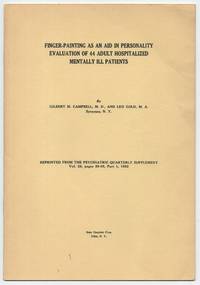
1952rif. 461205Utica New York: State Hospital Press 1952. Softcover. Near Fine. Offprint. Small quarto. 11pp. Not illustrated. Printed wrappers. A bit of foredge creasing throughout just about near fine. Reprinted from the Psychiatric Quarterly Supplement Vol. 26 1952. Uncommon. State Hospital Press unknown books
2021rif. 500153134Flammarion 2021 240 pages 13 6x20 8x2 2cm. 2021. Broché. 240 pages.
1996(Codice OR/0068) In 8° (27 cm) 184 pp. Catalogo d'asta: 376 lotti tutti illustrati con 72 tavole fotografiche a colori. Prezzi di stima in dollari. Brossura editoriale. Ottimo. ~~~ SPEDIZIONE IN ITALIA SEMPRE TRACCIATA
rif. 1575254492.Gpaperback. Good. Access codes and supplements are not guaranteed with used items. May be an ex-library book. paperback
2023rif. 006178UK: Harper Collins 2023. SIGNED BY AUTHOR AND DATED on Limitation page. #36 of 250. First Edition/First Printing UK. Fine condition. Includes beautiful illustration by Levi Pinfold seperate from book. Fine condition. Brodart protected ships in a box. Signed by Author. First Edition UK. Hard Cover. Fine/Fine. Harper Collins Hardcover
rif. 9780008582043CHILDREN�S FICTION. New. New CHILDREN�S FICTION unknown