West, J BBiblio.com
17.560 resultados
1980ref. xxx021Rosalia: Privately Published 1980. First Edition. Soft cover. Very Good. 1st printing date of issue suggested by library copies. 4to pictorial wraps. 210pp. Illus. Index. Maps including folding map "Mood Flat Eden Valley and Turnbow Flat 1910." Signed by West. Laid in is a printed order form for the book browned across top. Survey of this vast wide-open remarkable country in SW Washington. Near fine. Very scarce. Privately Published unknown
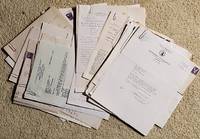
1950ref. 2406045Spokane: n.p. 1950. Soft cover. Very Good. Original letters and envelopes. I met Peltier only once but mainly I remember his remarkable bookstore filled with treasures. Peltier over the course of his bookselling career wrote without ceasing it seems to authors librarians publishers government authorities on various subjects asking for information signatures stories books etc. In turn many of them wrote back and he saved their correspondence. Remarkably he had old-timers and pioneers write monographs in their own hand about their experiences. This group also includes book orders from various people as well as Peltier's questions about various subjects specific to each party. Almost all letters have their mailing envelopes. To be clear I did not find stunning groundbreaking information in this big packet of correspondence but they are all still personal to some degree. From: Clarence Gorchels 1953 State College of WA Keith Murray 1953 WA State Advisory Board on Historic Sites Louis Caywood 1951 Ella Clark 1950 State College of WA Mary Masterson 1948 student at Whitman College 2 letters Richard Montgomery 1942 author Young Northwest 2 letters John Hotchkiss 1946 Publishers Western Representative Santa Monica Helene Magaret 1944 author of Father DeSmet J. Ronald Todd 1945 Northwest Librarian U of WA library Mary Lewis 1945 donated at collection to Maryhill Museum WA B. H. King D.D.S. 1950 three page handwritten letter on Hotel Marysville CA hotel talking above visiting the Britzmans authorities on Charley Russell plus another letter in 1946 Kenneth Roberts 1945 author of Northwest Passage Ellen Centers 1945 Garibaldi Or writer who has a story she wants someone to write Blanche C. Grant 1945 from Taos authority and author on the Southwest C. F. Allen 1945 an old-timer Elizabeth Marion 1944 author from Spangle WA J. Chadwick Brooks 1945 Hudson's Bay Society Record - clutch of letters pertaining to Peltier catching up on his membership and acquiring several years of annual publications F. M. Setzler 1946 Sect'y Advisory Board US Dept of Interior Lancaster Pollard 1945 Supt. Oregon Hist Soc. re Philip Ashton Rollins 1946 cattle trade historian; brief note from his wife telling Peltier that Rollins is quite ill C. M. Brewster 1945 State College of WA in Pullman clutch of letters / lists of books Peltier is offering the library Ronald F. Lee Chief Historian US Dept of the Interior Fred Lockley 1943-49 noted Seattle bookman and reprint publisher of Pacific Northwest historical booklets clutch of letters Ernest Horn College of Educ. State Univ of Iowa John C. Kuhns 1945 Ass't. Regional Forester U S Dept of Ag F. E. Thieme 1945 Ass't. Regional Forester signed by "acting" individual Elmer Hall 1945: Hall says he has nothing to give Peltier "due to my situation during the Nez Perce War." Arthur H. Clark Co. 1946 re Settle's The March of the Mounted Rifleman R. P. Newland 1945 District Engineer State of WA Dept of Highways. Almost all of these letters and envelopes are in very good condition. n.p. unknown
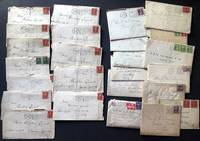
ref. H27660Very good. A remarkable group of 13 letters from Leib or Leybe Salmon 1869-1955 b. in either Lithuania or Poland a Jewish merchant of dry goods sundries shoes glass and silver -- M. Salmon & Son Beaver Falls -- to his cousin Bertha Quint in the Lower East Side of New York City wooing and courting her and arranging to marry her. Their son Jacob was born in 1907 J. Quint Salmon would serve as Judge in the Court of Common Pleas in Beaver County from 1970-1979. These are supplemented by letters to Bertha Quint Salmon from other family members including their son. For the first several years the couple and their child lived with Leib's parents Mayer and Rebekah before getting a place of their own. The letters offer a window into Jewish traditions in western Pennsylvania and into the close-knit ties of family and kinship among immigrant Jews. We will give a short summary of the contents of each of the 13 letters from Leib to Bertha and a general summation of the rest of the letters. Each has its original envelope with clearly legible postmarks and Salmon was a good writer. Although according to censuses Yiddish was their primary language all but one of these letters is in English. 1 Dec. 5 1905. 3 pp. "I am very glad that you got your suit and that you are so pleased with it and trust you look so well in it but you know a good looking girl looks good in anything she wears and that is what I think of you. I only wish I could see you now. I think I can arrange for your furs so you will get a nice set. I wish you would look around and write me what style you would like." He concludes with sincere expressions of affection. 2 Dec. 27 1905. 3 pp. Salmon reports he's working hard up to midnight each night and that in regards to the furs "I don't believe in selecting wearing apparel of that kind for you without you seeing it and have you pleased." He suggests that Bertha go to Lipman & Myers on E. 11th St. and select what would suit her best and that they would treat her right if she presented a letter of introduction from him. "I think that a throw over is a good style so you get it in a nice fur don't get a cheap one and if he has none to suit you don't get any." He expresses sorrow in hearing how hard she is working and hope that it will be better in the future. In a postscript he suggests besides fur Tibet lamb or astrakhan in black "for grays are worn to death." 3 Jan. 28 1906. Leybe is happy she is well pleased with her furs but "In reading your letter between the lines you seem to take it as an imposition from myself on you that you had to get them yourself but I can't see it that way." He recounts going to the theater to see "Hop" Ward in "The Grafter" and that he thought of her all evening as the last time he had been to a play it had been with her and hopes the next time he sees a play it will be with her and "don't forget all the nice things you have to tell me when I come to New York for it may be 3 to 4 weeks before I come." 4 Feb. 22 1906. 2 1/2 pp. He writes of his happiness at the family news she passes on. "Bertha the reason I did not answer your letter before this is I was ready to leave for New York on the 11th but the weather got cold and business revived so I had to postpone my trip and now if nothing happens I intent to leave Sunday March 4th." 5 April 1 1906. 3 pp. He expresses happiness with the letter she wrote him. "Your anxious question in regard to what my folks had to say is quite natural. I assure you that there never has been the least question between my folks and my self in regards to you. the only hint that they gave me was that I should make the wedding in B. F. Beaver Falls and as much as I would like to have them all at our wedding it would be an imposition on me to ask you to do it in as much I am opposed to it my self. Dear Bertha I want you to know that it was not that Wednesday night that I made my mind up it was a settled question with me for a long time: it was absolutely you and you only and when you said yes I was the happiest baby boy and the more I think of you the more happier I am." He concludes with some remarks regarding his cousins Julius and Sadie etc. 6 May 10 1906. 2 1/2 pp. He opens with some remarks about Sadie and her folks and that his mother is recovering from an illness corrects a false impression she might have had of a remark he made about good taste. "Dearest Bertha you want to know my idea if absence makes the heart grow fonder. I would say it does if the love is of the fervid passion nature. I assure you my dear that I am not in that class of lovers. My love for you is pure and honest and I have the greatest faith in you and it makes very little difference to me whether it is in absence or in presence." At the end in a postscript he grouses that she omitted the traditional "xxx" at the end of her last letter and wonders about its significance. 7 June 17 1906. 2 1/2 pp. He expresses happiness that Bertha has left her employment presumably to get ready for the move to Beaver Falls but is defensive about her response to his questions concerning the financial feasibility: "Bertha Dear I don't want an itemized statement of what you are getting it is not my disposition at all I was only trying to make it as easy and light for you as possible neither was I trying to give you lessons on economy it was only to save you a lot of hostling and worry as I know what it means for a girl to get ready for an occasion of that kind." 8 June 28 1906. 6 pp. In this letter he makes plans for the wedding including printing invitations and a possible wedding date -- August 6 -- but begins with a touching sentiment: "My Dear Bertha in accordance with the Hebrew calendar last Sunday was 22 years since we arrived in New York it is just about that time I saw you first you was running around in a little skirt but I had no idea then that in 22 years later will be so near our wedding and I believe you were also ignorant of the fact at that time." It appears that the wedding will not be in Beaver Falls after all: later in the letter he writes "Dearest you also question me in regards to my folks whether they are coming to our wedding. I am very sorry to say that I don't think they will. Father told me some time ago that it is too much for him as he is so unused to traveling and it would be so much harder for Mother to undertake it but don't let this worry you 'dear' I assure you of their anxiety to be at our wedding." 9 July 8 1906. 4 pp. In response to a letter from Bertha he found "full of arguments" Leib defends his choice of August 6th as a wedding date; "I will say the only reason I have for fixing the date on the 15th day of Ab which is the 6th of August is in as much as I don't pause to be pious but I like to observe anything in religion which don't cause me much inconvenience." He then discusses the Hebrew law regarding fasting on a wedding day and the possibility if she wants of the wedding to be held on Sunday August 12th which would probably result in a larger crowd but would also create more work for her and her helper Mary. 10 July 15 1906. 3 1/2 pp. It would appear that Bertha got her wish to change the wedding date to the 12th of August but Leib in this letter informs her that's not going to work either that would be the "21st day of Ab in the Jewish month. Father objects to have it on the old "chodesh" he says it's not right. So the first Sunday in 'Ellul' is 26th of August and I think it's the best we can do now." He reports that the clerks from the store will all be back from their annual vacation by the 10th of August and he will leave after that. He also cautions her against sending any invitations to his side of the family "as it will cause bad feelings for the rest and also look bad for outsiders as I want to be clear of it so I can say I did not invite anybody. When you get them printed 'dear' send me 3 or 4 of them." 11 July 29 1906. 3 pp. Leib refuses a suggestion from Bertha to change his name from Leybe to Louis. "I regret very much that I can't and will not consent to that request as I think Leybe is a much prettier name than Louis. In the Jewish Encyclopedia it is spelled Leib I have thought some time to spell it that way but will not have Louis." He does ask his wife to make some suggestions as to what he should wear at the wedding and also laments that she is shopping for goods for their life together when his dry goods store has all that they would need. 12 August 6 1906. 3 pp. Leybe assures Bertha that he's not angry with her for suggesting a name change but that he has a simple reason -- everyone knows him as Leybe and changing his name would be "silly." He also can't believe six months have passed since their last parting kiss on a railway platform and that in two weeks they would be married. 13 August 13 1906. 3 pp. Leybe has received the printed invitations he's requested but remarks that the date given for the wedding is JUNE 26th not August and that she can correct this before sending out the invitations. He has also implored her a number of times regarding the wedding not to make "a fuss" about it and to keep it simple; on hearing that she's going to have music at the wedding he remarks that music is something he can do without. It's just "common sense " he says. And that's the last letter he wrote before departing for New York on the 15th. The rest of the letters are from the mid-to-late 1930s to 1941: most are from a favorite niece of Bertha's in Brooklyn named Ruth who writes newsy letters about her family and Bertha's with several snapshots enclosed in one of them. A few are from their son Jacob including one written in his late twenties as he's visiting friends in the Boston area remarking on how impressed he was with Harvard's Law Library and its statue of Cardozo seeing it was quite a thrill for him and full portrait of Holmes. A rather longer letter from 1941 by which time he's married expresses concern about his father's health. There is also a letter in Yiddish to Bertha from a Mrs. Nathan Goldfarb dated 1933 from the Cincinnati area. The personalities of Leybe and Jacob come through in these letters: Leybe seems old before his time stuffy and prickly but with an admirable sincerity and a strong capacity to love; Jacob comes across equally sincere and a devoted and caring sort with a fine character. Beaver Falls for a small western Pennsylvania town had a fairly established Jewish population by the turn of the century and by the end of the 1920s the town had at least four synagogues supporting a several-hundred strong community of Jews in the Beaver Valley. unknown
1850ref. 68036Northumberland NY and Tuolumne County CA. 1850–1857. New Yorker in the "Land of Gold" A scattered but intriguing collection of manuscripts related to New York native Isaac Vanderwerker or Vanderwarker who made for the California gold mines in 1850 and remained out west until at least 1857. This group consists primarily of letters written to Isaac by his brother at home in Northumberland inquiring after Isaac's activities in the gold fields and commenting on matters at home though it also contains a detailed letter from Isaac himself a letter from his ill-fated sister Joann and two letters written by business partners in California. The earliest letter here written by Isaac's brother who signs only with initials is dated October 7 1850 shortly after Isaac arrived in California. Isaac was apparently one of many gold-seekers who elected to take a slow sailing ship from Panama rather than wait on the heavily delayed steamships though he weathered the journey better than most. Isaac's brother also notes several acquaintances who "have returned without making their fortune" and still more who are leaving regularly for the mines including a "Justus" who "made a vendue and sold his personal property" in order to fund the journey. Everyone in town it seems either wants to head to California or has an excuse not to. "I hope you will be one of the lucky ones and get well paid for all your toil sufferings and anxieties" he writes to his brother. "We have most of the California news every month. I saw in the last paper an account of the riot and burning of Sacramento City it spoke of some large lumps of gold being taken out weighing from one to forty pounds at Carsons new diggings on the Stanislaw another instance where a man took out four thousand dollars in two days at Murphy diggings but these cases are something extra John L. Cramer is at the Northern Mines on the Yuba…." The Vanderwerkers were early settlers of upstate New York and appear to have done well for themselves – Isaac and his brother are involved in several substantial properties and much of their correspondence relates to the management of their farms. The next letter in the group comes from the following summer written by Isaac's sister Joann. Joann discusses more details of the family's properties and notes that her health is poor enough that she is not sure to see the end of the week. Regardless news of California remains at front of mind: "There is a story in circulation that Aron Bliss Jaines Brother in law has stoll 15 thousand dollars at San Francisco and the owner has followed him here and there a going to take him back and hang him. John Cramer is on the yube never his Father said he guest by his writing he was not doing very well." From here we skip two years to October 16 1853 when Isaac's brother writes to tell him that large numbers are still heading for California. Joann has been holding on the last two years and "Old Frank" who used to work with them before moving to Canada would like to know if Isaac has work for him in California. He also goes on to discuss a bit of contentious New York politics: "We shall have five state tickets this fall viz whig Barnburner or soft hunker Adamantine or hard Temperance & abolition. The whigs no dout will carry the Election. The Barnburners had quite a majority in the State Convention….the Canal board are Barnburners & they are making a clean sweep of the hunkers." The letters continue over the next few years regarding more transcontinental legal matters real estate dealings Joann's eventual death in 1855 and the usual litany of deaths and marriages at home. The most content rich letter in the group is the only one written by Isaac himself sent to New York from Tuolumne County on May 18 1857. As Isaac describes his life in the west he also reveals himself to be a talented writer: "Dear Brother I will again endeavour to correspond with you by a few rude caught characters on paper which may put you in mind that you have a Brother Still in the land of gold…." He sends some gold home not present describes a chance meeting with the aforementioned John Cramer remarks on the high cost of goods in the mines and recent fires in San Francisco and Stockton. Business isn't cheap in the "land of gold" and he claims he "can do as much business in the States for 10 Dollars as I can Here for one Hundred." With that in mind he adds a postscript stating that he has sold out his plot and mining apparatus for $1500 and will try to go into business burning lime or supplying bricks and lumber in Benicia. He describes the new town and the rapid pace of development in California: "Benicia is situated about thirty miles up the Bay from San Francisco and about Six miles from the present Capital of the state named Vallejo. About three months ago the first building was erected which is a Hotel about two weeks ago they commenced building there is now about twenty small houses up and one three story Hotel. The government officers reside at Vallejo after the 10 of this month. I had an introduction to the governor at Vallejo last week he is a clever sort of man but not Dignified hardly fit for the Station…." Isaac's brother responds to this letter a few months later curious about his sibling's new business ventures. He also comments that "by what I can learn of the character of the Mexicans and Indians I should hate to travel alone without being well armed. I see by our papers that Lynch Law is that that governs all the mines I saw an account of a man being hung at San Francisco by Mr. Lynch at short notice." Unsurprisingly more and more are returning home by 1857 including a man named Wells " come in the same steamer your letter did he was sick but made out to keep up till he got home and died less than a week after he was not very successful in California." A heartfelt letter from a friend about the health of Isaac's mother also present seems to have convinced him and Isaac returned home for a visit to New York in the latter part of 1857. A September 3rd letter from his business partner John W. Kelly sent from Sawmill Flatt is addressed to Isaac in Saratoga and discusses business dealings in California. It would appear Isaac never pulled completely out of mining as the letter regards efforts to secure mortgage payments for Isaac's "ditch." The final letter in this collection is dated December 17 1857 and is addressed to Isaac from the offices of A.C. Goodrich in Columbia California. Goodrich describes a large flume his company has built 180 miles long and twelve feet wide by three feet deep "exclusive of the artificial embankment or five hundred ton stream capacity this day and night as we have reservoirs in abundance to hold the night & Sunday water. Would give 1000 ton streams which sold at the precent price viz $4.00 per day would pay ten per cent on a Capital of $1000.000. This would give a large basis for waste and reduction in price and still leave room for handsome profits on our Capital stock of $450000. The present cost of the work we can only approximate to but it is not far from 100000$." They hope that Isaac can become their agent and help them find investors. An interesting group of letters sent between brothers in California and New York during the Gold Rush stretching across seven long years of separation. Old folds occasional light tanning and staining. Very good. unknown books
1850ref. 68036Northumberland NY and Tuolumne County CA. 1850–1857. New Yorker in the "Land of Gold" A scattered but intriguing collection of manuscripts related to New York native Isaac Vanderwerker or Vanderwarker who made for the California gold mines in 1850 and remained out west until at least 1857. This group consists primarily of letters written to Isaac by his brother at home in Northumberland inquiring after Isaac's activities in the gold fields and commenting on matters at home though it also contains a detailed letter from Isaac himself a letter from his ill-fated sister Joann and two letters written by business partners in California. The earliest letter here written by Isaac's brother who signs only with initials is dated October 7 1850 shortly after Isaac arrived in California. Isaac was apparently one of many gold-seekers who elected to take a slow sailing ship from Panama rather than wait on the heavily delayed steamships though he weathered the journey better than most. Isaac's brother also notes several acquaintances who "have returned without making their fortune" and still more who are leaving regularly for the mines including a "Justus" who "made a vendue and sold his personal property" in order to fund the journey. Everyone in town it seems either wants to head to California or has an excuse not to. "I hope you will be one of the lucky ones and get well paid for all your toil sufferings and anxieties" he writes to his brother. "We have most of the California news every month. I saw in the last paper an account of the riot and burning of Sacramento City it spoke of some large lumps of gold being taken out weighing from one to forty pounds at Carsons new diggings on the Stanislaw another instance where a man took out four thousand dollars in two days at Murphy diggings but these cases are something extra John L. Cramer is at the Northern Mines on the Yuba…." The Vanderwerkers were early settlers of upstate New York and appear to have done well for themselves – Isaac and his brother are involved in several substantial properties and much of their correspondence relates to the management of their farms. The next letter in the group comes from the following summer written by Isaac's sister Joann. Joann discusses more details of the family's properties and notes that her health is poor enough that she is not sure to see the end of the week. Regardless news of California remains at front of mind: "There is a story in circulation that Aron Bliss Jaines Brother in law has stoll 15 thousand dollars at San Francisco and the owner has followed him here and there a going to take him back and hang him. John Cramer is on the yube never his Father said he guest by his writing he was not doing very well." From here we skip two years to October 16 1853 when Isaac's brother writes to tell him that large numbers are still heading for California. Joann has been holding on the last two years and "Old Frank" who used to work with them before moving to Canada would like to know if Isaac has work for him in California. He also goes on to discuss a bit of contentious New York politics: "We shall have five state tickets this fall viz whig Barnburner or soft hunker Adamantine or hard Temperance & abolition. The whigs no dout will carry the Election. The Barnburners had quite a majority in the State Convention….the Canal board are Barnburners & they are making a clean sweep of the hunkers." The letters continue over the next few years regarding more transcontinental legal matters real estate dealings Joann's eventual death in 1855 and the usual litany of deaths and marriages at home. The most content rich letter in the group is the only one written by Isaac himself sent to New York from Tuolumne County on May 18 1857. As Isaac describes his life in the west he also reveals himself to be a talented writer: "Dear Brother I will again endeavour to correspond with you by a few rude caught characters on paper which may put you in mind that you have a Brother Still in the land of gold…." He sends some gold home not present describes a chance meeting with the aforementioned John Cramer remarks on the high cost of goods in the mines and recent fires in San Francisco and Stockton. Business isn't cheap in the "land of gold" and he claims he "can do as much business in the States for 10 Dollars as I can Here for one Hundred." With that in mind he adds a postscript stating that he has sold out his plot and mining apparatus for $1500 and will try to go into business burning lime or supplying bricks and lumber in Benicia. He describes the new town and the rapid pace of development in California: "Benicia is situated about thirty miles up the Bay from San Francisco and about Six miles from the present Capital of the state named Vallejo. About three months ago the first building was erected which is a Hotel about two weeks ago they commenced building there is now about twenty small houses up and one three story Hotel. The government officers reside at Vallejo after the 10 of this month. I had an introduction to the governor at Vallejo last week he is a clever sort of man but not Dignified hardly fit for the Station…." Isaac's brother responds to this letter a few months later curious about his sibling's new business ventures. He also comments that "by what I can learn of the character of the Mexicans and Indians I should hate to travel alone without being well armed. I see by our papers that Lynch Law is that that governs all the mines I saw an account of a man being hung at San Francisco by Mr. Lynch at short notice." Unsurprisingly more and more are returning home by 1857 including a man named Wells " come in the same steamer your letter did he was sick but made out to keep up till he got home and died less than a week after he was not very successful in California." A heartfelt letter from a friend about the health of Isaac's mother also present seems to have convinced him and Isaac returned home for a visit to New York in the latter part of 1857. A September 3rd letter from his business partner John W. Kelly sent from Sawmill Flatt is addressed to Isaac in Saratoga and discusses business dealings in California. It would appear Isaac never pulled completely out of mining as the letter regards efforts to secure mortgage payments for Isaac's "ditch." The final letter in this collection is dated December 17 1857 and is addressed to Isaac from the offices of A.C. Goodrich in Columbia California. Goodrich describes a large flume his company has built 180 miles long and twelve feet wide by three feet deep "exclusive of the artificial embankment or five hundred ton stream capacity this day and night as we have reservoirs in abundance to hold the night & Sunday water. Would give 1000 ton streams which sold at the precent price viz $4.00 per day would pay ten per cent on a Capital of $1000.000. This would give a large basis for waste and reduction in price and still leave room for handsome profits on our Capital stock of $450000. The present cost of the work we can only approximate to but it is not far from 100000$." They hope that Isaac can become their agent and help them find investors. An interesting group of letters sent between brothers in California and New York during the Gold Rush stretching across seven long years of separation. Old folds occasional light tanning and staining. Very good. unknown
1980ref. 2090502113709004Not Available 1980. Soft Cover. Fine. Number of books: 1 Not Available paperback
ref. 0876056184New. New. Satisfaction Guaranteed or your money back. unknown
ref. 1655London: Collins 1946. First edition. Hardcover. Very Good. Octavo green cloth pp. 256; numerous illustrations. Signed presentation copy inscribed by Grierson to Bert Richardson of the Saskatchewan Star Phoenix dated in December of 1946. A brief typed letter signed from Grierson is laid in. The book was likely sent for the purpose of securing a review and bears occasional ink underlining in the text. Spine slightly faded and with some bubbling to the publisher's cloth covers else very good. Lacks dust jacket. London: Collins, 1946. First edition. hardcover
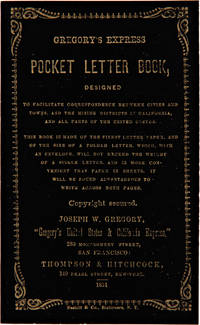
1851ref. 320912San Francisco: Joseph W. Gregory 1851. 20 blank leaves. 24mo. Original dark purple wrappers printed in gilt. Minor ink stains on inner wrappers otherwise a near fine copy with the original unused plain paper envelope. 20 blank leaves. 24mo. A lovely example of an unused Gold Rush letter book intended to advertise Joseph Gregory's California and New York Express Line by means of a convenient way for gold seekers in California to communicate with friends and family back home. According to the wrapper "this book is made of the finest letter paper and of the size of a folded letter which with an envelope will not exceed the weight of a single letter and is more convenient than paper in sheets Joseph W. Gregory unknown books
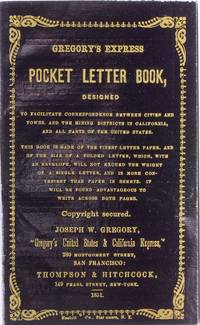
1851ref. 58179San Francisco: Thompson & Hitchcock 1851. Lovely Unused California Gold Rush Letter Book A lovely example of an unused Gold Rush letter book intended to advertise Joseph Gregory's California and New York Express Line as a convenient way for gold seekers in California to communicate with friends and family back home. Gregory's California Express according to the wrapper is "one of the oldest established in the business dispatch messengers BY EVERY STEAMER leaving New-York and San Francisco in charge of Letters Parcels Packages Gold Dust and valuables for distribution throughout the United States and California." Also according to Gregory's text "this book is made of the finest letter paper and of the size of a folded letter which with an envelope will not exceed the weight of a single letter and is more convenient than paper in sheets." The inside rear wrapper prints two testimonials from the PANAMA STAR praising the express line's speed and volume. Gregory also published a pamphlet titled GREGORY'S GUIDE FOR CALIFORNIA TRAVELLERS; VIA THE ISTHMUS OF PANAMA 1850 primarily to promote his business. A scarce and well-preserved piece of Gold Rush ephemera here with the original unused envelope. 24mo. Original dark purple wrappers printed in gilt. Very minor wear to wrapper edges. Near fine with the original unused plain paper envelope. unknown books
1851ref. 320912San Francisco: Joseph W. Gregory 1851. 20 blank leaves. 24mo. Original dark purple wrappers printed in gilt. Minor ink stains on inner wrappers otherwise a near fine copy with the original unused plain paper envelope. 20 blank leaves. 24mo. A lovely example of an unused Gold Rush letter book intended to advertise Joseph Gregory's California and New York Express Line by means of a convenient way for gold seekers in California to communicate with friends and family back home. According to the wrapper "this book is made of the finest letter paper and of the size of a folded letter which with an envelope will not exceed the weight of a single letter and is more convenient than paper in sheets Joseph W. Gregory unknown
1851ref. 58179San Francisco: Thompson & Hitchcock 1851. Lovely Unused California Gold Rush Letter Book A lovely example of an unused Gold Rush letter book intended to advertise Joseph Gregory's California and New York Express Line as a convenient way for gold seekers in California to communicate with friends and family back home. Gregory's California Express according to the wrapper is "one of the oldest established in the business dispatch messengers BY EVERY STEAMER leaving New-York and San Francisco in charge of Letters Parcels Packages Gold Dust and valuables for distribution throughout the United States and California." Also according to Gregory's text "this book is made of the finest letter paper and of the size of a folded letter which with an envelope will not exceed the weight of a single letter and is more convenient than paper in sheets." The inside rear wrapper prints two testimonials from the PANAMA STAR praising the express line's speed and volume. Gregory also published a pamphlet titled GREGORY'S GUIDE FOR CALIFORNIA TRAVELLERS; VIA THE ISTHMUS OF PANAMA 1850 primarily to promote his business. A scarce and well-preserved piece of Gold Rush ephemera here with the original unused envelope. 24mo. Original dark purple wrappers printed in gilt. Very minor wear to wrapper edges. Near fine with the original unused plain paper envelope. unknown
ref. 1023398095.Ghardcover. Good. Access codes and supplements are not guaranteed with used items. May be an ex-library book. hardcover
2000497 pages including index. Accessible, comprehensive, and entertaining, this is The book for anyone gardening in a greenhouse or sunspace. Light wear. Unmarked. Binding solid. Excellent copy. Book
1970(Cameo series)Smail illustrated handbook on Greek and Roman gems and jewellery. 157p. plates (col.) Book
1966The only flaw is the shadow of an old price sticker on the first endpaper. Pages clean and unmarked, binding tight - looks unread. There are some small damaged sections on the dust jacket, which is now protected by a plastic sleeve.235p. Illus B & W in text + 68 pages of photographs, Appendices, indexes Book
Madrid, 1999. 4to. mayor; 361 pp. Ilustraciones. Cubiertas originales.
1954ref. 017483Portland OR: Harold O. Leloff & Associates 1954. First Edition. Hardcover. Very Good. 8-1/2" x 9-1/2" Hardcover; 86pp; Green textured boards with titling to front boards square clean & bright text unmarked binding is tight VG condition. Scarce vintage directory of and advertisements for a variety of businesses in the eastern section of Portland Oregon in the 1950s. Includes the area of the city east of 50th Ave. Illustrated throughout with photos and ads. Fascinating snapshot of Portland in the 1950s. Published by an advertising and public relations firm. Harold O. Leloff & Associates hardcover
ref. 1414108834.Gpaperback. Good. Access codes and supplements are not guaranteed with used items. May be an ex-library book. paperback
1996ref. Q-0517701065Clarkson Potter 1996-10-29. Hardcover. New. In shrink wrap. Looks like an interesting title! Clarkson Potter hardcover
1996128 pages. "You don't need loads of experience, expensive lumber, or fancy tools to make attractive furniture for your home - just a few 2x4 boards and stock lumber will do to make furniture as good as anything custom-made." - from dust jacket. For each finished project, there are complete material lists, numbered illustrations, full-color photos, and easy directions any beginner can follow. Clean, bright and unmarked with lightest wear. Excellent copy. Book
1694ref. V67948London: Rhodes Meredith Harris & Newborough 1st edition in English 1694. Hardcover. Good. Folio calf but lacking spine leather damage to cover leather also/corners v.worn Licence leaf precedes TP TP in red & black 6pp of Subscribers 4p=Preface over 1165pp which is A-Z with Finis in mid page of last leaf. TP & License leaf with tears but no loss verso's sl.soiled and re-inserted.Newer EPS. Good wide margins no writing no worming a neat complete copy of the best edition of this first Historical Dictionary in English. Later editions were edited by Collier and appear under his name while this has no translator or editor given although the work is a compilation of the major classical dictionaries in Latin and French WING M-2725. Rhodes, Meredith, Harris & Newborough (1st edition in English) hardcover
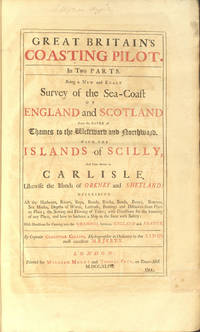
1744ref. 007689London: Tower-Hill: William Mount and Thomas Page 1744. 1st Edition 4th Printing. Hardcover. Very Good. Elephant Folio - over 15 - 23" tall. COLLINS Greenvile Captain. The most important work in the history of British maritime cartography. A Landmark in the Charting of Great Britain. Folio 18th century mottled half calf over blue-green marbled paper boards decorative gilt spine red morocco lettering piece pp. iv 26. Fine allegorical copperplate title incorporating a small map of the British Isles letter press title printed in red & black 47 copperplate charts & profiles 5 folding 3 single page the remainder double page & one chart in the text at p18. A couple of the folding maps just torn at fold some browning & offsetting text spotted in places but still a handsome copy. First published in 1693 & reissued many times throughout the eighteenth century this formidable & costly project was the first systematic survey of British coastal waters Moreland & Bannister Antique Maps 3rd ed p163. 511322 mm. Phillips 5199. Moreland & Bannister. In 1667 the Dutch sailed up the Thames & destroyed a great part of the British Navy in the Medway & bombarded Chatham. and the Government was shaken. by the realisation that the Dutch new more about the coastline of England than the English themselves & their confidence was not increased when it was found that John Seller in producing the first volume of his marine atlas the English Pilot in 1671 was still using Dutch plates & often very old ones at that. As now government was tardy in action & it was not until 1681 that Samuel Pepys as Secretary of the Navy instructed Captain Greenville Collins to carry out a survey of British coasts & harbours. In due course after a seven year survey Captain Collins issued in 1693 the Great Britain's Coasting Pilot an outstanding work consisting of 48 charts the first complete Pilot Book in English of all the coasts of Great Britain & the surrounding islands with special attention of course to the ports Moreland & Bannister. In 1693 he finally published his results in a folio volume of two parts Great Britain's Coasting Pilot containing sailing directions tide tables coastal views & about forty-nine charts. The charts were not completely accurate but with all their shortcomings they were an enormous advance on anything before them & entitle Collins to rank not only with the earliest but with the best of English hydrographers. The work covered England and Scotland & though Collins proposed a further study to cover Ireland the plan came to nothing. Collins recorded that he had spent £40 on instruments & charged £80 for the 120 manuscript maps he delivered. With his claim for expenses set at £200 per annum & his wages of £394 10s. he claimed a total of £1914 10s. for his work which was eventually paid in arrears. The cost was more than three times the original estimate. His cousin Freeman Collins printed the Coasting Pilot which Richard Mount sold. Mount's subsequent firm then went on to publish twenty-one further editions of the pilot throughout the nineteenth century. William Mount and Thomas Page hardcover
ref. 1334579954.Gpaperback. Good. Access codes and supplements are not guaranteed with used items. May be an ex-library book. paperback
1991Lorenzo Editore, dicembre 1991. Collana di Poesia Janus. Prima edizione. Spedizioni tracciabili con raccomandata entro 24 ore dall'ordine. First edition. Soft cover in fine conditions, no inscriptions or markings inside. Worldwide delivery.