Avner GoldBiblio.com
Dr Or Professor Slav GratchevBiblio.com
Cultural Models and Collective Mentalities in Literature Art and Philosophy
ref. 50455880like new. unknown
GreatBookPrices · Estados UnidosUS$ 116,74≈ € 104,49
2023ref. SKU1714906Mesorah Publications Ltd 2023-11-01. paperback. New. 6x9x2. New Book Ships with Tracking Mesorah Publications Ltd paperback
ref. 50455880like new. unknown
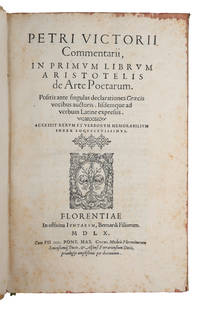
1610ref. 62508Florence In officina Iuntaru Barnardi Filiorum 1560. Small folio. 18th century full vellum with gilt labels to spine. Wear to capitals and small worm tracts towrad opper hinges. Corners a bit bumped. A very nice and sturdy binding. Marbled edges. Some browspotting throughout. Small wormholes to blank margin of final leaf far from affecting imprint. Woodcut vignette to title-page and to verso of colophon-leaf. 10 308 12 ff. The rare first edition of Vittore's main work his great edition translation and commentary on Aristotle's Poetics which is arguably the most important and influential commentary on the work ever published profoundly shaping our understanding and interpretation of Aristotelian literary theory. Petrus Victorius or Piero/ Pietro Vittore/Vettore 1499-1584 is not only the “first great editor of the Poetics” McMahon he is also considered "the greatest Greek scholar of Italy" Whibley “the leading Italian scholar of his time” Encycl. Britt. “the last great figure from that period in the domain of Greek studies” Willamowitz and “the foremost representative of classical scholarship in Italy during the sixteenth century which for Italy at least may well be called the “saeculum Victorianum”.” Sandys. His magnum opus and without doubt most influential work is his edition with commentary of Aristotle’s Poetics which is of seminal importance in several respects. It is crucial to our understanding of Aristotle’s great work shaping the way that all later scholars have read it. The understanding of Aristotle’s work on poetry came to define the way that we have understood literature and fiction ever since the Renaissance and Victorius is the leading interpreter. ““From the sixteenth century to Romanticism European literary theory used the term marvel or wonder It. meraviglia ammirabile Fr. merveille Sp. maravilla to designate everything that was on the conceptual margins of the poetics of probability and imitation. The discovery and complete reception of Aristotle’s Poetics between the fifteenth and sixteenth centuries resulted in the dissemination of an idea of poetry as the imitation of the actions of men whose main part was the plot or the structuring of actions ordered according to the laws of necessity credibility and probability. This formed the basis of Neo-Aristotelian poetics which determined the ways of thinking about literature and fiction for more than four centuries.” Vega p. 280. Especially the idea of “wonder” in Aristotle’s Poetics came to be one of the founding ideas of modern literary theory. And especially here Victurius’ reading is groundbreaking playing a central part in the reception and understanding of the work over the centuries to come. “A single editorial decision in just one passage and what is more in a complex fragmentary unfinished text like the Poetics affects the entire work…” Vega p. 284. “The text of the Poetics that can be read in the editions and translations of the sixteenth century and a large part of the seventeenth with one exception as we shall see NB. This exception is Victorius does not include the term alogon in the passage that deals with wonder. It does not appear in the first Greek edition the famous Aldine princeps of 1508 or in the Latin translations of the end of the fifteenth century; it is not in the edition and translation by Alexander Paccius or Pazzi the one most widely read in the sixteenth century neither does it appear in the edition with commentary by Francesco Robortello nor in Vincenzo Maggi’s Enarrationes nor in the vernacular commentaries of Ludovico Castelvetro and Alessandro Piccolomini. What is more a detailed revision of the history of the text reveals that no manuscript of the Poetics and no direct or indirect testimonies not even in the Arabic branch of its transmission have ever included the term alogon.” Vega p. 282. It is Victorius who is solely responsible for the reading that is generally accepted today as well. “The moment when the idea of irrationality alogon appears for the first time in Aristotle’s text can be identified without hesitation as 1560 which is the date when the edition translation and commentary on the Poetics by the philologist and Hellenist Pier Vettori or Victorius was printed on the presses of Giunti in Florence. Vettori is the one who first edits alogon even though no testimony provides him with this reading and he does so fully aware of his choice and its implications” Vega pp. 287-89. “The success of Victorius’ reading while not immediate was extraordinary.” Vega p. 287 Antonio Viperano accepts the reading “alogon” with all it involves De poetica libri tres Ricciboni adapts it in his edition of Aristotle’s Poetics Tasso embraces it Discorsi dell’arte poetica Discorsi del poema eroico and it is implicit in Alonso López Pinciano’s Philosophia Antigua Poetica. Vossius in 17th century Germany makes abundant glosses on alogon in his books on poetics and the commentators and translators of the “Poetics” in France preferred Victorius’ reading in every case. “Victorius’ conjecture seems to have convinced all editors and commentators who reproduce it without question in every case.” Vega p. 289. The influence of Victorius’ interpretation of Aristotelian literary theory that he presented in his magnum opus i.e. the present work was not limited to the use of specific words that changed the reception history of Aristotle’s Poetics. His entire view of poetry through an interpretation of Aristotle was highly original and came to define the way we understand literature in general. Victorius was one of the first to put forth the belief that heroic poetry should present a Platonic idea of perfect virtue contributing to the centuries long doctrine of the perfect hero as perfect exemplar and he was one of the first to revive Aristotle’s idea of purgation from tragedy still widespread today and to also understand the existence of a purgation from poetry. “He viewed poetry as a moderator of minds “By reading poetry men “become moderate in temper and their turbid motions are extinguished.” Poems “purge our minds of blemish and spot”. Vettori realized that Aristotle’s reference to catharsis should be applied to tragedy alone but he added that similar purgations could be achieved by other kinds of poetry effective however on other passions than pity and fear and with the aid of other instruments.” Hathaway pp. 292-93. Apart from his overall interpretation of Aristotle’s literary theory and his groundbreaking reading of the most central passages of the Poetics Victorius was also the first to determine that the Aristotelian text that has come down to us is not complete. “Victorius was the first to see that the treatise now known as the Poetics is only the surviving portion of a larger work.” Bywater p. XX. “during his lifetime five medals were struck in his i.e. Victorius’ honour and his portrait was painted by Titian… His fame was not limited to his own land or his own time. His scrupulous care and unwearied industry are lauded by Turnebus who declines to be compared with him even for a moment; the epiteths doctissiums optimus and fidelissimus are applied to him by the younger and the greater of the two Scaligers while Muretus calls him eruditorum coryphaeus; and similar eulogies might be quoted from Justus Lipsius. Dacius … and Graevius. He is described as having climbed the “hill of virtue” and taken his place on its summit between Cicero and Aristotle. In his funeral oration Salviati says of him in the personification of Italia: “Now no more shall distant peoples cross the snows of the Alps to see Victorius or men of mark arrive from every land to hear him; or princes hold converse with him. Now no more shall the works of scholars in all parts of the world be sent here for his approval; or youth learn wisdom from his lips.” Sandys pp. 139-40. “No one said a contemporary of his in a funerary laudatio ‘left Aristotle in a cleaner state purgatior’.” Baldi. _____________________________________________ Adams: 1905; Brunet V: 1179; Graesse I: 213 ”édition excellente quant à la critique” and noting that some copies bear the dates 1563 and 1564. Sandys: A History of Classical Scholarship Vol. II 2003 pp. 135-140. Hathaway Baxter: The Age of Criticism: The Late Renaissance in Italy. Cornell University Press 1962. A.Philip McMahon: On the Second Book of Aristotle's Poetics and the Source of Theophrastus' Definition of Tragedy Authors. In: Harvard Studies in Classical Philology 1917 Vol. 28 1917 pp. 1-46. Christopher Rowe: Petrus Victorius and Aristotle’s Eudemian Ethics Cambridge University Press online 2025. Vega Maria José: Wonder and the Irrational. The Invention of Aristotle’s Poetics in the Sixteenth Century. In: Nous Polis Nomos. Berlin Academia Verlag 2016. Baldi: Il greco a Firenze e Pier Vettori 1499–1585 Alessandria 2014 117. hardcover
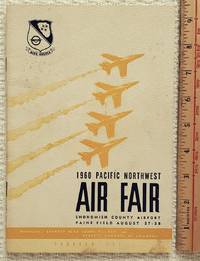
1960ref. SHEL2009Everett: B. P. O. E. 1960. First Thus. Soft cover. Very Good. Original 1960 program. Stapled wrappers. 20 pages. Illustrated with photos and with drawings of six of the maneuvers performed by the Blue Angels team. Abundant advertising in side. The fair as noted on the cover took place at Paine Field / Snohomish County Airport on August 27-28 and was sponsored by the BPOE Benevolent Protective Order of Elks. Quite minor stain spots to covers. 1/4" inch edge tear to fore edge of back cover. A very good copy of a quite scarce book. Very hard to find. B. P. O. E. unknown
ref. SONG8467578106EDICIONES SM 2015-05-13. 1. paperback. Used: Good. 6.81x2.76x8.27. Buy with confidence. Excellent Customer Service & Return policy. EDICIONES SM paperback
2016ref. x-147248066XTaylor & Francis 2016. Hardcover. New. 232 pages. 10.25x7.50x0.75 inches. Taylor & Francis hardcover
ref. ria9780887380259_inpHardback. New. New Book; Fast Shipping from UK; Not signed; Not First Edition; In Ranching Mining and the Human Impact of Natural Resource Development Raymond L hardcover
1767ref. 61751No place nor printer 1767. 8vo. In contemporary marbled paper covered board. Small paper-label pasted on to top of spine. Light wear to extremities internally nice and clean. 4 60 pp. Rare second edition of this work on governance and statecraft. Barbier III 84c5. unknown
1980ref. Alibris.0015774Doubleday Books. 1980. Good in good dust jacket. Foxing to textblock edges. Jacket a bit age-toned. Text unmarked. Boards binding and pages in very good condition. 412 p. Contains: Illustrations. Audience: General/trade. . Doubleday Books hardcover
1952ref. SHEL1928Yakima: n.p. 1952. First Thus. Hardcover. Good. Original Kingscraft Deluxe Covers yearbook with padded & decorated covers over boards. 120pp. Filled of course with class staff and activities photos and with lots of student notes best wishes and all that to the original owner which fill up preliminary and rear pages with some written on interior pages. 1952 was sasquatch icon Roger Patterson's senior graduation year. Little could he have known the fame he would garner over his filming a sasquatch in northern California in 1967. Little did he know that his 1966 book Do Abominable Snowmen of America Really Exist would become one of the most coveted books in the Bigfoot genre. Roger's senior portrait is on page 36 along with his school activities in terms of sports etc.: Boys glee club baseball football Gold Y whatever that is & FFA Future Farmer's of America but not all in his senior year. A bit of a bonus is that this year was also the4 senior year of Al DeAtley Roger's famous / infamous brother-in-law. His portrait is also in the senior class section. What makes this yearbook also a bit of a Patterson-related prize is that in the football section there is a photograph of Patterson carrying the football and being tackled. Very good condition. Traces of wear to cover corners. Very scarce and a must have for a serious collector of sasquatch books and Patterson material in particular. n.p. hardcover
ref. 46558161-nnew. unknown
ref. 49797721like new. unknown
2014ref. 162216New York: Yucca Publishing 2014. 1st edition. As New. octavo. hardback with dust jacket 451pp. A grand historical novel about Gertrude Bell one of the most influential women of the twentieth century. She was the most celebrated adventurer of her day the brains behind Lawrence of Arabia an adviser to kings and desert sheikhs and the British government's secret weapon in WWI in the campaign against the Turks. Presentation copy signed by Alan Gold Yucca Publishing hardcover
1953ref. 76489Barcelona: Edicions Hora 1953. First edition in Catalan Llull's native tongue and the first edition with Campany aquatints. One of XVI special copies. Text printed in Catalan Llull is known for being among the first authors to use his vernacular language Catalan to communicate his ideas. Folio . 175 1 pp. with 11 full page hand-colored etchings drawn engraved and colored by the artist and ten large chapter headings all signed in pencil by the artist. Loose as issued in vellum-backed chemise with gilt spine lettering. Housed in a custom acrylic slipcase. A wonderful copy.This is a Catalan translation of Llull's 1305 although first published in 1512 work entitled Liber de Ascensu et Descensu Intellectus The Book of the Ascent and Descent of the Intellect. Ramon Llull is often thought of as an alchemist of the first order but strictly speaking he was a philosopher/theologian. His magnum opus Ars Magna displays his chief theme; the understanding of eternal truths by way of the intellect. While not himself an alchemist the seekers of the philosopher's stone were very influenced by Llull's ideas. In this book Llull describes the movement of the intellect through the many levels of understanding which some Renaissance alchemists such as Heinrich Khunrath interpreted as analogous to the transmutation process in alchemy. This striking volume was issued in an edition of 165 copies. This copy is one of XVI #VII copies containing an original drawing of one of the plates or of 2 of the vignettes a complete set of the proofs a series of sanguine proofs of the plates and the vignettes and the final proof of all the plates. It is the most desired format. Ramon de Capmany y de Montaner 1899 - 1992 was a Catalan painter engraver and bibliophile. He trained as a painter at the Escuela de la Lonja where he studied under the supervision of Francesc Labarta. He was one of the members of the the Evolutionists and one of the regulars of the Sala Pares. The Evolutionists were an artistic group from Barcelona in the aesthetic sphere of Noucentisme and who rejected programmatic orthodoxy and influenced by Cezanne and the Fauvists developed a personal work constructed and of austere colors. Mainly a landscape painter he mostly painted the surroundings of the Montseny Massif and the old part of the city of Barcelonain a naturalistic style. He also illustrated bibliophile editions such as this one. He held the position of curator in the board of the Ateneo Barcelones during the presidency of Pedro Gual Villalbi between 1952 and 1962. Some of his works can be found in the National Art Museum of Catalonia.One of the proofs of the work apart from the one designated to be signed by the artist is dedicated by Capmany to a Mr. Riera with the following words: ‘Prueba dedicada al Sr. Riera por el artista. Ramon Campmany.’ An original steel etched plate one used in the making of this volume comes with the work. It’s an additional object and no other copies have such a plate. This plate was a gift from the artist to the same Mr. Riera. Edicions Hora hardcover
ref. 48404704like new. unknown
ref. 44778815-nnew. unknown
ref. 44779066-nnew. unknown
ref. 44507589-nnew. unknown
ref. 43749550-nnew. unknown
ref. 47477914-nnew. unknown
ref. 45023437like new. unknown
ref. 21449096like new. unknown
ref. 21684675like new. unknown
ref. 44507589like new. unknown
ref. 47338895like new. unknown