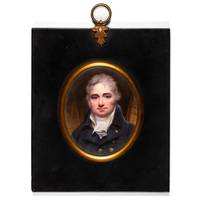
Portrait miniature of Robert Lord Hobart 4th Earl of Buckinghamshire 1760-1816.
réf. 42922Enamel on copper image 75 x 60 mm oval format; inscribed signed and dated on the counter-enamel verso: 'The Rt. Honble. The Earl of Buckinghamshire. Painted by Henry Bone ARA. Enamel Painter to HRH the Prince of Wales. Jany 1806'; some traces of surface dirt to the sitter's face and hair and some very minor pitting in the painted texture around the sitter's head but otherwise extremely well preserved; the work is unglazed and set within the original lacquered wood frame 130 x 110 mm with original brass suspension hook at top edge. This important portrait miniature of Robert Lord Hobart 4th Earl of Buckinghamshire was painted in 1806 by Henry Bone ARA Associate of the Royal Academy. Bone's miniature is after William Beechey's full-length portrait of Hobart also painted in 1806 which is now held in the Allport Library nipaluna/Hobart. The portrait has a significant connection to Australian settler history. In 1803 under instructions from Philip Gidley King Governor of New South Wales the recent settlement in Van Diemen's Land at Risdon Cove on the River Derwent had been named ""Hobart"" in honour of Lord Hobart the incumbent Secretary of State for War and the Colonies. When the settlement was abandoned a short time later David Collins the first Lieutenant-Governor of Van Diemen's Land then under the jurisdiction of New South Wales appropriated the name for the new settlement at Sullivan's Cove which he called ""Hobart Town"". This name first appears in a General Order issued on 15 June 1804. Hobart was proclaimed a city in 1842 and became the capital of the state of Tasmania at Federation in 1901. We know that Bone's enameled miniature must have been done towards the end of 1806: the National Portrait Gallery London holds in its Reference Collection NPG D17298 the artist's preparatory study for the work a pencil drawing squared in ink for transfer which is captioned and dated by the artist 'Earl of Buckinghamshire Septr. 1806' an image of the drawing has been provided in this listing. The finished portrait miniature - or possibly a copy of it made by the artist since it was standard practice for a miniature painter to produce multiple copies of the same work - was one of several enamels by Bone exhibited at the Royal Academy in 1808. It is described in the Academy's 1808 Exhibition catalogue thus: '357. Portrait of the Earl of Buckinghamshire in enamel. H. Bone A. i.e. Associate' an image of the catalogue entry has been provided in this listing. This was not the first time that Bone had made an enamel portrait miniature of the same sitter. In 1800 he had painted a portrait of a slightly younger Robert Lord Hobart which was after John Hoppner's large oil portrait done in the same year. Bone's preparatory sketch for his 1800 miniature is also held in the National Portrait Gallery Reference Collection NPG D17274; like his 1806 study it was acquired by the Gallery from Sir George Scharf in 1890. An example of Bone's 1800 enamel portrait miniature after Hoppner sold at Christie's London 7 December 2004 lot 120 for £7170. Provenance: Ellison Fine Art UK Acquired from the above in 2018 by the late Barry Lock 1934-2021 solicitor and philanthropist London UK Cheffin's Auctions UK 28-29 June 2023 lot 342 Private collection Adelaide Australia Biographical note on the sitter: Robert Lord Hobart 4th Earl of Buckinghamshire 1760-1816 soldier and politician was the eldest son of George Hobart 3rd Earl of Buckinghamshire and Albinia daughter of Lord Vere Bertie younger son of Robert Bertie 1st Duke of Ancaster and Kesteven. He was educated at Westminster School. Early in his career he served in the British army during the American Revolutionary War. From 1784 he served as aide-de-camp to successive Lord Lieutenants of Ireland. He sat in both Irish and English Houses of Commons from 1787 and 1788 respectively and was appointed to the Privy Council in 1793. He gained valuable experience in colonial service during the period he served as Governor of Madras between 1793-98. After his recall in 1798 he entered the House of Lords after inheriting the Hobart title from his uncle. From 1801 to 1804 Hobart served as Secretary of State for War and the Colonies displaying 'a better grasp of the local or colonial conditions and a more active spirit than did some of his successors' ADB. He succeeded his father to the earldom in November 1804 and died without issue in 1816 aged 55. Biographical note on the artist: Henry Bone RA 1755-1834 often referred to as the ""Prince of Enamelers"" was born in Truro Devon. His early career was spent working as a porcelain and jewellery painter but in the 1790s he won renown as an enamel painter and his portrait miniatures attracted the royal patronage of three successive monarchs across the next four decades. He was elected ARA on 2 November 1801 and RA on 11 February 1811. Soon after his death Bone's collection of unsold enamel portraits was dispersed when it was sold by auction at Christie's on 22 April 1836. His work has always been highly prized for its technical skill but it is also worth noting that it was considered fashionable enough in the mid-nineteenth century for there to have been a series of major sales of his portraits in 1846 1850 1854 and 1856. unknown