370 résultats
1889réf. E00911889. Titelblatt von J. Berjon in Tinte signiert / titre signé en encre par Berjon. 11 Lagen starkes Papier mit Kordelbindung. Lederband der Zeit mit goldgeprägtem Deckel- u. Rückentitel. Zustand 1.
réf. 124676Meldorf: Stiftung Mensch, 2021. 37 S. ; 21 x 14,5 cm ; broschiert.
1886réf. 8517BBLyon, A. Roux, 1886 ("achevé ... le VIII Sept. l'an de N.S. 1887"). Small 8vo. 1 w. Bl., 25 beidseitig gewebte Bll., 1 w. Bl. Mit 3 ganzseit. Ill., Frontispiz mit leergelassenem Wappen, zahlreichen Initialen u. durchgehenden floralen bzw. figürlichen Bordüren nach mittelalterlichen illuminierten Stundenbüchern. Text and illustrations entirely woven on a Jacquard machine with black and silver silk. Precious contemporary morocco leather in Jansenist-style, 5 raised bands, board edges with double gilt fillet, top and bottom edge gilt, doublures with burgundy moiré silk endpapers and inside boards with gilt tooled borders (dentelles, floral motifs and fillets). Binding signed J. Kaufmann and Ch. Meunier. Front board slightly concave. Dampstains throughout, mostly on the bottom margins and only spreading on the first and last one or two leaves, on the first few pages also affecting the top outer corners. All leaves with neat edges and free of any fraying.
1886réf. 37158ABLyon, A. Roux, 1886 ("achevé ... le VIII Sept. l'an de N.S. 1887"). Kl.-8°. 1 w. Bl., 25 beidseitig gewebte Bll., 1 w. Bl. Mit 3 ganzseit. Ill., Frontispiz mit leergelassenem Wappen, zahlreichen Initialen u. durchgehenden floralen bzw. figürlichen Bordüren nach mittelalterlichen illuminierten Stundenbüchern. Text und Illustrationen vollständig mit Jacquard-Technik in Schwarz auf silbergrauer Seide gewebt. Wertvoller, dunkelbrauner Maroquin-Meistereinband d. Zt. auf 5 Bünden, mit doppelten Goldfileten auf den Kanten, Kopf- u. Fußgoldschnitt, Dublüre in burgunderroten Moiré-Seidenvorsätzen mit floralen Goldbordüren, - Prägungen à la Dentelle und -Filetierung der Innendeckel. Signiert J. Kauffmann (vorderer Innendeckel) u. Ch. Meunier (Rückdeckel). Einband an wenigen, kleinen Stellen sehr leicht berieben. Frontdeckel leicht konkav gewölbt. Durchgehende Feuchtigkeitsspuren vor allem am Fußssteg, zu Beginn und am Schluss etwas ausgedehnter, auf den ersten Seiten auch an der oberen Außenecke. Alle Seit
1839réf. 461741839. Jacquard Joseph Marie 1752-1834. Portrait in silk of Joseph-Marie Jacquard after an original oil portrait by Claude Bonnefond manufactured by Didier Petit et Cie; woven by Michel-Marie Carquillat 1803-1884 in Lyon France 1839. The image including caption and Carquillat's name taking credit for the weaving is 55 x 34 cm.; the full piece of silk including blank margins is 85 x 66 cm. The visible portion of the image in the frame is 72 x 54.5 cm. and the frame measures 104 x 84 cm. Minor wear from folding barely visible in the image but with the image in clear unfaded and fresh condition. The weaving was professionally treated by a textile conservator whose conservator's report and images of before and after are available. Minor flaws visible in the large outer margins of the silk not affecting the image. In a large and attractive archival frame. This famous image of which only a very few examples are known was woven by machine using 24000 Jacquard cards each of which had over 1000 hole positions. The process of mis en carte or converting the image details to punched cards for the Jacquard mechanism for this exceptionally large and detailed image would have taken several workers many months as the woven image convincingly portrays superfine elements such as a translucent curtain over glass window panes. Once all the "programming" was completed the process of weaving the image with its 24000 punched cards would have taken more than eight hours assuming that the weaver was working at the usual Jacquard loom speed of about forty-eight picks per minute or about 2800 per hour. More than once this woven image was mistaken for an engraved image. The image was produced only to order most likely in a small number of examples. Recorded examples are those at the Metropolitan Museum of Art the Science Museum London The Art Institute of Chicago and the Computer History Museum Mountain View California Musée de Tissus Lyons. The image is the subject of the book by James Essinger entitled Jacquard's Web: How a Hand Loom Led to the Birth of the Information Age 2004. To Charles Babbage the incredible sophistication of the information processing involved in the mis en carte—what we call programming—of this exceptionally elaborate and beautiful image confirmed the potential of using punched cards for the inputting programming and outputting and storage of information in his design and conception of the first general-purpose programmable computer--the Analytical Engine. The highly aesthetic result also confirmed to Babbage that machines were capable of amazingly complex and subtle processes—processes which might eventually emulate the subtlety of the human mind. "In June 1836 Babbage opted for punched cards to control the machine the Analytical Engine. The principle was openly borrowed from the Jacquard loom which used a string of punched cards to automatically control the pattern of a weave. In the loom rods were linked to wire hooks each of which could lift one of the longitudinal threads strung between the frame. The rods were gathered in a rectangular bundle and the cards were pressed one at a time against the rod ends. If a hole coincided with a rod the rod passed through the card and no action was taken. If no hole was present then the card pressed back the rod to activate a hook which lifted the associated thread allowing the shuttle which carried the cross-thread to pass underneath. The cards were strung together with wire ribbon or tape hinges and fan-folded into large stacks to form long sequences. The looms were often massive and the loom operator sat inside the frame sequencing through the cards one at a time by means of a foot pedal or hand lever. The arrangement of holes on the cards determined the pattern of the weave. "As well as patterned textiles for ordinary use the technique was used to produce elaborate and complex images as exhibition pieces. One well-known piece was a shaded portrait of Jacquard seated at table with a small model of his loom. The portrait was woven in fine silk by a firm in Lyon using a Jacquard punched-card loom. The image took 24000 cards to produce and each card had over 1000 hole positions. Babbage was much taken with the portrait which is so fine that it is difficult to tell with the naked eye that it is woven rather than engraved. He hung his own copy of the prized portrait in his drawing room and used it to explain his use of the punched cards in his Engine. The delicate shading crafted shadows and fine resolution of the Jacquard portrait challenged existing notions that machines were incapable of subtlety. Gradations of shading were surely a matter of artistic taste rather than the province of machinery and the portrait blurred the clear lines between industrial production and the arts. Just as the completed section of the Difference Engine played its role in reconciling science and religion through Babbage's theory of miracles the portrait played its part in inviting acceptance for the products of industry in a culture in which aesthetics was regarded as the rightful domain of manual craft and art" Swade The Cogwheel Brain. Charles Babbage and the Quest to Build the First Computer 2000 107-8. . unknown books
1984réf. S8023New York:: Columbia University Press 1984. 1984. First English edition. 8vo. ix 187 pp. Figs. index. Yellow cloth dust jacket; jacket with short tear repaired neatly with tape else fine. Columbia University Press, 1984. hardcover books
1978réf. S7521San Francisco:: Freeman Cooper 1978. 1978. 8vo. 192 pp. Figs. tables index. Two-toned cloth. Fine. FIRST EDITION. Detailed survey of the genetics of human populations that mentions: genetic composition kinship evolution migration mutation genetic markers & synthesis. ISBN: 877354219 Freeman, Cooper, (1978). hardcover books
1978réf. S8022San Francisco:: Freeman Cooper 1978. 1978. First English edition. 8vo. 192 pp. Figs. index. Orange & blue cloth. FINE. Freeman, Cooper, (1978). hardcover books
1984réf. 55866NY:: Columbia University Press. Very Good in Very Good dust jacket. 1984. Hardcover. 0231054823 . Translated from the French by Margaret M. Moriarty. First American edition. Foxing on edges else very good in a very good fading along the spine dust jacket. . Columbia University Press, hardcover books
1984réf. 15522NY: Columbia University Press. Near Fine in Near Fine dust jacket. 1984. Hardcover. 0231054823 . Translated from the French by Margaret M. Moriarty. First American edition. Previous owner's name blacked out on front free endpaper else near fine in a fine dust jacket. . Columbia University Press hardcover books
This is an almost very good hardcover copy. This copy is bound in the publisher's cream polished cloth with gilt titles and designs, with just light wear. The spine is a little darker than the front and back covers. Still it just looks like an antique finish. Top page edge gilt. Some foxing throughout to margins of pages. Most pages clean. Illustrated in color with 24 color plates on a glossy paper with no foxing. All tissue guards present. Also many black & white photographs. Bibliography. 12" high X 9" wide, 427 pages. This book will be securely wrapped and packed in a sturdy box and shipped with tracking.
Un fin volume broché au format poche de 190 pp.; couverture illustrée. Bel état. Voir photo.
256p. Original full cloth binding. Limited edition. Extremely important and increasingly scarce study of loom woven coverlets. **PRICE JUST REDUCED! BEFORE ORDERING PLEASE Email to RareBooks@POBox.com so that we can CONFIRM AVAILABILITY
pp. 1-215. 8vo. Original full cloth binding. Includes also a significant important Pennsylvania-Dutch dialect vocabulary: LINGUISTIC VARIANTS OF THE PENNSYLVANIA GERMAN DIALECT, by Albert F. Buffington. Limited edition. Extremely important and increasingly scarce study of loom woven coverlets. Also issued as: Pennsylvania German Folklore Society. Volume XIII. BEFORE ORDERING PLEASE Email to RareBooks@POBox.com so that we can CONFIRM AVAILABILITY
256p. Original full cloth binding. Limited edition. Extremely important and increasingly scarce study of loom woven coverlets. **PRICE JUST REDUCED! BEFORE ORDERING PLEASE Email to RareBooks@POBox.com so that we can CONFIRM AVAILABILITY
In 4°; (166) pp. e (6) p. bianche .Vari disegni nel testo ed alcuni inserti di tessuti di seta. Legatura coeva in mezza tela con titolo impresso in oro al dorso. Magnifica grafia di metà ottocento di questa raccolta inedita di appunti, raccolti dallo studente Carlo Biraghi, di uno scritto del professore Luigi Bossi dedicato alla teoria e fabbricazione delle Stoffe di seta, secondo, probabilmente, le lezioni tenute dallo stesso Bossi. Il noto professore di tessitura serica ed ingegnere Luigi Bossi, autore di uno dei più celebri manuali sulla tessitura della seconda metà dell'ottocento (edito nel 1874) fu anche colui che costruì ed attivò la macchina a vapore con una potenza di 2 cavalli che riscaldò e mosse i 60 aspi, a partire dal 1846, della Filanda del Rag. Andrea Bossi. Luigi Bossi mise le proprie conoscenze al servizio della tessitura e dell'industria tessile del nord Italia, divenendo figura di riferimento per le nuove generazioni di imprenditori tessili. Partendo dalla teoria della seta, l'autore prosegue descrivendo il molinaggio, la trama, l'organzimo, varie qualità di sete lavorate come la granatina, l'ovale, il plate, la fantasia o Chappe, il fioretto, la crepe, il marabout, per proseguire poi con il titolo della seta, il perimetro o assaggiatore della seta, la stagionatura della seta, la cappiatura e assortitura della seta, la tintura della seta, i prodotti ottenuti dalla seta tinta in diversi colori per ogni Kg. Di seta cruda, la purga della seta, la tinta in cotto e a colori, la tinta in nero fino e minerale, la tinta in raddolcito o souple, la tinta in nero biscotto, tinta delle trame ingallate, la tinta a crudo, la tinta delle seti cotte e caricate, l'aspetto che presentano le sete tinte nei diversi processi, la cura per la conversazione della seta in magazzino, l'incannaggio delle seti, le precauzioni da usarsi nell'incannaggio, l'orditura, le precauzioni da usarsi nell'orditura, i rocchetti, l'imbancaggio, ordimenti-ombreggianti, l'imbancaggio per ombreggiati di 6 gradazioni primitive, l'avvertenza sull'incarnaggio delle sete per ompreggiati, gli schemi della regola per ottenere 21 gradazioni derivate da 6 gradazioni prmitive oppure 22 gradazioni d 8 gradazioni primitive. Segue un saggio o guidana con esempi, le regole per gli ordinamenti rigati, il piegaggio, il modo di fare il calcolo per disporre l'organzino alla tinta, il modo di calcolare la quantità di trama greggia da disporre alla tinta o già tinta, altri risultati che si possono ottnere coll'uso del divisore cost.se, il modo di calcolare la quantità di filato, la regola per il tessimento, vari esercizi o conti di fabbrica. Alla fine dell'opera seguono 60 pagine dedicate alla macchina Jacquard con un bel disegno spaccato dello stesso ed un attenta analisi delle sue parti e del suo utilizzo. Nel 1801 il francese Joseph-Marie Jacquard presentò questo tipo di telaio, dotato di un macchinario che permette, con l'ausilio di una scheda perforata, la movimentazione automatica dei singoli fili di ordito e che rivoluzionò il campo dell'industria tessile. Rarità bibliografica in perfette condizioni di conservazione.
in-8°, 203 pages, broche, couverture illustree plast. Bel exemplaire. [DV-9] Conversations avec (e.a.) : E. Baulieu, J. Bernard, R. Chauvin, Y. Coppens, P.-G. de Gennes, A. Jacquard, H. Laborit, J.-M. Pelt, H. Reeves, etc.
16 pages. Contents: Ladies' and children's suits; Fire-proof dresses; The Parlor; Manners Upon the Road - of Mountain air; New York Fashions - fall goods, faille, fancy silks, woolen goods, ecru woolens, Jacquard goods, about plaids and stripes, French calicoes, trimming laces, varieties; Personal; Toy harness and whip; bat of steel springs, carriage leather, and cord; netted and crochet ball net; black figured tulle jacket; black figured tulle Bedouin mantilla; crochet and flannel garters; skipping-rope with braid and cord cover; embroidered Panama convas work-box; knitted square for coverlets; Pollys' Victory; Paris Fashions; Sayings and Doings; Lovely full-page illustration for the month of August; Two half-page illustrations of watering-place toilettes; To the Bitter End - continued; English gossip; Sketches at Naples; Illustration "Naples - consulting the oracle of the cumaean sibyl; Nice large illustration "The English Laborer's Home - Evenings"; humor. Average wear. Book
100 pages. Features: Tromping through the ages - a Boston artist turned to the 18th century for design inspiration but he used 20th century technology to produce her woven coverlets; Jacquard Weaving in Huehuetenango - textiles woven on hand operated Jacquard looms have a distinctive place in the spectrum of Guatemalan weaving; Jacquard Weaving - a special report; Machine Knitting - the state-of-the-art; Rugs - for the floor, the wall and the imagination; A conversation with Lillian Elliott; Nancy Belfer; Maridadi West; Frank Gardner; Annie Dempsey; Lucille Landis; Kiyomi Iwata; Carol Mecagni; and more. Clean and unmarked with moderate wear. A sound copy. Magazine
80 pages. Features: A Mating of Nature and Technology - Jacquelyn Rice and Uosis Juodvalkis; Hisako Sekijima - explorer of fiber boundaries; Catharine Ellis Muerdter - the artist as teacher; Jacquard Boot Camp; Tilleke Schwarz's embroidery; Paula Nadelstern profile; and much more. Clean and unmarked with moderate wear. A sound copy. Book
Efforts to simplify the pattern-forming elements in the Jacquard weaving mill. With dedication from author to dated 1965 on title page. 111 pages. Illustrated.
Stampa antica ed originale del ritratto di Jacquard Giuseppe Maria nato nel 1752, inventore. Autore: Guadagnini inc.. Anno: 1835. Tecnica: incisione in rame. Dimensioni: 240x150 mm il foglio. In allegato 4 pagine descrittive della vita di Jacquart
réf. 489711-6Springer. Used - Good. Former library copy. Pages intact with minimal writing/highlighting. The binding may be loose and creased. Dust jackets/supplements are not included. Includes library markings. Stock photo provided. Product includes identifying sticker. Better World Books: Buy Books. Do Good. Springer unknown
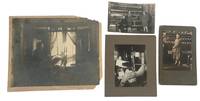
1900réf. 238851900. Women textile workers photo archive depicting Jacquard weaving and related mechanized textile production c. 1900 documenting an industrial technology directly connected to the development of programmable computation. Two photographs show women at Jacquard looms where large harness assemblies permit the selective control of warp threads required for figured weaving. The Jacquard system used sequences of punched cards to determine which warp cords were raised during successive passes storing instructions outside the loom mechanism. Charles Babbage adopted the punched card principle for his Analytical Engine in 1836 and Ada Lovelace in her 1843 Notes on the Analytical Engine compared its manipulation of mathematical operations to the Jacquard loom's weaving of figured patterns. Photo archive 4 silver gelatin photographs mounted on cardstock c.1900-1930. Two photographs show women seated at Jacquard looms enclosed by tall wooden frames supporting dense arrays of harness cords descending toward the warp; the punched card chains themselves are not visible in these views. A third shows a woman standing beside a monumental warp creel filled with scores of individually wound yarn packages each feeding thread through a corresponding guide. The fourth shows two women attending a broad industrial textile machine identified with Bruno Knobloch who patented a thread feeding device for flat warp knitting machines and a Jacquard device for warp knitting machinery. The four photographs document distinct pieces of equipment with women operating supplying and monitoring each machine. Textile manufacturing employed more women than any other industrial sector in Europe and the United States during this period and the Jacquard loom in particular was operated predominantly by women in both domestic workshops and factory settings. Jacquard demonstrated his punched card controlled loom in 1801. The women pictured here worked inside the industrial system Lovelace pointed to: textile production organized around the controlled selection of threads repeatable sequences of mechanical operations and machinery capable of translating predetermined instructions into complex physical patterns. Light fading and tonal variation with scattered surface and mount wear; overall in good condition. unknown
réf. 3543920-6Duke University Press. Used - Good. Former library copy. Pages intact with minimal writing/highlighting. The binding may be loose and creased. Dust jackets/supplements are not included. Includes library markings. Stock photo provided. Product includes identifying sticker. Better World Books: Buy Books. Do Good. Duke University Press unknown