MARDRUS, Joseph-Charles - SCHMIED, F.-L.Livre Rare Book
8 207 résultats
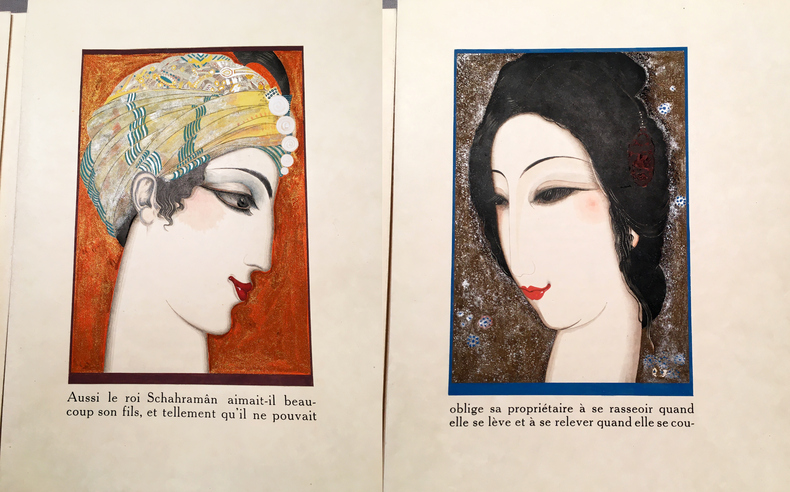
1926réf. 1290Paris, [Schmied], 1926. Un volume in-4 (27,7 x 20 cm), en feuilles, 102 pages, n.ch., couverture rempliée, chemise et étui décoré de l’éditeur, emboîtage de maroquin vert doublé de maroquin jonquille, dos titré (G. Cretté succ. de Marius Michel). Édition originale de la plus grande rareté, tirée à seulement 20 exemplaires numérotés sur japon. Splendide illustration en couleurs de François-Louis Schmied: environ 50 bois dont 18 de très grande taille, dans le texte, TOUS ENTIÈREMENT PEINTS À LA MAIN dans les ateliers de laquage de Jean Dunand ; près de 300 lettrines et bouts de lignes peintes à la main dans le texte, dans des harmonies de couleurs variant selon les pages, avec rehauts d'or, d'argent ou de blanc, traçant des motifs géométriques ou érotiques. Tirage unique à 20 exemplaires numérotés et signés du monogramme en rouge de FLS, tous sur papier Japon, celui-ci n° 13. Conservé à l'état d'origine dans un splendide coffret en maroquin doublé de Cretté. - Notes bibliographiques (pour ceux qui prennent le temps): « La Princesse Boudour est regardée par ceux qui savent voir, comme le livre capital de ce premier quart de siècle. Par sa graphie et sa technique générale, elle est une exception préméditée dans le faire de son auteur. Pour la réaliser, il s’est véritablement amusé, cette fois – en tant que lecteur enthousiaste des Mille nuits et une nuit - à commenter graphiquement le texte qu’il connaît si bien et dont il est comme imbibé [...]. Il nous a [...] octroyé le délectable cadeau de trois cent quatre-vingt-dix vignettes et en couleur, et toutes différentes, et qui se rapportent au texte [...]. Et cette munificence schmiedienne n’est-elle pas, en définitive, l’exaltation de notre modernité, et en conformité avec nos goûts, du faire des imagiers incomparables de l’Orient ? [...]. Avec quel attendrissement, avec quelle passion sourde et contenue, qui n’appartient qu’à lui, il a rendu, au moyen des fragiles outils du graveur et du coloriste, la grâce masculine des adolescents, et la tendre chair de banane des radieuses jouvencelles ! [...] Je pense que s’il fallait absolument appliquer une épithète au sourire des adolescentes schmiediennes, et même à celui des adolescents, rien ne leur conviendrait mieux que le mot ambigü... Une atmosphère de pures délices enveloppe cette oeuvre boudourienne, multiple, voluptueuse, spirituelle, et d’une telle essence d’authentique Orient qu’elle nous fait vraiment respirer tous les parfums de l’Arabie. » (Préface du catalogue de l’exposition Schmied à la galerie Arnold Seligmann Rey à New York, mars 1927, pp. 34-37).
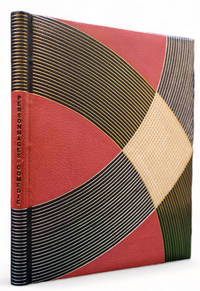
1922réf. 1SINGLE PRINT LIMITED TO 150 COPIES ON HOLLAND VELUM OF THE MOST FAMOUS WORK FROM THE COLLABORATION OF Barbier and Schlied. Copy n°97 signed by the author. 40 Figures headbands decorated letters by Georges Barbier engraved on wood in colors and worked by F.L. Schmied. Cover enhanced with gold and silver. Calligraphic text. Lined and mosaic binding signed by Jeanne Langrand 1931. Raspberry morocco crossed from one plate to the other and extending on the back with two wide strips of black morocco highlighted with twenty-five threads gilded for one of the strips palladium for the other the two strips crossing each other on a piece of cream morocco forming a decoration of iridescent lattices; smooth spine crossed with the same decoration gilded fillets at the head and palladium at the tail Title in large black letters; linings extending and repeating in symmetry the mosaic decoration of the covers; guards of pink moiré silk. Edges with matte gilding on witnesses. Covers and spines preserved. Perfect condition case a little rubbed. DAZZLING ART-DECO MOSAIC BINDING DUE TO Jeanne LANGRAND. Jeanne Langrand was one of the pioneers of the modern style in the field of bookbinding. After the First World War with her sister Andrée she found herself at the School of Decorative Arts Jeanne as assistant professor and Andrée as director. In this breathtaking binding of perfect mastery and great decorative audacity we can only admire the elegance of the mosaic tones the refined geometry of the composition with its symmetrical repetition in linings. Even the case bears witness to its particularly sober and relaxed style. One of the great successes of the art of illustration from the interwar period in a brilliant binding in perfect harmonious harmony. chez Meynial
1927réf. 1833Paris, François-Louis Schmied, 1927. Un volume in-4, reliure plein maroquin bleu, doublure et gardes de soie brochée gris-bleu sertie d’un jeu de filets dorés, dos lisse orné, couverture, tranches dorées, étui bordé de même maroquin (G. Cretté succ. de Marius Michel). Édition originale et tirage unique de ce conte oriental de Joseph Charles Mardrus magnifiquement illustrée et ornementée par François-Louis Schmied qui assura lui-même la mise en page et l'impression de ce chef d'œuvre du livre Art déco : le trait des planches a été gravé sur bois, la peinture en a été exécutée à la main, d'après les originaux, dans les ateliers de laquage de Jean Dunand. Cette illustration se compose d'une couverture illustrée, un frontispice, 7 illustrations à pleine page, une grande planche dépliante formant un triptyque, 29 bandeaux horizontaux dont 22 grands, la plupart en-tête, 32 lettrines ornées ou petites vignettes dans le texte, 6 petits bandeaux verticaux et de nombreux bandeaux et lettres mis en couleurs et dorés. TIRAGE UNIQUE À 25 EXEMPLAIRES SUR JAPON, SIGNÉS PAR SCHMIED. Celui-ci (n° XXV) comporte l’une des rares suites des bois tirés en noir sur Japon. L'ouvrage est entièrement monté sur onglet.
réf. 122110Paris 1920. . First edition landscape folio 320 x 450 mm; pictorial title page one leaf of text in French by Barbier with headpieace tailpiece and illustration 16 hand-coloured pochoir plates by Henri Reidel after Barbier table of plates plates loose as issued; original printed portfolio wrapper a little worn but plates in very good condition housed in a custom made black cloth clamshell box title to spine a near fine copy. Fine hand-coloured pochoir plates The sixteen plates of Le Bonheur du Jour are amongst the largest and most carefully meditated of Barbier's designs. So ambitious was this album that it took him from 1920 to 1924 to complete it to his satisfaction. A study of manners and fashion it was designed to appeal both to those who like to link the present to the past and to observers of the current scene. Barbier begins his introduction with a summary of fashion illustration from the 16th century onwards finding a specific predecessor for his own work in that of Horace Vernet's record of First Empire costume Incroyables et merveilleuses published around a hundred years earlier. Barbier saw similarities between the period after the Napoleonic Wars and his own post-Great War era with dandies and their ladies free at last to enjoy frivolities and sensuality. Paris, 1920. hardcover
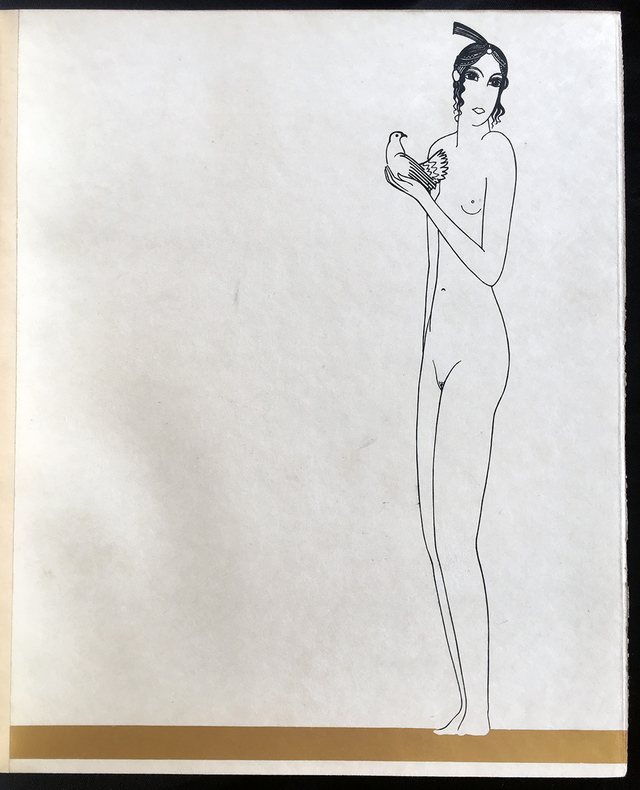
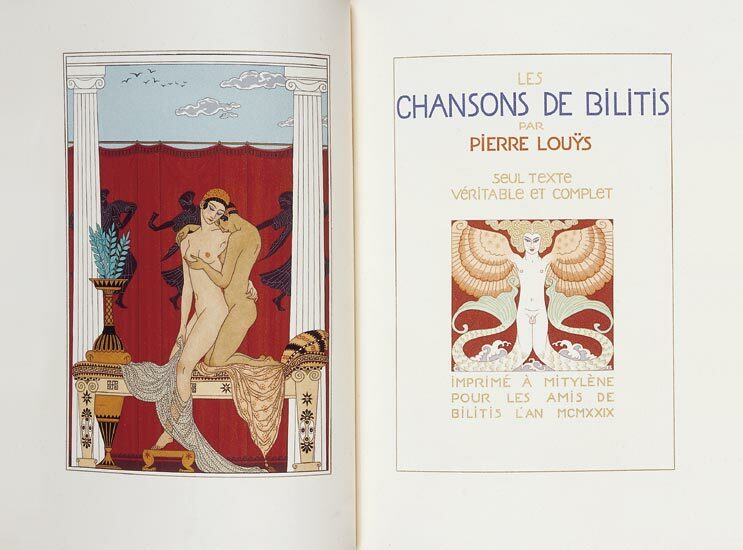
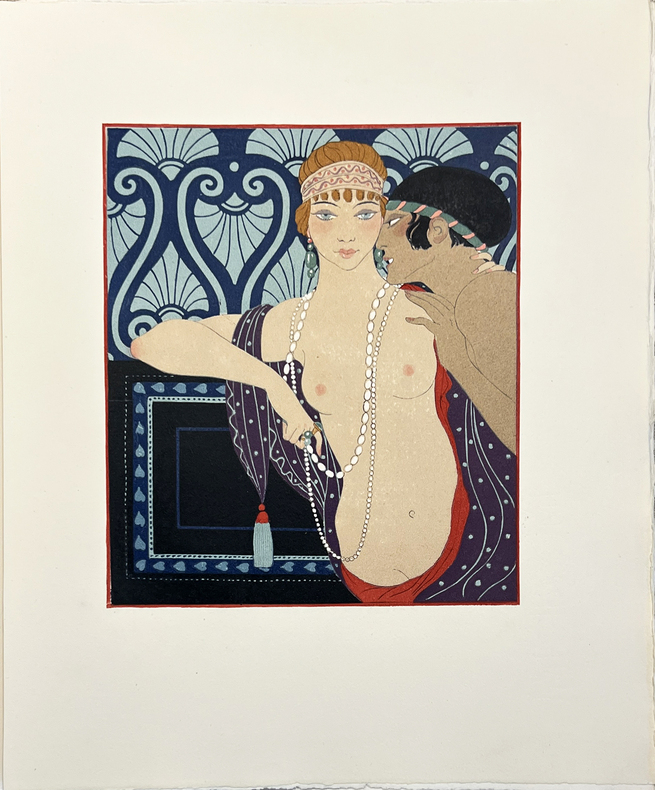
1929réf. 1850Imprimé à Mitylène pour les amis de Bilitis [Paris: P. Bouchet], 1929. Volume petit in-4 (24,5 x 19,5 mm) relié en plein maroquin mosaïqué, doublé et décoré, étui. - 62 COMPOSITIONS GRAVÉES SUR BOIS EN COULEURS DE GEORGE BARBIER dont un frontispice et 6 à pleine page, 24 sujets à mi-page et de nombreuses lettrines et culs-de-lampe. - PREMIÈRE ÉDITION INTÉGRALE de ces 22 chansons, publiée pour le compte de Louis Barthou, Jacques André et Georges Miguet. Réalisé en 1929, période où le talent de l'artiste était alors à son apogée, ce livre est l'une des productions les plus importantes des années trente. - LE LIVRE LE PLUS RARE DE GEORGE BARBIER TIRÉ SEULEMENT À 25 EXEMPLAIRES. Un des 20 sur papier vélin filigrané au titre de l'ouvrage, celui-ci, non numéroté mais d'une prestigieuse provenance, est augmenté d' UNE SUITE COMPLÈTE DU TRAIT EN BRUN/ROUGE SUR JAPON. La suite tirée à 5 ou 6 ex. comprend également l' illustration des couvertures et une planche inédite. La reliure à décor d'attributs érotiques a été commanditée à Charles Septier par le bibliophile Beauvillain. Avec son ex-libris gravé : "Et BEAUVILLAIN ? / toujours il vous aime". SUPERBE EXEMPLAIRE RELIÉ EN PLEIN MAROQUIN DOUBLÉ MOSAÏQUÉ DE L'ÉPOQUE. - Références : Carteret Illustrés IV, 251 ; Dutel II, 1183 ; Pia Enfer 201-203. - Notes : Les Chansons de Bilitis sont l’œuvre la plus célèbre de Pierre Louÿs (1870-1925) qui s'est ici amusé à monter une petite mystification, faisant croire qu'il s'agissait d'un véritable document historique retrouvé, les œuvres d'une contemporaine de Sappho, dont il ne nous reste que quelques bribes de poèmes… Il n'a pas même négligé de citer de vrais ouvrages savants issus de l'industrieuse université allemande, d'inventer des découvertes archéologiques, et de multiplier les évidences pour donner du corps à son invention. Elle a eu le bonheur d'attraper quelques érudits enthousiastes, professeurs d'université offrant leurs services pour améliorer la traduction ! Bilitis est même devenu un nom commun, comme Sapho. "Je voulais entendre Le rire de Sappho Et la voix de Sa lyre Ce qui me parvint fut Le marmonnement moustachu Des grammairiens Des ptérodactyles grecs Et des dodos victoriens". Il s'agit en fait d'un pastiche, mélangeant bribes saphiques, épigrammes de l'Anthologie Grecque, et de tout ce que peuvent offrir Alciphron (Lettres de pêcheurs, de paysans, de parasites et d'hétaïres), La Pastorale de Daphnis et Chloé de Longus, Lucien et tous les romans grecs... Au final, on a plus d'une centaine de poèmes suggestifs et ingénieux, fruit de la malicieuse imagination et de l'art imitatif de l'auteur. Ce n'est pas mal du tout, mais quand même: c'était bien trop beau pour être vrai ! L'introduction : Vie de Bilitis, est excellente, et remplit parfaitement son office… "Bilitis naquit au commencement du sixième siècle avant notre ère, dans un village de montagnes situé sur les bords du Mélas, vers l’orient de la Pamphylie. Ce pays est grave et triste, assombri par des forêts profondes, dominé par la masse énorme du Taurus ; des sources pétrifiantes sortent de la roche ; de grands lacs salés séjournent sur les hauteurs, et les vallées sont pleines de silence. Elle était fille d’un Grec et d’une Phénicienne. Elle semble n’avoir pas connu son père, car il n’est mêlé nulle part aux souvenirs de son enfance. Peut-être même était-il mort avant qu’elle ne vînt au monde. Autrement on s’expliquerait mal comment elle porte un nom phénicien que sa mère seule lui put donner. Sur cette terre presque déserte, elle vivait d’une vie tranquille avec sa mère et ses sœurs. D’autres jeunes filles, qui furent ses amies, habitaient non loin de là. Sur les pentes boisées du Taurus, des bergers paissaient leurs troupeaux. Le matin, dès le chant du coq, elle se levait, allait à l’étable, menait boire les animaux et s’occupait de traire leur lait. Dans la journée, s’il pleuvait, elle restait au gynécée et filait sa quenouille de laine. Si le temps était beau, elle courait dans les champs et faisait avec ses compagnes mille jeux dont elle nous parle. Bilitis avait à l’égard des Nymphes une piété très ardente. Les sacrifices qu’elle offrait, presque toujours étaient pour leur fontaine. Souvent même elle leur parlait, mais il semble bien qu’elle ne les a jamais vues, tant elle rapporte avec vénération les souvenirs d’un vieillard qui autrefois les avait surprises. La fin de son existence pastorale fut attristée par un amour sur lequel nous savons peu de chose bien qu’elle en parle longuement. Elle cessa de le chanter dès qu’il devint malheureux. Devenue mère d’un enfant qu’elle abandonna, Bilitis quitta la Pamphylie, d’une façon assez mystérieuse, et ne revit jamais le lieu de sa naissance. Nous la retrouvons ensuite à Mytilène où elle était venue par la route de mer en longeant les belles côtes d’Asie. Elle avait à peine seize ans, selon les conjectures de M. Heim qui établit avec vraisemblance quelques dates dans la vie de Bilitis, d’après un vers qui fait allusion à la mort de Pittakos. Lesbos était alors le centre du monde…" - ENGLISH DESCRIPTION : Pierre Loüys- George Barbier : LES CHANSONS DE BILITIS. Seul texte véritable et complet. Imprimé à Mitylène pour les amis de Bilitis, 1929. Small 4to. (246 x 192 mm). pp. (iv), 56, (i), (i). Wood-engraved colour frontispiece, printed title in various colours with colour wood-engraved vignette and Louÿs test in three sections ('Bucoliques en Pamphylie', 'Elegies à Lesbos' and 'Epigrammes dans lIle de Chypre') illustrated with 60 wood-engraved illustrations by Pierre Bouchet after George Barbier, 54 in colour, seven full-page, 24 decorating the text, the remainder culs-de-lampes or vignettes, final leaf with justification and achevé d'imprimer; three-line initials in colour against gilt background throughout as well as numerous head- and tail-pieces and initial letters, verse numbering in gilt in Roman numerals, text in capitals ruled throughout and two additional wood-engravings for the wrappers; this copy with the additional suite printed in outline in bistre on Japon including the cover illustrations and a "planche refusée" in black. Our copy is not numbered but comes from a important collector and provenance with ex-libris. Full contemporary emerald crushed morocco by Charles Septier with his signature gilt, front and rear boards ruled in gilt to surround a decorative border of inlaid jade morocco with gilt Greek key pat-tern around curvilinear jade morocco surround with gilt roll tool for a central vignette with argent disc supported by lamp tools, banded spine in five compartments with gilt titles and elaborate decorative tooling, doublures of tan morocco with gilt surrounding an inner border of red and black inlaid morocco, central inlaid circular medallions illustrating vignettes from the book in colour morocco, gilt floral, foliate, phallic and vulvic tools at corners, patterned silk guards, marbled endpapers, board edges ruled in gilt, original wrappers with gilt illustration and backstrips preserved, a.e.g., matching morocco-edged wool-lined marbled board slipcase. The binding was commissioned by Beauvillain as he had commissioned other bindings from Septier and that his ex libris is bound in as a full sheet rather than pasted on one of the pages. Provenance: leaf with engraved ex-libris of Robert Beauvillain by Jouas bound in with the text: "Et BEAUVILLAIN ? / toujours il vous aime". - BARBIER'S RAREST BOOK, Les Chansons de Bilitis, bound by Septier and with the very rare additional suite. From the edition limited to 25 copies on vélin d'Arches only, this copy also with the very rare suite printed in outline in bistre on Japon of which very few copies were printed. Also with an extra unpublished full page print in bistre bound in the suite. The rarest and most recherché and erotic work by George Barbier. The magnificent binding by Septier features phallic and vulvic tools to the doublures and a central circular vignette to each: that for the front doublure is after the illustration for the second poem Je me suis dévêtue pour monter a un arbre ... ); that for the rear is after the twenty-third (D'abord je n'ai pas répon-du ... ). First published in Paris in 1894, this purports to be translations of poems by a woman named Bilitis, a contemporary and ac-quaintance of Sappho. This caused a sensation, not only because finding an intact cache of poems from a completely unknown Greek poet circa 600 B.C. would be a miracle, but because of its open and sensitive exploration of lesbian eroticism. Actually Bilitis never existed. The poems were a clever forgery by Pierre Louÿs -- the "translator"; to lend weight, he had even included a bibliogra-phy with bogus supporting works. Louÿs actually did have a good command of the classics, and he salted Bilitis with a number of quotations from real poets, including Sappho, to make it even more convincing. (J. B. Hare). They [Barbier's Les Chansons de Bilitis and Aphrodite] are celebrations of the ancient gods and their freedom from taboo. Bar-bier's illustrations reveal this world in full flower ... When reality and imagination fused, not only was it possible to travel freely wherever you liked, it was also possible to encounter ancient gods and fairies. Art Deco mixed old and new in previous unseen ways ... In his glass, Barbier mixed an uncanny cocktail of neoclassic and modern. (Hiroshi Unno) [Carteret Illustrés IV, 251; Dutel 1183; not in Unno].
1924réf. 76866Sous emboi?tage de velours illustré, fenêtre circulaire sur le premier plat, laissant apparai?tre le dessin de la couverture (Jean-Claude Chalanson).Superbe et rare album comprenant 21 compositions en couleurs gravées par H. Reidel d'après les compositions de George BARBIER, dont une sur la couverture, une sur le titre, 3 dans le texte et 16 hors texte.
1912réf. 1091912. 1st Edition. Soft cover. Fine. FIRST EDITION OF ALL 79 ISSUES WITH 186 HAND-COLORED PLATES by some of the most famous artists of the era. Number 884 each issue from the same set of only 1250 sets on Holland paper out of a total edition of 1279. IN ORIGINAL WRAPPERS IN FINE CONDITION. "The Journal des Dames et des Modes lasted only two years the first issue appeared on 1 June 1912 and the last on 1 August 1914. This stylish periodical was issued regularly three times a month and ceased publication upon the outbreak of the First World War. With its expensive layout its society columns its poetic texts its colourful annotations and its fashion reports it represented the last brilliant refined impartial and aestheticizing impulse of a happy and optimistic society occupying the centre of the stage in the period that has aptly been called the 'belle époque'. It was essentially the testimony the history--illustrated or rather 'clothed' and narrated--of the customs ideas and ideals of a society and a period. "Every issue carefully reviewed all the current novelties of fashion and every issue carried coloured stencil prints reproducing the latest conceptions of the fashion designers." For the text "the magazine could count on the collaboration of the best known writers and littérateurs of the time" including Henri Duvernois Marcel Boulenger Paul Margueritte Jean Cocteau and many others. The artistic contributions "included the works of some outstanding artists and many promising young ones. Most frequent in his appearance and outstanding for the quality of his illustrations was Georges Barbier." Other artists included Léon Bakst Bernard Boutet de Monvel Umberto Brunelleschi H. Robert Dammy Paul Iribe Charles Martin and Fernand Siméon. Christina Nuzzi Parisian Fashion from the "Journal des Dames et des Modes". Note: all 186 plates are present numbered 1-184 with two unnumbered plates. Paris: 1912-1914. Octavo each issue loose as issued in original wrappers inserted loosely into four half-yearly plus one supplemental original large wrappers. A few plates with spots but generally exceptionally clean dampstaining to edges of five issue wrappers. A nearly immaculate set exceedingly scarce in original wrappers. unknown books
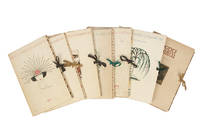
réf. 121033Paris Pierre Corrard 1913-1922. . 7 issues complete 8vo; all issues a total edition of 300 issue no.1 one of 271 copies on Japon no.276 12 plates after Lepape initialled in pencil by Lepape and Corard on the justification; issue no. 2 one of 17 copies with an original 'remarque' on Japon no.27 original signed in pencil by Lepape creased in the bottom corner 12 plates after Charles Martin signed by Martin on the justification; issue no. 3 one of 271 copies on Japon no. 139 initialled by Barbier on the justifcation 12 plates after Barbier; issue no.4 one of 17 with an original 'remarque' on Japon no.20 original drawing with silver monogrammed by Charles Martin 12 plates after Lepape; issue no. 5 one of 271 copies on Japon no.113 12 plates after Andre Marty; issue no. 6 one of 271 copies on vélin d'arches no. 74; 12 plates after Robert Bonfils; issue no. 7 one of 271 copies on vélin de cuve no.76 12 plates by Fernand Siméon; all loose as issued in the original portfolios with patterned paper folding paper internally each issue with a illustration on the upper by the corresponding artist some issues with some spotting to covers no. 4 with split spine no. 6 lacking one tie housed in a modern red cloth box with brown morocco label to spine a very good set. Complete set of seven volumes of Modes et Manières in the original portfolios with 84 plates in total. A fine bright copy of an Art Deco landmark. Two of the issues numbers 2 and 4 are from the smaller edition with an original signed drawing one by Lepape and one by Martin. Paris, Pierre Corrard, 1913-1922. hardcover
1933réf. 1713Se trouve pour les amateurs à Paris à l'enseigne du nombril de Vénus (1933). Un Album in-folio oblong (310 x 415 mm), en feuilles, chemise toilé à quadruple rabat. Très rare album commandé à Charles Martin par Marcel Valotaire, Jean Beauclair et Georges Cretté, composé d'un titre illustré et de 12 planches très libres, en couleurs et en noir, gravées à l’eau-forte au repérage par Charles Martin. Chaque planche est présentée dans une chemise légendée. Feuillet de justification en fin d'ouvrage. Celui-ci exemplaire J comprenant : La planche de titre en état définitif couleur, état en noir et état avant la lettre ; les 12 COMPOSITIONS LIBRES EN 4 ÉTATS DONT : couleur, noir, eau-forte pure, à part l'état en noir avec très importantes remarques, réservé aux seuls exemplaires lettrés. Cet exemplaire est accompagné de : 13 DESSINS ORIGINAUX DONT : 6 AUX CRAYON DONT UN REHAUSSÉ DE COULEUR, 7 DESSINS DÉFINITIFS À L'ENCRE DE CHINE (À LA PLUME) DONT UN ENTIÈREMENT AQUARELLÉ, tous au format 310 x 415 mm et un dépliant recto-verso, et 4 rarissimes "kodatraces" gravés ayant servis au reports sur cuivre des originaux de Charles Martin.
1914réf. 20580Paris: Aux Bureaux du Journal des Dames 1914. First edition. Wraps. Loose in original wrappers as issued. Near fine. 25 x 16 cm. Limited edition copies 14 & 15 of twelve examples numbered 6-17 on Japan Imperial with illustrations in two states -- monochrome and color from total of 1270 copies. 184 pochoir plates plus two supplemental unnumbered plates "Le Choix Difficile" Charles Martin and "La Folie Du Jour" Georges Barbier also in two states. The Art Deco fashion plates by leading artists of the period including Leon Bakst Iribe Martin Brunelleschi Simeon Vallee Wegener et al: Georges Barbier the principal illustrator. Plate 184 in colored state only plate 183 supplied from another copy printed on Hollande paper with watermark "Journal Des Dames."Plates1-93 from copy 14 Plates 94-184 from copy 15 both housed in original paper wrappers with spine reading Journal Des Dames Tome III Juillet-Decembre 1913 title within front cover rectangular decorated border. No text. Plates fresh bright and crisp copies in two states are rare. Aux Bureaux du Journal des Dames unknown books
1914réf. 191067Paris: La Belle Édition 1914. Neoclassical Art Deco First edition one of 25 copies on vergé paper and with the extra suite of monochrome illustrations from a total edition of 240 numbered copies of which this is number 63. Barbier transforms the Song of Songs into a sumptuous reverie both neoclassical and charged with the style of early Art Deco. Indeed this is "one of the few significant illustrated books in which the Art Deco style already predominates published in 1914 or earlier" Ray p. 32. Quarto. With 17 designs including 13 pochoir plates each present in two states: black and gold and monochrome. Original wrappers. With glassine dust jacket. Housed in a custom black cloth solander box by Sangorski & Sutcliffe. Contents possibly reglued into wrappers still a near-fine copy. Gordon Ray "The Art Deco Book in France" in Studies in Bibliography vol. 55 2002. hardcover
1998réf. SBBI-L-BFL00202-RAG-20230Centre for European Reform CER 1998. paperback. Good. Our good condition books are generally good for reading but not for gifting or collecting. They could have imperfections such as creasing fanning inscriptions margin notes yellowing staining on edge or cover or pages bumps scuffs etc etc sometimes multiple of these. It's a wide category that encompasses anything that isn't almost-new down to anything that is slightly better than poor. We would NOT recommend gifting Good books - these should be considered reading copies. Our books are dispatched from a Yorkshire former cotton mill. We list via barcode/ISBN so please note that the images are stock images and may not be the exact copy you receive furthermore the details about edition and year might not be accurate as many publishers reuse the same ISBN for multiple editions and as we simply scan a barcode or enter an ISBN we do not check the validity of the edition data when listing. If you're looking for an exact edition please don't order at least not without checking with us first although we don't always have time to check. We aim to dispatch prompty the service used will depend on order value and book size. We can ship to most countries see our shipping policies. Payment is via Abe only. Centre for European Reform (CER) paperback
1912réf. 1091912. 1st Edition. Soft cover. Fine. FIRST EDITION OF ALL 79 ISSUES WITH 186 HAND-COLORED PLATES by some of the most famous artists of the era. Number 884 each issue from the same set of only 1250 sets on Holland paper out of a total edition of 1279. IN ORIGINAL WRAPPERS IN FINE CONDITION. "The Journal des Dames et des Modes lasted only two years the first issue appeared on 1 June 1912 and the last on 1 August 1914. This stylish periodical was issued regularly three times a month and ceased publication upon the outbreak of the First World War. With its expensive layout its society columns its poetic texts its colourful annotations and its fashion reports it represented the last brilliant refined impartial and aestheticizing impulse of a happy and optimistic society occupying the centre of the stage in the period that has aptly been called the 'belle époque'. It was essentially the testimony the history--illustrated or rather 'clothed' and narrated--of the customs ideas and ideals of a society and a period. "Every issue carefully reviewed all the current novelties of fashion and every issue carried coloured stencil prints reproducing the latest conceptions of the fashion designers." For the text "the magazine could count on the collaboration of the best known writers and littérateurs of the time" including Henri Duvernois Marcel Boulenger Paul Margueritte Jean Cocteau and many others. The artistic contributions "included the works of some outstanding artists and many promising young ones. Most frequent in his appearance and outstanding for the quality of his illustrations was Georges Barbier." Other artists included Léon Bakst Bernard Boutet de Monvel Umberto Brunelleschi H. Robert Dammy Paul Iribe Charles Martin and Fernand Siméon. Christina Nuzzi Parisian Fashion from the "Journal des Dames et des Modes". Note: all 186 plates are present numbered 1-184 with two unnumbered plates. Paris: 1912-1914. Octavo each issue loose as issued in original wrappers inserted loosely into four half-yearly plus one supplemental original large wrappers. A few plates with spots but generally exceptionally clean dampstaining to edges of five issue wrappers. A nearly immaculate set exceedingly scarce in original wrappers. unknown
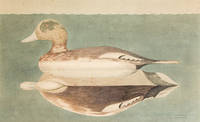
1928réf. 214599New York: The Derrydale Press 1928. Watercolor signed "Joel D. Barber / New York 1928" lower right. 1 vols. 11-1/2 x 18-3/4 in. framed to 16 x 22-1/2 in. overall. Fine condition. Watercolor signed "Joel D. Barber / New York 1928" lower right. 1 vols. 11-1/2 x 18-3/4 in. framed to 16 x 22-1/2 in. overall. Fine 1928 Original Duck Decoy Watercolor by Joel Barber. A fine large rendering very much reduced in the Derrydale Press and Windward House editions of Barber's classic book. It shows "a Stevens Widgeon . In this decoy the painting is original and still shows the work of a 'graining comb' on the back." The watercolor execution is meticulous. Inscribed verso: "Amer. Widgeon Baldpate / No detailed history - just used in Currituck Sound North Carolina / the Currituck Club. / Reproduced through the Courtesy of H.F. Stone Esq. of New York 1928. / Note-- Undoubtedly a machine made decoy of the Eighties - a product of some early northern factory possibly a Stevens - Weedsport / Joel." A UNIQUE AND HIGHLY DESIRABLE DERRYDALE DUCK RENDERING. Siegel 85. Provenance: From the private collection of Eugene V. Connett III. Literature: Barber's Wild Fowl Decoys plate 60 [The Derrydale Press] unknown books
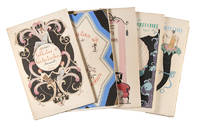
réf. 121036Paris Meynial 1922-1926. . First editions; 5 vols 8vo 252 x 170 mm; each issue with colour vignette to title & 12 colour pochoir plates 60 in total introductory text by Colette; loose as issued in original coloured pictorial wrappers by Barbier a fine set. A fine example of a complete set A complete set of this exquisite series displaying fashion in magnificent and imaginative illustrations. The series includes Barbier's depiction of the seven deadly sins in the volume for 1925. Here one finds a great theme of the Western iconographical tradition at home in Barbier's special world. 'Anger' shows a modish couple quarrelling in a formal garden; 'Envy' is displayed by a maid regarding her mistress as she steps from a Rolls Royce; and 'Gluttony' is depicted as a gourmandise. Falbalas et fanfreluches was the last of Barbier's books to reflect contemporary life. Its special value lies in the unique way in which it catches the tone and mood of les années vingts. Gaudriault p115. Paris, Meynial, 1922-1926. unknown
1922réf. 48789Paris.: Chez Meynial. 1922. Loose as issued in original publisher's printed wrappers with a colour design by Barbier heightened with gilt gilt black and purple marbled board chemise and matching slipcase. Folio. 380 x 294 mm. Illustrated half-title with colour wood-engraved design by Barbier title with colour wood-engraved Harlequin vignette 12 full- and 2 half-page wood-engraved colour plates 22 wood-engraved colour four-line initials as well as decorative devices in the text many heightened in silver and gold final wood-engraved colour vignette list of plates and colophon. Each leaf of text surrounded by decorative frame. The cover illustration is repeated on the half-title. A very fine copy of this delightful collaboration between two Art Deco masters: Georges Barbier and François-Louis Schmied.From the edition limited to 150 numbered copies signed by Barbier in pencil. The plates were engraved by Schmied after Barbier's magnificent original designs. Chez Meynial. unknown
1922réf. 3930Collection Pierre Corrard, Paris 1922. Un volume in-4 en feuilles sous coffret décoré imitant la peau de serpent dorée, incrustée au premier plat, la médaille de Bilitis réalisée pour l'occasion par le sculpteur art-déco, Albert POMMIER. Première édition illustrée par GEORGE BARBIER et gravée sur bois par F.L. SCHMIED. 44 superbes illustrations couleurs dont la couverture, 13 en hors-texte et 8 à pleine page, 21 dans le texte ainsi que de nombreux ornements. L'un des 125 ex. numérotés sur Arches, seul tirage, signé par G.Barbier. Il est joint à cet exemplaire trois maquettes originales d'essai de la couverture avec ajouts et découpes par Barbier. - ENGLISH DESCRIPTION: P. Loüys. LES CHANSONS DE BILITIS. Taduit du grec. Illustrations de G. Barbier gravées sur bois par F.L. Schmied (1922) .Collection Pierre Corrard, Paris 1922. A quarto volume (33 x 26 cm) issued in loose sheets within a shellcase featuring a gold snakeskin-effect finish; the front cover is inset with the "Bilitis" medallion created for the occasion by Art Deco sculptor Albert Pommier. First edition, illustrated by George Barbier and featuring wood engravings by F.L. Schmied.- 44 superb illustrations, including the cover, 13 plates and 8 full-page images, 21 in-texte, as well as numerous decorative elements. One of 125 copies numbered on Arches paper, signed by G. Barbier. Included with this copy are three original cover mock-ups featuring additions and cut-outs by Barbier. A perfectly preserved copy housed in a highly elegant custom-made presentation box. Additional photographs available upon request.
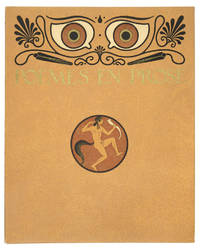
réf. 94761Paris A. Blaizot 1928. . First edition number 101 of 150 copies; 4to 26 x 21 cm; 27 text illustrations wood-engraved by Pierre Bouchet and printed in colour after designs by Barbier; presentation copy signed by Barbier on front blank; loose as issued in original pictorial wrappers after Barbier publisher's burgundy cloth chemise and slipcase. Presentation copy inscribed by Barbier A French Romantic poet Maurice de Guérin 1810-39 achieved cult status in his lifetime as one of the first writers of 'prose poems.' The present work is illustrated by George Barbier who provides beautiful illustrations of the mythological Centaur and the Bacchante a follower of Bacchus Dionysus. The charming presentation inscription reads: 'À Mademoiselle Violette Gath / ces petites divinités d'autrefois déjà touchées par la mélancolie d'aujourd'hui / avec les respectueux compliments de l'artiste / George Barbier / juin 1928.' To Miss Violette Garth / These small deities of days past already touched by the melancholy of today / With respectful compliments of the artist George Barbier / June 1928. Carteret IV 195; Méhé II 309-310; Ritchie 25. Paris, A. Blaizot, 1928. hardcover
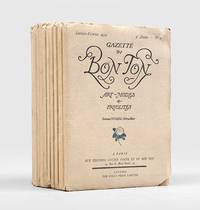
1920réf. 118958London: the Field Press Limited 1920. An attractive run of the hugely influential French fashion magazine. Founded by Lucien Vogel the first issue was released in November 1912. Publication was suspended in 1915 due to the First World War resuming in 1920 with the present volume and continuing until 1925. Extensive runs such as this especially in such bright condition are uncommon. "After the last issue of this excellent magazine in 1925 nothing else quite like it was ever produced. It has the prestige of having pioneered the idea of using the very best artists to illustrate the very best haute couture designs of having maintained a superb standard of printing on hand-made paper and for most of its life it was guided by one director Lucien Vogel" Robinson p. 28. Although short-lived Gazette du Bon Ton was a key publication and reported on the latest developments in fashion and lifestyle at the beginning of the twentieth century at a time when styles were changing dramatically in the space of a few years. The magazine was only available to subscribers at a price which equals $425 per year in today's money thereby creating a very exclusive image. Lucien Vogel the editor aimed to establish fashion as an art form and to create "good taste" for the Parisian elite. Contributing artists included all the greatest names of the day such as Dufy Bakst Barbier and Brunelleschi all of whom depicted the haute couture in a narrative and dramatic style using vivid colours and the pochoir technique on special handmade paper. Many of the designs were idealistic leisure scenes of the well-to-do illustrating the latest creations of Paris vintage fashion houses such as Worth Lanvin Doucet Poiret Callot Soeurs Paquin and Beers often without explanatory text. The literary content was also of the highest quality with essays by well-known art historians playwrights and novelists of the day. 10 vols quarto: 79 hand-coloured lithograph plates en pochoir 48 coloured croquis. Loose as issued in original printed paper wrappers. Housed in a custom orange cloth solander box. Trivial wear to edges corners very slightly defective to front wrapper of part I; a very good remarkably well-preserved set. Julian Robinson The Golden Age of Style 1976. hardcover
réf. 125420Paris Pierre Corrard 1914. . First edition folio 32.5 x 27.8 cm; No.396 out of a limited edition of 512 numbered and initiated by the publisher; signed by Karsavina; title page with pictorial vignette to head and verso 12 full-page coloured illustrations by Barbier printed on rectos only plates exceptionally fresh; original pictorial wrappers; 24 ll. Signed by Tamara Karsavina An attractive copy in the original wrappers of Barbier's early masterpiece dedicated to Tamara Karsavina. 'The cover design pays homage to Beardsley. and its 12 pochoir plates depict Karsavina in her principal parts. That their purpose is again to stir the emotion and delight the eye of the viewer not to document the performance is demonstrated by Le spectre de la rose glimpsed at the moment when the phantom lover of whom the young girl has dreamed after the ball is about to disappear as the rose drops from her hand.' Ray. Paris, Pierre Corrard, 1914. unknown
1928réf. 87423Sous étui et chemise cartonnés. Couverture illustrée en rempliée.Belle édition publiée d'après une maquette typographique de François-Louis Schmied, illustrée de 33 compositions en couleurs de George BARBIER gravées sur bois par Pierre Bouchet.
1812réf. M12282Paris:: Crapart & C.L.F. Panckoucke 1812-22. 1812. Complete set of 60 volumes. 127 engraved plates list of subscribers in the index volume 10 folding charts; occasional foxing ink and water-stains. Modern quarter green spines over original marbled boards gilt-stamped black leather spine labels; re-backed. Ex-lib bookplates and ink stamps of the Norwich & Norfolk United Medical Book Society early ownership inscription of Hudson Gurney. Fine. FIRST EDITION. 19th Century French Medical Encyclopedia Possibly one of the most important encyclopedia/dictionaries of medicine ever assembled and certainly the earliest. As Diderot's encyclopedia became the model for assembling scientific knowledge this massive set brings together all that was known about medicine in the post-Napoleonic era. Included here are numerous engraved plates of surgical instruments of the period. Also illustrated are facial expressions and signs of mental abnormality many in the style of Esquirol's work. A smaller set Dictionnaire abrege des sciences medicales. . . was concurrently published however that set is only 15 volumes. In 1821-25 Panckoucke published Dictionnaire des sciences medicales Biographie medicale. . . which includes biographies of medical luminaries. Nicolas Philibert Adelon 1782-1862 and Francois Victor Merat 1780-1851 were two of the prominent contributors to this medical encyclopedia. This compendious work was not included amongst the items exhibited by the Library of Congress in their Circle of Knowledge exhibition of the history of the encyclopedia. Panckoucke 1736-1798 was involved with issuing various encyclopedias beginning with Diderot's Encyclopedie which ". . . was an immediate success: a new edition was called for even before the first had been completed. C.J. Panckoucke proposed such a new edition in 1761 and bought the rights to the first seven volumes. He approached Diderot to edit a new revised edition and when Diderot refused began to reissue the original volumes. The government intervened in 1770 and seized the three which had appeared. After the death of the last of the original proprietors in 1775 Panckoucke published a five-volume supplement to the Encyclopedie and later in 1780 a two-volume index. The complete first edition comprises Diderot's twenty-eight volumes plus Panckoucke's seven; its publication spanned the years 1751-80." Circle of Knowledge 1979 p. 8. Provenance: Hudson Gurney 1775-1864 was an antiquary and verse-writer of Norwich. He became an M.P. for Newtown in 1816 and sat in six successive parliaments. In 1835 he was high-sheriff of Norfolk and was elected fellow of the Society of Antiquaries 1819 was vice-president from 1822-46 a fellow of the Royal Society and a member of the British Archaeological Association. As such Gurney may have been the donor of this set to the Norwich & Norfolk Library. DNB Vol. VIII pp. 803-4. Circle of Knowledge 1968 1979; Wellcome II p. 465. Crapart & C.L.F. Panckoucke, 1812-22. hardcover
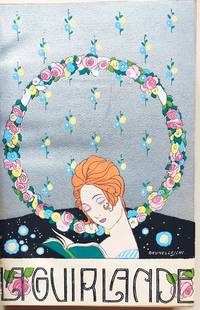
1917réf. 002990Paris: La Guirlande 1917. Book. Near Fine. Hardcover. 1st Edition. Complete set of this rare and highly decorative art deco periodical. Eleven issues all published bound in two volumes. 59 pochoir colored plates by renowned illustration artists Georges Barbier Umberto Brunelleschi Taquoy Vallee Bonotte Domergue Wegener Stab and others. Most pages with in-text color illustrations including head- and tail-pieces. All eleven original printed wrappers with colored and silver design by Brunelleschi are included. Brunelleschi was the artistic director of the short lived but significant La Guirlande. Jean Hermanovits was the literary director. Jean Saude one of the foremost artists to explore and promote pochoir techniques was responsible for the brilliant pochoir coloring. Texts by Lucie Delarue-Mardrus Rene Boylesve Jean Hermanovits Abel Hermant and others. Each issue numbered 79 of a total edition of 800 copies. Both Barbier and Brunelleschi at that time were at the top of their artistic prowess and their beautiful illustrations in La Guirlande reflect their talents. Includes duplicate of 'L'Heure du Bain' as stated in Colas. Each issue complete with mostly illustrated advertisements of 'Maisons de luxe'. Bound in two volumes half calf with raised bands and patterned boards matching patterned endpapers and gilt titles on spine. Top edges gilt. Besides the inevitable offsetting from the pochoirs this is a very fine complete set of all issues published. No marks or inscriptions no foxing. 28 x 20 cm. . La Guirlande Hardcover
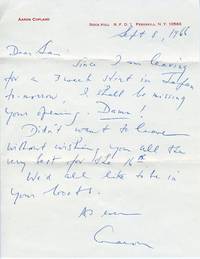
réf. 10127Used; Like New/Used; Like New. A fascinating and important collection of autograph letters and telegrams to the important American composer dating from the premieres of his two operas Vanessa 1958 and Antony and Cleopatra 1966. Included are autograph letters from Aaron Copland John Browning who premiered Barber's Piano Concerto Rosalind Elias the original Erika in Vanessa and Charmain in Antony and Cleopatra Ignace Strasvogel and other friends and admirers and telegrams from Leonard Bernstein Martha Graham Jerome Robbins W. H. Auden Noel Coward and many others. While Vanessa with libretto by Menotti won Barber the 1958 Pulitzer Prize for music Antony and Cleopatra written for the opening of the new Metropolitan Opera at Lincoln Center was not well-received. Franco Zeffirelli chosen to write the libretto and stage the opera weighed down the production with over-the-top scenery animals and extras; technical difficulties marred the opening night. As Barber departed New York for Italy the very next morning his years of success had for the most part come to an end. The 1966 letters to Barber reflect his unhappy state with many of his friends consoling him over the bad reviews and assuring him that his music transcended the problems of staging. Included are: 88 telegrams sending best wishes and congratulations on the première of Vanessa in 1958 sent by W. H. Auden Noel Coward Aaron Copland Leonard Bernstein Jerome Robbins John Browning Frank O'Hara Stephen Spender Martha Graham Erich Leinsdorf Antal Dorati Andre Kostelanetz Regina Reznik "Your old Baroness" Roberta Peters G. Schirmer Lillian Gish Max Rudolf Samuel Chotzinoff the heads of ASCAP and NBC and many other luminaries and friends. 3 letters about Vanessa two ALS and one TLS dated January 1958. One from Roberta Peters celebrated Met coloratura thanking Barber for sending her some music mentioning that she is looking forward to learning Barber's song "Nuvoletta" and wishing him good luck for Vanessa 2 pp.; one from Eleanor Belmont a member of the Metropolitan Opera board congratulating Barber on the premiere 1 p.; and one from a music student William Gordon expressing his love for the opera and asking where he can obtain the score 1 p. typed and undated. 19 letters mostly autograph with one TLS to Barber from before and after the 1966 premiere of Antony and Cleopatra. Dated September-November 1966. Letters are from: Ignace Strasfogel 1 p; John Browning 3 pp.; Rosalind Elias 2 pp.; John Barrows 1 p.; Aaron Copland wishing Barber the best for the opening 1 p. with original envelope; David Johnson from Time-Life Records 2 pp.; C. W. Bailey 3 pp.; Dick 1 p.; Ellie Frankfurter 3 pp.; an unidentified correspondent in Russian 1 p.; Nina Fassler 1 p.; Lisette Lewis and another correspondent in one airmail letter from South Africa 3 pp.; Andrew Chiappe 2 pp.; Channing Way Jr a West Chester friend1 p.; Katy Katsoyanis mentioning Dimitri Mitropoulos 1 p.; "Chandler" 1 p.; Edith Jackson Barber's old school teacher from West Chester! 2 pp.; Horace P. Halsing from West Chester 1 p.; Mrs. Henry Holt 3 pp. Also included is one letter about the premiere addressed to "Bill" from "Ed" on the letterhead of the St. Thomas Aquinas Rectory Chicago; and an envelope addressed to Barber letter missing from Sol Schoenbach postmarked October 31 1966. Also included are 2 telegrams sent to Barber at the Metropolitan Opera House on the occasion of the premiere of Antony and Cleopatra. One is from an Ada Camillo congratulating Barber on behalf of all Cadegliano Menotti's hometown in Lombardy. The other reads "Love the story hated the music I think you are an American disgrace. Frank Terez 17" - a comic reaction to Barber's music but one that may have hit a nerve unknown books
1934réf. 260057New York: The Derrydale Press 1934. First Edition ONE OF 55 LARGE-PAPER COPIES signed by Barber this being No. 22. 5 color plates one of them handcolored and 121 other illustrations. TOGETHER WITH BARBER'S ORIGINAL INK DRAWING FOR THE TITLE PAGE laid in. 1 vols. 4to. Original full red morocco gilt t.e.g. others uncut; very slight chipping to top of spine else a fine copy of a book seldom found approaching this condition. Half red morocco slipcase with Derrydale logo on spine and on upper cover leather label with chemise. First Edition ONE OF 55 LARGE-PAPER COPIES signed by Barber this being No. 22. 5 color plates one of them handcolored and 121 other illustrations. TOGETHER WITH BARBER'S ORIGINAL INK DRAWING FOR THE TITLE PAGE laid in. 1 vols. 4to. "One of the most important books published by Connett." -- Siegel This is the large paper edition of this work. The regular trade edition was published at the same time by Windward House a sporting press started by Connett in 1933. Both editions used Barber's vignette on the the title page. From this drawing it appears that Connett liked the artist's Windward design and used in it the Derrydale edition: in the margin of the drawing Connett has pencilled "reduce 1/4 inch" and the drawing was photographically reduced to the smaller dimension for the large paper copies. A simplified version of the design was used on the Derrydale edition spine. One of the rarest and most desirable productions of the Derrydale Press and by virtue of the drawing a unique copy. Siegel 85; Frazier B-5-a The Derrydale Press unknown