BERGERON, L-E.Livre Rare Book

779 résultats
1816réf. 899Paris, Chez Hamelin-Bergeron, 1816. 3 volumes (2 vol de Texte + 1 Atlas), COMPLET. In-4 - 21 x 27 cm (Texte) ; Grd In-4-25,5 x28 cm (Atlas). Reliure postérieure en pleine basane fauve, dos lisse orné de doubles filets dorés et de filets à froid simulant les nerfs, auteur, titre et tomaison dorés. xxxij-509 pp. (T.1) ; xi-(1)-542 pp. (T.2) ; 96 planches (Atlas). Exemplaire bien complet de son Atlas, formé de 2 tomes contenant respectivement 39 et 57 planches, soit 96 en tout, dont les 8 premières (figurant 72 essences de bois) en couleurs, aquarellées à l'époque, et 42 planches doubles ou dépliantes. Seconde édition revue, corrigée et considérablement augmentée par P. Hamelin-Bergeron [pseudonyme de Louis-Georges-Isaac Salivet (1737-1805)]. Cette seconde édition est reconnue comme plus complète et bien supérieure à l'originale de 1792-1796 (Brunet I -785) de cet ouvrage, "dans lequel on enseigne aux amateurs la manière d'exécuter sur la Tour à Pointes, à Lunettes, en l'Air, à Guillocher, Carré, à Portraits, à Graver le Verre ; Et avec les Machines excentriques, ovales, épicycloïde, etc., Tout ce que l'Art peut produire d'utile et d'agréable. Précédé de notions élémentaires sur la Connoissance des Bois, la Menuiserie, la Forge, la Trempe, la Fonte des Métaux, et autres Arts qui se lient avec celui du Tour". De fait, outre le tournage du bois, l'auteur aborde le travail du fer, le tournage des pièces d'architecture, des colonnes torses et de la vis d'Archimède, le moulage des bois et de la corne, etc.
1702réf. 142788A Paris, chez Thomas Moette, 1702 In-4, plein veau marbré, dos à nerfs, caissons ornés rel. de l’époque 2- 208 pp. L'illustration se compose de 7 eaux-fortes hors texte, reprises par l'éditeur aux ouvrages de Félibien et Blondel, et de l'abondante illustration gravée sur bois des premières éditions du Théâtre de l’art de charpentier, comprenant 12 figures à mi-page et 82 à pleine page, dont 12 doubles et une dépliante. Teliure frottée, coisn émoussés. Petite déchirures au centre de deux ff. pp. 77 & 58 avec infime perte de texte. Humidité marginales aux deux dernières eaux-fortes, Par ailleurs frais.
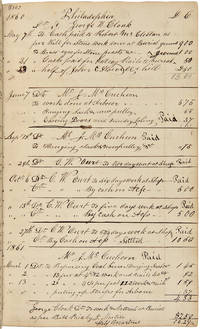
1835réf. 52261Philadelphia. 1835–1866. Account Book of a Philadelphia Carpenter An interesting carpenter's account book from 19th-century Philadelphia containing a voluminous number of entries listing client names types of carpentry work done and the costs thereof. Internal evidence his name on pages 52 and 114 suggests that this belonged to Philadelphia carpenters John and W.H. Martin. The accounts start on July 22 1835 exactly one month after the 1835 Philadelphia general strike ended. Workers' rights and formative unions owe much to this strike in Philadelphia the first general strike by wage workers in North America. The strike helped alleviate long hours and low pay by involving some 20000 workers who demanded a ten-hour work day and increased wages. The strike was very successful ending in an almost complete victory for the workers. About half of the ledger deals with work done in the first five years in which it was kept between 1835 and 1840. There are no entries from June 1847 to June 1849 and only sporadic entries from 1857 to the final entries in 1866; most of the rest of the accounts are from 1840 to 1855 except the two-year hiatus. The account book lists a wide assortment of different types of work accomplished by carpenters including framing putting up awnings "repairing a privey seat" hanging doors and windows putting up lightning rods making shutters mending floors and much more. In addition Martin seemed to occasionally make furniture specifically benches and tables for which there are some entries here. It also contains important information on the prices paid by tradesmen for supplies in Philadelphia at the time mostly lumber and nails in this case. Although there is no explicit ownership signature both internal evidence and other material purchased from the same estate suggest John Martin as the principal craftsperson and W.H. Martin as an employee or other principal of the business. The ledger offers much insight into American trade in one of its most important cities at a time of immense growth. A fascinating account book with much detail on the development of Philadelphia private homes in the middle of the 19th century. Contemporary half calf and marbled boards. Binding worn and rubbed. Very good. hardcover
réf. DIV001M1900, J.JUSTIN STORCK, Paris, édition originale