4033 resultados
ref. 64988aafLugduni Batavorum (Leiden), apud Gerardum Potvliet, 1733, in-8vo, 8 Bll., Titelbl. in Rot u. Schwarz + 481 SS. + 13 SS. (Index) + 6 (5 mehrf. gefalt.) Kupfertaf., auf etwas gutem Papier gedruckt, marmor. Lederband mit Rverg. u. Rsch., vord. Spiegel teils hs. bezeichnet, beide mit Wurmspuren, Rücken stärker betroffen, Fehlstellen an den Kapitalen, Rotschnitt. Hübsches Exemplar.
ref. 13017Used; Like New/Used; Like New. An interesting collection of six posters related to the theme of food and conservation during WWI including two by Frederick Cooper. As follows: Cooper Fredrick G. Save a Loaf a Week Help Win the War. No. 3. W.F. Powers Co.: New York 1917. Measures 23 x 29.5 in. Cooper Fredrick G. Save and serve the cause of Freedom. No. 2. W.F. Powers Co.: New York 1917. Measures 21 x 29 in. The illustrator Frederick Cooper popularized lower case lettering instead of the traditional all uppercase in his posters and his clean style graced the cover of many Life magazines and produced iconic images that captured the spirit of his time. Like many illustrators at the time he contributed his art to the war effort in his modern-style posters created for the U.S. Food administration.The second of his posters offered in the lot especially exemplifies his clean style and use of text. Fight World Famine enroll in The Boys Working Reserve. Thomsen-Ellis Company: Baltimore 1914-1918. Measures 19 x 28.9 in. A dramatically illustrated poster produced for the U.S. Department of labor that depicts a young man wielding a pitchfork and his fist in front of an illuminated hill of wheat fighting against a hoard of angry vultures. Raleigh Henry. Hunger / For Three years America has fought starvation in Belgium. Will you Eat less-wheat meat- fats and sugar that we may still send food in ship loads poster. Edwards & Deutsch Litho. Co.: Chicago 1917. Measures 21 x 29 in. Put out Waste Bones- they make glue for Aircraft. J Weiner Ltd.: London 1940s. Measures 10 x 15 in. Put out Waste Paper- it is used for Ammunition and other vital needs. J. Weiner Ltd.: London 1940s. Measures 10 x 15 in. Condition: Save a Loaf a Week: Very good Fight World Famine: the top left corner is missing and there is a tear on the center bottom. Save and serve the cause of freedom: brittle edge on the left bottom side. Put out Waste Paper and Bones: linen backed in very good condition. unknown books
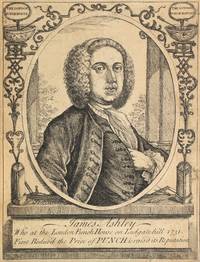
ref. 267136London: Thomas Worlidge n.d. ca mid-18th century. Engraved portrait of James Ashley in cartouche flanked by ornate pedestals supporting two punch bowls with engraved caption as above by Thomas Worlidge. 1 vols. 7-9/16 x 5-3/4 in. A strong impression laid down light creases from prior folding small pin hole near engraved caption. Engraved portrait of James Ashley in cartouche flanked by ornate pedestals supporting two punch bowls with engraved caption as above by Thomas Worlidge. 1 vols. 7-9/16 x 5-3/4 in. Scarce trade card of James Ashley proprietor of the London Coffee House and Punch-House 1731-1776 who was "London's leading purveyor of Punch in the eighteenth century" Wondrich Punch p. 65 and "the world's first celebrity mixologist the first man to become famous for compounding and selling a mixed drink" ibid p. 172. Ashley a former cheese merchant opened his Punch-House in 1731 in Ludgatehill London. Extensive advertising in London papers as well as the distinct ornate pedestals surmounted by iron punch bowls which flanked its entrance made the London Punch-House one of the most well-known drinking establishments in the city. Clientele included Hogarth Boswell Oliver Goldsmith and Benjamin Franklin. A large sign outside of the Punch-House echoes the caption on this trade card "Pro bono publico. James Ashley in 1731 first reduced the price of punch raised its reputation and brought it into universal esteem." Ashley did indeed reduce the price of punch - from 8 shillings for punch made from a quart of arrack to 6 shillings - but his great innovation was to offer punch in smaller portions in servings as small as two ounces. These small servings made to order for the customer were the precursor to the modern cocktail. This trade card is engraved by Ashley's friend Thomas Worlidge 1700-1766 dubbed "the English Rembrandt" who also engraved portraits of Ashley's wife and one Mrs. Graywood the bar-keep at the London Punch-House. Not in ESTC Thomas Worlidge unknown
New edition, [2], ii, 3, [1], xxiii, [1], 271, [1], 46pp., 'On distilling in general' has separate pagination, handsomely bound in half calf by Trevor Lloyd of Ludlow, marbled boards, five raised bands to spine with red morocco title label and tooled in gilt, a very nice copy. It was not until the publication of this new edition that the "Ingenious Foreigner", responsible for the 1770 and 1771 editions, revealed himself as "Mr. Borella, now head confectioner to the Spanish Ambassador in England." All three edition are rare with ESTC recording 7 copies of the first 1770 edition, 1 of the second edition of 1771, and 8 copies of this new and last edition. Maclean, pp. 10-11; Oxford, p. 102; Bitting, p. 49-50; Simon, 227; Cagle, 572.
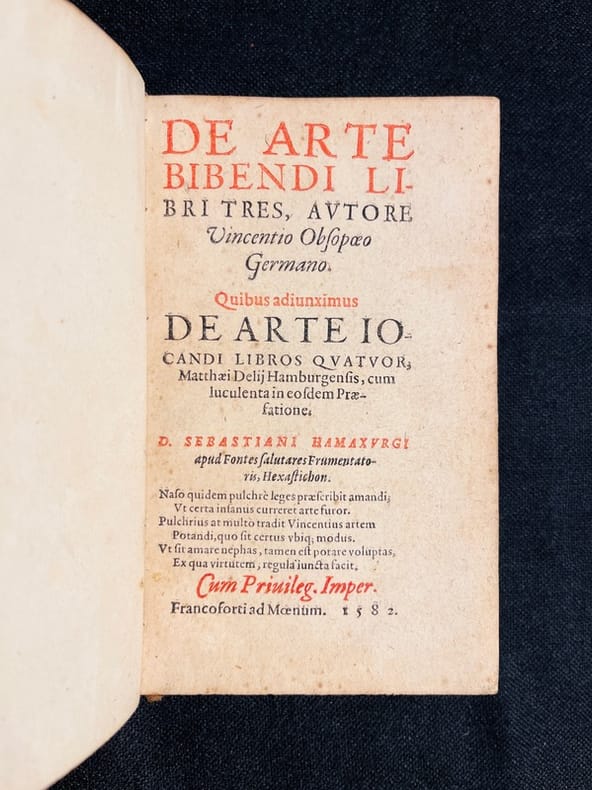
ref. 20889Francoforti ad Moenum, héritier de Christian Egenolff, Coloniae, Konrad Bütgen, 1582 - 1611. In-12 de 208 [et] [16]-189 pages, plein veau marbré marron, dos lisse orné de filets et fleurons dorés, pièce de titre en maroquin rouge, roulette dorée sur les coupes, tranches rouges.
1891In-8 gr. (mm. 259x185), 2 volumi, preziosa legatura in pieno marocchino blu realizzata dal celebre rilegatore parigino Emile Mercier (al risguardo è impresso “Mercier S.r de Cuzin”), sottili cornici dorate e delicate decoraz. di foglie ai piatti, dorso a cordoni con decoraz. e titolo oro; ricche dentelles dorate ai risguardi marmorizzati, tagli dorati, conservate le brossure orig., pp. (4),XXVIII,176; (4),387 (numeraz. continua),(4). Magnifica edizione illustrata da 36 “compositions” di C. Delort, “gravés au burin et a l’eau-forte” da L. Boisson: 1 vignetta ai 2 frontesp., 1 ritratto della “Duchesse du Maine” sulle 2 bross. anter., il ritratto di Madame de Staal, 1 tavola f.t. (alla fine del 2° volume), 15 testatine e 15 culs-de-lampe. Cfr. Carteret,IV, p. 366: “Très belle pubblication très cotée, à rechercher sur japon ou vélin avec les états. C’est à la suite du succés et du prix d’honneur décerné (par un concours) aux "Mémoires du comte de Grammont", que l’éditeur confia cette nouvelle publication aux memes artistes” - Benezit,IV, p. 417: “Charles Delort (1841-1895), célèbre artiste: peintre d’histoire, sujets typiques, aquarelliste, dessinateur, illustrateur. ” - Benezit,II, p. 479: “Léon Boisson (1854-1941), graveur, obtint le Grand Prix de Rome de Gravure en 1876”. Cfr. Alastair Duncan “Art Nouveau and Art Deco bookbinding. The French masterpieces”, p. 194: “Emile-Philippe Mercier (1855-1910), bookbinder and gilder, in 1869 was apprenticed to Charles Magnier père, under whom, and with the tutelage of the master gilder, Francisque Cuzin, he developed into the foremost gilder of his time. By 1890, when he succeeded Cuzin, his studio on the rue Séguier was producing a wide range of bindings which, though classical in inspiration, could not be juged merely as copies of past works..” - Devauchelle “La reliure en France”,III, p. 65-67. “Edition de grand luxe, imprimé par Georges Chamerot, en caractères elzéviriens”, in tiratura di 600 esemplari numerati. Il ns., “imprimé pour M. Le Comte de l’Aigle”, fa parte di una tiratura di 30 “sur Japon ou sur papier vélin, avec trois états des planches (eau-forte pure, avant la lettre et avec la lettre)”. Esemplare in perfetto stato, con bell’ex-libris nobiliare.
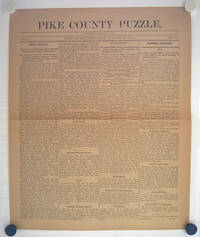
1894ref. WRCLIT74696Camp Interlaken Penn. 1894. 4pp. Folio leaflet 15" x 12 1/8" ; 38 x 31 cm. Text printed in four columns. Horizontal fold with small break at margin at fold slight tanning at edges and along fold faintly in excess of the uniform tan tone of the wove paper stock faint tidemark at extreme lower corner of top sheet otherwise an unusually nice copy of a very fragile item. One of the black tulips of Crane collecting being his second separate publication albeit with some likely contribution by L. C. Singer Jr. The .PUZZLE . is a 4 page mock newspaper formatted as a parody of a small town newspaper written by Crane at an adult camp Twin Lakes where he spent part of the summers of 1894 and 1895. The text is based on the experiences Crane and his cohorts had while at the camp and during their return trip. The paper was set up and printed for them by the staff of the PORT JERVIS UNION. On September 7th THE PORT JERVIS UNION printed an appreciative notice of the PIKE COUNTY PUZZLE's appearance and content. An account of the circumstances is contained in THE CRANE LOG. Much of the content is jocular in nature including Crane's identification of himself as "office boy" and in an advert on the last page as "Drink Mixer." Among the other content is a "stenographic" report of "Dinner-Time Conversations": "Miss Pronk with a sudden rush of courage. - 'Mr. Crane dont you like the Lays of Ancient Rome I think they are awfully sweet. Crane:- 'My uncle had a hen named Ancient Rome once and her eggs were popular all over the county. Yes Miss Pronk you are undoubtedly right.'" Personal advertisements "Telegraphic News" from other locales and similar tongue-in-cheek texts round out the mix. Until a clearly identified facsimile was published in 1967 by THE STEPHEN CRANE NEWSLETTER in an edition of 300 copies including 70 on white laid paper this original edition was the sole printing in this format. While not an absolute rarity in the strictest sense -- OCLC locates 19 copies at institutions not likely to have commingled entries for the facsimile with entries for the real thing -- it is scarce in the market place. WILLIAMS & STARRETT 43. Wertheim and Sorrentino THE CRANE LOG pp.109-113. BAL 4069. OCLC: 8523158 etc. unknown books
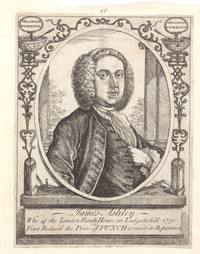
ref. 267079London: Thomas Worlidge mid-18th century. Engraved portrait of James Ashley in cartouche flanked by ornate pedestals supporting two punch bowls with engraved caption as above by Thomas Worlidge. 7-9/16 x 5-3/4 in. A strong impression with very slight rubbing and discoloration. Engraved portrait of James Ashley in cartouche flanked by ornate pedestals supporting two punch bowls with engraved caption as above by Thomas Worlidge. 7-9/16 x 5-3/4 in. Scarce trade card of James Ashley proprietor of the London Coffee House and Punch-House 1731-1776 who was "London's leading purveyor of Punch in the eighteenth century" Wondrich Punch p. 65 and "the world's first celebrity mixologist the first man to become famous for compounding and selling a mixed drink" ibid p. 172. Ashley a former cheese merchant opened his Punch-House in 1731 in Ludgatehill London. Extensive advertising in London papers as well as the distinct ornate pedestals surmounted by iron punch bowls which flanked its entrance made the London Punch-House one of the most well-known drinking establishments in the city. Clientele included Hogarth Boswell Oliver Goldsmith and Benjamin Franklin. A large sign outside of the Punch-House echoes the caption on this trade card "Pro bono publico. James Ashley in 1731 first reduced the price of punch raised its reputation and brought it into universal esteem." Ashley did indeed reduce the price of punch - from 8 shillings for punch made from a quart of arrack to 6 shillings - but his great innovation was to offer punch in smaller portions in servings as small as two ounces. These small servings made to order for the customer were the precursor to the modern cocktail. This trade card is engraved by Ashley's friend Thomas Worlidge 1700-1766 dubbed "the English Rembrandt" who also engraved portraits of Ashley's wife and one Mrs. Graywood the bar-keep at the London Punch-House. Not in ESTC Thomas Worlidge unknown