4037 risultati
1928rif. 64506Los Angeles & Guasti CA: Italian Vineyard Co. Printed by Young & McCallister Inc. Nov. 1928. 16mo. 5 x 7 in. 31 1 pp. With numerous colour text illustrations panorama centerfold birds-eye view of Italian Vineyard Co. vineyards and winery. Colour-illustrated softcovers cover art of Italian chef leaning over the housewife to encourage use of Guasti wines small closed tear at foot of spine very minor edgewear minor soiling back cover still a VG- copy. First edition of this very scarce cookbook issued by the then famous Guasti California Italian Vineyard Co. under the direction of founder Secondo Guasti whose company by 1920’s owned 8 square miles of desert land in San Bernardino County east of Los Angles with over 20000 acres of vineyards. Guasti Cooking Sherry which was salted was excellent for sauces meats fowl stews and gravies while the old claret was perfect for red meats poultry and game dishes. The Sweet Sherry flavoring Sweet Port Flavoring and the Sauterne combined Guasti wines with cane sugar. Now largely a ghost town between the 10 & 60 freeways in Rancho Cucamonga the church replicating a 17th-Century Italian Church in Guasti’s native village of Asti still remains. Worldcat locates 1 copy of the 1st edition UC Davis 2nd edition released later is more common. Italian Vineyard Co., [Printed by Young & McCallister, Inc.], paperback
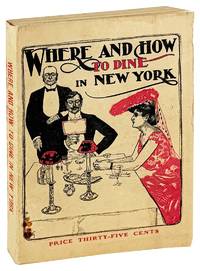
1903rif. 45614New York: Lewis Scribner & Co 1903. Very Good. New York: Lewis Scribner & Co. 1903. First Edition. Octavo 19cm; publisher's cream pictorial wrappers; 2621416pp.; frontispiece and seventeen 17 halftone plates throughout extensive illustrated advertisements at beginning and end of the volume. Very light shelf wear textblock slightly starting to pull from binding else a fresh Very Good to Near Fine example. Brilliant example of this uncommon dime novel-format guide to dining out in turn-of-the-century New York City. The entries deal primarily with the hotels and major restaurants of Manhattan with just a couple forays into New Jersey or Brooklyn. Each entry is given two or three pages of description and frequently a photographic illustration of the dining room or the facade. Diners are reminded to visit the Waldorf Astoria during Horse Week while at the Pabst Grand Circle one can enjoy both "liquid and solid refreshments" while looking out over Central Park. At the Women's Lunch Club on West 23rd there is a strictly restricted membership limited to "fashionable shoppers" to keep the establishment from overcrowding. The many nationalities promised in the title appear to be limited to English American French and German. Lewis, Scribner & Co unknown
1930rif. 63169Austin & Minneapolis MN: Minnesota Utilities Company; Northern States Power Company - Home Service Department Cooking School; Federal Public Service Corporation of Minnesota ca. 1930-1936. Eight parts. 4to. 46 pp assorted separate numbering. w/ most leaves printed on recto only but 2 printed on recto & verso in mimeograph typescript stapled at upper left corners separately 1 part w/ “Seasons Greetings” printed in red minor age toning edgewear still a VG group. A culturally significant group of mimeographed recipes instructions and promotional flyers for the Home Economics & Cooking School demonstrations put on by Naoma Rice for three different Minnesota utility and public utility companies through the depths of the Great Depression. Spearheaded by Rice 1899-1937 the demonstrations emphasized the use and advantages of electric ranges and refrigerators as their popularity and use slowly became more widespread in the 1930’s with an emphasis on local produce and fruits. The first group of recipes includes instructions for such confections as Cranberry Sponge Cake Cider Sherbet Macaroon Pie Spagetti sic Sauce and Bran Refrigerator Rolls. Mixed through the other recipes there are instructions for Crunchy Potato Chip Cookies Apple Cheese Cake Parmesan Veal Frozen Pumpkin Pie and Corn Flake Crust. Several of the recipes emphasize the use of popular Minnesota fruits including Apple Quince Grapes and others.The importance of refrigeration was also emphasized in the “Cooking School” and Model Kitchens with instructions on temperatures needed for home rangers and refrigerators for cooked foods meats butter opened jelly or preserves cheeses and more. Rice suffered through an unspecified childhood illness by by the early 1920’s had become a public school Home Economics Teacher and then by 1928 was listed in Austin MN street directories as a “Demonstrator” for home economics and cooking classes. The Minnesota Utilities Company had been created in 1917 from several smaller utilities and my the Great Depression had grown large enough that it became subject to both the TVA and the Rural Electrification Project as Roosevelt’s New Deal programs attempted to encourage increased use of electricity and electric appliances to boost the economy. The Northern States Power Co. was based out of Minneapolis MN and extended across Minnesota Michigan into the Dakotas and operated an extensive Home Service Dept. The Federal Public Service Corporation of Minnesota appears to have been one of the short-lived outgrowths of WPA and PWA-sponsored programs under the New Deal. This cataloguer could not locate any similar surviving documents for Naoma Rice cooking classes or the Minnesota-based utility companies. Minnesota Utilities Company; Northern States Power Company - Home Service Department, Cooking School; Federal Public Service Cor unknown
1915rif. 60411Montreal Canada: Lake of the Woods Milling 1915. 4to. 144 pp. Title in red & black text in red & black. With numerous colour plates colour advertisements for Five Roses flour text illustrations. Colour-illustrated softcovers minor creasing & scuffing to corners still VG bright copy w/gold braid still retained at upper left corner w/ ownership markings dated 1927 on title. First edition of this exceptionally popular Canadian cookbook devoted to cakes breads fancy breads biscuits buns pies tarts scones fritters griddle cakes muffins pancakes and more using the Five Roses flour and drawn from over 2000 cooks’ recipes. The famed Lake of the Woods Milling Co. at its height ground 62000 bushels a wheat daily producing 10000 barrels of flour and over 850000 Canadian households used the popular cookbook which was literally used until they perished by generations. Lake of the Woods Milling, paperback
1893rif. 61003Minneapolis MN: Washburn Crosby Co. Washburn’s Superlative Flour 1893. 12mo. 3.8 x 6 in. which folds out to 6.75 x 6 in. colour chromolithograph trade card illustrated recto & verso minor wear rubbing at fold crease minor shelfwear still VG exemplar from the library of Prof. Marvin Nathan. First edition of this nicely chromolithographed advertising souvenir folding trade card handed out by Washburn Crosby & Co. flour mills at the 1893 Columbian Exposition where they again won a gold medal for their “Superlative Flour.” Image shows sacks of flour being shipped across the Great Lakes with Columbia seated above illustration of gold medal ribbons on recto. Washburn 1818-1882 built his first flour mill in Minneapolis MN in 1866 with a capacity of 840 barrels per day but after fire and setbacks had erected a huge new mill in 1880 with state-of-the-art machinery which produced “Gold Medal” winning flour. Not in Dybwad & Bliss Annotated Bibliography: World’s Columbian Exposition Chicago 1893. Washburn, Crosby Co., Washburn’s Superlative Flour, unknown
1893rif. 64726St. Louis MO Chicago IL & Milwaukee WI: William J. Lemp Brewing Co. Miwlaukee Litho. & Engr. Co. 1893. Oblong 12mo. 5.25 x 3.25 in. 8 pp. With 42 leaves of Albertype sepia-tinted lithograph plates 3 colour chromolithograph plates 1 colour-lithograph folding map sized 6 x 9.5 in. mounted at rear. Colour-chromolithograph illustrated textured softcovers cover art of gnome holding a frothy mug setting on hops & rye w/ decorative lettering minor scuffing slight loss on first leaf neatly filled-in scuffing & minor loss to image on back cover still a VG- bright copy. First edition of this exceptional 1893 Columbian World’s Fair souvenir for the historic Western brewery first opened by Johann Adam Lemp in 1840 in St. Louis Missouri and vastly expanded by his son William J. Lemp and grandson William J. Lemp Jr. The St. Louis brewer was built atop a complex of natural caves which proved perfect for lagering beer used as underground beer gardens and eventually by the 1890’s the Lemp brewery covered 27 buildings on a 13.7 acre site. This souvenir’s illustrations provide an essential visual document of the brewery operations including a massive early refrigerating machine department followed by views of their breweries in Los Angeles & San Francisco CA Leadville Pueblo & Denver CO Wichita & Atchison KS El Paso Galveston Houston Austin & Dallas TX Portland OR and Salt Lake City UT along with the view of the booth at the World’s Fair. The beautifully chromolithographed images of Lemp Beer bottles include those for Standard Extra Pale and Culmbacher. Family tragedies including suicide by William J. Lemp Sr. in 1904 his son in 1922 and Prohibition forced the brewery operations to cease by 1920 and their Western breweries were spun off to other companies and the St. Louis Complex was sold to the International Shoe company in 1922. Worldcat locates 3 copies Hagley Newberry & The Strong. William J. Lemp Brewing Co., [Miwlaukee Litho. & Engr. Co.], paperback
1519rif. 63708Cincinnati OH: The Zanol Products Co. Oct. 15 1935. Folio. 64 pp. Red & black borders decorative printing throughout numerous photo illustrations diagrams. Orange textured softcovers brick-red coloured lettering & design on covers textblock slightly curved minor shelfwear dustsoiling still VG copy. First edition of this fantastic Zanol products direct sales catalogue including such products as perfumes fragrances creams lotions powders other cosmetics as well as cooking products and cleaning chemicals. The company’s most popular cosmetics product lines included the Faith Avery and La Bara lines. The La Bara cosmetics borrowed the femme fatale art deco image established by the actress Theda Bara in Cleopatra Salome and Manon Lescaut who began life as Theodosia Burr Goodman from Cincinnati OH. The perfume bottles lipstick compacts soaps were all produced with distinctive art deco packaging and remained popular through the 1930s. Of additional interest are their pioneering direct sales of packaged foods to shorten preparation time for housewives and home cooks as well as offer quick meals. Along with extracts for Root Beer and other soft drinks the Zanol line-up included Marshmallow Cream Lemonade Ezemade Biscuits Ice Cream Powder and a variety of boxed pasta and canned Italian style sauce for preparing meals within minutes. This catalogue includes an additional section with shaving creams cough syrups and other pharmaceutical products. See: Cosmetics by the American Products Company -- Zanol The Vamp and America’s Greatest Perfumer 2015; No copies located in Worldcat. The Zanol Products Co., paperback
1935rif. 63707Cincinnati OH: The Zanol Products Co. Feb. 1 1935. Folio. 56 2 pp. Red & black borders decorative printing throughout numerous photo illustrations diagrams. Orange textured softcovers brick-red coloured lettering & design on covers textblock slightly curved minor shelfwear dustsoiling occasional pencil annotations still VG copy with the National Recovery Administration logo printed on front cover corner. First edition of this fantastic Zanol products direct sales catalogue including such products as perfumes fragrances creams lotions powders other cosmetics as well as cooking products and cleaning chemicals. The company’s most popular cosmetics product lines included the Faith Avery and La Bara lines. The La Bara cosmetics borrowed the femme fatale art deco image established by the actress Theda Bara in Cleopatra Salome and Manon Lescaut who began life as Theodosia Burr Goodman from Cincinnati OH. The perfume bottles lipstick compacts soaps were all produced with distinctive art deco packaging and remained popular through the 1930s. Of additional interest are their pioneering direct sales of packaged foods to shorten preparation time for housewives and home cooks as well as offer quick meals. Along with extracts for Root Beer and other soft drinks the Zanol line-up included Marshmallow Cream Lemonade Ezemade Biscuits Ice Cream Powder and a variety of boxed pasta and canned Italian style sauce for preparing meals within minutes. See: Cosmetics by the American Products Company -- Zanol The Vamp and America’s Greatest Perfumer 2015; Worldcat locates 1 copy Public Library of Cincinnati. The Zanol Products Co., paperback
1915rif. 64380Chicago IL: Libby McNeill & Libby 1915. 4to. folded into 8vo. 20 4 columns i.e. 12 pp. Colour-litho illustrated front cover showing globe and all of the peoples and Libby products back cover showing the Libby’plants in Ontario CA an Alaskan salmon cannery and pineapple cannery in Honolulu H.T. numerous photo illustrations large double-page centerfold colour plate of the Exposition colour map at rear of San Francisco and the Exposition by P. Northrup minor shelfwear slight rubbing slight soiling covers still a VG bright copy. First edition of this scarce Libby’s promotional brochure for the Panama-Pacific International Exposition filled with photo illustrations of the plants canneries factories and the canned products including peaches pineapple fruit preserves ox tongues pork & beans and much more. The splendid panoramic birds-eye view of the PPIE is reminiscent of California Plein-Air paintings by William Phelps Northrup 1850-1929 artist cartographer and partner in the Matthews-Northrup Works in Buffalo NY who typically contracted with the Poole Bros. in Chicago. Worldcat locates 4 copies Canadian Centre for Architecture Hagley Osher Map Lib & Van Pelt Library. Libby, McNeill & Libby, unknown
1943rif. 63912San Francisco CA: Monaco Theatre Restaurant 560 Pacific Ave. 1943. 8vo. 8 pp unpaginated. colour printed bi-fold which opens up into panoramic interior scene menu minor edgewear center creasing from folding slight scuffing still VG copy. First edition thus of this souvenir menu touting the Monaco Theatre Restaurant which anchored one end of Gavallo’s International Settlement Latin Quarter following the clean-up of the notorious Barbary Coast during the 1939-1940 Golden Gate International Exposition. The Monte Carlo-themed nightclub was authentically appointed filled with musicians singers and dancers in Spanish-revival costume and was instant hit serving De Luxe dinners for $2.50 initially $ 1.00 and featured Mixed Green Salad Minestrone Soup Raviolis or Spaghetti as well as Fresh Crab Bordelaise or Roast Duck. California Sparkling Wines including the Ambassador Red or Aristocrat White were very popular. The International Settlement thrived during the World’s Fair but really boomed after the U.S. entered World War II and armed forces swamped the city ironically returning Pacific Avenue back to its red-light roots with many of the Monaco’s neighbors offering burlesque shows honky-tonk and a smattering of prostitution. Worldcat locates 1 similar copy Bancroft; See: Woody LaBounty International Settlement Jackson Square Teh Exotic Restaurant Row San Francisco Story March 19 2025. Monaco Theatre Restaurant, 560 Pacific Ave., unknown
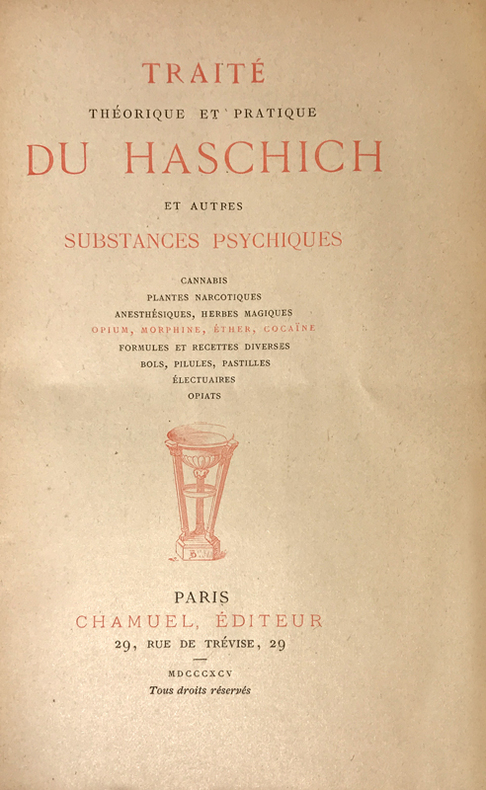
1895rif. 15352Paris, Chamuel, 1895 ; in-12, broché ; 177 pp., (1 bl.), (2) pp. de catalogue, couverture crème rempliée, illustrée, imprimée en vieux-rose et noir, petites figures.
First Edition, xiv,[ii],123,[3],[2],324pp., part II has a separate title-page, pagination and register, without endpaper, cont. calf, rubbed, hinges cracked. "The preface is signed 'Arabella Atkyns', which the B.M. catalogue says is a pseudonym. In it she states that the medical portion, which is much larger than the cookery, is taken from a common-place book of her brother who was a physician. It may be mentioned that she is the first lady who apologizes for her boldness in venturing to treat certain maladies which a lady would hardly be expected ti include. The cookery part is well arranged, the medical part is full of horrors. The treatment for appendicitis is to 'apply a live puppy to the naked belly' and follow up with a cataplasm of rotten apples or of 'sheeps-dung boil'd with milk'."?Oxford, English Cookery Books. Oxford, p.71; Maclean, p.49; Bitting, p.550; Cagle, 673; Pennell, p.150; Simon, 658.
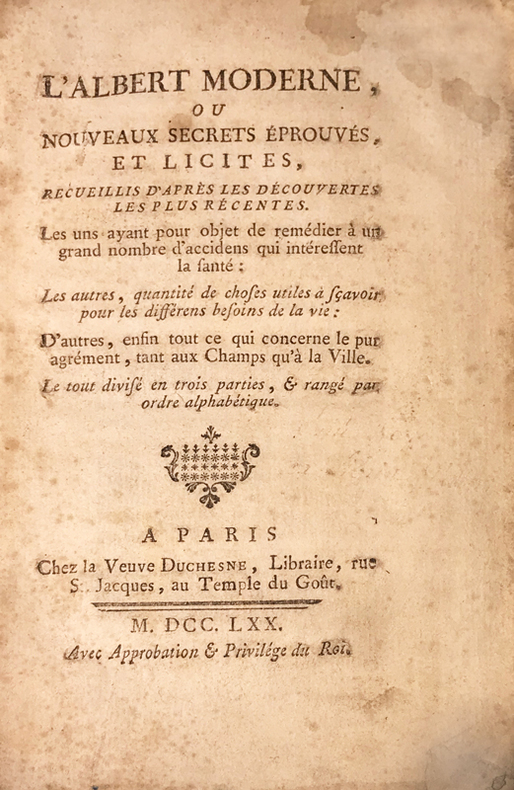
1770rif. 11006Paris, Veuve Duchesne, 1770 ; in-12 ; cartonnage rigide de papier marbré bleu, étiquette manuscrite au dos, non rogné ; XXII pp. (y compris le titre), (1) f., 384 pp.
rif. 0353788317.Ghardcover. Good. Access codes and supplements are not guaranteed with used items. May be an ex-library book. hardcover
1920rif. 29267Partitions sur la Boisson Salabert 1920
1912rif. 30844Partitions sur les Autres régions,Partitions sur la Boisson Durand 1912
1940rif. 88257Partitions sur la Seconde guerre mondiale,Partitions sur la Boisson 1940 approx.
1889rif. 32897Partitions sur le Militaria Lafleur 1889
1950rif. 32534Partitions sur la Boisson 1950 approx.
2000Colonia, Naumann & Gobel, s.d. (anni 2000), 8vo cartonato editoriale con copertina illustrata a colori, pp. 96 completamente illustrate con fotografie a colori.
1860Two Parts. pp. 56: 48. Illustrated with top margin woodcuts. 4to. Original full purple cloth binding. Edges sun faded. Owned by Judge Mayer Sulzberger (1843-1923). XLib. [Dropsie College]. Scarce reprint of the rare original 1700's edition. Interesting poems describing public houses (Pubs) in London and Westminister during the 1700's. Describes the kinds of beers they served and the sorts of people that frequented them. Wood cut images accompany each verse. Ward (1667-1731), was a humourist, of `low extraction' and with little education. In early life he visited the West Indies, and afterwards he began business as a publican in Moorfields. By 1699 he had moved to Fulwood's Rents, where he kept a punch-shop and tavern (probably the King's Head), next door to Gray's Inn, until his death. Giles Jacob (Poetical Register, 1723) says: `Of late years he has kept a public-house in the city (but in a genteel way), and with his wit, humour, and good liquor, has afforded his guests a pleasurable entertainment; especially the high-church party. A man of considerable natural parts and with a gift of humour, `Ned Ward,' as he is frequently called, imitated Butler's `Hudibras' both in his style and in his attacks on the Whigs and low-church party. Though vulgar and often grossly coarse, his writings throw considerable light on the social life of the time of Queen Anne, and especially on the habits of various classes in London; but much allowance has to be made for exaggeration" - DNB. **PRICE JUST REDUCED! WHISKEY 4
1990Sqaure medium octavo in green boards and blue illus DJ; 167p, illus in b/w and color. An uncommon wine book. No copy found in OCLC WorldCat at time of cataloging. Some portions in Catalan, Spanish and English. Numerous photos. Contributions by Pere Grases, Josep Tarin Iglesias, Miquel A. Torres, Mauricio Wiesenthal, Emili Giralt I Reventos. Rough translation of title: 1000 Years of Wine-Making in Catalonia. // Food. Drink. Cooking. Wine, Enology; Viticulture. Grape-growing. Spanish Wine. Grapes. Thirst!
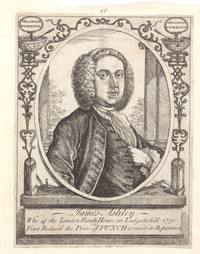
rif. 267136London: Thomas Worlidge n.d. ca mid-18th century. Engraved portrait of James Ashley in cartouche flanked by ornate pedestals supporting two punch bowls with engraved caption as above by Thomas Worlidge. 1 vols. 7-9/16 x 5-3/4 in. A strong impression laid down light creases from prior folding small pin hole near engraved caption. Engraved portrait of James Ashley in cartouche flanked by ornate pedestals supporting two punch bowls with engraved caption as above by Thomas Worlidge. 1 vols. 7-9/16 x 5-3/4 in. Scarce trade card of James Ashley proprietor of the London Coffee House and Punch-House 1731-1776 who was "London's leading purveyor of Punch in the eighteenth century" Wondrich Punch p. 65 and "the world's first celebrity mixologist the first man to become famous for compounding and selling a mixed drink" ibid p. 172. Ashley a former cheese merchant opened his Punch-House in 1731 in Ludgatehill London. Extensive advertising in London papers as well as the distinct ornate pedestals surmounted by iron punch bowls which flanked its entrance made the London Punch-House one of the most well-known drinking establishments in the city. Clientele included Hogarth Boswell Oliver Goldsmith and Benjamin Franklin. A large sign outside of the Punch-House echoes the caption on this trade card "Pro bono publico. James Ashley in 1731 first reduced the price of punch raised its reputation and brought it into universal esteem." Ashley did indeed reduce the price of punch - from 8 shillings for punch made from a quart of arrack to 6 shillings - but his great innovation was to offer punch in smaller portions in servings as small as two ounces. These small servings made to order for the customer were the precursor to the modern cocktail. This trade card is engraved by Ashley's friend Thomas Worlidge 1700-1766 dubbed "the English Rembrandt" who also engraved portraits of Ashley's wife and one Mrs. Graywood the bar-keep at the London Punch-House. Not in ESTC Thomas Worlidge unknown books
rif. 267079London: Thomas Worlidge mid-18th century. Engraved portrait of James Ashley in cartouche flanked by ornate pedestals supporting two punch bowls with engraved caption as above by Thomas Worlidge. 7-9/16 x 5-3/4 in. A strong impression with very slight rubbing and discoloration. Engraved portrait of James Ashley in cartouche flanked by ornate pedestals supporting two punch bowls with engraved caption as above by Thomas Worlidge. 7-9/16 x 5-3/4 in. Scarce trade card of James Ashley proprietor of the London Coffee House and Punch-House 1731-1776 who was "London's leading purveyor of Punch in the eighteenth century" Wondrich Punch p. 65 and "the world's first celebrity mixologist the first man to become famous for compounding and selling a mixed drink" ibid p. 172. Ashley a former cheese merchant opened his Punch-House in 1731 in Ludgatehill London. Extensive advertising in London papers as well as the distinct ornate pedestals surmounted by iron punch bowls which flanked its entrance made the London Punch-House one of the most well-known drinking establishments in the city. Clientele included Hogarth Boswell Oliver Goldsmith and Benjamin Franklin. A large sign outside of the Punch-House echoes the caption on this trade card "Pro bono publico. James Ashley in 1731 first reduced the price of punch raised its reputation and brought it into universal esteem." Ashley did indeed reduce the price of punch - from 8 shillings for punch made from a quart of arrack to 6 shillings - but his great innovation was to offer punch in smaller portions in servings as small as two ounces. These small servings made to order for the customer were the precursor to the modern cocktail. This trade card is engraved by Ashley's friend Thomas Worlidge 1700-1766 dubbed "the English Rembrandt" who also engraved portraits of Ashley's wife and one Mrs. Graywood the bar-keep at the London Punch-House. Not in ESTC Thomas Worlidge unknown books
rif. 267136London: Thomas Worlidge n.d. ca mid-18th century. Engraved portrait of James Ashley in cartouche flanked by ornate pedestals supporting two punch bowls with engraved caption as above by Thomas Worlidge. 1 vols. 7-9/16 x 5-3/4 in. A strong impression laid down light creases from prior folding small pin hole near engraved caption. Engraved portrait of James Ashley in cartouche flanked by ornate pedestals supporting two punch bowls with engraved caption as above by Thomas Worlidge. 1 vols. 7-9/16 x 5-3/4 in. Scarce trade card of James Ashley proprietor of the London Coffee House and Punch-House 1731-1776 who was "London's leading purveyor of Punch in the eighteenth century" Wondrich Punch p. 65 and "the world's first celebrity mixologist the first man to become famous for compounding and selling a mixed drink" ibid p. 172. Ashley a former cheese merchant opened his Punch-House in 1731 in Ludgatehill London. Extensive advertising in London papers as well as the distinct ornate pedestals surmounted by iron punch bowls which flanked its entrance made the London Punch-House one of the most well-known drinking establishments in the city. Clientele included Hogarth Boswell Oliver Goldsmith and Benjamin Franklin. A large sign outside of the Punch-House echoes the caption on this trade card "Pro bono publico. James Ashley in 1731 first reduced the price of punch raised its reputation and brought it into universal esteem." Ashley did indeed reduce the price of punch - from 8 shillings for punch made from a quart of arrack to 6 shillings - but his great innovation was to offer punch in smaller portions in servings as small as two ounces. These small servings made to order for the customer were the precursor to the modern cocktail. This trade card is engraved by Ashley's friend Thomas Worlidge 1700-1766 dubbed "the English Rembrandt" who also engraved portraits of Ashley's wife and one Mrs. Graywood the bar-keep at the London Punch-House. Not in ESTC Thomas Worlidge unknown