3.454 resultados
1550ref. 5044Rome: ca 1550. SECOND STATE of three with the addition of "Romae" incised at lower right. Hardcover. Fine. A very fine example with high contrast of this rare print. This is the first published engraving dedicated to Michelangelo's Moses and one of only two made in the 16th century. The funerary monument of Julius II occupied Michelangelo in various phases from 1505 to the 1540s. Prints of the entire monument are few. In them the figure of Moses is necessarily reduced in size and imperfectly executed. Later prints of the statue in isolation such as that by the Netherlandish artist Jacob Matham 1571-1631 in which the figure is shown in reverse fail to match the standard set by this early engraving. The inscription reads: Moysis ingens ex marmore simulacrum in Julij Secundi/ Pontificis Maximi ad petri in Exquilijs uincula sepulcro / præstanti Michaelis Angeli Bonarotae manu fictum. The immense marble statue of Moses in the Church of San Pietro in Vincoli on the Esquiline Hill sculpted by the hand of Michelangelo Buonarroti for the tomb of Pope Julius II. Michelangelo's design for the tomb of Pope Julius II with the master's iconic figure of Moses was originally intended for St. Peter's but was ultimately installed in the church of San Pietro in Vincoli in Rome. The work was commissioned by Pope Julius in 1505 at which time Michelangelo received an initial payment of 100 gold ducats but was not completed until March 1545. Michelangelo re-worked his initial design numerous times first in 1513 after Julius' death and again in 1516 1525/1526 1532 and 1542. The final monument includes three figures carved by Michelangelo: the aforementioned Moses and Leah and Rachel symbols respectively of the active and contemplative life. Michelangelo's sculptures of the dying and rebellious slaves now in the Louvre and the Genius of Victory Palazzo Vecchio Florence were not used in the final design. On the second tier of the monument as it stands is an effigy of the reclining Julius II attributed to Tommaso di Pietro Boscoli 1503-1574 but with the face possibly the work of Michelangelo watched over by the Madonna and Child carved by Alessandro Scherano di Settignano after a model by Michelangelo and flanked by a sibyl and a prophet; these last two sculptures were carved by Michelangelo's pupil Raffaello da Montelupo ca. 1504-ca. 1567. "The engraving reproduces accurately in the same direction and without substantial variations the sculpture of the tomb of Julius II identifying the light source at the top left. The work attributed by Bottari to Beatrizet Heinecken 1768 was treated as anonymous by Heinecken in the Nachrichten of 1768 but later included by him in the list of Beatrizet's works Dictionnaire 1788. Nagler recorded it both under the monogram of Cornelis Bos and as the work of Beatrizet. Appearing in the Hollstein repertoire as Bos it was subsequently treated among works of doubtful attribution both of Bos Schéle 1965 and of Beatrizet Bianchi 2004. "Due to the fact that copies of this print are found in volumes of Roman composition on the model of the Speculum Romanae Magnificentiae El Escorial; Madrid Biblioteca Nacional; both datable between the mid-1580s and the 1590s one would be led to believe that the plate was engraved in Rome where in the last decade of the 16th century it was acquired by Van Aelst. This does not however exclude Cornelis Bos as a possible author since more than one of his plates is known to bear a Roman address in late editions even if it makes it more likely -in our opinion- the identification with a Flemish engraver active in Italy. In the sparse and luminous texture and in the clean geometries one could also perceive the burin of Niccolò della Casa."Alberti Rovetta and Salsi "D'après Michelangelo"2015 p. 219 ff. ca hardcover
1550ref. 5044Rome: ca 1550. SECOND STATE of three with the addition of "Romae" incised at lower right. Hardcover. Fine. A very fine example with high contrast of this rare print. This is the first published engraving dedicated to Michelangelo's Moses and one of only two made in the 16th century. The funerary monument of Julius II occupied Michelangelo in various phases from 1505 to the 1540s. Prints of the entire monument are few. In them the figure of Moses is necessarily reduced in size and imperfectly executed. Later prints of the statue in isolation such as that by the Netherlandish artist Jacob Matham 1571-1631 in which the figure is shown in reverse fail to match the standard set by this early engraving. The inscription reads: Moysis ingens ex marmore simulacrum in Julij Secundi/ Pontificis Maximi ad petri in Exquilijs uincula sepulcro / præstanti Michaelis Angeli Bonarotae manu fictum. The immense marble statue of Moses in the Church of San Pietro in Vincoli on the Esquiline Hill sculpted by the hand of Michelangelo Buonarroti for the tomb of Pope Julius II. Michelangelo's design for the tomb of Pope Julius II with the master's iconic figure of Moses was originally intended for St. Peter's but was ultimately installed in the church of San Pietro in Vincoli in Rome. The work was commissioned by Pope Julius in 1505 at which time Michelangelo received an initial payment of 100 gold ducats but was not completed until March 1545. Michelangelo re-worked his initial design numerous times first in 1513 after Julius' death and again in 1516 1525/1526 1532 and 1542. The final monument includes three figures carved by Michelangelo: the aforementioned Moses and Leah and Rachel symbols respectively of the active and contemplative life. Michelangelo's sculptures of the dying and rebellious slaves now in the Louvre and the Genius of Victory Palazzo Vecchio Florence were not used in the final design. On the second tier of the monument as it stands is an effigy of the reclining Julius II attributed to Tommaso di Pietro Boscoli 1503-1574 but with the face possibly the work of Michelangelo watched over by the Madonna and Child carved by Alessandro Scherano di Settignano after a model by Michelangelo and flanked by a sibyl and a prophet; these last two sculptures were carved by Michelangelo's pupil Raffaello da Montelupo ca. 1504-ca. 1567. "The engraving reproduces accurately in the same direction and without substantial variations the sculpture of the tomb of Julius II identifying the light source at the top left. The work attributed by Bottari to Beatrizet Heinecken 1768 was treated as anonymous by Heinecken in the Nachrichten of 1768 but later included by him in the list of Beatrizet's works Dictionnaire 1788. Nagler recorded it both under the monogram of Cornelis Bos and as the work of Beatrizet. Appearing in the Hollstein repertoire as Bos it was subsequently treated among works of doubtful attribution both of Bos Schéle 1965 and of Beatrizet Bianchi 2004. "Due to the fact that copies of this print are found in volumes of Roman composition on the model of the Speculum Romanae Magnificentiae El Escorial; Madrid Biblioteca Nacional; both datable between the mid-1580s and the 1590s one would be led to believe that the plate was engraved in Rome where in the last decade of the 16th century it was acquired by Van Aelst. This does not however exclude Cornelis Bos as a possible author since more than one of his plates is known to bear a Roman address in late editions even if it makes it more likely -in our opinion- the identification with a Flemish engraver active in Italy. In the sparse and luminous texture and in the clean geometries one could also perceive the burin of Niccolò della Casa."Alberti Rovetta and Salsi "D'après Michelangelo"2015 p. 219 ff. ca hardcover books
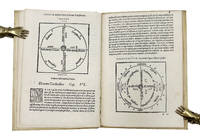
ref. 20264Small 4to 192 x 137 mm 18 pp. A-D4 E2 woodcut printer's device on title four woodcut illustrations in text historiated initials italic and roman types. Modern binding reusing an old parchment. First edition of Biondo's extremely rare treatise on navigation. This important and exceedingly scarce work presents one of the earliest systematic treatments of navigation. It includes detailed chapters on the causes and dangers of winds the classification and names of the cardinal winds storms and their effects and the influence of celestial bodies on navigation. A further section discusses the dimensions of the Earth. Chapter 23 introduces a new compass. "The writer gives on fol. 14 ch. xxiii a careful description of the compass including theory and rules for use. The compass is called on fol. 15 pixis or buxulos cf. "the French boussole" Wheeler. One chapter is devoted to America folio 16: De navigatione oceani ad novum orbem. Biondo offers one of the earliest attempts to calculate the breadth of the Atlantic Ocean and to explain how navigation across it is possible. He estimates that the sea from the Straits of Gibraltar to the newly discovered lands beyond the Equator the New World extends about 64000 stadia or roughly 8000 Roman miles. Michelangelo Biondo was born in Venice and studied the humanities and medicine under Agostino Nifo in Naples where he also practiced as a physician. Between 1535 and 1545 he resided primarily in Rome with a brief return to Venice in 1542. During his Roman period he secured the patronage of Pope Paul III and published numerous works. He took part in the controversy on dies critici between Fracastoro and the papal physician Andrea Turino revealing he still adhered to Arabic astrology. In 1545 Biondo settled permanently in Venice and became the editor of his own writings as well as those of other authors. Although he styled himself "bookseller and printer" and his publications typically carry the imprint "Ex Tigurio Blondi" the printing was carried out by established Venetian presses such as those of the Sabbio brothers or Comin da Trino. REFERENCES: BM/STC Italy p.105; Harrisse 274; Libri 341: "one of the rarest books respecting America"; Sabin 5518; Wheeler Gift 24: "very rare". G. Innamorati "Ex tugurio Blondi" Paragone. Letteratura XXXVI/428 1985 pp. 10–37. . [Colophon: Ex Tigurio Blondi. Venice: Cominus de Tridino Montisferrati, 1546.] hardcover
1568ref. 48781Florence.: Nella Stamperia de' Giunti. 1568. Later full limp vellum with Yapp edges. Small 4to. 240 x 166 mm. Leaf with printed pictorial title with elaborate decorative woodcut border the central block reused from vols. II and III of the 1568 'Vite' title i.e. with the woodcut view of Florence surmounted by the Medici arms leaf with decorative woodcut head-piece and seven-line inhabited initial with Vasari's dedication to Alessandro de Medici recto and verso dated 1567 see below leaf with half-page woodcut portrait of Michelangelo within decorative architectural border with five-line woodcut initial and Vasari's text in Tuscan in Roman type 46 lines with headline and catchword conclusion of text in italic with small decorative typographic woodcut tail-piece final leaf with 'Registro' and decorative typographic woodcut recto and colophon with large woodcut Giunta device verso numerous mispaginations and errors in signature as usual but complete marginal manuscript annotations and underlining in sepia ink throughout; sheet size: 235 x 155 mm. PROVENANCE: Ownership signature in sepia ink to title effaced purchasse note to foot of title in sepia ink also effaced. An excellent large margined and annotated copy of the rare first offprint from any work the discrete edition of the first artistic biography of Michelangelo by Giorgio Vasari.The second edition of Giorgio Vasari's famous biographical compendium the 1568 illustrated edition of 'Le Vite de' piu eccellenti Pittori Scultori et Architettori . &c.' included an updated biography of Michelangelo from 1550 the date of the first unillustrated edition until 1564 the date of Michelangelo's death. So popular did Vasari imagine this particular biography would prove shortly after the dedication of the whole edition to Cosimo de' Medici in January 1568 he wrote a new dedication to Alessandro de' Medici later very briefly the shortest-serving pontiff Pope Leo XI in February 1568 and issued the present work. The sheets of the printed text for the biography in the 'Vite' were used here the pagination and signatures remain the same together with three new and additional leaves: a new title it uses only the most central of the blocks from the 'Vite' titles with the arms of the Medici at the head and the vignette view of Florence beneath with the new dedication mentioned above and a final inserted leaf with 'Registro' recto and the colophon and large woodcut device of the Giunti verso. Whether the idea for this edition was Vasari's - he claims credit in the dedication see below and as PMM indicates 'Michelangelo was his great hero' - or that of the Giuntas the precedent for the offprint was established and a clever piece of cost-reducing marketing implemented. The fact that two issues of the work are known suggests too that the device was successful.This copy is from the first issue with Vasari's dedication to Alessandro de' Medici dated February 6th 1567; as Breslauer states so succinctly: 'As it is unthinkable that the dedication for the offprint should have been written eleven months before the dedication for the entire work i.e. the whole of the 'Vite' to Cosimo de' Medici which is dated January 1568 the date 1567 is obviously a printer's error which was corrected in later copies'. It should be added that the date of the dedication in the present separatum is also an interesting indication of how soon Vasari's or the Giuntas intention or decision to publish the discrete biography occurred after the dedication of the whole edition a period of only a few weeks and is a further measure of how important this offfprint was considered to be. A final irony is that the note in OCLC regarding the dating of the dedication of this first issue is also in error and gives the year as '1857' 'In this state the dedication has old-style date Feb. 6 1857' and misspells Buonarroti giving it three instances of the letter 'R'; that the error is repeated across multiple entries is suggestive of the practices of modern bibliographers rather than Florentine typesetters in the Cinquecento.The annotations in the present copy all in sepia ink mainly consist of highlighting and underlining but there are also marginal notes dates names and places and other indications some faded but all untrimmed of a clear engagement with Vasari's text.'C'est un tirage à part de la grande édition des Vite . mais il a un titre particulier et une dédicace spéciale . Le dernier f. qui porte le colophon est également spéciale à cette pièce extrêmement rare.' Brunet. 'An offprint from the 1568 Vite with a title-page and dedication leaf added at front and a new half sheet EEeee at the end . The new signature EEeee2 contains a new setting of the last two text pages from the Vite with a type-ornament tailpiece added to EEeeee1v a register on EEeee2r and Giunta device and colophon on EEeee2v. Otherwise the setting is that of the Vite with page numbers and signature marks unchanged.' Ruth Mortimer.We trace copies at the British Library in London the Bibliothèque Mazarine in Paris the Metropolitan Museum in New York and the Universiteit Leiden; we trace a number of further copies all with the errors cited above i.e. with the dedication dated '1857' and 'Buonarrroti' in the title as follows: New York University the Getty Research Institute Yale Harvard two copies Wake Forest North Carolina Brigham Young Utah and the National Art Library at the V & A. Three further copies all suspiciously give the same provenance are held at the Courtauld Oxford and the British Library. Needless to say these errors in bibliography rather undermine confidence in what may otherwise be accurate records.Brunet Suppl. II 846; Mortimer Italian 517; not in Cicognara; see Bernard Breslauer's response to A. N. L. Munby's original query 'Query 85. The Origin of Offprints': ' . Can any reader cite examples of offprints before 1772' in 'Bibliographical Notes and Queries' in 'The Book Collector' Vol. 6 Nos. 3 Autumn & 4 Winter 1957; see PMM 88 for the 1568 'Vite'. Nella Stamperia de' Giunti. hardcover