Gauguin, PaulBiblio.com
1 982 résultats
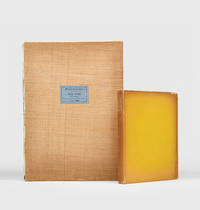
1926réf. 52826München: R. Piper & Co 1926. Limited Deluxe edition. Hardcover. Very good condition. 42/80. Small Folio. 3 204 i.e. 208pp. Rebacked retaining the original gilt-stamped yellow leather backstrip with gilt-framed pebbled leather retaining original endpapers; housed in the original woodcut illustrated paper-covered slipcase. Top edge gilt. Publisher's colophon bookplate pasted to inside front cover reading: "Marees Gesellschaft MCMXXVI. VI. Druck. Herausgeber: Meier-Graefe. Verlag: R. Piper & Co. München. Hersteller: Ganymed GMBH. Berlin. Von den Stücken I-LXXX trägt dies Nr. XLII." Embossed Exlibris of Ernst Simon on free endpaper. Facsimile of Gauguin's original handwritten and illustrated journal. Richly illustrated with color and b/w reproductions of paintings in watercolor woodcuts drawings and the occasional photograph. This deluxe edition published by R. Piper & Co. in 1926 is still considered theto be the finest facsimile of Gauguin's original manuscript now kept in the Louvre. Paul Gauguin started to write his travel journal Noa Noa Fragrance in Paris after returning from Tahiti in 1893. He gave the text pages to the symbolist poet Charles Morice keeping the original pages with drawings prints watercolors and other visual material. Gauguin was a changed man after returning from Tahiti: 'Farewell hospitable land delicious land home of freedom and beauty! I leave after two years twenty years younger more uncouth therefore than on arrival and yet more educated. Yes the savages have taught many things to the old civilized man those illiterates about the science of living and the art of being happy.' Paul Gauguin Text in French. The slipcase has been expertly restored with original front and back panel woodblocks attached. Slipcase imagery with some water staining and imperfections along edges. The water staining to back cover and spine of the book has been professionally restored. Error in pagination of original numbering 38 and 39 twice and numbers of pages 60 and 61 omitted with following page numbered 61. Several blank pages as issued. Ernst Simon 1872-1945 was a German entrepreneur and engineer. He entered the company of his father Dölken & Co.GmbH at the age of twenty and was instrumental in the expansion of the venture. Simon invented a new recycling method and patented it selling the licenses to companies throughout Europe. After the death of his father he lead the compnay with his brother Otto. The company was admitted to the German Werkbund in 1913. The company grew due to a number of innovative steps Simon had undertaken and he became an active member in the cultural and political affairs in Essen Werden. Due to his Jewish ancestry the Nazis forced him to give up his business. His brother Otto emigrated to the Netherlands but was deported and killed in Bergen-Belsen in 1945. The comapny had been arienized in 1938 Ernst Ludwig taken into protective costody but was permitted to emmigrate to the Netherlands with his wife where he managed to leave for the USA in 1940. He died there penniless in 1945. R. Piper & Co hardcover
réf. 51-3873Paris: L'Ymagier 9 rue de Varenne 1894-1896. . 2 vols. 278 244pp with hors texte plates. Complete with 8 issues. Original symbolist paper covered boards with later half goatskin spine and corners. 20 x 26cm. With 11 handcolored folding plates printed by Pellerin à Epinal several with repaired tears; original lithographs and woodcuts by Whistler Jarry Bernard et al. Lacking the print by Rousseau. See complete list below.________________________Vol 1: 1894. 278 pp….N°1 : comprising a leaf bearing a title and a miniature by Filiger printed in mauve a Head of a Martyr by R.G. Rémy de Gourmont a drawing by Émile Bernard printed in blue forty old images and vignettes; on large folio Épinal folding images printed in colors 620 x 380 mm and 615 x 395 mm: Jesus sur la Croix…. - - N°2 : with a woodcut in red by Armand Séguin 1869 – 1903 Les Bretonnes Breton women an original print by E. Forbes-Robertson Adam and Eve numerous woodcuts of which two from Indochina printed on 2 ll. of folded China paper lithograph “L’Annonciation” signed R.G. Rémy de Gourmont printed in black an original lithograph by Alfred Jarry Caesar-Antichrist “Bedouin” an unpublished drawing by Emile Bernard and two folding Épinal images: Le miroir du P”echeur des Pyramides 400 x 580 mm and Bonne Bière de Mars 420 x 509 mm. Lacking: an original lithograph by Douanier Rousseau War ….-- - N° 3 :. Numerous illustrations in text and hors texte among them: La Madeleine after a woodcut printed in dark orange by Paul Gauguin “The Bishop” an original woodcut in dark green by Georges d'Espagnat an original woodcut in black by Alice Feurgard an original drawing printed in blue by Emile Bernard an original drawing printed in dark green by Jossot an original woodcut in bistre by M. Delcourt; an Épinal folding image printed in colors Saint Claude…. - - - N° 4 :. Numerous illustrations to text and hors texte including: an original sketch cut onto mahogany wood. “Sainte Gertrude” by Alain Jans Alfred Jarry;a woodcut “La Peur” in black by Georges d'Espagnat an original drawing printed in black by Roderie O'Conor; an original drawing printed in blue by Émile Bernard a folded woodcut very pale 455 x 198 mm two folding Épinal images printed in colors : Saint Nicolas and Notre-Dame des Sept Douleurs….Volume II. Issues 5-8. 224 pages….- N°5 : . Numerous illustrations to text and hors texte including: an unpublished original print and folding plate by Jean-Baptiste Auguste Clésinger of Two Bulls printed in black 281 x 430 mm an original unpublished lithograph by James Abbott McNeill Whistler on China paper between silk paper guards: “Girl With Bowl” Stratis & Tedeschi 118; Way 82; Levy 121; first bearing a title folding facsimile of a vernacular colored image entitled Le vrai portrait du Juif-Errant…A true portrait of the Wandering Jew… 485 x 304 mm folded fragment of an enormous former engraving 368 x 305 mm. Printed by Lefevre-Corbinière….- - N° 6 :. Numerous illustrations to text and hors texte including a folding Épinal image in colors Les 3 Chemins de l’Etnernité. ….- - - N° 7 : . Numerous illustrations to text and hors texte including an original woodcut of Jesus on the cross with Crying Woman by Émile Bernard printed in red on strong grey tinted paper; previous page with clean tear a folding Épinal image in colors showing St. Blaise et St. Guerinand and a color lithograph: L’Arche de Noé. Noah’s Ark from the 12cth Century…. - - - N° 8 : . Numerous illustrations to text and hors texte including: L’Annonciaiton by Emile Bernard; a color Epinal folding plate of Napoleon 1er; a vernacular image of a procession in colors in the form of a folding banner 280 x 475 mm; triangle; an original woodcut“Les Pendus” by Georges D’Espagnat and a red woodcut: Santo Cristo with Christ wearing a skirt….From the Van Gogh Museum:At the fin de siècle printmakers often turned to primitive art forms and popular visual culture for sources of inspiration.In this vein the French Symbolist writers Alfred Jarry and Remy de Gourmont founded L’Ymagier an ambitious art review. Here they presented the works of contemporary printmakers next to examples of medieval woodcuts and popular prints known as Épinal.L’Ymagier’s interest in religious Épinal and medieval woodcuts was rooted in a fervent desire to achieve a more authentic form of modern art. For Jarry archetypal Christian symbols such as the Passion and the Virgin Mary possessed universal meaning of continued importance to contemporary artists.This interest in the past was shared by the artists of the School of Pont-Aven who looked to the traditions and rituals of the Breton peasants for creative inspiration.L’Ymagier helped to revive contemporary interest in the woodcut technique for artists like Edvard Munch and Emil Nolde.Juliet Simpson:Remy de Gourmont's and Alfred Jarry's journal L’Ymagier published in eight issues between October 1894 and January 1896. In attempting to create a 'book of symbols' structured explicitly around the image notably the popular image the L’Ymagier project develops the verbal-visual problematic exemplified by the Symbolist 'illustration'. It also raises some very fundamental questions about artistic homologies in general which test Symbolist theories of synthesis to their limits. As I hope to show Gourmont's and Jarry's appropriation of the popular image as the inspiration ror L’Ymagier becomes a strategy for destabilizing hierarchies or images and texts including Symbolist ones which has both radical aesthetic and political implications.Bolliger Dokumentations-Bibliothek Zur Kunst Des 20. Jahrhunderts II 243; VI 829;Library of Congress Control Number41040620 Paris: L'Ymagier, 9 rue de Varenne, 1894-1896. hardcover
1964réf. 84541Les Beaux-Arts. As New. 1964. Hardcover. FREE UPGRADE to Courier/Priority Shipping Upon Request - IN STOCK AND IMMEDIATELY AVAILABLE FOR SHIPMENT - AS NEW THE TEXT BLOCK IS PRISTINE CLEAN UNMARKED AND IN EXCELLENT CONDITION - - Text in French. Pages: 10 282 4. 639 illustrations; small folio. First of a planned two volume set though as of early 2013 the second volume remains unpublished. Catalogue Raisonne Catalog Raisonné Complete Works La Vie et L'uvre Oeuvre Raisonnee Les Beaux-Arts hardcover
1926réf. 157706Berlin: Ganymed Presse for Marées-Gesellschaft 1926. Gauguin in Tahiti First edition thus number 22 of 80 copies of the deluxe issue rarely found with the portfolio which includes a previously unpublished original woodcut. This fine facsimile of Gauguin's autobiographical tale of his first two years in Tahiti 1891-3 was based on the Louvre manuscript and "represents an important project in book-making by this major artist" Garvey. Gauguin's arrival in Tahiti coincided with the funeral of Pomare V the last king "a symbolic marker of the demise of 'authentic' Polynesian culture. This overlap is enough to make Noa Noa apparently irresistible as a source of information about his life in Tahiti: through a series of intimate cross-cultural encounters it provides the script of his attempt at 'going native' He may have initially intended the publication of Noa Noa to coincide with the exhibition of his Tahitian work that was held at the Galerie Durand-Ruel in Paris following his return to France in 1893 but it remained incomplete when the exhibition opened in November 1893 At some point before returning definitively to Polynesia in July 1895 Gauguin enlisted Charles Morice who had written the catalogue essay for his exhibition to help develop the project and their collaboration led to the version that is now known as the Louvre manuscript" Goddard pp. 64-8. The conceit was that Gauguin and Morice would alternate chapters although the exact division of labour remains unclear. "What is clear however is that Gauguin did not spend his time passively awaiting Morice's revisions and additions. Instead he began actively to conceive of the text as part of a larger performative project that could serve to promote his image as an artist-savage. During gatherings in his Paris studio whose decorative scheme was in itself a 'visual manifesto' for his primitive persona he gave readings from his work in progress". The present edition had a total print run of 400 copies: 80 specially bound in citron morocco as here the remainder in a raffia binding. A significantly revised version of the text had been published in 1901 followed by another in 1924 although "that gives no sense of the physical appearance of the volume". During the inter-war years the Marees Gesellschaft 1917-1929 was among the finest European fine art printers issuing work by among others Van Gogh Matisse Max Beckmann and Oskar Kokoschka. It was founded "as a collaboration between influential art historian and critic Julius Meier-Graefe and avant-garde publisher Reinhard Piper named after the now largely forgotten German realist painter Hans von Marées 1837-1887 whom Meier-Graefe revered. As a special imprint they issued lavishly produced illustrated books and portfolios" MoMA. Regal Portfolio and large quarto. Portfolio with 14 collotype reproductions of watercolours and original woodcut each with the blind stamp of Ganymed Press on image window-mounted on 13 card leaves. Quarto with many full-page and in-text collotype reproductions of watercolours drawings woodblock prints and photographs. Portfolio: original raffia blue printed label to front stiff card flaps with cloth mounts. Quarto: original citron morocco-grain skiver gilt-lettered spine gilt fillet frame to covers top edge gilt. Portfolio: some flaking of raffia largely to spine toning to flaps: very good. Quarto: signature on front free endpaper of Emil Oberholzer Jr d. 1981 authority on church history. Without pictorial dust jacket. Spine and periphery of covers toned extremities rubbed some minor stripping inner hinges partially cracked but sound: very good. Garvey The Artist and the Book 115. Linda Goddard Savage Tales: The Writings of Paul Gauguin 2019. hardcover
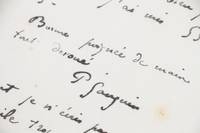
1896réf. 84738s. l. (Tahiti) août (1896) | 20.50 x 27 cm | quatre pages sur deux feuillets
1896réf. 84738s. l. Tahiti 1896. Fine. ""I'm gifted he says to the point of making others jealous."" s. l. Tahiti août 1896 20.50 x 27 cm quatre pages sur deux feuillets Yes I have sarcasm in my words yes I do not know how to flatter and bend my back how to beg in official salons I am nothing but a braying schemer but if I had submitted - yes I would be comfortable."" Long autograph letter dated August 1896 and signed by Paul Gauguin to painter Daniel de Monfreid. Four pages in black ink on two lined sheets. Small tears to margins not affecting the text traces of folds inherent to sending. In the midst of his descent into hell abandoned in his Tahitian artificial paradise Gauguin feels cursed : Definitely I was born under a bad star. he laments. His quest for primitive freedom leaves him in destitution and misery. Suffering agony the painter sends paintings to one of his few supporters his faithful friend Daniel de Monfreid - but writes the wrong address. Published in Lettres de Paul Gauguin à Georges-Daniel de Monfreid 1918 p. 146 n° XXIII; our letter reveals the name of Émile Schuffenecker his friend and associate on the Paris stock exchange and then Pont-Aven - anonymized in the published version - whom Gauguin vilifies on numerous occasions in these pages. This exceptional missive was written in Tahiti where the painter had returned the previous year bidding a final farewell to the old Europe. Gauguin had just come out from a stay in hospital in Papeete to treat his bruised legs following the beating he had received in Concarneau two years earlier for defending his muse Annah the Javanese. The painter could not escape the aftermath of this altercation and suffered from a terrible purulent eczema on his leg as well as syphilis drowning his torments in alcohol. The letter is a perfect example of Gauguin's correspondence from the summer of 1896 which ""smells of the fever that has seized a mind overheated by pain and lack of sleep"" David Haziot. In his confusion the painter misspelt the address of Monfreid's studio at the Cité Fleurie a famous chalet-like artists' residence where Gauguin had stayed : I sent you a bunch of paintings last month. I'm afraid for them because it seems to me that I put 55 Bd Arago instead of 65 This mailing included his composition Eihaha Ohipa painted in his studio in Punaauia and now kept at the Pushkin Museum in Moscow. Shipped via a naval officer - fees to be paid by Monfreid - the paintings did not arrive until November. Beyond his feverish fears Gauguin delivers in these lines a true manifesto of his integrity as an artist - the perfect counterpart to his famous Christlike self-portrait Near Golgotha painted around the same period. To him his destiny and generosity are nothing short of Christ-like: in the most difficult moments of my life I more than shared with unfortunate people and never had any reward other than complete abandonment. He had in fact helped display Schuffenecker's paintings in Impressionist exhibitions saved his friend Laval from suicide and opened his purse to so many others. Instead of returning the favor Schuffenecker prefers to feel sorry for himself: Schuff really wrote me a crazy and unfair letter and I don't know what to answer because he is a sick mind . he would be more unhappy than me who has glory strength and health. Let's talk about it! I'm good at making others jealous he says. Gauguin who had always refused to make concessions and compromise is finally betrayed by one of his closest relations Schuffenecker who becomes in the letter a true Judas Iscariot: Schuff has just made a useless petition I believe for the State to come to my aid. This is the thing that can offend me the most. I'm asking friends to help me out for the time it takes to get back the money I'm owed and their efforts to recover it but begging the State was never my intention. The painter reaches a point of no return not only bruised in his flesh but also unknown
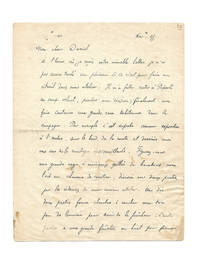
1895réf. Gauguin2GAUGUIN Paul 1848-1903 Autograph letter signed " Paul Gauguin " to Daniel de MonfreidTahiti November 1895 3/4 p. in-4°Tears on folds some spots and browning Fascinating letter opening the last chapter of his life: his second trip to PolynesiaGauguin evokes his settlement in Tahiti his life of sexual and financial debauchery his desires for painting and his family who remained in Europe " Mon cher DanielÀ l'heure où je reçois votre aimable lettre je n'ai pas encore touché un pinceau si ce n'est pour faire un vitrail dans mon atelier. Il m'a fallu rester à Papeete en camp volant prendre une décision ; finalement me faire construire une grande case tahitienne dans la campagne. Par exemple c'est superbe comme exposition à l'ombre sur le bord de la route et derrière moi une vue de la montagne épastrouillante. Figurez-vous une grande cage à moineaux grillée de bambous avec toit en chaume de cocotier divisée en deux parties par les rideaux de mon ancien atelier. Une des deux parties forme chambre à coucher avec très peu de lumière pour avoir de la fraîcheur. L'autre partie a une grande fenêtre en haut pour former atelier. Par terre des nattes et mon ancien tapis persan. Le tout décoré avec étoffes bibelots et dessins.Vous voyez que je ne suis pas trop à plaindre pour le moment.Toutes les nuits des gamines endiablées envahissent mon lit ; j'en avais hier trois pour fonctionner. Je vais cessercette vie de patachon pour prendre une femme sérieuse à la maison et travailler d'arrache-pied d'autant plus que je me sens en verve et je crois que je vais faire des travaux meilleurs qu'autrefois.Mon ancienne femme Teha'amanas'est mariée en mon absence et j'ai été obligé de cocufier son mari mais elle ne peut habiter avec moi malgré une fugue de 8 jours qu'elle a faite.Voilà l'endroit de la médaille ; l'envers est moins rassurant. Comme toujours quand je me sens de l'argent dans la poche et des espérances je dépense sans compter me fiant à l'avenir et à mon talent puis j'arrive vite au bout du rouleau. Ma maison payée il va me rester 900 F et je ne reçois de France aucune nouvelle ce qui me fait unpeu peur. Quand je suis parti Lévy devait m'envoyer 2600 que me devait le café des variétés. Avec d'autres créances il m'est dû en tout 4300 F je ne reçois pas même de lettre.Vous êtes comme toujours le premier qui pensiez à moi et je vous en suis bien reconnaissant. Au reçu de ma lettre voyez Lévy rue St Lazare 57 et dites-lui que je suis très inquiet et de mon argent et de mes affaires de tableauxchez lui.Si vous êtes à Londres écrivez à Mollard.On me dira : Pourquoi allez-vous si loin – Mais quand je suis absent tout près comme en Bretagne par exemple c'est la même chose.Vous voilà donc décorateur et à Londres j'en suis très heureux pour vous. Si vous pouvez faire un voyage productif en tous cas intéressant. Je vois dans votre lettre que vous avez été dans le midi et que vous vous êtes occupé de divorce. Mais vous ne me dites pas comment cette affaire s'est terminée. Que d'ennuison se crée fatalement avec le mariage cette stupide institution. Et je vois que Mailhol Maillol est dans le train : je lui souhaite bonne chance. Mais j'ai peur pour lui et ce serait dommage car c'est une bonne âme et un artiste.Voyez ce que j'ai fait du ménage : j'ai filé sans prévenir. Que ma famille se démerde toute seule car s'il n'y a que moi pour l'aider !!!Je compte bien finir mon existence ici dans ma case parfaitement tranquille.Ah oui je suis un grand criminel qu'importe. Michel-Ange aussi et je ne suis pas Michel-Ange.Bien le bonjour à vos amis et à AnnetteTout à vous grandementPaul GauguinJ'écris par ce courrier à Schuffenecker " From the port of Marseille Gauguin embarked on L'Australien a steamboat to arrive in Tahiti on September 9 1895. Disappointed by the transformations of the small town occupied by more and more foreigners between his first stay 1891 and the new one he decided to move 13 kilometers away from the capital to settle as close as possible to nature in Punaauia. It is here that his new traditional Tahitian hut made of bamboo and palm leaves was built with the help of the locals and which he describes here in detail. He also evokes without naming her Teha'amana a very young girl whom he married during his first stay she was then 13 years old but meanwhile the painter's absence between 1893 and 1895 married another man Ma'ari. When he arrived in the autumn of 1895 Gauguin waved at her she became his vahinée again. The romance lasted only a week during which Gauguin boasted of having "cuckolded" the said Ma'ari: "My former wife married in my absence and I was forced to cuckold her husband."The painter refrains to say that Teha'amana was horrified by the syphilitic wounds covering her legs. She ran away and returned to her Ma'ari. From then on Gauguin enjoyed more than ever the pleasures of the flesh spent without counting and multiplied the adventures with "wild girls".The painter is already at a loss barely two months after his installation: "As always when I feel money in my pocket and hopes I spend without counting relying on the future and my talent then I quickly become broke".He married Pau'Ura a few months later to get out of this "life of couch potato to take a serious woman at home" as he writes. If the first Tahitian period 1891-1893 reflects a discovery of culture it opens with the second on a new approach: "I feel in verve and I believe that I will do better work than before". Gauguin paints a mythical world where Eastern Western and Oceanian religious traditions past and present merge. His paintings are reflections of a world he believes in an ideal world that he stages. Gauguin is finally very direct with his correspondent then in the throes of a conflictual divorce: "See what I did with the household I spun without warning. Let my family go crazy on their own because there is only me to help them!!! "Despite the violent remarks he makes towards his family it is obvious that the thought of his children has never left Gauguin. The premature death of his favorite daughter Aline in 1897 will put him in deep of sorrow. References:Lettres de Gauguin à Daniel de Monfreid Crès. 1918 lettre XXGauguin à Tahiti et aux îles Marquises Bengt Danielsson éd. du PacifiqueGauguin. David Haziot Editions Fayard. 2017 p. 620-622