Pablo PICASSOBiblio.com
5 182 résultats
1957réf. 89530Cannes 1957. Fine. ""The 7th Bull races"" Cannes 13 juin 1957 21 x 27 cm 2 pages sur un feuillet Multi-coloured autograph letter from Pablo Picasso to Max Pellequer signed and dated by the author on June 13 1957. The document includes the autograph address of his villa La Californie. 2 pages on one sheet 22 lines in green blue and red pencils on a watermarked sheet. Minor folds. An exceptional account of Pablo Picasso's passion for bullfighting a recurring theme in his art since his very first works painted at the age of eight ""The Little Yellow Picador"" 1899. Pablo Picasso gives Max Pellequer and his wife details regarding a trip to Arles on July 5 6 and 7 1957 to which the artist has invited them along with a handful of friends. With undisguised enthusiasm he announces that he has booked their rooms at the ""Norpinus"" Nord-Pinus and their seats for the bullfight. Only after providing this essential information does the painter mention the opening of his exhibition at the Réatu Museum and the official dinner with Douglas Cooper the great collector and the mayor of Arles Charles Privat: ""Dinner with Cooper & the mayor"". A performance of ""Aïda at the bullring"" is also scheduled during this Arlesian getaway which ends on the 7th with an intriguing ""bull run with the presence of a black king"". In the 1950s Pablo Picasso and Jacqueline Roque are regular visitors to the Arles bullrings. At that time the painter is not discovering the city. Fascinated by Van Gogh's portraits he paints his first Arlésienne in 1912 and his last featuring Jacqueline just after writing this letter in 1958. But it is his love of bullfighting that will ultimately bind the Andalusian to the bullfighting capital of Provence. From his early Barcelona works Scène de corrida and courses de Taureaux presented to Ambroise Vollard in 1901 to the famous and omnipresent theme of the Minotaur Picasso was one of the main promoters of bullfighting in France. In the late 1950s Arles becomes the painter's mecca for his passion immortalised in 1956 by David Douglas Duncan who photographed Pablo in the Arles bullring captivated by the bullfights. This exceptional letter bears witness to the excitement of the artist who at the height of his international fame becomes for the time being a groupie happy to accommodate his friends in the legendary ""Norpinus"" hotel known for hosting toreros after their bullfights. Bullfighting also features in the other major events presented by the artist in the 22 lines of our sheet. He announces the opening of his first exhibition at the Musée Réattu which gives pride of place to the figure of the bull in Picasso's work. Among the paintings on display from July 6 to September 2 1957 38 of the artist's artworks will be exhibited for the first time. Picasso the main lender for this event will ironically be absent from the opening too busy painting portraits of Jacqueline using pigeon feathers. The author continues his letter by proposing a dinner with British collector Douglas ""Cooper"" who along with the Barcelona Museum will also be invited to contribute to the exhibition. The ""mayor"" of Arles Charles Privat is the second personality invited to this dinner. Picasso and Privat who meet for the first time in April 1957 will maintain a fruitful relationship that will conclude in 1971 with the artist's donation of 57 artworks to the Musée Réattu. In the second part of the letter Pablo Picasso adds a performance of Verdi's opera ""Aïda"" to the schedule demonstrating the artist's continued keen interest in operatic works more than 30 years after designing sets for the Ballets Russes. Finally the only possible conclusion for Picasso's letter and stay with his friends is to attend of course one final bullfight whose announcement itself seems like the title of a painting: bullfight with the presence of a black king"". We do not know which African dignitary attended the 1957 bullfight but the pain unknown
1950réf. 48463Paris.: Bordas Editeur. 1950. Original publisher's printed paper wrappers with flaps artist's and author's names in black to front cover and publisher's and details to rear additional vellum jacket with flaps and printed titles to front cover. Small folio. 328 x 258 mm. Half-title printed title with original lithograph illumination copyright verso and the 4 sections of Tzara's text in verse and prose illustrated with 8 full-page original lithographs in black by Picasso 3 leaves with 'Table' and final leaf with justification and achevé d'imprimer verso; also included loose is the additional suite of all of the lithographs on Japon. The édition de tête of Tzara's collection with a suite of Picasso's finger-drawn lithographs on Japon and with the additional vellum jacket.From the edition limited to 350 copies with this one of 30 on Hollande Van Gelder Zonen signed by the author and artist and with the additional suite of the plates on Japon Impérial paper; the 300 copies issued on Arches and the 20 hors commerce copies on Alfa Mousse were initialled by Tzara only.For Tzara's four-section collection the sections are 'Le Temps Détruit' 'Le Déserteur' 'Le Boeuf sur la Langue' and 'Le Poids du Monde' Picasso drew the illustrations directly and spontaneously on the lithographic stone with his finger. Although Tzara had been specific in what illustration he desired the lithographs he produced for the book were ultimately Picasso's own. The illustration for the title does not feature printed text in the suite.'This great poem which is in both verse and prose and which is formed of four parts was written by Tzara between 1946 and 1949. To some degree the poem represents the sum of the poet's experiences . Although Picasso agreed to illustrate the poem he kept putting off the work. He finally got around to it when Mourlot paid him a visit at Vallauris on April 16 1950. This same day he made the cover for the second volume of Picasso Lithographe as well as the 9 lithographs for De Mémoire d'Homme using a somewhat unusual procedure; he dipped his painting finger into the lithographic ink and then drew flora and fauna designs which are at once familiar and strange; he then marked their contours with lithographic chalk.' Patrick Cramer.Cramer 59; Berggruen 35. Bordas Editeur. hardcover
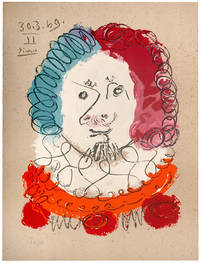
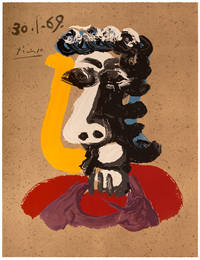
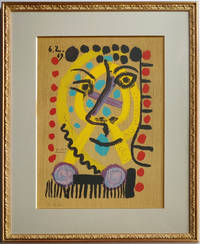
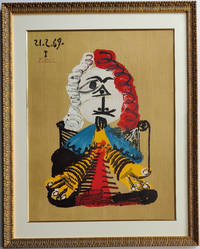
réf. 1203781969 . Lithograph in colours 1969 on wove paper with the artist's printed signature as issued numbered from the American edition of 250 marked 'A' Printed by Marcel Salinas New York with his blindstamp verso Published by Harry N. Abrahams inc. New York 65 x 50 cm. 25½ x 19¾ in. 1969 unknown
réf. 15155Paris Editions d'Art Les Heures Claires 1965 in folio (38x29) 1 fort volume broché en faux-feuillets sous couverture rempliée, 220 pages et 5 faux-feuillets non chiffrés, avec 19 planches hors-texte en couleurs et un portrait de A. Warnod en frontispice (phototypie), sous boitage de l'éditeur. Préface de Pierre Brisson. Lithographies de Derain, et Van Dongen (tirées par Lucien Détruit), lithographies de Dufy, Matisse, Chagall, Dunoyer de Segonzac, Cavaillès, Terechkovitch et Carzou. Lithographies de Picasso, et Buffet (tirées par P.-J. Ballon), Lithographies de Miro (tirée par l'atelier Arte), eaux-fortes de Villon et Zadkine (tirée par Manuel Robbe), eau-forte de Braque (tirée par A. et P. Crommelynck). Original etchings by Braque, Jacques Villon, Zadkine. Original woodcuts by Vlaminck, Rouault, Pascin, Utrillo. Original lithographs by Derain, Dufy, Matisse, Van Dongen, Picasso, Chagall (engraved by Sorlier), Dunoyer de Segonzac, Cavaillès, Terechkovitch, Bernard Buffet, Carzou, Miro. Tirage limité à 250 exemplaires numérotés sur grand vélin d'Arches (limited to 250 copies), et quelques exemplaires hors-commerce. Notre exemplaire imprimé sur grand vélin d'Arches est un exemplaire d'artiste, il porte sur la justification la mention imprimée: exemplaire d'artiste. Cet exemplaire est enrichi d'une importante suite de 33 planches de divers états de la décomposition des couleurs de la lithographie de Picasso (sous chemise). Collationné complet. Très bel et rare exemplaire d'artiste ( Photographies sur demande / We can send pictures of this book on simple request )
réf. 23482Paris, éditions du Cercle d'art, 1958. In-folio, 18 pp. 58 pl., cartonnage éditeur illustré, chemise et étui cartonnés (légère insolation et petits frottements).
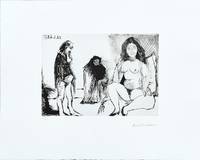
1969réf. 155791Paris: Galerie Leiris 1969. Edition of 50. Signed in pencil lower right by Picasso numbered lower left. At the age of 86 Picasso created 347 etchings between 16 March - 5 October 1968. This is plate no. 193 from the series. Aquatint scraper and drypoint on wove paper all edges deckled. Image size: 14.8 x 20.8 cm. Sheet size: 28 x 35.3 cm. Framed size: 38.3 x 43 cm. Excellent condition. Presented in a gold leaf frame with conservation acrylic glazing. Bloch 1673; Baer 1689 IV Bb1. unknown
réf. 1203761969 . Lithograph in colours 1969 on wove paper with the artist's printed signature as issued numbered from the American edition of 250 marked 'A' Printed by Marcel Salinas New York with his blindstamp verso Published by Harry N. Abrahams inc. New York 65 x 50 cm. 25½ x 19¾ in. 1969 unknown
réf. 1203841969 . Lithograph in colours 1969 on wove paper with the artist's printed signature as issued numbered from the American edition of 250 marked 'A' printed by Marcel Salinas New York with his blindstamp verso published by Harry N. Abrahams inc. New York 65 x 50 cm. 25½ x 19¾ in. 1969 unknown
1966réf. 112218Cannes 1966. Unpublished and heavily corrected manuscript of Brassai's account of his visit to Picasso A superb unpublished and heavily corrected manuscript in French in which Brassaï recounts a visit to Picasso a long-standing friend at his home near Cannes. Brassaï who photographed much of Picasso's work in the 1940s published Conversations with Picasso in 1964 creating an intimate portrait of the artist through an account of their friendship and artistic collaboration and recording each of their meetings in minute detail. Picasso said of the volume "Read this book if you want to understand me." Written in a similar style this account records an afternoon during which Picasso speaks about his nostalgia for his former studios his health his enthusiasm for the recently invented felt-tip pen his opinion of his own writings his relationship with his wife Jacqueline and his views on feminism. Though unmarked as such the manuscript comes from the collection of Brassaï's close friend and colleague the photographer Stefan Lorant founder of Picture Post the pioneering pictorial magazine. Quarto 285 x 233. 20 typed sheets in French rectos only legibly hand-corrected throughout by Brassai in black ink. Housed in a black cloth album with each sheet in a separate clear plastic file. In excellent condition the final page a little creased and with minor loss to right-hand side affecting one letter. Overall fresh and clean. hardcover
1962réf. D17822Monaco: Éditions du Rocher 1962. First Edition. Paperback. Near Fine. Inscribed and signed by Cocteau for editor Jean Denoël with a drawing at the front and signed by Picasso and Cocteau on the colophon. Among a number of copies on Rives reserved for collaborators from a total edition of 255. 24 original lithographs 11 of them hors-texte including the front wrapper and 2 double-page by Picasso printed in black by Mourlot. Folio contents loose as issued in original wrappers with cut-out design revealing title on front cover; 1/4 calf gilt-backed chemise and board slipcase split. Contents are fine. Prospectus laid in. "On the occasion of Picasso's 80th birthday Pierre Bertrand who was Cocteau's publisher assembled eleven of the poet's texts which reflected his friendship with Picasso. The latter illustrated these texts with 24 lithographs some of which are drawn in Cocteau-esque style "---Cramer 117; Monod 292; Bloch 1037-1060. Éditions du Rocher paperback
1962réf. D17822Monaco: Éditions du Rocher 1962. First Edition. Paperback. Near Fine. Inscribed and signed by Cocteau for editor Jean Denoël with a drawing at the front and signed by Picasso and Cocteau on the colophon. Among a number of copies on Rives reserved for collaborators from a total edition of 255. 24 original lithographs 11 of them hors-texte including the front wrapper and 2 double-page by Picasso printed in black by Mourlot. Folio contents loose as issued in original wrappers with cut-out design revealing title on front cover; 1/4 calf gilt-backed chemise and board slipcase split. Contents are fine. Prospectus laid in. "On the occasion of Picasso's 80th birthday Pierre Bertrand who was Cocteau's publisher assembled eleven of the poet's texts which reflected his friendship with Picasso. The latter illustrated these texts with 24 lithographs some of which are drawn in Cocteau-esque style "---Cramer 117; Monod 292; Bloch 1037-1060. Éditions du Rocher paperback books
1996réf. 129565Kornfeld Et Klipstein & Editions Kornfeld. As New. 1996. Hardcover. 3857730269 . - IN STOCK AND IMMEDIATELY AVAILABLE FOR SHIPMENT - AS NEW THE TEXT BLOCK IS PRISTINE CLEAN UNMARKED AND IN EXCELLENT CONDITION - Complete seven 7 volume set - Catalogue Raisonné Catalogue Raisonne Catalog Raisonnee Complete Works Kornfeld Et Klipstein & Editions Kornfeld hardcover
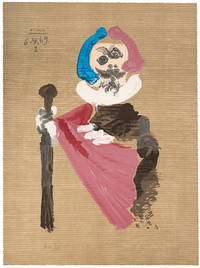
1969réf. 74883After Pablo Picasso One plate from Les Portraits Imaginaires 1969 Lithograph in colors on Arches paper with printed signature as issued Numbered A126 / 250 from the America edition Printed by Marcel Salinas Published by Éditions Cercle D'art Sheet size: 66 x 50 cm Frame size: 87 x 71.5 x 3 cm
1969réf. 74884After Pablo Picasso One plate from Les Portraits Imaginaires 1969 Lithograph in colors on Arches paper with printed signature as issued Numbered F18 / 250 from the French edition with the blindstamp of the publisher/printer Printed by Marcel Salinas Published by Éditions Cercle D'art Sheet size: 66 x 50 cm Frame size: 76.5 x 61 x 2.5 cm
1943réf. 64141943 Zurich, Édité par Louis Grosclaude, 1943. En feuillets sous chemise rempliée: 25 x 33.5 cm, [2] pl., 32-[2] pp., 14 pl. + 14 pl. Édition illustrée de 14 dessins originaux de Picasso gravés sur cuivre par les établissements Haefli et Cie, tirés par Christian Bischel. Tirage limité à 350 exemplaire, tous signés par l'éditeur. Le nôtre est un des 100 exemplaires de tête sur Japon impérial contenant une suite sur chine des 14 gravures (nr. 68). De plus, notre exemplaire est truffé de 2 gravures tirées en sanguine sur vélin. Comprend une présentation de l'éditeur et 14 poèmes de Sappho mis à disposition par la bibliothèque nationale suisse. Étui-chemise d'éditeur. Dos lisse en parchemin avec auteur en doré. Magnifique exemplaire de ce rarissime ensemble avec la SUITE, très frais. Envoi de photographies sur demande.
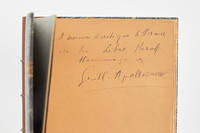
1918réf. 78956Paris: Mercure de France 1918. Fine. Mercure de France Paris 1918 14.50 x 23 cm relié First edition a first impression copy numbered in the press. Binding in half brown morocco spine in five compartments gilt date at the foot geometric pattern paper boards and endpapers in the same paper top edge gilt wrappers and spine preserved in perfect condition binding signed by T. Boichot. Apollinaire's second major poetic work with bold graphic innovations and a portrait of Guillaume Apollinaire by Pablo Picasso as frontispiece. Some of the best war poems all languages combined are brought together in this collection alongside experimental works such as Les Fenêtres close to Cubism and La Jolie Rousse which were far ahead of their time Cyril Connolly Cent livres-clés de la littérature moderne n° 32. A beautiful copy on non-brittle paper which is unusual and a rare and surprising handwritten inscription signed by Guillaume Apollinaire: à monsieur le critique littéraire de La Libre Parole hommage de Guill. Apollinaire."" To the literary critic of La Libre Parole tribute by Guill. Apollinaire. Who could be the recipient of this inscription unnamed but addressed to a collaborator of the famous anti-Semitic newspaper founded by Édouard Drumont The ostensibly philo-Semitic position of Guillaume Apollinaire is well-known. In an 1899 letter he boasts to Toussaint Luca that he tried to provoke Henri Rochefort who was reading La Libre Parole by deploying L'Aurore in front of him but as the young Dreyfusard regrets without daring to engage the controversy. In 1902 he publicly marked his fraternity with the Jewish people with a new publication in La Revue blanche Le Passant de Prague"": I love Jews because all Jews suffer everywhere. Then in Alcools he will dedicate a poem to the Hebrew religion: ""La Synagogue"". But it is undoubtedly through his poem Le Juif latin published in L'Hérésiarque et Cie that Apollinaire poetically reveals the essence of his particular link with Judaism: that he shares the condition of eternal stranger the feeling of uprooting and the search for identity. It may therefore seem very surprising that this poet whose only trace of political commitment was in favor of Dreyfus dedicated his work to a La Libre Parole journalist even if he is a literary critic. And in fact La Libre Parole does not contain literary columns! A few months before the poet's death this laconic inscription thus proves to be a formidable and final scoff of poetic impertinence to political intolerance. Mercure de France hardcover
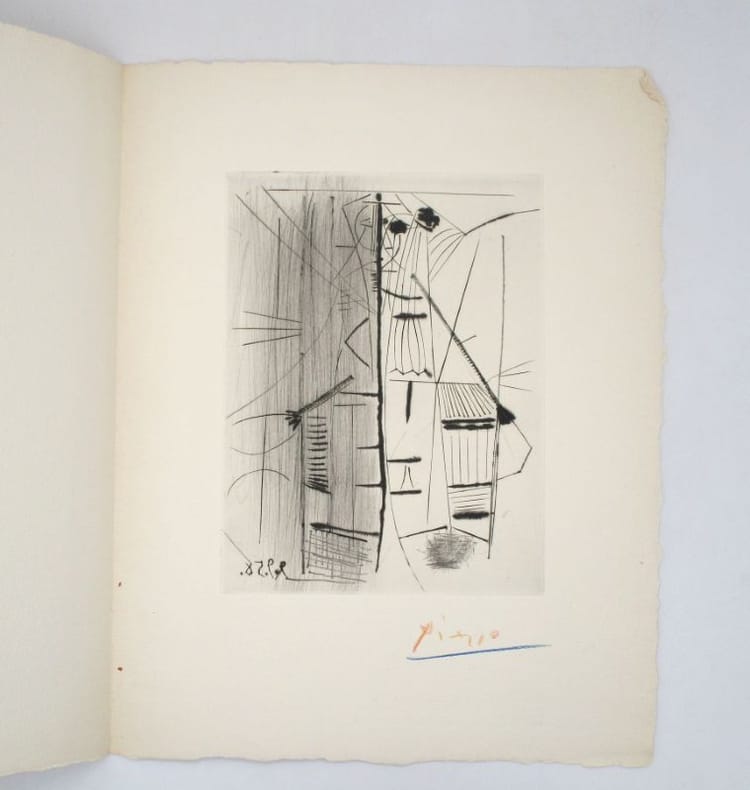
1957réf. 68709Paris: Louis Broder 1957. Fine. Louis Broder Paris 1957 13.50 x 16.50 cm relié sous chemise et étui Antonin ARTAUD & Pablo PICASSO .Autre chose que de l'enfant beau .Something Other than a Beautiful Child Louis Broder Paris 1957 13.5 x 16.5 cm full box in custom chemise and slipcase First edition printed in 120 numbered copies on Japon paper ours is one of 100 copies numbered in Arabic numerals. Illustrated with an original drypoint in colour by Pablo Picasso printed in Georges Leblanc's workshops in Paris. Handwritten signature of Pablo Picasso on the print details page. Binding in full grey box title and names of the author and illustrator gold-stamped on the spine boards decorated with an abstract and geometric decoration of gilt and black fillets mouse grey box endpapers covers and spine preserved top edge gilt chemise in half mouse grey box marbled paper boards slipcase edged in mouse grey box marbled paper boards contemporary binding signed Desmules. Using a process used the previous year for the illustration of Autre chose by P. A. Benoit the artist pierced the black mould giving the appearance of an empty circle in the engraving. This circle not pressed by the plate forms a white half-sphere in relief a unique and empty eye of a dismembered character very surely inspired by one of Artaud's great drawings from 1946 L'Homme et sa douleur preserved at the Cantini museum in Marseille. Rare and very beautiful copy perfectly set in a decorative binding comprising the only intaglio produced in colour by Picasso to illustrate the book. Louis Broder hardcover
1957réf. 89530Cannes 13 juin 1957 | 21 x 27 cm | 2 pages sur un feuillet
1943réf. 208661Robert-J. Godet éditeur 1943. Number 23 of 25 such copies. Paperback. Bound book is VG with expected age-toning to the solid covers. Accompanying suite is as good as can be hoped for with the thin paper printed wraps broken at the spine and the 18 prints most with acidic sheets between that are printed on low-quality acidic paper solid clean with a noted printing smudge on one about 1/10 an inch in size and undamaged but wanting some conservation or de-acidification. Again in case you have not noted otherwise THE BLACK AND WHITE SIGNED ETCHING is lacking but the limitation page is signed by both Hugnet and Picasso and there is a unique collage by Hugnet to noted collectors on the half-title. Thick wrapped cardstock glued covers with printed lettering in black and green. Unpaginated 38 pp with the 6 zincographs bound in and then containing in a separate folder a suite of 3 copies each in a different color of the 6 bound zincograph plates from the book. LACKS THE BLACK AND WHITE ETCHING but contains a custom-designed and signed presentation collage by Georges Hugnet to Nannette and Herbert Rothschild on the half-title with painted design and applied materials dated April 9 1956. First edition printed in 525 numbered copies: 25 on Arches vellum signed by the author and illustrator. This is one of the first 25 copies on Arches vellum signed by the author and the painter with the set of three engraving colors red ochre and blue-green in the separate suite and 1 original etching by Pablo Picasso SIGNED ETCHING IS NOT PRESENT IN THIS COPY. The justification indicates: "the illustrations were etched by Pablo Picasso in order to be printed in the text through common typographic means. The etching meant only for the first prints is one of six illustrations printed in intaglio on Roger Lacouriere's printing press." An additional 500 regular copies with no suite and no etching on Lafuma plus VI author's copies on arches and III nominatives on bristol. The request to insert by Paul Eluard is entitled "Pour Georges Hugnet" 1 p. and is present as called for. Also contains some other laid-in items including a dated 1956 photograph of Hugnet along with a lithographed invitation to an exhibition of graphics by Hugnet at Galerie Furstenberg dated 1954 contains a colored illustration on the right inside panel and a printed belly-band of unknown relation to the artist or publication. Robert-J. Godet éditeur paperback
1943réf. 208661Robert-J. Godet éditeur 1943. Number 23 of 25 such copies. Paperback. Bound book is VG with expected age-toning to the solid covers. Accompanying suite is as good as can be hoped for with the thin paper printed wraps broken at the spine and the 18 prints most with acidic sheets between that are printed on low-quality acidic paper solid clean with a noted printing smudge on one about 1/10 an inch in size and undamaged but wanting some conservation or de-acidification. Again in case you have not noted otherwise THE BLACK AND WHITE SIGNED ETCHING is lacking but the limitation page is signed by both Hugnet and Picasso and there is a unique collage by Hugnet to noted collectors on the half-title. Thick wrapped cardstock glued covers with printed lettering in black and green. Unpaginated 38 pp with the 6 zincographs bound in and then containing in a separate folder a suite of 3 copies each in a different color of the 6 bound zincograph plates from the book. LACKS THE BLACK AND WHITE ETCHING but contains a custom-designed and signed presentation collage by Georges Hugnet to Nannette and Herbert Rothschild on the half-title with painted design and applied materials dated April 9 1956. First edition printed in 525 numbered copies: 25 on Arches vellum signed by the author and illustrator. This is one of the first 25 copies on Arches vellum signed by the author and the painter with the set of three engraving colors red ochre and blue-green in the separate suite and 1 original etching by Pablo Picasso SIGNED ETCHING IS NOT PRESENT IN THIS COPY. The justification indicates: "the illustrations were etched by Pablo Picasso in order to be printed in the text through common typographic means. The etching meant only for the first prints is one of six illustrations printed in intaglio on Roger Lacouriere's printing press." An additional 500 regular copies with no suite and no etching on Lafuma plus VI author's copies on arches and III nominatives on bristol. The request to insert by Paul Eluard is entitled "Pour Georges Hugnet" 1 p. and is present as called for. Also contains some other laid-in items including a dated 1956 photograph of Hugnet along with a lithographed invitation to an exhibition of graphics by Hugnet at Galerie Furstenberg dated 1954 contains a colored illustration on the right inside panel and a printed belly-band of unknown relation to the artist or publication. Robert-J. Godet éditeur paperback books
1956réf. 89529Cannes 1956. Fine. 'I continue my work with passion' Cannes 27 janvier 1956 21 x 27 cm un feuillet Autograph letter by Pablo Picasso to Max Pellequer vividly executed in multiple colours signed and dated by the artist 27 January 1956 addressed from his villa La Californie. Fourteen lines written in green blue pink orange red violet and turquoise pencil on a watermarked BFK Rives sheet.A few negligible transverse folds as expected from mailing. Picasso did not regularly employ colour in his correspondence. Here however he seems to have offered a gracious gesture to his friend and banker Max Pellequer as the more visually striking his letters the more sought-after they become. To speak of his work Picasso turns to red pencil: je continue mon travail avec ardeur - a telling choice that conveys the fervour he wished to bring to his art. Although Picasso maintained a substantial correspondence letters written entirely in his own hand remain exceedingly scarce. As Laurence Madeline observes in her study of this private facet of the artists life: The inertia that paralyses Picasso who prefers his activity as an artist to that of a secretary renders the letters he does choose to write all the more essential and touching Picasso épistolier LHerne no. 106. From his home overlooking Cannes Picasso was assisted by his devoted secretary and childhood companion Jaume Sabartés who penned many of the artists letters - except those destined for Pellequer. To him Picasso wrote every message himself however trivial in a generous flowing script playing with letters and words as though they were graphic elements arranged in an aesthetic dialogue across the sheet far removed from the sobriety of the text. His artistic impulse seems to have seeped into even his most routine administrative exchanges with his banker and impassioned collector. Part of the Picasso-Pellequer correspondence is held today by the Musée national Picasso in Paris. A singular recipient Max Pellequer banker and collector was introduced to Pablo Picasso in 1914 by his uncle by marriage André Level. He quickly emerged as one of the artists foremost collectors and in time became Picassos financial adviser for over three decades. Pellequers engagement with Picassos oeuvre began in the 1910s notably through a bronze jester acquired from Ambroise Vollard. During the 1930s and 1940s he became Picassos personal banker safeguarding the artists wealth and facilitating his comfortable establishment in the South of France. Their friendship was lifelong and intensely collaborative. Among other commissions Picasso executed a splendid copper ex-libris for Pellequer; Pellequer purchased paintings such as Cézannes La mer à LEstaque Musée Picasso Paris; and Picasso reciprocated with gifts of several works. A discerning and avid collector Pellequer assembled one of the finest collections of modern masterworks - Degas Dufy Gauguin Léger Matisse Miró Modigliani and Utrillo - today preserved in major international museums. The epistolary art of Picasso Picassos correspondence served as an outlet for his relentless creative energy expressed across ceramics sculpture photography illustrations collages and poetry. Every letter provided a space for the emergence of genius irrespective of the prosaic content of his exchanges with Pellequer. To counterbalance such banality Picasso took care to arrange his letters diagonally across the page enlivening them with colour from pastels felt pens or coloured pencils. Letters numerals words and sentences became visual and musical elements animated by the painters imaginative force. A striking and vividly visual illustration of Picassos imperative for total self-expression manifested through his correspondence with one of his closest friends and advisers. unknown
1959réf. 1719Alès, PAB, 1959. Un volume In-8° (232 x 175 mm), broché, couverture de papier bleu orné de papiers découpés (pour chaque exemplaire l'artiste a fait un découpage particulier et dessiné les étoiles à l'encre de Chine). 2 POINTES SÈCHES ORIGINALES EN BLEU, hors-texte à pleine page. Édition originale de ce court et spirituel poème pour enfant. Édition totale à 35 exemplaires + 5 HC, celui-ci bien signé à l'encre par l'auteur, l'artiste et l'éditeur au colophon.
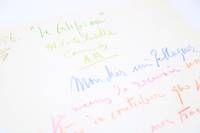
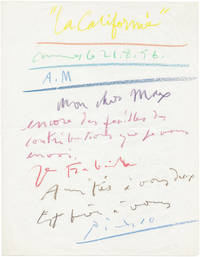
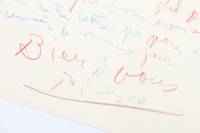
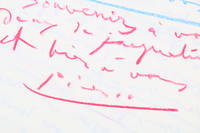
1956réf. Picasso19PICASSO Pablo 1881-1973 Autograph letter signed " Picasso " to Max Pellequer " La Californie " Cannes 21 August 1956 1 p. in-4° in colored oil pastels Watermark 'BFK RIVES.' Faint traces of pastel transfer revealing a hasty fold made by Picasso in order to enclose the sheet creasing minute loss to the lower right corner. Picasso or the Art of Correspondence A spectacular letter from the master to his friend Max executed in ten shades of oil pastel " Mon cher Max Encore des feuilles des contributions que je vous envoie. Je travaille Amitié à vous deux et bien à vous Picasso " Settled at "La Californie" in the hills above Cannes Picasso relied on the good offices of his secretary Jaume Sabartés to handle the bulk of his correspondence. Max Pellequer a close friend of the painter was nonetheless among the rare privileged few to receive letters written entirely by Picasso's own hand. Oil pastels in hand the painter deploys his nervous sweeping handwriting alternating between no fewer than ten colors—so many graphic nuances echoing and harmonizing with elegance across the surface of the sheet. A banker and discerning art collector Max Pellequer began assembling a considerable collection of modernist works in the 1920s. In 1920 he married Francine Level niece of the dealer and businessman André Level. It was through André Level that he first met Picasso in 1914 forging an enduring friendship. Pellequer became one of the artist's closest friends as well as his banker and financial advisor. Over more than thirty years he acquired from the master a remarkable collection of paintings and sculptures. Provenance: Max Pellequer's estate ; private collection
1955réf. 855571955. Fine. 20 décembre 1955 26.80 x 20.90 cm un feuillet Multi-colored autograph letter to Max Pellequer Elegant multi-colored autograph letter by Pablo Picasso to Max Pellequer signed and dated 'December 20 1955'. A leaf in multi-color pencil blue green orange and red. Traces of transverse folds. This ""graphic"" letter in the most literal sense constitutes a superb polychrome and artistic link in an epistolary chain that linked Picasso and his prominent patron for decades. Despite his prolific correspondence Picasso's entirely autographed letters are extremely rare as Laurence Madeline points out in her article on the confidential activity of the great artist:The inertia paralyzing Picasso who preferred his work as an artist to that of a secretary made the letters he took pleasure in writing more essential and more touching Laurence Madeline Picasso épistolier L'Herne no. 106. Living on the hills over Cannes the painter was indeed helped by his faithful secretary and childhood friend Jaume Sabartés who was responsible for writing numerous missives save a few correspondents notably Pellequer. Picasso wrote each of Pellequer's letters even the most insignificant in an ample voluptuous script playing with letters and words as graphic objects blending aesthetically in the space of the page in perfect contrast to the prosaic nature of the letter's content. It could even be argued that his artistic soul largely invaded his daily and administrative correspondence with his banker and ardent collector of his works. Part of their correspondence is kept at the National Picasso Museum in Paris. An extraordinary recipient. Banker and collector Max Pellequer was introduced to Picasso in 1914 by his uncle by marriage André Level. He quickly became one of Picasso's most important collectors and his financial advisor for over 30 years. Pellequer's interest in his art began as early as the 1910's when he purchased a Picasso bronze from the art dealer Ambroise Vollard. During the 1930s and 1940s as Picasso's personal banker he secured and enhanced the painter's wealth and allowed him to settle comfortably in the South of France. Picasso created a superb ex-libris on copper for him bought him paintings including La mer à L'Estaque by Cézanne now in the Picasso museum and offered him a few works. Pellequer assembled a vast collection of paintings by the great masters of modern art: Degas Raoul Dufy Paul Gauguin Fernand Léger Henri Matisse Joan Miró Modigliani and Maurice Utrillo today preserved in the most important international museums. The epistolary art of Picasso. Picasso's epistolary production acted as an outlet for his incessant creative energy which was expressed in ceramics sculptures photographs illustrations collages or poetry. Each letter was an opportunity for genius to blossom regardless of the administrative content of his exchanges with Pellequer. Perhaps to counteract the dullness of his work Picasso redoubled his efforts: an explosion of color calligraphic letters across the page. to conjure up beauty and adorn his words in shimmering hues using oil pastels black felt-tip pens or colored pencils.These alphabet letters numbers words and sentences placed on the paper like so many musical scales are literally brought to life by the creative power of the painter. The years of La Californie in Cannes. Living with Jacqueline Roque in the villa La Californie at the time of this letter the painter was producing a series of captivating lithographed portraits of his partner. Paradoxically this colorful letter corresponds to a very monochrome period of his work a superb counterpart to the black washes on zinc. Matisse with whom Pellequer also corresponded had died a month earlier. A very beautiful and visual illustration of Picasso's need for total expression through his correspondence with one of his close advisors and friends. unknown
1960réf. 1535Paris, Jean Hugues, 1960. Un volume petit in-4 (195 x 142 mm) broché. 31 pages + fnch., couverture blanche imprimée rempliée. Édition originale de ce recueil de quatorze poèmes en prose précédés d'un prologue par René Cazelles. L'ouvrage est orné d'UNE LITHOGRAPHIE ORIGINALE EN COULEURS DE JOAN MIRO. Tirage : 25 ex. avec la lithographie en trois états + 50 ex. avec la lithographie à l'état définitif + tirage typographique courant de 300 ex. tous sur Arches. Notre exemplaire est l' 1 des 25 de tête (n° 14) comprenant, sur un cahier dépliant formant triptyque, LA LITHOGRAPHIE EN 3 ÉTATS SIGNÉE AUX CRAYONS DE COULEUR ET JUSTIFIÉE 3/25 sur le deuxième volet : 1er état couleurs, 2ème état avec des modifications dans l'encadrement et ajout d'étoiles, 3ème état avec modification des couleurs et ajout d'un gaufrage. La typographie est dûe à l'imprimerie Union et le tirage de la lithographie à Mourlot. René Cazelles, ami de René Char, fut publié par Guy Lévy-Mano, Pierre-André Benoit, Aimé Maeght, Jean Hugues…