5 280 résultats
1969réf. 123936Paris Galerie Creuzevault 1969 1 vol. broché plaquette in-8 oblongue, agrafée, couverture illustrée en couleurs, 16 p. Catalogue de l'exposition présentée du 18 novembre 1969 au 15 janvier 1970. Avec un texte de Jean-Jacques Lévêque et 19 numéros décrits et reproduits.
1924réf. 345912Paris: L'Union des Artistes Russes 1924. Softcover. Very Good. First edition. Folio. 12pp. Printed self-wrappers stapled. Soiling to the front wrap and edges else very good or better. Title vignette by Victor Barthe. With six full page plates by Boris Chatzman Edouard Manet Pablo Picasso Marie Vassilieff Serge Fotinsky and Nachmann Granovsky. Printed on thick sheets of "Normandy Vellum" paper. Program for the third ball of the Union of Russian Artists in Paris "from midnight to 6 am." Scarce. OCLC locates only 4 copies. From the library of the artists Ben Shahn and Bernarda Bryson Shahn with an estate label designed by their son Jonathan Shahn. L'Union des Artistes Russes unknown
1924réf. 27069Paris: Union des artistes russesFrançois Bernouard 1924. Fine. Union des artistes russes François Bernouard Paris 1924 24.50 x 29 cm broché The program is illustrated by V. Barthe wrapper and includes hors-texts by Chatzman Manet a reproduction of his Olympia Picasso Vassilieff Fotinsky and Ganovsky a spatial composition. Appearing at this event were: Olga Koklova and the Ballets Suédois of Juger Friis and Jean Borlin the dance of the lobster crab and crocodile with costumes by Marie Vassilieff and Fernand Léger the Petrograd Puppet Theatre with costumes and puppets by Goncharova and music by Bohslav Martinou and Vernon Duke three-dimensional poems by Iliazd and Katabadze as well as futurist poems from Vazry a dance by Thamara Svirskya to Satie's Gymnopédies Japanese Sports by Foujita a Spectacle on a Star from Tzara a new system of fantastical projections from Larionov and universal Foot Ball with multicolored balloons by Fotinsky and Bogoutsky. The rooms were decorated by Barthe Pougny Tchelitcheff Chazman Lanskoy Weinberg Geo Charles Chana-Orloff Alexeieff Maner-Katz and Frenkel. A rare and attractive copy. Union des artistes russesFrançois Bernouard unknown
1924réf. 27069Union des artistes russes François Bernouard | Paris 1924 | 24.50 x 29 cm | broché
1924réf. 345912Paris: L'Union des Artistes Russes 1924. Softcover. Very Good. First edition. Folio. 12pp. Printed self-wrappers stapled. Soiling to the front wrap and edges else very good or better. Title vignette by Victor Barthe. With six full page plates by Boris Chatzman Edouard Manet Pablo Picasso Marie Vassilieff Serge Fotinsky and Nachmann Granovsky. Printed on thick sheets of "Normandy Vellum" paper. Program for the third ball of the Union of Russian Artists in Paris "from midnight to 6 am." Scarce. OCLC locates only 4 copies. From the library of the artists Ben Shahn and Bernarda Bryson Shahn with an estate label designed by their son Jonathan Shahn. L'Union des Artistes Russes unknown books
1933réf. B-2022-0929Lot of three artistic programs: Le Ballet des Champs Elysées 1948 Les ballets 1933 au théâtre des Champs Elysées Les ballets de Roland Petit 1949. -Ballets des Champs Elysées. 1948 The program for the November 1948 ballet season with the cover designed by Picasso text by Sartre and Barrault. Incomplete with only 18 pages Picasso cover Sartre and Barrault text are included. Picasso cover with some painting stains at the bottom. -Les ballets 1933 de George Balanchine. Editions des quatre chemins Paris. Artistic director Boris Kochno Théâtre des Champs Elysées. Preface by Edward James. The program include presentation text of the performances and illustrations of scenography and customs by Derain Tchelitchew and a full page reproduction drawing by Caspar Neher for Les Sept Peches Capitaux performance. -Les ballets de Roland Petit. Paris 1949 Preface by Marcel Archard and Lenor Fini. With full pages of photographic portraits of Roland Petit Colette Marchano Serge Perrault and others performers illustrated with marquettes in color by Antoni Clavie and double page of Leonor Fini. French text. Good conditions. Please ask for complete report. paperback
1933réf. B-2022-0929Lot of three artistic programs: Le Ballet des Champs Elysées 1948 Les ballets 1933 au théâtre des Champs Elysées Les ballets de Roland Petit 1949. -Ballets des Champs Elysées. 1948 The program for the November 1948 ballet season with the cover designed by Picasso text by Sartre and Barrault. Incomplete with only 18 pages Picasso cover Sartre and Barrault text are included. Picasso cover with some painting stains at the bottom. -Les ballets 1933 de George Balanchine. Editions des quatre chemins Paris. Artistic director Boris Kochno Théâtre des Champs Elysées. Preface by Edward James. The program include presentation text of the performances and illustrations of scenography and customs by Derain Tchelitchew and a full page reproduction drawing by Caspar Neher for Les Sept Peches Capitaux performance. -Les ballets de Roland Petit. Paris 1949 Preface by Marcel Archard and Lenor Fini. With full pages of photographic portraits of Roland Petit Colette Marchano Serge Perrault and others performers illustrated with marquettes in color by Antoni Clavie and double page of Leonor Fini. French text. Good conditions. Please ask for complete report. paperback books
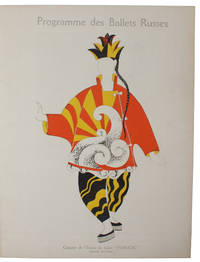
1917réf. 60103Paris Mai 1917. Folio. Original illustrated extra wrappers with a picture by Picasso on the front and the décor for "Baba Iaga" on the back; original illustrated wrappers for "Théatre du Chatelet" drawing by André Marty on front and advertisements on back in grey and red; original illustrated coloured wrappers for "Programme des Ballets Russes" front wrapper illustrated by Picasso with the Chinaman-costume from "Parade". A bit of soiling to the extra-wrappers and small professional restorations to upper front cover and top of spine this barely noticeable as well as to blank margin of back wrapper. Apart from that an excellent and very well perserved copy with only slight browning to some leaves. Apart from the described wrappers and extra-wrappers there are in all 24 leaves with -mostly photographic- illustrations four of them with original hand-colouring on top and 6 leaves of text.With the original errata-leaf laid in loose stating also that the illustrations "Femmes de bonne humeaur" and "Parade" have been hand-painted by Carlos Socrate after the designs of Bakst and Picasso and that the front wrapper for "Parade" the Chinaman has been handpainted by Picasso himself. Scarce original printing of this seminal avantgarde-publication the May 1917 "Théatre du Chatelet"- publication that presents Diaghilev's "Ballets Russes" in Paris - here containing the entire separate publication mainly devoted to Jean Cocteau's groundbreaking ballet "Parade" - being one of the most important publications in the history of modern art. It is here in his presentation-article to "Parade" that Apollinaire coins the term "surrealism" and thus lays the foundation for the seminal cultural movement that Bréton came to lead. Furthermore the ballet "Parade" represents a historical collaboration between several of the leading artistic minds of the early twentieth century: Erik Satie Jean Cocteau Pablo Picasso Léonide Massine and Serge Diaghilev and is famous not only for its contents and its music but also for its magnificent costumes designed by Picasso the drawings of which are presented in the present publication for the first time - most famously the front cover for the "Parade"-programme which depicts the "Costume de Chinois du ballet "PARADE"/ Aquarelle de Picasso" an etching with original stunning pochoir-colouring hand-painted by Picasso himself!.It is the 1917 ballet "Parade" - the first of the modern ballets - originally presented for the first time in the present publication that marks Picasso's entry into the public and bourgeois institutions of ballet and theatre and presents Cubism on the stage for the first time. The present publication constitutes an outright revolution in the history of art theatre and ballet.Several variants of this spectacular publication exist but the one we have here is as original and complete as it comes containing the entire contents of the different variants. We not only have the extremely scarce and fragile dust-wrapper and the equally scarce illustrated coloured double-wrappers front: "Peinture de Picasso"; back: Décor de Larionow pour le ballet "BABA IAGA"" but also the entire 1917 "Théatre du Chatelet"-programme in original illustrated wrappers with the entire separate "parade"-issue -also entitled "Programme des Ballets Russes"- also in original illustrated wrappers with more than 20 leaves of photographic illustrations containing pictures of the actors and actresses also in their spectacular avant-garde-costumes Bakst's portrait of Leonide Massine Picasso's portrait of Stavinski Bakst's portrait of Picasso Picasso and Massine in the ruins of Pompei Picasso's drawings of a scene from "Parade" and of Massine as well as several mostly humorous advertisements. But more importantly we have apart from the above-mentioned famous Chinaman by Picasso in original pochoir-colouring the other famous etching by Picasso "Costume d'acrobate du ballet "Parade"/ Aquarelle de Picasso" also in original pochoir-colouring bright blue the seminal presentation-article by Apollinaire which coins the term "surrealism" see bottom of description for full translation of this groundbreaking preface the two "Les Femmes de Bonne Humeur"-figures by Bakst Constanza and Battista printed and heightened in gold pochoir the printed costume by Larionow "Les contes russes" which is with original bright red and blue pochoir-colouring and the "Le Mendiant"-costume by Bakst for "Parade" and of course the texts by Bakst on choreography and décor Georges-Michel Ballets Russes after the War as well as the texts for the various ballets listing the actors and their rôles as well as a resume of the plot. " "Tact in audacity consists in knowing how far we may go too far." Jean Cocteau poet writer and arts advocate made this statement in his 1918 manifesto The Cock and Harlequin. Cocteau in collaboration with Erik Satie and Pablo Picasso discovered "how far" to "go too far" in the circus-like ballet Parade-one of the most revolutionary works of the twentieth century. Parade incorporates elements of popular entertainment and uses extra-musical sounds such as the typewriter lottery wheel and pistol combining them with the art of ballet. Cocteau wrote the scenario for the one-act ballet and contracted the other artists. Satie wrote the score to the ballet first in a piano four-hands version and then in full orchestration while Picasso designed the curtain set and costumes. Later Léonide Massine a dancer with the Ballet Russes was brought in as the choreographer. Serge Diaghilev's Ballet Russes premiered the ballet Parade on May 18 1917. The program notes for the ballet were written by the poet Apollinaire. They became a manifesto of l'esprit nouveau or "the new spirit" which was taking hold in Paris during the early twentieth-century. Apollinaire described the ballet Parade as "surrealistic" and in doing so created a term which would develop into an important artistic school." Tracy A. Doyle Erik Satie's ballet PARADE p. 1.When the French poet and army officer Guillaume Apollinaire wrote the program notes For "Parade" he created the manifesto of the "l'esprit nouveau" - "the new spirit". Cocteau had called the ballet "realistic" but Apollinaire took it an important step further and described it as "surrealistic" thus coining a term that would soon develop into an important artistic movement. With Picasso Apollinaire had established the aesthetic principals of Cubism and was considered a leader in the European avant-garde. ENGLISH TRANSLATION OF APOLLINAIRE'S PROGRAMME NOTES TO "PARADE": "Definitions of Parade are blossoming everywhere like the lilac bushes of this tardy spring.It is a scenic poem transposed by the innovative musician Erik Satie into astonishingly expressive music so clear and simple that it seems to reflect the marvelously lucid spirit of France. The cubist painter Picasso and the most daring of today's choreographers Léonide Massine have here consummately achieved for the first time that alliance between painting and dance between the plastic and mimetic arts that is a herald of the more comprehensive art to come. There is nothing paradoxical about this. The Ancients in whose lives music played such an important role were totally unaware of harmony which constitutes the very basis of modern music. This new alliance - I say new because until now scenery and costumes were linked only by factitious bonds - has given rise in Parade to a kind of surrealism which I consider to be the point of departure for a whole series of Manifestations of the New Spirit that is making itself felt today and that will certainly appeal to our best minds. We may expect it to bring about profound changes in our arts and manners through universal joyfulness for it is only natural after all that they keep pace with scientific and industrial progress. Having broken with the choreographic tradition cherished by those who used to be known in Russia under the strange name 'balletomanes' Massine has been careful not to yield to the temptation of pantomime. He has produced something totally new-a marvelously appealing kind of dance so true so lyrical so human and so joyful that it would even be capable if it were worth the trouble of illuminating the terrible black sun of Dürer's Melancholy. Jean Cocteau has called this a realistic ballet. Picasso's cubist costumes and scenery bear witness to the realism of his art. This realism - or this cubism if you will - is the influence that has most stirred the arts over the past ten years. The costumes and scenery in Parade show clearly that its chief aim has been to draw the greatest possible amount of aesthetic emotion from objects. Attempts have often been made to return painting to its barest elements. In most of the Dutch painters in Chardin in the impressionists one finds hardly anything but painting. Picasso goes further than any of them. This is clearly evident in Parade a work in which one's initial astonishment is soon replaced by admiration. Here the aim is above all to express reality. However the motif is not reproduced but represented-more precisely it is not represented but rather suggested by means of an analytic synthesis that embraces all the visible elements of an object and if possible something else as well: an integral schematization that aims to reconcile contradictions by deliberately renouncing any attempt to render the immediate appearance of an object. Massine has Adapted himself astonishingly well to the discipline of Picasso's art. He has identified himself with it and his art has become enriched with delightful inventions such as the realistic steps of the horse in Parade Formed by two dancers one of whom does the steps of the forelegs and the other those of the hind legs. The fantastic constructions representing the gigantic and surprising features of The Managers far from presenting an obstacle to Massine's imagination have one might say served to give it a liberating impetus. All in all Parade will change the ideas of a great many spectators. They will be surprised that is certain; but in a most agreeable way and charmed as well; Parade will reveal to them all the gracefulness of the Modern movements a gracefulness they never suspected. A magnificent vaudeville Chinaman will make their imaginations soar; the American Girl cranking up her imaginary car will express the magic of their daily lives whose wordless rites are celebrated with exquisite and astonishing agility by the acrobatin blue and white tights." unknown
réf. 8168Paris, Théâtre des Champs-Elysées, 1924. 27,5 x 21,5 cm, non paginé. Plaquette agrafée, couverture illustrée. Couverture avec des rousseurs, intérieur en bon état. Programme des Ballets russes de Monte-Carlo, dirigé par Serge de Diaghilew, au Théâtre des Champs-Elysées, dans le cadre des Jeux olympiques d'été de 1924. Représentations en mai, juin et juillet, comprenant: Le Train bleu ( Cocteau, Milhaud, Chanel, Laurens) Les Biches (Poulenc, Nijinska, Laurencin), Les Facheux (Kochno, Auric, Braque), Une Éducation manquée (Chabrier, Juan Gris) - Les tentations de la bergère (Monteclair, Juan Gris) - Petrouchka (Stravinsky, Fokine, Benois) - Noces (Cocteau, Massine, Picasso, Satie) - Le Sacre du Printemps (Straninsky, Massine, Roerich) - Pulcinella ( Stravinsky, Massine, Picaso) - Parade (Cocteau, Massine, Picasso, Satie) - Cimarosiana (Cimarosa, Massine). Rideau des ballets russes de Picasso. Couverture et 6 hors-texte de Picasso, dont un en couleurs. Photographies des artistes, des écrivains et des musiciens (Milhaud, Cocteau, Auric, Pollenc, Stravinsky) et reproductions en couleurs des costumes et décors de Marie Laurencin, Juan Gris, Georges Braque.
1917réf. 60103Paris, Mai 1917. Folio. Original illustrated extra wrappers (with a picture by Picasso on the front and the décor for ""Baba Iaga"" on the back)"" original illustrated wrappers for ""Théatre du Chatelet"" (drawing by André Marty on front, and advertisements on back) in grey and red"" original illustrated coloured wrappers for ""Programme des Ballets Russes"" (front wrapper illustrated by Picasso with the Chinaman-costume from ""Parade""). A bit of soiling to the extra-wrappers and small professional restorations to upper front cover and top of spine (this barely noticeable) as well as to blank margin of back wrapper. Apart from that, an excellent and very well perserved copy with only slight browning to some leaves. Apart from the described wrappers and extra-wrappers, there are, in all, 24 leaves with -mostly photographic- illustrations (four of them with original hand-colouring on top) and 6 leaves of text.With the original errata-leaf laid in loose, stating also that the illustrations ""Femmes de bonne humeaur"" and ""Parade"" have been hand-painted by Carlos Socrate, after the designs of Bakst and Picasso, and that the front wrapper for ""Parade"" (the Chinaman) has been handpainted by Picasso himself.
2001réf. 785072001 Editions Thames & Hudson - 2001 - In-4, broché couverture illustrée à rabats - Sans pagination (160 pages) - Avec 116 illustrations dont 108 en couleurs
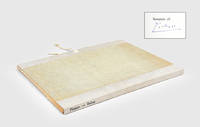
1957réf. 190907Paris: Éditions Louise Leiris 1957. Signed limited edition number 96 of 100 copies signed by Picasso. Printed by Mourlot Paris this complete set of Picasso's 8 portraits of French novelist and playwright Honoré de Balzac is accompanied by text by French surealist writer Michel Leiris. In 1927 Picasso was commissioned by publisher Ambroise Vollard to do a series of illustrations for Balzac's novella Le Chef-d'uvre inconnu The Unknown Masterpiece. First published in 1831 in the newspaper L'Artiste under the title Maître Frenhofer Master Frenhofer the story tells of an obsessive painter who has toiled over his magnum opus for ten years. When he finally unveils the finished work his fellow artists fail to be impressed and Frenhofer driven mad by his masterpiece burns the artwork and kills himself later that night. Frenhofer's plight clearly resonated with artists. Cezanne supposedly once lamented "Frenhofer c'est moi!" However Picasso's obsession with the tale went one step further. He even claimed that he was being haunted by the ghost of Balzac and in 1937 chose the address believed to have been the setting of the opening scene of Le Chef-d'uvre inconnu to be his new studio. Ironically it was there that Picasso produced what is widely regarded to be his own chef-d'uvre Guernica. These eight portraits of Balzac created in 1952 and published five years later are testimony to Picasso's enduring obsession and deep admiration for the writer. 8 transfer lithographs on Velin d'Arches. Loose as issued in original beige cloth portfolio with ties and black lettering to spine. Some gentle toning and minor foxing to a few leaves mainly confined to the edges. Overall the prints are clean and bright in a very good portfolio. hardcover
1986réf. 153Conception et réalisation Floc'h et Fromental, 1986. Irrésistible petit in-12 broché, couverture illustrée en couleurs, premier plat orné d'un billet de banque à l'effigie de BB.
1970réf. 44977Couverture rigide. Reliure de l'éditeur. 219 pages. Légèrement défraîchi. Port gratuit à partir de 10 volumes de cette collection. Nous consulter .
réf. REG5152MDossier in-4. Complet. Bon état
réf. 25676P., éditions Futuropolis, 1977, grand in-4, br., non paginé, illustrations en noir et blanc. Edition originale. Collection 30/40.
1978réf. 1032521978 6 Paris, Libération et Bazooka Production, janvier 1978-juillet 1978, collection complète.Six fascicules format journal 405x290mm, 32p., en feuilles, impression en couleurs.Directeur de la publication Alain Bizot, participation de Olivia Clavel, Loulou Picasso, Kiki Picasso et Lulu Larsen, avec le concours de Libération ou Serge July, alors directeur du journal écrira le 12 août 1977 (pp.12-13) : « Bazooka fout la merde ».Le groupe a également publié de nombreuses page d’illustration dans le même journal toujours dans un esprit de provocation c’est la première génération de l’après guerre dont la culture dominante est celle de l’image et non du texte.Défauts et manques au dos n°0.Contre-cultures 1969-1989 L'Esprit Français p.256-257. (103252)
1997réf. ABE-159095773130098 PAGES-22,5 CM X 29 CM-L'EXPOSITION DU GRAND PALAIS-(PRART3)
1962réf. 61509ABBerlin, Herbig 1962. Gr.-8°. 237, (3) S. + 33 Tafeln, zweifarb. illustr. OHlwd. Nachsatz stw. gebräunt. DEA. zweifarb. illustr. OHlwd. Nachsatz stw. gebräunt. DEA.
1962réf. 3177BB1962. Berlin F.A. Herbig Verlagsbuchhandlung 1962. 20 x 245 cm. 237 Seiten. Hardcover/ Gebundene Ausgabe. Sehr guter Zustand mit minimalen Gebrauchsspuren. Enthält u.a.: Der König von La Californie / Der König von Kalifornien Ein Märchen / Kleine Geschichten von La Californie - Der Mistral / Der Strand / Mappen voller Zeichnungen / Picasso in der Arena / Portrait der Madame H.P. / Die Friedenstauben und die Menschen / Vom Geist Vauvenargues / hardcover
1948réf. 13313West Drayton, Penguin Books, 1948. Hard board, dj, 8vo, 15 pp, 31 plates; -paper browned, dj with some tear, very good copy.
réf. 19180Pour la première fois, les dessins de Bernard Pagès sont montrés dans leur ensemble. Pagès a commencé par peindre dans le Quercy, où il est né en 1940. Il renoncera cependant assez vite à la peinture pour le terrain plus périlleux pour lui de la sculpture. Et c’est en sculpteur que la pratique du papier va continuer de s’imposer à lui. En sculpteur qu’il va aimer et malmener le papier. Papier qu’il n’a de cesse d’expérimenter, se fiant au répertoire du sculpteur qu’il s’est inventé, aux infinies possibilités des matériaux, toujours inconnus, ou encore au hasard et aux cueillettes d’objets dans le monde auquel il est attentif. Antibes, 2015 Snoeck 130 p., illustrations couleur, relié sous jaquette. 21 x 27
1956réf. 10341956 Nice, Galerie H. Matarasso, 1956. 24,5 x 16,5 cm, 18 pp., plaquette agrafée, couverture imprimée et illustrée.