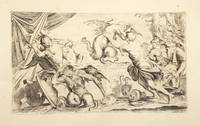
1663ref. 4850Rome: Da Gio. Giacomo de Rossi alla Pace al insegna di Parigi 1663. FIRST EDITION. Hardcover. Fine. Bound in modern quarter red morocco over marbled boards. A very good copy of the complete set of etchings. Some mostly mild soiling and staining a little heavier on two of the final plates and one small defect in plate 4 repaired. A complete set of etchings after the parietal frescoes in Palazzo Fava Bologna painted by the Carracci ca. 1593 depicting the story of Aeneas. The set comprises a title page 12 etched plates numbered from I to XII with the scenes of the cycle; and 4 additional sheets with 2 etchings per sheet reproducing the trompe l'oeil grisaille "statues" that divide the scenes. The title leaf includes the dedication to Lepoldo de Médici 1617-1675 with the Medici arms. The frescoes illustrating scenes from Books II and III of the "Aeneid" were etched by Giuseppe Maria Mitelli after drawings made by Flaminio Torri whose untimely death had prevented him from executing the plates himself. At the foot of the plates Mitelli attributes the individual scenes to one or another of the Carracci Annibale Agostino or Ludovico but these individual attributions do not always correspond to the conclusions of the most recent criticism. According to the Carracci biographer Carlo Cesare Malvasia "Felsina pittrice 1678 the frescoes were executed under the direction of Ludovico with at least two scenes Polyphemus and the Harpies being drawn by Ludovico and painted by Annibale. The Carracci - Annibale 1560-1609 his brother Agostino 1557-1602 and their cousin Ludovico 1555-1619- are among the most famous Bolognese painters of the last two decades of the sixteenth and the first part of the seventeenth centuries. Their artistic production took on a new importance in the history of Italian and European art of that time exerting a huge influence on subsequent generations. They gave life to an art based on a renewed awareness of nature and on the careful study of reality contributing to the development of the Baroque style which was opposed to the artificiality of late Mannerism. Towards the end of the sixteenth century the Carracci founded what has been called the first private school of painting of the modern age: the Accademia degli Incamminati. Annibale certainly the most talented of the three would be called to Rome to work for the powerful Farnese family while Ludovico and Agostino remained rooted in Bologna. But it is in Palazzo Fava that their "avvenetura" begins. Here the Carracci executed their first commission and the first important fresco cycle of their career. In 1584 thanks also to the intercession of Antonio Carracci father of Annibale and Agostino and tailor of the Fava family Count Filippo Fava entrusted the decoration of the entire "piano nobile" of the building to young artists who immediately gave proved their talent by creating an absolute jewel of Bolognese and Italian art. Thanks to the Fava family a family of patrons who played a fundamental role in the history and artistic development of Bologna Palazzo Fava became a place of study for the young artists of the time who were able to take advantage of mobile scaffolding to closely observe the adventures represented in the friezes of the cycle: those of Jason and Medea and in those of Aeneas the latter of which is reproduced here. https://genusbononiaeblog.it/i-carracci-palazzo-fava/ The engraver Giuseppe Maria Mitelli was renowned for the familiar playful carnivalesque and visionary themes of his etchings exemplified by allegorical figures genre scenes and images of everyday life in the streets of his native Bologna. He produced a large and varied body of work from genre scenes and fantastic imagery to reproductions of the works of the great Italian painters such as this suite. Mitelli was among the founders of Bologna's Accademia Clementina and was one of its first directors. For a full biography see "Agostino e Giuseppe Maria Mitelli" in Arte antica e moderna 3 1958 pp. 295-301. Da Gio. Giacomo de Rossi alla Pace al insegna di Parigi hardcover books
1920ref. 1408304Paris: Nouvelle Cythere c. 1920. Softcover. Quarto 10 80 pages. In Very Good minus condition. Bound in white covers. Chipping and tearing along edges of covers. Foxing and soiling to covers. Light soiling scattered throughout interior. Plate Nos. III and IV pages 9-12 and pages 73-76 loose but present. Shelved in Case 11. Facsimile of the edition published in 1798. 1408304. Shelved Dupont Bookstore. Nouvelle Cythere unknown books
1994ref. 604402New York: Sotheby's 1994. Hardcover. Fine/Near Fine. Auction catalog. Small quarto. Illustrated in color. Fine in a near fine dust jacket with a bit of rubbing and a few gentle bumps. Cover features Annibale Carracci's "Boy Drinking. Sotheby's hardcover books
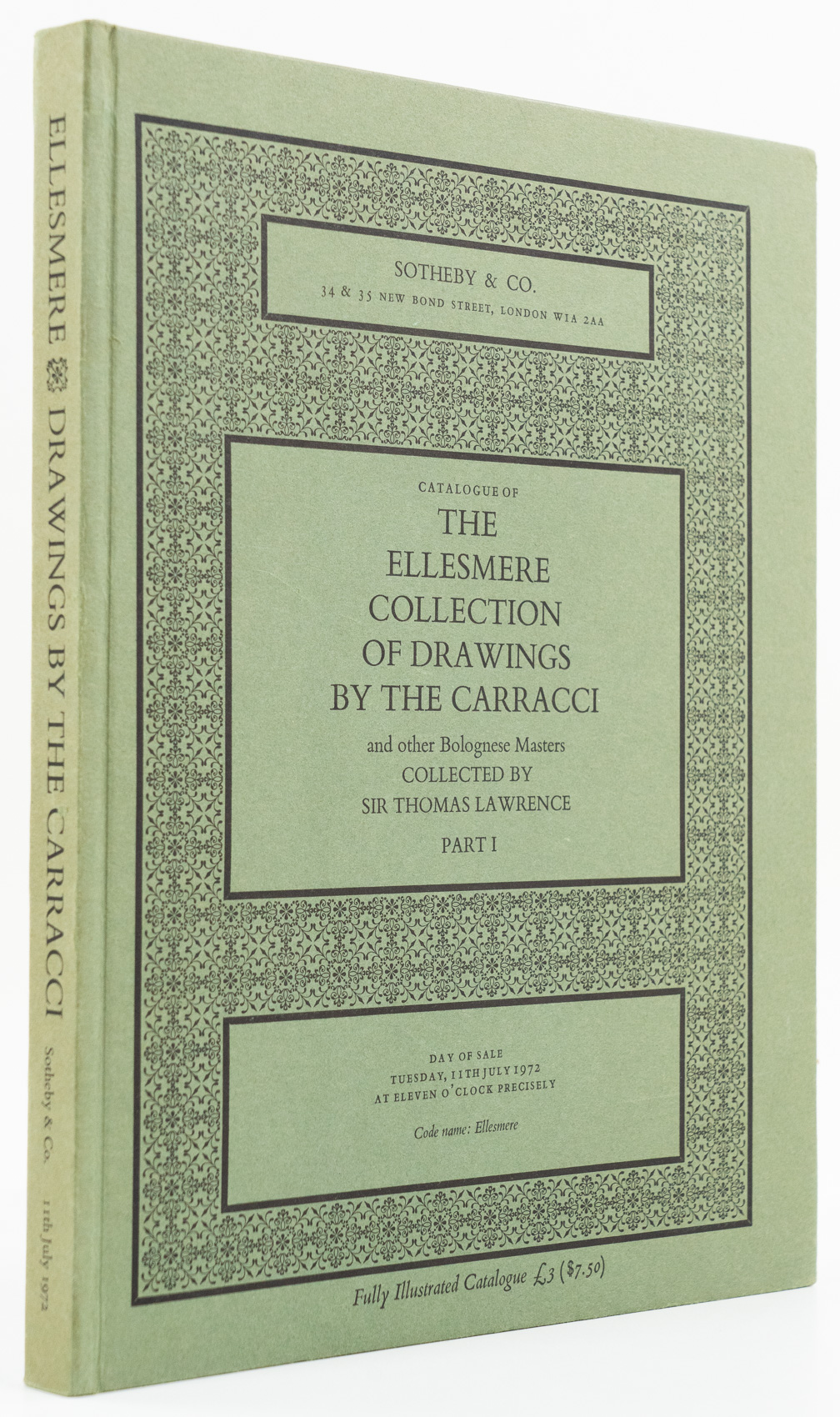
1972ref. 98203HBLondon:, Sotheby, 1972. 209 Seiten, OPpbd., 24,5 x 18 cm.
1990ref. 41039Berlin : Wagenbach 1990. 156 S. ; 22 cm engl., Softcover/Paperback, Exemplar in gutem Erhaltungszustand
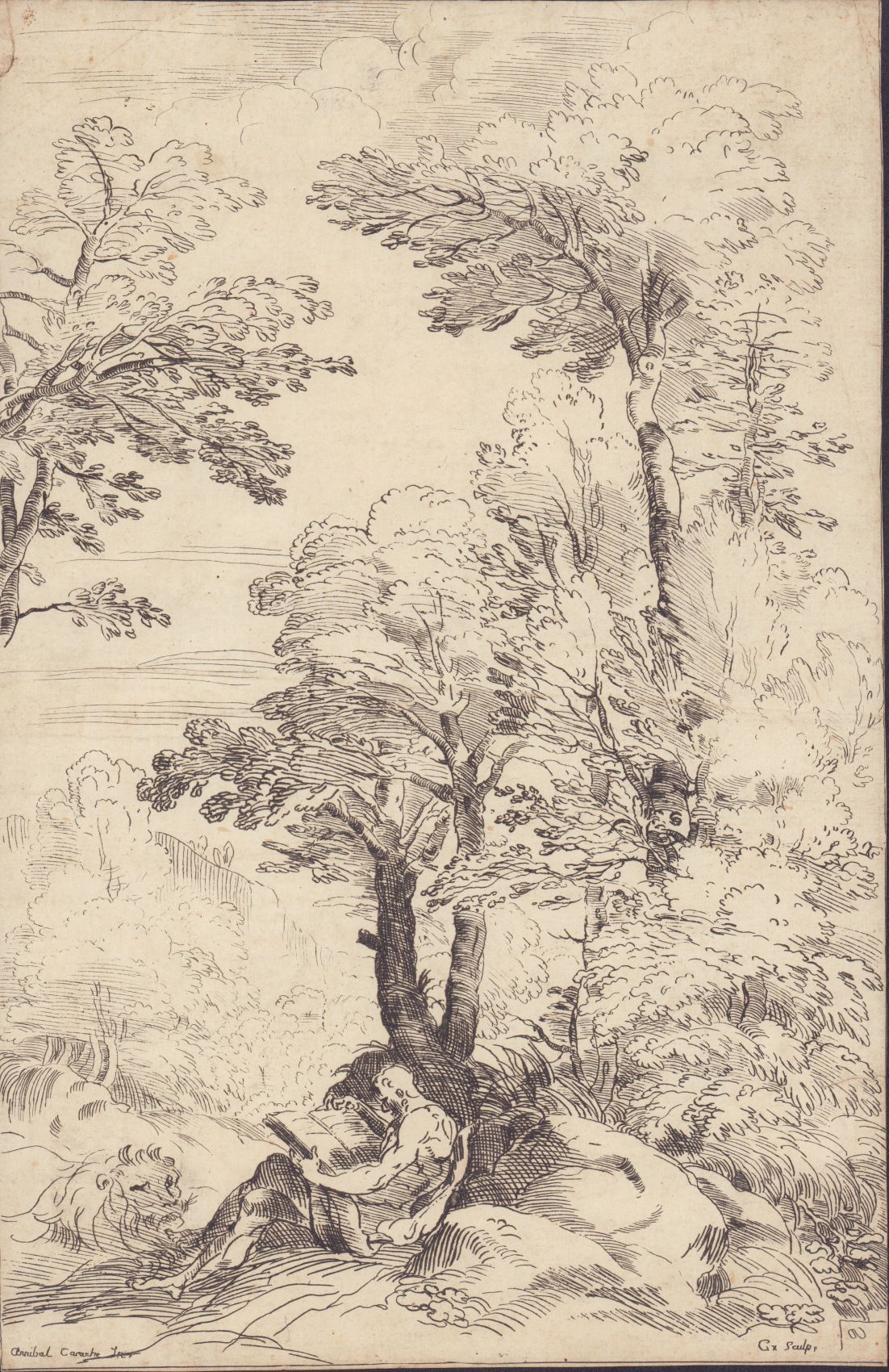
1750ref. 902882AG[Um 1750]. Kupferstich 39,5 x 26 cm.
1992ref. 25082Aosta, Fabbri Editori, 1992. 4°. Mit zahlreichen farbigen und s/w Abbildungen, 327 S., Orig-Kart. - Chefs d'oeuvre du Musée Puskin de Moscou. Dessins italiens du XV au XVIIIe siècle. / Masterpieces of the Pushkin Museum of Moscow. Italian Drawings from the XV to the XVIII centuries. Ausgabe in Italienisch - Französisch - Englisch. Good copy.
ref. LCS-18404Première et célèbre édition de l’Arétin d’Augustin Carrache, «le plus artistique des Livres érotiques…» (H. Cohen, col. 88). A la Nouvelle Cythère [Paris, Didot, 1798]. Grand in-4 de 1 feuillet pour le faux-titre (relié à l’époque sans le titre), 10 pp. de préface, (1) f. de table et d’errata, 80 pp. et 20 gravures numérotées à pleine page hors textes protégées par des serpentes, veau fauve marbré, roulette dorée autour des plats, dos lisse orné, pièce de titre en maroquin rouge, roulette intérieure, tranches dorées. Reliure de l’époque. 301 x 225 mm.
2003ref. 7167Broché sous couverture illustrée. Paris Les Éditions de l’Amateur 2003 1 volume in-8°.
ref. 8623Eau-forte et burin .Faussement attribué à Annibal Carrache, alors qu'il s'agit d'une estampe anonyme d'après Augustin Carrache. In L'art érotique sous la Renaissance, tome 3, page 860. en feuille Très bon 24,5 x 44,5 cm
1961ref. 14102Numéro 77, Mai 1961. Méry Laurent, Comment travaille Pierre Soulages, Brébiette, Dessins de Carrache pour la Galerie Farnèse. Photos en couleurs. Broché sous couverture illustrée Très bon Paris L'Œil 1961 1 volume in-folio
ref. 14373Rare estampe, coupée à la marque du cuivre et contrecollée. En feuille Moyen 1 volume in-8°
1974ref. 119957Bologne Arnaldo Forni Editore 1974 1 vol. en feuilles in-folio, en feuilles sous chemise cartonnée illustrée à lacets, 40 gravures à pleine page légendées en italien. Belle reproduction en fac-similé de l'édition de 1660. Très bon état.
1974ref. 119957Bologne Arnaldo Forni Editore 1974 1 vol. en feuilles in-folio, en feuilles sous chemise cartonnée illustrée à lacets, 40 gravures à pleine page légendées en italien. Belle reproduction en fac-similé de l'édition de 1660. Très bon état.
1910ref. 56729Carte panoramique géante en couleurs, format 56 x 23 cm, Carrache éditeur, Pau, s.d. (vers 1910)
1910ref. 56731Carte panoramique géante en couleurs, format 58 x 23 cm, [ Carrache éditeur ], Pau, s.d. (vers 1910)
1910ref. 56734Carte panoramique géante en couleurs, format 56 x 22,5 cm, Carrache éditeur, Pau, s.d. (vers 1910)
1910ref. 56735Carte panoramique géante en couleurs, format 56 x 22,5 cm, Carrache éditeur, cliché Rayssé, Pau, s.d. (vers 1910)
1910ref. 56736Carte panoramique géante en couleurs, format 56 x 22,5 cm, Carrache éditeur, Pau, s.d. (vers 1910)
1688ref. 16537Paris, Auboüin, Emery et Clousier (Imprimerie Antoine Lambin), 1688 ; in-12, veau jaspé, dos à nerfs décoré et doré, pièce de titre grenat, roulette sur les coupes, tranches rouges mouchetées (reliure d’époque) ; (20), 304 pp.
1925ref. LIQ-5140P. A La Nouvelle Cythere s.d. (1925). Grand in-4° demi chagrin bleu, dos à nerfs ornés de feurons et filets dorés.
1964ref. SPNE-328Paris : Éditions du Chêne, 1964. 140 pages illustrées de planches en noir et bistre in-texto, biographies, bibliographie, nomenclature des artistes et des planches. Relié toile 24x23.
2007ill., br. Si tratta del catalogo a cura dell'antiquario fiorentino Massimo Vezzosi, contenente contributi su scultori e pittori tra il Trecento e il Settecento, illustrati con numerose immagini. Tra le opere un "Busto di Santo" di Jacopo Sansovino, opera lignea dipinta di bianco e blu e parzialmente dorata, e un "Paesaggio con il ritorno dalla fuga in Egitto" di Annibale Carracci, databile intorno al 1585, durante il periodo bolognese di Annibale, uno dei rari dipinti superstiti il cui soggetto figurativo (il ritorno dalla fuga in Egitto) ha un ruolo subordinato alla rappresentazione del paesaggio. Il catalogo spazia dal trecentesco "San Giovanni Battista" in pietra arenaria policromata dello scultore della maestranza del coro di Santo Stefano a Vienna, a "La strage degli innocenti" di Luigi Ademollo, dipinto del fine Settecento che ha il sapore antico del quarto-quinto secolo d.C., un inestricabile groviglio di corpi tutti ribaltati sul primissimo piano.
1932in-16°, pp. 18 nn. con 24 itav. f.t. Leg. in cartonato edit. figurato.