543 risultati
1986rif. 66995Institute; Et Al. New. Paperback. FREE UPGRADE to Courier/Priority Shipping Upon Request – – IN STOCK AND IMMEDIATELY AVAILABLE FOR SHIPMENT - Flawless copy brand new pristine never opened -- Text in Italian. 360 pp. With 487 ills. 23 x 22 cm. -- with a bonus offer-- . 1986. Institute; Et Al paperback
ill., br. Si tratta del catalogo a cura dell'antiquario fiorentino Massimo Vezzosi, contenente contributi su scultori e pittori tra il Trecento e il Settecento, illustrati con numerose immagini. Tra le opere un "Busto di Santo" di Jacopo Sansovino, opera lignea dipinta di bianco e blu e parzialmente dorata, e un "Paesaggio con il ritorno dalla fuga in Egitto" di Annibale Carracci, databile intorno al 1585, durante il periodo bolognese di Annibale, uno dei rari dipinti superstiti il cui soggetto figurativo (il ritorno dalla fuga in Egitto) ha un ruolo subordinato alla rappresentazione del paesaggio. Il catalogo spazia dal trecentesco "San Giovanni Battista" in pietra arenaria policromata dello scultore della maestranza del coro di Santo Stefano a Vienna, a "La strage degli innocenti" di Luigi Ademollo, dipinto del fine Settecento che ha il sapore antico del quarto-quinto secolo d.C., un inestricabile groviglio di corpi tutti ribaltati sul primissimo piano.
18,5 cm, brossura con sovracop. editoriale; p. 102, (8); 80 tavole anastatiche delle stampe di mestieri di Carracci
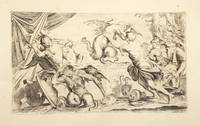
1663rif. 4850Rome: Da Gio. Giacomo de Rossi alla Pace al insegna di Parigi 1663. FIRST EDITION. Hardcover. Fine. Bound in modern quarter red morocco over marbled boards. A very good copy of the complete set of etchings. Some mostly mild soiling and staining a little heavier on two of the final plates and one small defect in plate 4 repaired. A complete set of etchings after the parietal frescoes in Palazzo Fava Bologna painted by the Carracci ca. 1593 depicting the story of Aeneas. The set comprises a title page 12 etched plates numbered from I to XII with the scenes of the cycle; and 4 additional sheets with 2 etchings per sheet reproducing the trompe l'oeil grisaille "statues" that divide the scenes. The title leaf includes the dedication to Lepoldo de Médici 1617-1675 with the Medici arms. The frescoes illustrating scenes from Books II and III of the "Aeneid" were etched by Giuseppe Maria Mitelli after drawings made by Flaminio Torri whose untimely death had prevented him from executing the plates himself. At the foot of the plates Mitelli attributes the individual scenes to one or another of the Carracci Annibale Agostino or Ludovico but these individual attributions do not always correspond to the conclusions of the most recent criticism. According to the Carracci biographer Carlo Cesare Malvasia "Felsina pittrice 1678 the frescoes were executed under the direction of Ludovico with at least two scenes Polyphemus and the Harpies being drawn by Ludovico and painted by Annibale. The Carracci - Annibale 1560-1609 his brother Agostino 1557-1602 and their cousin Ludovico 1555-1619- are among the most famous Bolognese painters of the last two decades of the sixteenth and the first part of the seventeenth centuries. Their artistic production took on a new importance in the history of Italian and European art of that time exerting a huge influence on subsequent generations. They gave life to an art based on a renewed awareness of nature and on the careful study of reality contributing to the development of the Baroque style which was opposed to the artificiality of late Mannerism. Towards the end of the sixteenth century the Carracci founded what has been called the first private school of painting of the modern age: the Accademia degli Incamminati. Annibale certainly the most talented of the three would be called to Rome to work for the powerful Farnese family while Ludovico and Agostino remained rooted in Bologna. But it is in Palazzo Fava that their "avvenetura" begins. Here the Carracci executed their first commission and the first important fresco cycle of their career. In 1584 thanks also to the intercession of Antonio Carracci father of Annibale and Agostino and tailor of the Fava family Count Filippo Fava entrusted the decoration of the entire "piano nobile" of the building to young artists who immediately gave proved their talent by creating an absolute jewel of Bolognese and Italian art. Thanks to the Fava family a family of patrons who played a fundamental role in the history and artistic development of Bologna Palazzo Fava became a place of study for the young artists of the time who were able to take advantage of mobile scaffolding to closely observe the adventures represented in the friezes of the cycle: those of Jason and Medea and in those of Aeneas the latter of which is reproduced here. https://genusbononiaeblog.it/i-carracci-palazzo-fava/ The engraver Giuseppe Maria Mitelli was renowned for the familiar playful carnivalesque and visionary themes of his etchings exemplified by allegorical figures genre scenes and images of everyday life in the streets of his native Bologna. He produced a large and varied body of work from genre scenes and fantastic imagery to reproductions of the works of the great Italian painters such as this suite. Mitelli was among the founders of Bologna's Accademia Clementina and was one of its first directors. For a full biography see "Agostino e Giuseppe Maria Mitelli" in Arte antica e moderna 3 1958 pp. 295-301. Da Gio. Giacomo de Rossi alla Pace al insegna di Parigi hardcover
33 cm, ril. editoriale, sovracop. illustrata, p. 87, 40 tavole a colori f.t
In-4 (cm. 32.90), cartonato editoriale, sovracoperta editoriale illustrata, pp. 87, (1), con illustrazioni a colori nel testo applicate alla pagina. In ottimo stato (nice copy).
Bologna, Credito Romagnolo1972, 8vo punto metallico con copertina illustrata a colori, pp. (64) completamente illustrato da tavole a colori.
Mm 170x240 Brossura editoriale, pagine 64, ricco apparato iconografico a colori. Opera in buone condizioni. Spedizione in 24 ore dalla conferma dell'ordine.
17x24 cm., ca. 72 pp. n.n., numerose ill. a col., bross. edit., cop. ill. a col., ottimo stato. 850
Terza edizione. In 4°; pp. 87 con molte immagini a colori nel testo; cartonato editoriale con titoli al piatto e sovraccoperta illustrata; cucito. CONDIZIONI OTTIME.
Mm 175x245 Collana "Biblioteca di Storia dell'Arte" - Testo a cura di Andrea De Marchi, traduzione di Guenter Schwabe e Gemma Buonanno. Volume in copertina rigida con sovraccoperta, 720 pagine con 499 figure in nero nel testo. Opera in ottime condizioni. Spedizione in 24 ore dalla conferma dell'ordine.
Book is in excellent condition. Binding is solid and square, oversize format in bright orange heavy cloth with gilt letting at cover and spine. Covers have sharp corners, exterior shows no blemishes, text/interior is clean and free of marking of any kind. Dust jacket shows moderate wear with chipping at top spine, two very small tears and one 1" closed tear near spine. 244 illustrations, including 190 full page plates in full color, with descriptions/commentary at end of book. Plates are impressively large and from the collection of Italian paintings in the Leningrad Hermitage. Artists include Simone Martini, Campigli, Morandi, Guttuso, Leonardo da Vinci, Raphael, Giorgione, Tintoretto, Titian, Veronese, Carracci, Tiepolo, Guardi, Canaletto, 307 pp.
Mm 175x250 Volume in piena tela privo della sopracoperta, titolo impresso al piatto e al dorso. 237 pp. con 200 illustrazioni in nero nel testo e due tavole a colori f. t. Libro in ottimo stato complessivo, spedizione in 24 ore dalla conferma dell'ordine.
Mm165x265 Collana "Biblioteca di Storia dell'Arte" - Volume rilegato in tela, una sovraccoperta figurata ed una trasparente, xliv-533 pagine con 318 figure in nero nel testo. Ottima copia ovvero poco o mai frequentata; spedizione in 24 ore dalla conferma dell'ordine.
per li Manolessi, In Bologna, 1672. In 4°, 22 cm, rilegatura coeva in piena pergamena, dorso a cinque nervi, titolo in oro su tassello. p. (24), 406, (2) Volume riccamente illustrato, prima antiporta architettonico a tutta pagina con porticato ornato dalle insegne alle armi del decicatario, il cardinale Francesco Barberini (stemma con tre api) e stemma degli accademici Gelati con il motto "Nec longum tempus", sullo sfondo la città di Bologna in lontananza ed una selva di alberi spogli ricoperti dal gelo (simbolo degli Accademici Gelati). Ritratto del cardinale Barberini, inciso da Hubert van Otteren al retro del frontespizio. Secondo frontespizio calcografico con impresa dell'Accademia dei Gelati incisa da Lorenzo Tinti su disegno di Agostino Carracci. 31 ritratti e 71 stemmi con le "imprese" degli accademici gelati a cui è sempre accompagnato un motto ed un aggettivo attribuito all'accademico rappresentato; La pubblicazione è a cura di Giovambattista Capponi, il cui nome figura nella dedicatoria e firma l'introduzuine come "animosissimo segretario". Testo entro doppia conrice, testatine incise su rame, capilettera, fregi e finalini xilografici in cui sono ricorrenti le iconografie del dedicatario e degli accademici (le api ed i rami "gelati"). Antico restauro al dorso sotto al tassello ed al margine della pagina 105-106. Le prime quattro carte leggermente brunite e qualche sporadico alone, ma pagine per lo più bianche ed in ottimo stato. Alcuni errori di impaginazione carattestici dell'edizione. Bell'esemplare completo in tutte le sue parti, con incisioni fresche e nitide.
In folio (cm. 53 x 37), rilegatura inizio '800 in mezza pelle con titolo e fregi in oro al dorso; p. 117, incisione del chostro al frontespizio, una tav. inserita (dedica al prof, Francesco Rizzoli) seguono 47 tavole a piena pagina disegnate da vari artisti e incise solo sul recto da Fabbri che riproducono il ciclo pittorico realizzato da Ludovico Carracci e dai pittori della sua scuola sulle pareti del chiostro ottagonale di S. Michele in Bosco; 39 grandi capilettera e 33 testate e finalini animati, finemente incisi da Pio Panfili. Bello e fresco esemplare.
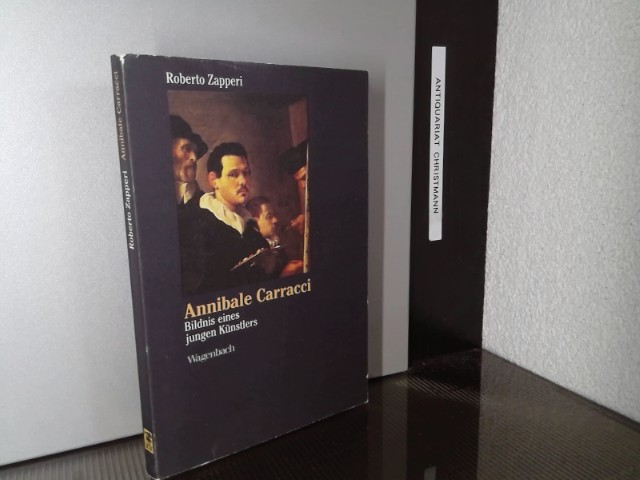
1990rif. 41039Berlin : Wagenbach 1990. 156 S. ; 22 cm engl., Softcover/Paperback, Exemplar in gutem Erhaltungszustand
1971rif. 1987554Phaidon Press 1971. First Edition. hardcover. Used-Very Good. Cloth dj. Two-volume set. 4to. Vol. 1: Text xiv 183 pp. Light general edge wear to dj and boards a bit heavier at spine ends. Vol. 2: Catalogue and Plates 351 pp. 346 b&w plates 10 color plates 121 figs. Moderate edge wear to dj with some chipping at spine ends and bottom corners; minor edge wear to boards. Expected age-toning to text blocks but text and images remain clean and bright. Phaidon Press unknown