MIRO, Joan; TZARA, TristanBiblio.com

2659 resultados
ref. 118369Paris Maeght Editeur 1950. . Limited edition number 18 of 20 copies on Montval from a total edition of 253 signed by the author and illustrator; folio 37.5 x 28 cm; half-title 72 lithographed illustrations many full-page printed in black and colour by Joan Miro with an additional aquatint and lithographed plate heightened with crayon signed and dated 12 June 1950; original upper wrapper bound in collage of coloured paper and newsprint with lithographed design by Miro; binding signed and dated by Georges Leroux 1962 full beige calf covers decorated with elaborate title composed of onlaid coloured calf over 4 strips of inlaid black calf spine with names of artist and author onlaid in mottled calf gilt edges straw-weave doublures and endpapers calf-backed chemise and slipcase both with lithographed designs by Miro on covers a fine copy. Limited edition number 18 of 20 copies signed by the author and illustrator From the edition de tête with an additional lithograph heightened and signed by the artist. Tzara composed these poems without punctuation or capitalisation in 1945 at the psychiatric hospital of Saint-Alban at the invitation of Dr. Lucien Bonnafé. Miro's early books published before the war were sparsely illustrated and so this is considered his first significant artist's book. It also represents the artist's first publishing project in collaboration with Maeght. This copy is one of only 20 examples on velin de Montval. The additional plate has been considerably heightened by Miro in crayon and signed and dated using a mixture of colours. Combined with the exquisite binding by Leroux this is a superlative example of Miro's Parler Seul. Paris, Maeght Editeur, 1950. unknown
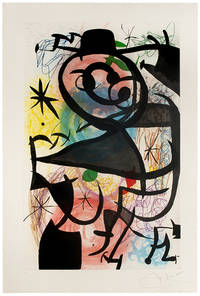
ref. 1152901974 . Etching with aquatint in colours 1974 on Arches paper signed in pencil and numbered 48/50 from the edition of 50 printed by Morsang Paris published by Maeght Paris with full margins sheet: 1378 x 965 mm. 54¼ x 38 in. The title of this work translates as 'The Pink Clown' and portrays a captivating abstract figure centred in the composition and brought to life through bold black lines. The figure is playful and full of movement reaching out towards the edges of the sheet. Crowned with a whimsical hat the figure is formed of vigorous linework that conveys its energetic and spirited nature. Unlike Miró's typical vibrant colour palette this print is dominated by a soft pink wash lending it a dreamlike atmosphere. Surrounding the central figure are unexpected stars and spontaneous scribbles heightening the image's sense of dreamlike fantasy. A work full of energy 'Le Pitre Rose' captures Miró's distinctive ability to evoke emotion and whimsy through simple yet dynamic forms and colours. Dupin 653 1974 unknown
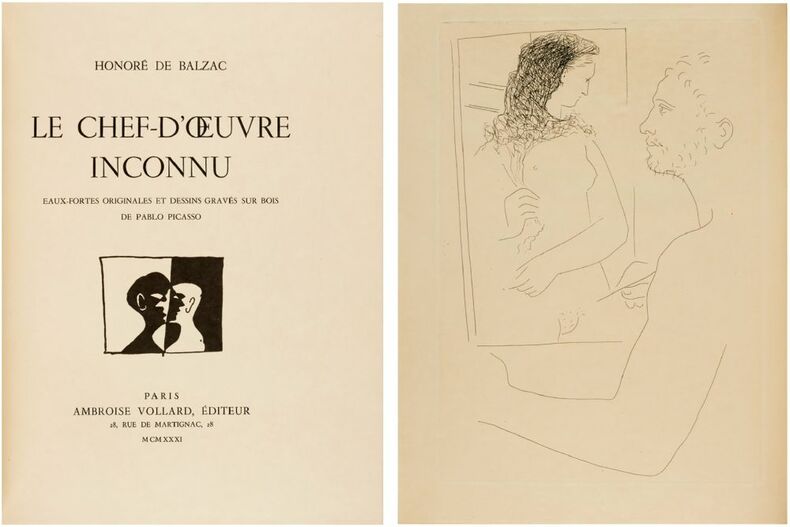
1931ref. 3114Paris, Ambroise Vollard Éditeur, 1931. Un volume in-4 (32 x 24 cm). Remarquable reliure "sculptéee de Paul Bonet en plein box bleu nuit et décor polychome en relief, chemise et étui (signée et datée de 1944). - 12 EAUX-FORTES ORIGINALES EN HORS-TEXTE et 1 EAU-FORTE pour la "table des eaux-fortes" GRAVÉES PAR PABLO PICASSO. - UNE SUITE COMPLÈTE DES 12 GRAVURES HORS-TEXTE SUR VÉLIN DE RIVES. - Dessins de l'artiste gravés sur bois par Georges Aubert et tirés en in-texte. Une "préface" de 16 pages de dessins composés de points et de traits dessinés par Picasso en 1924 également gravés sur bois par Aubert. Tirage : 340 exemplaires (65 Japon + 240 vélin de Rives + 35 H.C.). Celui-ci 1 DES 65 EXEMPLAIRES SUR JAPON IMPÉRIAL, LES SEULS SIGNÉS AU PINCEAU PAR PICASSO et monogramés à la plume par Vollard, avec UNE SUITE COMPLÈTE DES 12 GRAVURES HORS-TEXTE SUR VÉLIN DE RIVES. - Dans une extraordinaire reliure "sculptée" de Paul Bonet, datée 1944 : "box bleu corbeau, un grand caisson ovale occupe presque chaque plat, encadrant un grand motif abstrait sculpté et couvert de veau de différentes couleurs vives" (Carnets, n°692), couverture conservée, chemise, étui. Bonet n'a réalisé qu'une poignée de ces fameuses reliures sculptées qui sont très recherchées. Celle-ci étant l'une des plus réussies et des plus élégantes. —— ENGLISH DESCRIPTION: Paris, Ambroise Vollard Éditeur, 1931. Illustrated with 12 original etchings by Pablo Picasso (and 1 for the plate "Table des eaux-fortes") and numerous woodcuts by G. Aubert after the drawings by Picasso. One of 65 NUMBERED ON JAPAN PAPER SIGNED BY PICASSO AND VOLLARD with an EXTRA SUITE of the 12 original etchings on Rives paper. Only the 65 numbered on japan paper are signed by Picasso and Vollard. Mint condition. Outstanding "sculptural" binding by Paul Bonet, dated 1944: "raven blue box, a large oval box occupies almost each cover, framing a large abstract motif carved and covered with calfskin in different bright colors" (Carnets, n°692), cover preserved, folder, case.
1959ref. 18109New York: Pierre Matisse 1959. FIRST EDITION. Complete with 22 pochoir reproductions after gouaches by the artist on Arches wove paper with the title page text in French by André Breton table of contents and justification signed by the artist in blue ink and the author in red ink. Complete with 2 original lithographs sheet size 17 ½ x 14” image: 12 x 9 3/4” hand-numbered and signed by Miró in pencil at lower margin each framed. The pochoirs are laid into their original paper folders all in the original illustrated portfolio housed in its beige linen box illustrated in black by Miró on front cover and spine; box has been repaired. First edition of this luxurious publication. No. 109 of 150 copies which include the 2 signed and numbered lithographs the total edition was 384. Miró began the series of gouaches reproduced in Constellations on September 21 1940 in Varengeuville Normandy where he was exiled from Francoist Spain. He created ten of the gouaches before the invasion of France by German troops pushed him to flee the country with his wife and daughter. He completed the twenty-third and final gouache of the series on September 12 1941. The village where he stayed was subject to a blackout and that fact prompted Miro's most luminous and affecting series of paintings the Constellations. Miró was originally in discussions with MoMA to exhibit Constellations but it was ultimately with the New York gallery owner Pierre Matisse that the complete series of 22 gouaches would be exhibited Miró having wished to keep the twenty-third in early 1945. It was not until 1959 when Matisse decided to publish reproductions. André Breton had been inspired by the series and wrote poems to accompany each work of art. Of the 384 copies produced only the first 150 included the 2 additional signed and numbered lithographs. In his preface to this edition Breton emphasized the historical significance. With the background of war and the occupation of France these works symbolized the triumphal “resistance” of art and the spirit of man in the face of the menace. They became the first new works from Europe to be exhibited in America following the ending of hostilities. The 22 works are arranged in the chronological order of their creation thus respecting one of the instructions given by the artist at the time of the New York exhibition. This arrangement was so important to Miró that as early as 1957 he insisted that each one indicate the date and place it was created. This information is reproduced on the back of the gouaches with a facsimile drawing. Pierre Matisse unknown
1959ref. 18109New York: Pierre Matisse 1959. FIRST EDITION. Complete with 22 pochoir reproductions after gouaches by the artist on Arches wove paper with the title page text in French by André Breton table of contents and justification signed by the artist in blue ink and the author in red ink. Complete with 2 original lithographs sheet size 17 ½ x 14” image: 12 x 9 3/4” hand-numbered and signed by Miró in pencil at lower margin each framed. The pochoirs are laid into their original paper folders all in the original illustrated portfolio housed in its beige linen box illustrated in black by Miró on front cover and spine; box has been repaired. First edition of this luxurious publication. No. 109 of 150 copies which include the 2 signed and numbered lithographs the total edition was 384. Miró began the series of gouaches reproduced in Constellations on September 21 1940 in Varengeuville Normandy where he was exiled from Francoist Spain. He created ten of the gouaches before the invasion of France by German troops pushed him to flee the country with his wife and daughter. He completed the twenty-third and final gouache of the series on September 12 1941. The village where he stayed was subject to a blackout and that fact prompted Miro's most luminous and affecting series of paintings the Constellations. Miró was originally in discussions with MoMA to exhibit Constellations but it was ultimately with the New York gallery owner Pierre Matisse that the complete series of 22 gouaches would be exhibited Miró having wished to keep the twenty-third in early 1945. It was not until 1959 when Matisse decided to publish reproductions. André Breton had been inspired by the series and wrote poems to accompany each work of art. Of the 384 copies produced only the first 150 included the 2 additional signed and numbered lithographs. In his preface to this edition Breton emphasized the historical significance. With the background of war and the occupation of France these works symbolized the triumphal “resistance” of art and the spirit of man in the face of the menace. They became the first new works from Europe to be exhibited in America following the ending of hostilities. The 22 works are arranged in the chronological order of their creation thus respecting one of the instructions given by the artist at the time of the New York exhibition. This arrangement was so important to Miró that as early as 1957 he insisted that each one indicate the date and place it was created. This information is reproduced on the back of the gouaches with a facsimile drawing. Pierre Matisse unknown books
ref. 1152861974 . Etching and aquatint in colours 1974 on Arches wove paper signed in pencil and numbered 49/50 from the edition of 50 printed by Morsang Paris published by Maeght Paris sheet: 1392 x 960 mm. 54 x 37 in. 'La Femme Toupie' bursts with vibrant splashes of bright green yellow and orange. Created in 1974 this print is part of a series of 60 that Miró made between 1974 and 1975 using a combination of etching and aquatint. Central to the composition is the figure of a woman outlined in thick black lines. While abstracted in Miró's signature style her large black eyes nose and red mouth emerge distinctly. She raises her arms high and kicks one leg out spinning with joyful motion. Stars crown her head while swirling grey and orange washes behind her head enhance the print's sense of dynamic movement. A playful and evocative print it conveys both spontaneity and a deep emotional resonance. Dupin 652 1974 unknown
1967ref. 3152Paris, Tériade Éditeur, 1967. Un volume in-folio (450 x 345 mm) en feuilles sous couverture imprimée rempliée, chemise titrée or et étui de l'éditeur recouverts de toile écrue. - 38 LITHOGRAPHIES ORIGINALES DE MARC CHAGALL : 15 EN COULEURS DONT 3 À DOUBLE PAGE (450 x 687 mm) ET 18 EN NOIR. Toutes les lithographies sont en hors-texte et ont été tirées sur les presses de Fernand Mourlot. Tirage : 250 exemplaires + 20 exemplaires HC. Celui-ci est un exemplaire de collaborateur, il n'est donc ni numéroté ni signé. - Note historique et bibliophilique : Le sujet du cirque est l’un des thèmes les plus importants dans l’œuvre de Marc Chagall. Cette fascination remonte à l'enfance, quand il vit à Vitebsk une petite troupe itinérante exécuter quelques acrobaties maladroites devant un public indifférent : cette triste performance était-elle le destin de toute vie d’artiste ? C’est Ambroise Vollard, lui-même très amateur de cirque, qui incita Chagall à développer ce thème, mais c’est Tériade, qui après la mort de Vollard, le convainquit de travailler à un livre illustré de lithographies. Accompagné de textes de l’artiste, CIRQUE est certainement la meilleure réalisation lithographique de Chagall avec Daphnis & Chloé paru en 1961 chez le même éditeur, "sans aucun doute le plus personnel de tous ses livres, le plus exceptionnel aussi par l'intensité du trait et des couleurs, mais aussi par l'harmonie qu'il crée entre texte et peinture, enfin par le caractère même et la qualité de l'écriture" (Hommage à Tériade, Grand Palais, 1973). - ENGLISH DESCRIPTION: MARC CHAGALL (1887-1985) : CIRQUE, Tériade Editeur, Paris, 1967 (book/ portfolio). The complete set of 38 lithographs (23 lithographs in colors and 15 lithographs in black), on Arches paper, all hors-texte, title page, text in French and justification. This copy on Arches paper, from a collaborateur, it is not numbered and not signed, of the 270. The colors fresh, the full sheets, loose (as issued), in mint condition, within original paper wrapper, beige cloth-covered boards with title stamped in gilt on spine and matching slipcase 17 3/4 x 13 1/2 in. (450 x 345 mm.) References: Mourlot 490-527; Cramer books 68.
ref. 1152921974 . Etching and aquatint in colours 1974 on Arches wove paper with the Maeght watermark signed in pencil and numbered from the edition of 50 printed by Morsang Paris published by Maeght Paris with full margins sheet: 1405 x 945 mm. 55¼ x 37¼ in. 'Le Somnambule' is a whimsical and energetic portrayal of Miró's signature symbols and motifs. The title suggests being in a dreamlike state hinting at the artist's fascination with exploring and expressing the subconscious mind in his art. Depicted in the composition is a dynamic combination of floating visual elements layered to create a sense of depth and movement. Subtle colour accents along with vigorous linework give the piece a playful spontaneity. Unexpected bursts of red orange and blue spots surround the central abstracted form hinting at a startled mask with wide eyes. Dominated by dark hues the print allows subtle areas of white to shine through the background enhancing the image's overall dreamlike quality. Dupin 656 1974 unknown
Paris: Editions de la Revue Verve, 1940. In-folio - Reliure editeur à la bradel en Velin - Volume 2 : N° 5/6 - Consacrée à la figure humaine - Couverture illustrée en couleurs par Aristide MAILLOL - Textes de J. PAULHAN, J. SUPERVIIELLE, J. GRENIER, A. JARRY, M. JOUHANDEAU, J. GIRAUDOUX, ALAIN, G. ROUAULT, A. SUARES, etc.. - Peintures en quadrichromie par MARINUS, RUBENS, CORNEILLE de Lyon, COROT, etc, - Enluminures (Héliogravure couleurs & or) St-Grégoire-le-Grand, Les Echecs Amoureux, Les Dames de Renom de Boccac, les Fouquet de Chantill, livre d'Heures d'Etienne, chevalier, XV è siècle - Lithographies de Constantin GUYS, G. BRAQUE, G. ROUAULT, A. DERAIN, F. LEGER, P. BONNARD, H. MATISSE, P. KLEE - Dessins, Peintures, Scultures de GOYA, MIRO, A. GIACOMETTI, etc.. - Photographies en Héliogravure par DISDERI, H. LIST, EGER-TERMET, BRASAI, etc..- 181 pages. N° 7 - Les très riches Heures du duc de Berry 12 enluminures, reproduction très fidèle de l’intégrale du calendrier. N° 8 - couverture illustrée de MATISSE - Texte de REVERDY, J. GIRAUDOUX, A. MONNIER, A. MALRAUX, etc - Peintures de MATISSE, MIRO, etc - Calendriers de Charles d'ANGOULEME, André DERAIN TRES BEL EXEMPLAIRE