DUPIN (Jacques).Livre Rare Book

1984rif. 0045601984 Paris, Daniel Lelong, 1984-2001. Quatre volumes grand in-quarto (259 X 329 mm) toile bleu marine, titre sur le premier plat et au dos en blanc, jaquette papier couleurs à rabats, étui carton muet pour le quatrième et dernier tome. Petite déchirure en tête du dos de la jaquette du tome III, consolidée au scotch blanc, rousseurs très claires sur les contreplats des tomes II et III.
rif. 37881catalogue de l'exposition présentée à New-York à la galerie Pierre Matisse du 17 novembre au 19 décembre 1981 - un volume (21x26,7 cm), impression sens dessus-dessous, 44 pages - 2 planches en couleurs contrecollées et 22 pages consacrées à chacun des deux artistes illustrées dans et hors-texte en noir - bon état -
1963rif. 20587ABZch., Conzett & Huber, 1963. 4°. 80 S. OKt.
1990rif. 203636Couverture souple. Broché. 48 pages.
rif. B9781350345409Paperback / softback. New. Over 60 years on from its inception the celebrated Fun Palace civic project – developed in the 1960s by the radical theatre director Joan Littlewood and the architect Cedric Price – continues to capture the architectural imagination. Despite the building itself never being realized much of the previous analysis of the Fun Palace has been devoted to Price and his drawings. The critical role that Littlewood played however remains largely unrecognized by architectural scholarship and a whole area of the project’s cultural agenda remains overlooked. Architecture Media Archives is the first serious study of the complex relations between Littlewood and Price reframing the Fun Palace as an extended media project and positioning Littlewood more clearly as co-designer. Drawing on extensive archival material the book considers how due to a lack of institutional support the aims of the Fun Palace – to transform the passive mass-audiences of post-war consumer society into active citizens through forms of self-directed pleasure-led and open exchange – were realized through different ‘sites of information’ throughout the 1960s. From broadsheets pamphlets and journals to films and press news the book addresses the conditions of production circulation storage and reception of these ‘sites’ and reveals how they not only recorded the transformation of the project but also fundamentally enhanced and informed its meaning in specific ways. The book also raises important questions about the agency of the Fun Palace archive in shaping the reception of the project in the decades since its inception presenting its analysis through a novel ‘Fun Palace Reception Index and Chart’ fundamentally altering our view of the project itself and transforming the way in which we understand the technological and cultural production of the 1960s. paperback
rif. 50939960like new. unknown
rif. A9781350345362Hardback. New. hardcover
1952Pieghevole (cm 16,5 x 12,5) con foto in b/n di Miro' mentre osserva un suo quadro, ill. in b/n a doppia pagina. Testo di presentazione di Gillo Dorfles, pittore e filosofo fra i fondatori del MAC (Movimento per l'Arte Concreta), alla mostra di Miro' del 1952 alla galleria dello Zodiaco di Roma. Dalla presentazione di Dorfles: 'Oggi, dopo la morte di Klee, Joan Miro' rappresenta forse la personalita' piu' viva e attuale nella pittura europea. Proprio perche' la sua arte, nutrita di tutte le esperienze dell'ultimo cinquantennio, e' a sua volta la progenitrice di nuove forme artistiche proiettate verso il futuro'.
1946rif. 7044Paris, imprimerie Henry Maillet, 1946. In-4 en feuilles de [4]-64 pages sous chemise à rabats imprimée en vert.
1961rif. 11604The Atlantic Monthly. Boston. 1961. First Edition. 1961 Usual Atlantic format and size of about 8 by 11 inches but a special issue featuring Spain and containing some 160 pages. Color front cover by Joan Miro Courtesy of Ernest Hemingway. Pre-publication excerpt from the new J P Donleavy book 'A Fairy Tale of New York'. And other articles stories poems by Charles W Morton Margaret C Hubbard Jeannette Nichols F D De Castro and others. And a 60 page section on Spanish essays poems and art. Exceptional issue. Very light wear; half inch closed tear on front cover fore-edge; tiny wear at spine top/bottom. NEAR FINE Language: eng Language: eng 0.0 Language: eng Language: eng Language: eng. 1st Edition. Soft cover. Near Fine/No Jacket. The Atlantic Monthly. Boston. 1961. First Edition. paperback
rif. EXE-836Paris, Maeght Éditeur, 1960. In-folio en feuilles, couverture illustrée. Illustrée d’une zincographie en couleur de Pierre Tal Coat (pp.34-35) et de 8 lithographies en couleur, 2 en noir, et 2 reproductions de tableaux.
rif. EXE-840Paris, Maeght Éditeur, 1964. In-folio en feuilles, chemise et étui de l’édition. Illustré d’une zincographie en couleur de Pierre Tal Coat, et 4 lithographies. Tirage à 350 exemplaires sur vélin de Rives, CELUI-CI LE NUMÉRO 160, COMPRENANT L’EAU-FORTE TROIS OISEAUX SUR FOND VIOLET DE GEORGES BRAQUE.
1944rif. 3117Paris, Robert-J. Godet, 1944. Un volume in-4 (280 x 190 mm), 62 pages, broché, couverture rempliée. Édition originale. Exemplaire n° 74 sur vélin pur fil de Lafuma. 1 feuillet volant (287 x 194 mm) avec l'eau-forte originale (245 x 131 mm) signée et datée inversement sur le cuivre : "Picasso 23.D.43". 1 des 200 épreuves sur vélin Lafuma. (Atelier Lacourière pour le tirage de la gravure). Picasso grave en décembre 1943 la planche pour le recueil "Contrée" dédié à Youki qui partageait la vie du poète depuis 1930. L'ouvrage, achevé d'imprimer le 31 Mai 1944, a paru après l'arrestation de Robert Desnos par la Gestapo survenue le 22 février. Desnos mourra en déportation le 8 juin 1945 au camp de Térézine en Tchécoslovaquie. Exceptionnelle gravure "surréaliste" de Picasso. L'artiste combine procédés cubistes (l'architecture est identique à la 3ème planche de Saint-Matorel - 1911) et surréalistes avec des réminiscences de gravures précédentes (voir le buste pour l'Anthologie de l'Humour Noir de Breton - 1938-1940)… Réferences : Baer-Geiser 689; Bloch 362; Cramer 39. - ENGLISH DESCRIPTION : - First edition, first printing. 1 loose leaf (287 x 194 mm) with the original etching "Femme assise" (245 x 131 mm) signed and dated on the copper: "Picasso 23.D.43". 1 of 200 proofs on Lafuma vellum (n° 74). (Atelier Lacourière for the printing of the engraving). Historical notice: Picasso engraved this plate in December 1943 for the collection "Contrée" dedicated to Youki who shared the life of the poet since 1930. The work, printed on May 31, 1944, was published after the arrest of Robert Desnos by the Gestapo occurred on February 22. Desnos died in deportation on June 8, 1945 at the Terezine camp in Czechoslovakia. Exceptional "surrealist" etching by Picasso. The artist combines here cubist (the architecture is identical to the 3rd plate of Saint-Matorel - 1911) and surrealist processes with reminiscences of previous engravings (see the bust for the Anthologie de l'Humour Noir de Breton - 1938-1940 )… - Edition: Paris, Robert-J. Godet, 1944. A 4° volume (280 x 190 mm), 62 pages, paperback, folded cover, (n°183 on pur fil Lafuma wove paper). References: Baer-Geiser 689; Block 362; Cramer 39. More pictures on request. Right mouse click for a full screen picture. In mint condition.
1957rif. 1839Louis Broder, Paris 1957. Collection "Miroir du poète" n° VI. Un volume in-12 carré (167 x 136 mm), en feuilles, 42 pages, sous couverture de papier japon à rabats titrée en rouge sur le premier plat. Chemise et étui de l'éditeur noir et gris titré en rouge sur le dos. Édition originale de ce recueil de 7 poèmes de Robert Desnos inédits en volume. 4 GRAVURES ORIGINALES À L'EAU-FORTE ET AQUATINTE EN COULEURS (150 x 120 mm). La typographie est dûe à l'imprimerie Union et le tirage de la gravure à Robert Dutrou. Édition : 120 exemplaires numérotés sur vélin de Rives BFK. Celui-ci, l'exemplaire n°2 est signé par André Masson au colophon. Il comporte UNE SUITE COMPLÈTE DES GRAVURES ET DE LA DÉCOMPOSITION DES COULEURS : chaque épreuve de l'état final est justifiée 5/7 et signée au crayon par l'artiste, chaque épreuve de la décomposition des couleurs est justifiée 5/7 et monogrammée au crayon par l'artiste. 16 planches signées au total. Sixième volume de la collection "Miroir du poète" qui en comporte 7. Un huitième volume prévu n'a jamais vu le jour, mais la maquette existe. Le volume en parfait état, l'emboîtage de même (Saphire-Cramer 42). ENGLISH : André Masson - Robert Desnos, : Mines de Rien, Collection Miroir du Poète VI, Louis Broder, Paris, 1957. 4 aquatints printed in colours, 1957, on BFK Rives, title, text, list of contents, justification and the set of four, the justification signed in pencil by André Masson. copy numbered on vélin de Rives paper, from the total edition of 130. This one, copy no. 2, includes A COMPLETE SUITE OF THE ENGRAVINGS AND DECOMPOSITION OF COLORS: each proof of the final state is justified 5/7 and signed in pencil by the artist, each proof of the decomposition of colors is justified 5/7 and monogrammed in pencil by the artist. There is 16 signed plates in total. The set is in mint++ condition in its original slipcase, perfect. overall S. 177 x 153mm. (Cramer 42).
rif. 36695Paris Maeght 1971. 4° 10 lose Doppelbl. pag. 31 S. 3 farb. Orig.-Lithogr. 1 auf Umschlag 1 doppelblattgross Brosch. m. losen Bl. Umschlag am Rücken min. knittrig u. gebräunt Bl. oft min. staubrandig allg. gutes Ex. Mit einem Text «ad Miro» von Pierre Alechinsky. 010 Paris, Maeght, 1971 unknown
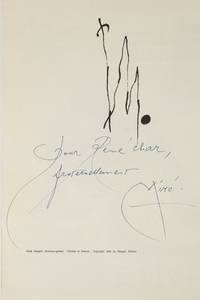
rif. 28433Paris Maeght Éd. Pierre à Feu n° 139-140 juin-juillet 1963. 1 vol. 280 x 380 mm de 28 p. En feuilles sous couverture illustrée en couleurs. . L’un des plus importants numéros de Derrière le miroir consacrés à Miró. 6 lithographies originales en couleurs dont 4 en double page 380 x 560 mm et 1 en 3 volets 380 x 830 mm ainsi que 3 reproductions en noir. Précieux exemplaire de René Char avec un envoi signé au recto de la couverture : « Pour René Char fraternellement Miró ». . Le lien entre Miró et Char trouve son origine dans l'entremise de Christian et Yvonne Zervos au sortir de la guerre. Leur première collaboration se fera pour l'édition de Fête des arbres et du chasseur en 1948 et la lithographie qui l'ouvre. Plusieurs PAB et GLM suivront jusqu'au point d'orgue de 1964 et l'édition chez Maeght du Flux de l'aimant avec dix-sept pointes-sèches. L'année précédente Aimé Maeght aura donné pour Derrière le miroir cette admirable livraison double d'été avec la célèbre lithographie en triple page placée en son centre. La chaleureuse et fraternelle dédicace de Miró à Char n'est pas une posture mais une sincère envolée d'un artiste vers le poète français avec lequel il aura le plus collaboré et marque un sincère témoignage de l'artiste vers le poète avec lequel il aura le plus collaboré. Plouvier souligne dans le Dictionnaire Char combien « l'irradiation de la vie inexprimable posée par Char au principe de sa création a trouvé en Miró l'équivalent de son espace ». Au même titre que Picasso Brauner Giacometti de Staël ou Braque Miró dans l'oeuvre de René Char est promu au titre quasi générique d' « allié substantiel ». Exceptionnelle et rare provenance. Paris, Maeght, Éd. Pierre à Feu, n° 139-140, juin-juillet 1963. 1 vol. (280 x 380 mm) de 28 p. En feuilles, sous couverture i unknown
1986rif. 19556Barcelona: Ed. Poligrafa. 1986. zahl. Abb. 293 S. Folio. 1. Ausgabe Leinen, Originalumschlag
rif. c6717Paris, Maeght, 1965 ; In-folio en feuilles, couverture illustrée en couleurs ( photographie) et 28pp.
1950rif. 52695ABParis, Galerie Maeght, Editions Pierre à Feu, mai - juin 1950. 38x28 cm. 8 p.n.ch., avec 2 lithographies originales en couleurs en double page.
1956rif. 17962ABParis. Editions Pierre à Feu, A. Maeght, Editeur. Juin-Juillet-Août 1956. Folio. 20 p., 1 f. "chronique". Avec 6 lithographies originales en couleurs (dont 3 en double page), 1 lithographie en noir, 1 photographie en noir de Sabine Weiss (en double page) et 2 de Ernst Scheidegger. Broché.
1960rif. 91440Paris Maeght, N° spécial de la revue "Derrière le miroir", n° 119 1960 1 vol. Broché in-folio, en feuilles, sous couverture illustrée d'une lithographie en couleurs de Raoul Ubac, 36 p. avec 12 lithographies de Braque, Chagall, Léger, Kandinsky, Miro, Giacometti, Ubac, Bazaine, Chillida, Palazuelo, Tal-Coat et Fiedler. Textes de René Char, Blaise Cendrars, Pierre Volboudt, Joan Brossa, Raymond Queneau, Léna Leclercq, André Frénaud, Jean Tardieu, Miguel Hernandez, Jorge Guillen, André Du Bouchet et Jacques Dupin. Petites traces de colle à deux pages, sinon bonne condition.
1960rif. 91440Paris Maeght, N° spécial de la revue "Derrière le miroir", n° 119 1960 1 vol. Broché in-folio, en feuilles, sous couverture illustrée d'une lithographie en couleurs de Raoul Ubac, 36 p. avec 12 lithographies de Braque, Chagall, Léger, Kandinsky, Miro, Giacometti, Ubac, Bazaine, Chillida, Palazuelo, Tal-Coat et Fiedler. Textes de René Char, Blaise Cendrars, Pierre Volboudt, Joan Brossa, Raymond Queneau, Léna Leclercq, André Frénaud, Jean Tardieu, Miguel Hernandez, Jorge Guillen, André Du Bouchet et Jacques Dupin. Petites traces de colle à deux pages, sinon bonne condition.
1963rif. 28433Précieux exemplaire de René Char, dédicacé par Miró Paris, Maeght, Éd. Pierre à Feu, n° 139-140, juin-juillet 1963. 1 vol. (280 x 380 mm) de 28 p. En feuilles, sous couverture illustrée en couleurs. L’un des plus importants numéros de Derrière le miroir consacrés à Miró. 6 lithographies originales, en couleurs, dont 4 en double page (380 x 560 mm) et 1 en 3 volets (380 x 830 mm), ainsi que 3 reproductions en noir. Précieux exemplaire de René Char, avec un envoi signé au recto de la couverture : « Pour René Char, fraternellement, Miró ».
1977rif. h00936Leon Amiel 1977. First edition. Hardcover. Folio. 385 pp with two lithographs by Joan Miro. Black cloth. Near Fine in Very Good dust jacket. Slight shelfwear to boards. A few small tears to jacket extremities 1/2" chip to rear panel. Book design by Jacques Dopagne. Leon Amiel hardcover
1928rif. 2448Paris Edition Jeanne Bucher. 1928. Drawings in color by Joan Miró. 8 color pochoirs after drawings by Miró colored by Jean Saudé on Arches paper. 4to published in a folio of 14pp. One of the limited edition of 300. Enclosed in the ORIGINAL LINEN FOLIO in pearl grey background with black numbers and green sun. Interior lined with black paper. 11 5/8 x 10 5/8 x 5/8. Housed in a new black clam shell case. Signed and dedicated by Lise Hirtz to Jane de Margerie. RARE. Miro created one of the most imaginative books for children and far beyond its time. Joan Miró was studying art in Barcelona and moved to Paris in 1919 He was introduced to a surrealists group in 1924 by his neighbor Andre Masson who shared his studio. He found among these artists the inspiration necessary for his work. But it was his humor that dominated his creations especially the black humor of the surrealists. In August 1927 Paul Eluard sent Miro the poems by Lisa Hirtz born Ann - Marie Meyer a friend of Breton. She was married to Paul Deharme 1898-1934 one of the pioneers of Radio France. In October 1927 Miró completed the gouaches a part of which would be executed for the 8 plates of this book. Jeanne Bucher 1872-1946 completed the book in 1928. The artistic involvement of the editor was an integral part of the work of preserving the creation of the avant-garde. Lisa Hirtz published Une Petite Pie in Pierre Chareau's gallery where she had opened her bookstore in 1925. Her interest in children's books was inspired by her grandson Pierre. Eight gouaches were executed by Miro for the colored plates which were then colored by the pochoir process by Saudé. Edition is limited to 300 copies. On Arches. Ref: Jean Bucher Un Galerie d'avant garde 1925-1946 Skira 1994. Eluard and his Painter Friends. Sante George Pompideau 1992. Cramer. Joan Miró Catalogue Raisonné des Livres Illustrés no. 1. Johnson. Artists' Books in the Modern Era p. 98. Andel. Avant-Garde Page Design 1900-1950 p. 330. Éditions Jeanne Bucher hardcover books