21 452 résultats
réf. 9178New York: Dieu Donné Papermill Inc 2002. Limited Edition. Hardcover. Fine in Fine Slipcase. Limited Edition. Hardcover. An artist book with poems by Raphael Rubinstein. "Each book cover is a one-of-a-kind handmade paper collage created by the artist in the papermaking studio assisted by Susan Gosin and Mina Takahashi. The white cotton text paper and colored abaca chapter covers were handmade at Dieu Donne Papermill. The circles in the chapter covers were die-cut by hand. Carol Joyce bound the edition and slipcase each book in one of four colors of raw Indian silk to match the colored chapter covers. The text is letterpress printed in Avenir types by Ruth Lingen." from the colophon. OCLC finds 5 copies only Getty U.Minnesota U.Wisconsin U.Washington BNF; we find 2 additional copies at the Met and MoMA. Tight bright and unmarred. Collaged covers composed of hand-cut paper and string with translucent paper overlaid onto boards; contents variously letterpressed photo-copied and digitally printed with die-cut chapter covers and various inserts; matching slipcase in gold silk. 4to. np. Illus. color and b/w plates. Numbered limited edition this being 15 of 17 Artists Proofs in addition to the 30 of the Standard edition for a total of 47 copies. Dieu Donné Papermill, Inc hardcover books
1924réf. 25216Paris - La Renaissance du Livre éditeur 1924. Enorme in-8 relié à grande marges de 296 pages au format 20 x 4,5 x 15 cm. Magnifique reliure demi maroquin rouge, avec plats en papier marbré. Dos rond avec titre gravé et doré. Tête dorée. Livre glissé sous bel emboitâge. Intérieur parfait, à l'exception d'une petite restauration au filmoplast au bord de la page 53/54. Couvertures illustrées par Lorenzi et dos conservés. Magnifiques illustrations in et hors texte en couleurs et noir et blanc de Raphaël Kirchner, Chimot, Domergue, Jaquelux, Lorenzi, Robaudi, Bourdelle. Superbe ex-libris érotique gravé et signé, contrecollé au verso de la couverture. Tirage sur grand papier, non justifié. Superbe état, proche du parfait. Edition définitive en grande partie originale. Exemplaire unique, contenant une carte postale avec dédicace autographe de Félicien Champsaur, 2 dessins originaux à la plume sur calque, 33 dessins originaux à la plume, retouchés à la gouache, ayant servi à l'illustration de l'ouvrage, quelques-uns avec le monogramme de Raphaël Kirchner et un pastel de Bourdelle, signé, retouché aux crayons de couleur. De toute rareté.
réf. 13-1379Rome: Dominico de Rossi Jo. Jacobi Jo. Jacobi de Rubeis August 15 1693. Oblong folio. 46.5 x 69 cm. 18.25 x 27.25 inches page size. Suite of 12 engravings. Housed in a custom portfolio with painted boards leather spine large embossed leather label leather ties and leather corners by the celebrated Russian-American binder Alexandr Sasha Mosalov. OCLC Number: 504754030Set of 12 engravings of Raphael’s frescoes of scenes from the myth of Cupid also known as Eros and Psyche in the Villa Farnesina in Rome. Raphael’s paintings illustrate part of the story The Metamorphoses of Lucius Apuleius the only Latin novel to survive in its entirety. In this work Venus jealous of a beautiful mortal girl named Psyche sends Cupid on an errand to punish the girl. Cupid instead falls in love with Psyche and after a series of secrets betrayals and trials the lovers are reunited and Psyche is made immortal.The frescoes are painted on the vaults and ceiling above demilune reserves on the ground floor at the end of the entrance hall now known as the Loggia of Psyche. Images of leafy garlands of fruit accentuate the arches of the vaults also framing the classical images. The frescoes were commissioned by the Sienese banker Agostino Chigi called “magnifico” by his peers for his richly decorated villa and the elegant entertainments he hosted there. The paintings were recently restored and the Villa Farnesina is open to the public as a museum.Some foxing Rome: Dominico de Rossi, Jo. Jacobi (Jo. Jacobi de Rubeis), August 15, 1693 hardcover
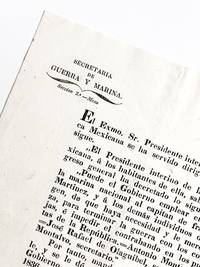
1836réf. 52758Mexico City: Palacio del Gobierno Nacional 1836. Fine. Official printed government notice of Mexico's continuing efforts to maintain control over Texas immediately after the loss at San Jacinto - here working with privateers to harass Texans at sea. When Mexico finally won its independence from Spain in 1821 its territory included modern-day Texas settled by a mix of Tejano Mexican and Texian Anglo-American populations in addition to indigenous tribes and enslaved African Americans. Tensions between the Tejano and Texian factions increased and finally erupted into full-scale violence in 1835 beginning what is now called the Texas Revolution. Its most famous battle at the Alamo occurred a few months before this broadside was issued. The decisive battle of the war San Jacinto occurred on 21 April a Mexican defeat that led to the formation of the Republic of Texas. While the Mexican general Santa Anna negotiated a surrender the Mexican government deposed him for it and refused to recognize an independent Texas. After San Jacinto Mexico avoided pitched battles but continued to take action to undermine and antagonize the new Texas nation. This broadside was one such effort issued just over a week after the defeat at San Jacinto. It announces the formal employment in the navy of private ships to aid in attacking Texans at sea and forming a blockade "para terminar la guerra con los colonos de Tejas é impedir el contrabando en los puertos y costas de la República". Privateers were necessary because the Mexican government did not yet have a robust navy a weakness that the United States would later exploit in the Mexican-American War of 1846-1848. Ephemeral broadsides like this survive in few numbers; many of this era during José Justo Corro's interim presidency show only two or three institutional holdings via OCLC. This particular imprint shows three institutional holdings in the US Baylor Texas A&M and Brigham Young. A rare piece of Texana. 12'' x 8.25''. Single letterpress broadside printed recto only. A bit of faint wrinkling. Crisp and bright. Palacio del Gobierno Nacional unknown
1836réf. 52758Mexico City: Palacio del Gobierno Nacional 1836. Fine. Official printed government notice of Mexico's continuing efforts to maintain control over Texas immediately after the loss at San Jacinto - here working with privateers to harass Texans at sea. When Mexico finally won its independence from Spain in 1821 its territory included modern-day Texas settled by a mix of Tejano Mexican and Texian Anglo-American populations in addition to indigenous tribes and enslaved African Americans. Tensions between the Tejano and Texian factions increased and finally erupted into full-scale violence in 1835 beginning what is now called the Texas Revolution. Its most famous battle at the Alamo occurred a few months before this broadside was issued. The decisive battle of the war San Jacinto occurred on 21 April a Mexican defeat that led to the formation of the Republic of Texas. While the Mexican general Santa Anna negotiated a surrender the Mexican government deposed him for it and refused to recognize an independent Texas. After San Jacinto Mexico avoided pitched battles but continued to take action to undermine and antagonize the new Texas nation. This broadside was one such effort issued just over a week after the defeat at San Jacinto. It announces the formal employment in the navy of private ships to aid in attacking Texans at sea and forming a blockade "para terminar la guerra con los colonos de Tejas é impedir el contrabando en los puertos y costas de la República". Privateers were necessary because the Mexican government did not yet have a robust navy a weakness that the United States would later exploit in the Mexican-American War of 1846-1848. Ephemeral broadsides like this survive in few numbers; many of this era during José Justo Corro's interim presidency show only two or three institutional holdings via OCLC. This particular imprint shows three institutional holdings in the US Baylor Texas A&M and Brigham Young. A rare piece of Texana. 12'' x 8.25''. Single letterpress broadside printed recto only. A bit of faint wrinkling. Crisp and bright. Palacio del Gobierno Nacional unknown books
1974réf. 13010FISCHER 06-07/1974. 1. softcover. 900 Großmütter FISCHER paperback
1594réf. B6281Venetiis Munich possib. Anvers: : Joann. and Raphael Sadeler c. 1594-1606. . An illustrated work in very good condition with plates clean and mostly wide margined; a few of the plates are reinforced with fine tissue paper; also occasional marginal tears repaired. Edition: First edition anthology of five works. Binding: 18th century full vellum; rebacked expertly saving the original spine; flat spine with gilt lettered and dated title on morocco label; edges marbled; renewed endpapers. Notes: Captions in Latin. The work depicts hermits saints with one of five parts devoted to female believers; this anthology is rarely offered. The members of the Sadeler family were among the most successful Flemish engravers and publishers of their time. Size: Oblong folio 335x263mm. Illustration: 103 copper-engravings; of these 102 illustrated; these include: three titles to the first three works; the paragramma with engraved border. The first work “SYLVA SACRA” being one complete series of hermetic saints with 31 illustrated plates plus a dedication; of the remaining four series of hermetic saints one is dedicated to female hermits: Work II or the “SOLITUDO SIVE VITAE FOEMINARUM” has 14 plates of 25; Work III or the “ORACULVM // ANACHORETICVM. // … MDC” has 22 plates of 26; Work IV or the “Solitudo // sive // vitae patrum // eremicolarum…” has 12 plates of 30; Work V or the “Trophaeum vitae solitariae. // … Venetiis” 1598 Martin de Vos figur. has 23 plates of 26. Volume: five works in one volume References: Graesse VI: 211-212. Pages: Ll: bl. ill.102ff. Collation: all of 31 ill. plus 1 dedication; 14 ill.; 22 ill.; 12 ill.; 23 ill. Category: Book Europe Italy; Book Europe Benelux; Book Europe Germany; Book Plate Books General; Book Religious Christianity; Book Early Printed 1500; Joann. and Raphael Sadeler, hardcover
réf. 542567Softcover. Near Fine. Typed carbon manuscript. Two volumes. Quartos. 393 leaves typed rectos only 1-196; 197-393 pp. Bound in quarter black canvas and flexible black wrappers with typed labels. Light edgewear very near fine. A collection of 16 stories which was published in 1946. On the contents page a title of a story is added in ink presumably by Sabatini and nearly every title has a penciled note as to where it was first published etc. in a different hand. In the typescript itself there are 42 revisions totaling some 57 words plus deletions on 29 pages numbered approximate – again all presumably by Sabatini; together with 10 typos corrected on 8 pages. The corrections and revisions are made in ink and red pencil. Sabatini’s stories are tales of bravery heroism intrigue and adventure. His manuscripts are exceptional uncommon. xxxcheck stories for any significancexxx. unknown books
réf. 7326Soyer Raphael. Soyer Raphael. CONVERSATION. Cole 21. Lithograph 1931-32. Hand colored in watercolor. 11 x 15 inches; 280 x 382 mm. with wide full margins. Edition of 25. Signed and titled in pencil lower margin and also further inscribed and signed in pencil. A very good impression of this scarce print with fresh colors. Although Cole does not mention that any of the prints of this edition were colored it was not unusual for Soyer to handcolor prints particularly a presentation print like this one. Rare and Fine. unknown
1622réf. 3515Augsburg: 1622-1631 1622. 17th-century sheepskin parchment sewn on 3 double cords with a hollow back each board with a border of double-blind fillets with 17th-century combed and curled marbled wrappers of both parts bound in preserved in a new cloth portfolio lined with Japanese paper in a matching half goatskin morocco slipcase. Small 4to. With 2 engraved title pages each with the title in a large scrollwork cartouche and the arms of the dedicatee Philipp Heinhofer or Hainhofer 50 numbered oval emblems in rectangles 8.5 x 12 cm in the first volume. The second volume has besides the engraved title page 23 wholly engraved leaves each with an emblem 9.5 x 10.5 cm with the German motto above a Latin distich below and below that a 4-line German verse. The emblem pages in both volumes are printed on the rectos only except for the colophon on the back of the last emblem in volume 1. Further with a large woodcut scrollwork tailpiece and woodcut roman and gothic decorated initials. In volume 1 the German texts are set in fraktur types and the Latin texts in roman types. The engraved German verses in volume 2 are in fraktur lettering. 2 volumes bound as 1. Beautiful German emblem book volume 1 with verses in German and Latin volume 2 in German with Latin distichs with large love emblems engraved by Raphael Custos 1590-1664 after the Amorum emblemata by Otto Vaenius 1556-1629 one of the most popular emblem books which went through various adaptations all over Europe. Custos dedicated the book on both title-pages to Philipp Heinhofer or Hainhofer 1578-1647 a leading Augsburg merchant adding a Latin and German dedication and a Latin and German preface in volume 1. In volume 1 Custos used Vaenius's Latin mottos and verses adding a German variant in 4 to 6 lines. The love-emblems appear in a large oval inside a rectangle. At the end of the first part the colophon states that the book was printed for publication by Custos by Luca Schultes in 1623.The second part published some 8 years later is entirely engraved with the love emblems occupying more than half of the plate and a German motto a Latin distich and verses in German. The plain endpapers have their chain lines unusually close together about 1.6 cm but one can see only the top of the watermark difficult to identify but topped by a small cross above a quatrefoil.With a tear running into the text of 1 engraved leaf some other marginal tears and somewhat thumbed but otherwise in good condition. The sewing is loose with 1 bifolium nearly detached the parchment has wormholes and tears and lacks its ties. An Augsburg love emblem book with 73 engraved emblems.l Landwehr German emblem books 217-218; Praz p. 525; USTC 2528015 7 copies only first part; VD17 23:247454Q first part. 1622-1631, hardcover
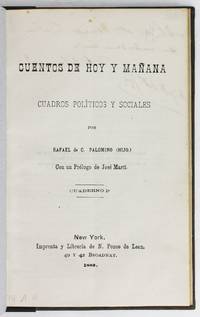
1883réf. 4665New York: Imprenta y Libreria de N. Ponce de Leon 1883. Very good. vii53pp. Modern quarter calf and marbled boards spine gilt. Inscribed by the author on verso of title page. Manuscript pencil numbering to top corner of each page. Minor foxing. One of the most important and intriguing 19th century Cuban-American imprints featuring two Socialist 'morality tales' that while lauding the quest for social and economic equally also decry the risks posed by human nature and totalitarianism upon the practical application of Marxism. It was written by the prominent Cuban émigré Rafael de Castro Palomino and features a famous prologue by his close friend and colleague José Martí. From the 1870s to 1890s New York City was the heart of the Cuban community in exile. During the Ten Years' War 1868-1878 a wave of Cuban dissidents many being highly educated and with financial resources arrived in New York forming a vibrant and politically active community. There they had almost unfettered freedom to publish raise money and buy arms to support the struggle in the homeland especially since the U.S. Government hoped to exploit instability in Cuba for its own imperialistic advantage. From 1881 until 1895 José Martí 1853-1895 the brilliant author philosopher poet and journalist who was the 'Apostle of Cuban Independence' often made New York his home. Upon Martí's arrival in New York in 1881 he was greatly assisted by Rafael de Castro Palomino a long-established Cuban resident of the city. Palomino was a prominent Socialist writer and journalist being the author of numerous articles and short books. Even though his name comes up frequently much of Palomino's biography remains hazy. We do know that he was considerably older than Martí hailed form an affluent Havana family and had been educated in France. Like Martí he was deeply concerned about the potential excesses and pitfalls of Marxism as applied on the real world. Notably Martí and Palomino were close friends of Néstor Ponce de León y de la Guardia 1837-1899. An exiled Cuban lawyer and bibliophile he founded the Imprenta y Librería de N. Ponce de León in the early 1870s a Spanish-language printing house and bookstore that became the intellectual center of the New York Cuban émigré community. As an interesting side note he possessed the largest Spanish language private library in New York featuring more than 1700 titles which he made openly available to his colleagues such as Martí and Palomino. The work is relatively rare and particularly so in commerce. We locate four copies in OCLC at the University of Florida's Cuban collection Harvard Yale and the University of Chicago. An important work from the Cuban exile community. Imprenta y Libreria de N. Ponce de Leon unknown
1883réf. 4665New York: Imprenta y Libreria de N. Ponce de Leon 1883. Very good. vii53pp. Modern quarter calf and marbled boards spine gilt. Inscribed by the author on verso of title page. Manuscript pencil numbering to top corner of each page. Minor foxing. One of the most important and intriguing 19th century Cuban-American imprints featuring two Socialist 'morality tales' that while lauding the quest for social and economic equally also decry the risks posed by human nature and totalitarianism upon the practical application of Marxism. It was written by the prominent Cuban émigré Rafael de Castro Palomino and features a famous prologue by his close friend and colleague José Martí. From the 1870s to 1890s New York City was the heart of the Cuban community in exile. During the Ten Years' War 1868-1878 a wave of Cuban dissidents many being highly educated and with financial resources arrived in New York forming a vibrant and politically active community. There they had almost unfettered freedom to publish raise money and buy arms to support the struggle in the homeland especially since the U.S. Government hoped to exploit instability in Cuba for its own imperialistic advantage. From 1881 until 1895 José Martí 1853-1895 the brilliant author philosopher poet and journalist who was the 'Apostle of Cuban Independence' often made New York his home. Upon Martí's arrival in New York in 1881 he was greatly assisted by Rafael de Castro Palomino a long-established Cuban resident of the city. Palomino was a prominent Socialist writer and journalist being the author of numerous articles and short books. Even though his name comes up frequently much of Palomino's biography remains hazy. We do know that he was considerably older than Martí hailed form an affluent Havana family and had been educated in France. Like Martí he was deeply concerned about the potential excesses and pitfalls of Marxism as applied on the real world. Notably Martí and Palomino were close friends of Néstor Ponce de León y de la Guardia 1837-1899. An exiled Cuban lawyer and bibliophile he founded the Imprenta y Librería de N. Ponce de León in the early 1870s a Spanish-language printing house and bookstore that became the intellectual center of the New York Cuban émigré community. As an interesting side note he possessed the largest Spanish language private library in New York featuring more than 1700 titles which he made openly available to his colleagues such as Martí and Palomino. The work is relatively rare and particularly so in commerce. We locate four copies in OCLC at the University of Florida's Cuban collection Harvard Yale and the University of Chicago. An important work from the Cuban exile community. Imprenta y Libreria de N. Ponce de Leon unknown books
1480réf. 101696Cologne: Heinrich Quentell 9 September 1480. Folio 287 x 196 mm. Collation: a8a1 b-c6 e6 f8 g-h6. 45 of 46 leaves lacking a1 woodcut verso recto blank. Gothic types 40 lines manuscript Lombardic initials rubrication throughout. Woodcut device on colophon. Later roan-backed marbled boards; wear and loss to lower portion of spine printer's ink smudges to a8v b1 reinforced at gutter worming to gutter throughout and to margins of final two gatherings. Library ink stamps at upper corner of a2r and h6v. A treatise on papal authority published as a work by Juan de Torquemada but in fact written by the Dominican theologian Raphael de Pornaxio ca. 1388-1467. From the celebrated incunable and post-incunable collection of the Frankfurt physician and bibliophile Georg Kloss and sold at his sale Sotheby's May 1835.PROVENANCE: Georg Kloss M.D. bookplate his catalogue Sotheby's London 7 May 1835 et seq no. 3637REFERENCE: BMC I 262; BSB-Ink R-12; Goff T542; GW M3704460; ISTC it00542000 Heinrich Quentell hardcover
réf. 13449Soyer Raphael. Soyer Raphael. BACKSTAGE. Cole 36. Lithograph 1935. 15 1/4 x 11 1/2 inches. Editon of about 30. In excellent condition. Rare. Nicely framed unknown
réf. 11921Soyer Raphael. Soyer Raphael American born Russia 1899-1987. BACKSTAGE. Cole 43 Gettings 43. Etching and drypoint c. 1937. Edition size not known but likely only about 25 according to Soyer as told to Gettings. Signed in pencil lower right and stamped "Federal Art Project/NYC WPA" lower left. 8 3/8 x 6 7/8 inches image 13 3/4 x 11 3/4 sheet. Thematically similar to the artist's lithograph "The Team" Cole 23 Gettings 42 but with the addition of the two figures at left the man in the doorway appears to be a self-portrait. Soyer commented to Gettings in 1982 "I think it is the only complete drypoint I ever made." Soyer did several prints under the auspices of the WPA's Federal Art Project all in small editions all now rare. In excellent condition. unknown
1920réf. 51561920. Soyer Raphael. Soyer Raphael. GIRL IN STRIPED SWEATER HELEN. Lithograph printed on newsprint about 1920 Cole 10 Gettings 7. Edition of about 15 signed in pencil. Printed with wide margins on three sides and to the sheet edge bottom as issued. 10 1/8 x 10 1/2 inches 255 x 265 mm. Chipping at edges resulting from brittleness of paper newsprint else a fine impression of this very scarce early print. Mounted to Japanese paper for support. According to Soyer's comment in the Gettings Hirschhorn catalogue the model "is the sister of Jacob Friedland who printed my first lithographs." unknown
réf. 7539Soyer Raphael. Soyer Raphael. THE LETTER. Cole 25. Lithograph 1933. Edition of 25. 14 1 /4 x 11 1/8 inches; 362 x 283 mm. image; 18 1/4 x 14 1/4 inches; 464 x 362 mm. sheet. Signed and titled in pencil. Rare. unknown
1875réf. 018433Mexico: Imprenta de Ignacio Escalante 1875. Book. Good condition. Hardcover. First Edition. 4to - over 9¾ - 12" tall. ii 60 pages of text followed by 12 beautifully hand-colored plates of hummingbirds. The text has sustained water damage but those pages have been professionally washed and stabilized. Signatures page gatherings were reformed and resewn. Rebound with a new leather spine with gilt-lettered leather spine label and linen-covered boards. The tinted lithographed frontisportrait and six pages of text are affected by dark areas of discoloration from the water exposure and many pages have minor rippling as some treated pages were discreetly detached for treatment and re-inserted on an added tab. Minor rippling to the hand-colored plates but the images remain bright and are not noticeably affected. There is minor soiling to the plates. All page edges were trimmed by about a half inch to remove damaged paper and does not affect any text or plates; the size is about 10.5 inches height by about 7.5 inches. Imprenta de Ignacio Escalante Hardcover
1932réf. 105001932. Soyer Raphael. Soyer Raphael. BACKSTAGE THE TEAM. Lithograph 1932 Cole 23. 14 3/4" x 11." Edition of about 25 published by Asociated American Artists NY. Titled "Backstage" and signed in pencil. In very good condition. unknown
réf. 8268Soyer Raphael. Soyer Raphael. OLD FIDDLER. Cole 44. Etching 1937. Published by Federal Art Project WPA in an edition of unknown size. Signed and titled in pencil. With full margins. In excellent condition. Rare. "I did these etchings from pen and ink drawings. In those days you would see people standing around doing nothing. I would sketch them all the time. Sometimes I would ask them to hold a pose and give them twenty-five or fifty cents. The man with his hands in front is warming his hands over the sidewalk grate." Soyer quoted in Gettings. unknown
1937réf. 26021937. Soyer Raphael. Soyer Raphael. OLD MAN WARMING HIMSELF. Etching 1937 Cole 45. 9 7/8" x 5 7/8." Signed and titled in pencil and with the stamp "Federal Arts Project NYC WPA." Edition of about 25 See Gettings Raphael Soyer Sixty Five Years of Printmaking Hirshhorn Museum 1982 #36; Cole states edition is of unknown size. Rare. "I did these etchings from pen and ink drawings. In those days you would see people standing around doing nothing. I would sketch them all the time. Sometimes I would ask them to hold a pose and give them twenty-five or fifty cents. The man with his hands in front is warming his hands over the sidewalk grate." Soyer quoted in Gettings. unknown
1932réf. 51551932. Soyer Raphael. Soyer Raphael. JOHN REED CLUB - THE COMMITTEE. Lithograph 1932 Cole 22. Edition of 25 signed in pencil. 7 1/4 x 10 inches 185 x 255 mm. A fine impression but with a well-repaired tear top center. Scarce. John Reed Club Committee members pictured are Nemo Piccoli Adolf Wolff Walter Quirt Ivar Rose and Anton Refregier. We weren't poor. As I said before you know I had nothing to lose in the Depression so I didn't feel it very much. And as far as what happened politically I became a member of the John Reed Club. That was a club of writers and artists leftists all and I think Rebecca influenced me very much. She was more aware of the politics. She was more aware than I. And I still look back to this John Reed Club as a great kind of for me it was a great education. Nikolai Cikorsky indoctrinated me into the John Reed Club and. . . . Well there I knew what was taking place all the unrest all over the place the beginning of Nazism that you mentioned and the advance of Communism all those things you know. And I became aware of those things. And that was my political education the John Reed Club the John Reed Club for Artists and Writers. There were a number of writers there were a number of artists and. . . . And what's his name again William Gropper. Joe Jones. Philip Bard. A number of these people. And they were all left and all young in those days. And I came there completely as a novice. I didn't know much about it. Rebecca knew much more what was taking place. Raphael Soyer Smithsonian Oral History Archives interview with Milton Brown 1981. This is on loan to the Museum of the City of NY until ```````` unknown
1932réf. 70431932. Soyer Raphael. Soyer Raphael. JOHN REED CLUB - THE COMMITTEE. Lithograph 1932 Cole 22. Edition of 25 signed in pencil. 7 1/4 x 10 inches 185 x 255 mm. In excellent condition. Scarce. John Reed Club Committee members pictured are Nemo Piccoli Adolf Wolff Walter Quirt Ivar Rose and Anton Refregier. We weren't poor. As I said before you know I had nothing to lose in the Depression so I didn't feel it very much. And as far as what happened politically I became a member of the John Reed Club. That was a club of writers and artists leftists all and I think Rebecca influenced me very much. She was more aware of the politics. She was more aware than I. And I still look back to this John Reed Club as a great kind of for me it was a great education. Nikolai Cikorsky indoctrinated me into the John Reed Club and. . . . Well there I knew what was taking place all the unrest all over the place the beginning of Nazism that you mentioned and the advance of Communism all those things you know. And I became aware of those things. And that was my political education the John Reed Club the John Reed Club for Artists and Writers. There were a number of writers there were a number of artists and. . . . And what's his name again William Gropper. Joe Jones. Philip Bard. A number of these people. And they were all left and all young in those days. And I came there completely as a novice and didn't know much about it. Rebecca knew much more what was taking place. Raphael Soyer Smithsonian Oral History Archives interview with Milton Brown 1981. unknown
1932réf. 25991932. Soyer Raphael. Soyer Raphael. THE TEAM. Lithograph with hand coloring 1932 Cole 23. 14 3/4" x 11." Edition of 25 published by Associated American Artists NY. A unique or one of a few colored by Soyer. Signed in pencil. In very good condition but with traces of glue verso. unknown
1935réf. 31027AB1935. Harvard / Brandeis / Cambridge Mass. etc. c. 1935 - 1975. Octavo & Quarto. More than 2000 pages. Original Softcover / Stapled. Very good condition with only minor signs of wear. Henry David Aiken 19121982 U.S. philosopher. Aiken was born in Portland Oregon and taught at the universities of Columbia Washington Harvard 194665 and Brandeis 196580 specializing in ethics esthetics and the history of philosophy. He was influenced by the British analytic movement by the American naturalists especially Santayana and by David Hume's moral and political writings some of which he edited. Among the works he wrote are The Age of Ideology 1957 selections including a commentary on 19th-century thought; Reason and Conduct 1962 a collection of essays in moral philosophy; and Predicament of the University 1971. Source: Richard H. Popkin paperback