David Hockney ; PaintersBiblio.com
18.848 risultati
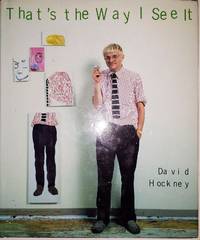
1993rif. 141881993. Hockney David. That's the Way I See It 1993 a visual and narrative account of the artistic development of one of the most influential figures in late twentieth century British and international art. David Hockney emerged in the 1960s as a central artist associated with British Pop Art and later became internationally recognized for his paintings photographic experiments stage designs and explorations of perspective and visual perception. This book presents Hockney's own reflections on his artistic practice and intellectual influences offering commentary on the evolution of his work across multiple media and decades of artistic production. Hockney David. That's the Way I See It. London: Chronicle 1993. First edition. Inscribed by the author on the front endpaper "For Mimi Bernie" and signed "David Hockney." The volume functions as Hockney's visual autobiography combining the artist's commentary with a large body of reproduced work spanning painting drawing graphic design and experimental visual projects. The book contains approximately 350 reproductions of Hockney's artworks and design projects integrated with a personal narrative in which the artist discusses his creative process influences and technical experimentation. Hockney's work helped redefine contemporary figurative painting and visual culture in the late twentieth century particularly through his vivid depictions of California life explorations of photography and collage and investigations into spatial representation and perspective. His writing in this volume offers direct insight into the ideas guiding these experiments and the broader artistic environment in which his work developed. Signed copies of Hockney's major retrospective publications provide documentary evidence of the artist's engagement with the public presentation of his career and artistic philosophy. Light handling wear; dust jacket clean and intact. Overall very good condition. unknown
1908rif. 158371908. Rackham Arthur illustrated edition of William Shakespeare's A Midsummer Night's Dream 1908 marks a major Edwardian interpretation of Shakespearean fantasy through the work of one of the defining British illustrators of the gift-book era. Rackham's treatment of Shakespeare's woodland comedy belongs to the cultural sphere of early twentieth-century illustrated literature where fairy imagery theatrical imagination and decorative book design transformed canonical texts into visually immersive editions for adult and juvenile audiences alike. The volume supports research into Shakespeare reception British illustration fairy iconography and the commercial culture of deluxe illustrated books before the First World War. Rackham Arthur illustrator. Shakespeare William. A Midsummer Night's Dream. London: William Heinemann; New York: Doubleday Page & Co. 1908. First Rackham edition. Quarto. Latimore & Haskell p. 32; Riall p. 87. Single volume with color frontispiece and 39 color plates mounted on tan paper each with captioned tissue guard together with black-and-white drawings in the text by Rackham. Original tan cloth boards with gilt titles to spine and gilt title and vignette to front cover. The illustrations emphasize the play's enchanted forest world with Rackham's characteristic attenuated figures grotesque fairies delicate linework and subdued color palette shaping the visual identity of Shakespeare's dream logic metamorphosis and nocturnal mischief. Published during the height of Rackham's prominence as a book illustrator this edition helped fix A Midsummer Night's Dream within the visual language of Edwardian fantasy connecting Shakespeare's stage tradition to the era's taste for fairy painting Arts and Crafts book design and collectible illustrated quartos. Spine ends and tips lightly nicked; binding sound and plates present as described; overall very good. A strong first Rackham edition of Shakespeare's fairy comedy valuable for collections centered on illustrated books Shakespeare reception and British fantasy art. unknown
1885rif. 143011885. Iran Art Qajar School Lovers in Embrace gouache painting on paper nineteenth century represents the courtly aesthetic erotic refinement and dynastic visual language that defined Persian painting under Qajar rule. The composition situates a princely male figure and his adorned companion in intimate embrace reinforcing themes of aristocratic leisure romanticized sovereignty and elite identity in Qajar Iran. The work supports research in Persian court painting gender representation in Islamic art Qajar costume and regalia and nineteenth century Iranian material culture. Persian Qajar gouache on paper with gold illuminated border. Depicts a young prince wearing blue and gold coat and karakul headgear embracing female companion adorned with tiara and pearls. Floral and animal illuminated margins including deer and monkeys. Image size 18.5 x 11 inches. The prince's distinctive headgear confirms Qajar rather than Zand period attribution aligning the work with the heightened stylization and opulent textile rendering characteristic of nineteenth century Tehran ateliers. Comparable compositions appear in Qajar painting traditions associated with artists such as Mohammad Sadiq whose courtly embrace scenes similarly emphasize costume detail glassware and staged intimacy as markers of refinement. The illuminated border populated by floral and animal motifs situates the lovers within a cosmological and decorative framework typical of Qajar manuscript aesthetics adapted to single-sheet painting. Minor browning to margins and discreet restoration to verso margins not affecting image. Very good. A refined example of Qajar visual culture centered on dynastic elegance and performative intimacy. unknown
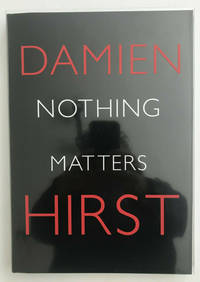
2009rif. 168042009. Hirst Damien. Nothing Matters 2009 publication documenting a major body of work exhibited at White Cube's London galleries presenting large scale triptych paintings and new directions in Hirst's studio practice. Issued during a period when Hirst remained a central figure in contemporary British art following the Young British Artists movement the volume records his continued engagement with themes of mortality repetition and visual spectacle. The work contributes to research on contemporary exhibition practice artist authored catalogues and the evolution of Hirst's painting after earlier conceptual and installation based works. Hirst Damien. Nothing Matters. London: White Cube 2009. Signed "Damien Hirst." First edition. Hardcover exhibition catalogue produced in conjunction with Hirst's dual exhibition at White Cube Mason's Yard and Hoxton Square in November 2009. The volume features numerous large scale reproductions including tri fold gatefold plates presenting color triptychs as well as the first published reproductions of Hirst's oil paintings executed on newspaper. The catalogue documents both the scale and material experimentation of the exhibited works. Published in the context of a major London exhibition this volume reflects the continued prominence of gallery based publication in disseminating contemporary art and shaping critical reception. Hirst's work often centered on themes of death and commodification remained influential within global art markets and institutional exhibitions in the early twenty first century. The inclusion of gatefold triptychs and newly reproduced works situates this catalogue within the documentation of a specific phase in his artistic production. Clean and well preserved; overall near fine. A signed example of a contemporary exhibition catalogue documenting a major British artist's work. unknown
rif. DADAX0300097654New unknown
rif. DADAX0548846928New unknown
rif. DADAX0932171052New unknown
rif. 0253348196.Ghardcover. Good. Access codes and supplements are not guaranteed with used items. May be an ex-library book. hardcover
1913rif. 368143New York: Association of American Painters and Sculptors 1913. Matted and framed. 21 x 21 inches. Some yellowing to postcards one spot to formal invitation otherwise near fine. Matted and framed. 21 x 21 inches. Rare set of ephemera from the International Exhibition of Modern Art better known as The Armory Show of 1913 including: - Stationary from the organizers of the show: The American Painters and Sculptors New York with Arthur B. Davies Gutzon Borglum Walt Kuhn Elmer L. MacRae listed on the masthead - Invitation to the Formal Opening of the International Exhibition of Modern Art at the Lexington Avenue Armory on February 17 1913 - Invitation to the Press Preview of the International Exhibition of Modern Art on February 16 1913 "Please present this card." - Two lapel buttons using the image of the uprooted pine tree traken from the Massachusetts Revolutionary War era battle flag with the text "The New Spirit" created by Walter Kuhn - Postcard advertising the exhibition with the flag with uprooted tree - Postcard Battleships 1913 by Elmer L. MacRae treasurer of the Association of American Painters and Sculptors. Association of American Painters and Sculptors unknown
rif. A9781343683839Hardback. New. hardcover
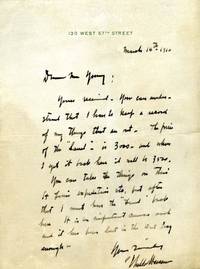
1910rif. 135101910. Hassam Childe. Autograph letter signed discussing the exhibition and valuation of the painting The Laurel. Dated March 14 1910 the letter documents Childe Hassam's management of one of his important canvases during a period when American Impressionism was gaining national recognition through exhibitions and international expositions. Hassam a leading figure in the American Impressionist movement and a painter known for luminous landscapes and urban scenes writes about maintaining records of works circulating in exhibitions and stresses the importance of recovering the painting known as The Laurel or The Laurel on the Ledge. In the letter he states "You can understand that I have to keep a record of my things that are out" before noting the value of the work and emphasizing its significance within his body of paintings. Hassam Childe. Autograph letter signed. New York March 14 1910. One page written on Hassam's personal stationery and signed "Childe Hassam." The text concerns the circulation and pricing of the painting The Laurel which Hassam describes as "an important canvas." He writes that "The price of the 'Laurel' is 3000 and when I get it back here it will be 3500" and instructs that the painting may be shown in connection with the St. Louis exposition before being returned to him. Hassam adds that the painting has "been lost in the West long enough" emphasizing his intention to regain control of the work after its exhibition. Childe Hassam emerged in the late nineteenth and early twentieth centuries as one of the principal American painters associated with Impressionism producing landscapes coastal scenes and city views that translated European Impressionist techniques into an American context. His career began in Boston as an illustrator and watercolorist before he studied painting more formally and later worked in New York where he became an influential participant in the American art market and exhibition circuit. Letters concerning the movement and valuation of specific paintings provide insight into how American artists of the period managed exhibitions pricing and the circulation of works through regional and national art venues. Light wear consistent with age and handling. Overall condition very good. unknown
1953rif. 149651953. Dufy Raoul. Letter concerning a photograph of one of his paintings written by the French artist whose work became associated with Fauvism and modern decorative painting in the early twentieth century. Raoul Dufy developed an internationally recognized style characterized by vivid color rhythmic line and scenes of leisure music and coastal life while also producing designs for textiles ceramics book illustration and large decorative murals. The letter records Dufy's response to receiving a photograph of a painting that had previously been outside his possession providing a brief but revealing document of the ways modern artists used photography to record and preserve images of their own work. Dufy Raoul. Typed Letter Signed. One page written in French and signed in ink "Raoul Dufy." In the letter Dufy expresses gratitude to the recipient for sending a photographic image of one of his paintings writing: "Cher Monsieur Je vous suis très reconnaissant de l'amabilité que vous avez eue de me faire remettre par un de vos collaborateurs la photographie d'un de mes tableaux qui était entre vos mains. Celle-ci manquait à ma collection et je vous remercie encore de me l'avoir fait tenir. Veuillez croire Cher Monsieur à mes meilleurs sentiments." In this statement Dufy notes that the photograph "manquait à ma collection" indicating that the image filled a gap in his own documentation of his artistic production. During the early twentieth century photography became an important tool for artists seeking to document works that had entered private collections or exhibitions beyond their immediate control. For painters such as Dufy whose work circulated widely through galleries collectors and decorative commissions photographic reproductions functioned as records of artistic output and as a means of preserving visual documentation of completed works. The letter therefore illustrates a practical aspect of artistic practice in the modern art world where painters increasingly relied on photographic images to maintain a record of paintings no longer physically accessible to them. Light wear to paper edges; otherwise well preserved. Overall very good condition. unknown
1910rif. 135961910. Rodin Auguste. Father of modern sculpture. Autograph Letter Signed 27 May 1910 a document from the mature career of the sculptor widely regarded as a foundational figure in modern sculpture and a central presence in late nineteenth and early twentieth century European art. Written at a moment when Rodin's international reputation was firmly established the letter reflects the personal networks and cultivated friendships that accompanied his public stature. In his own hand he writes "My dear foremost friend I am very touched by your faithful friendship. I send my hommage to Madame Vidi Griffin cordially" and signs "A. Rodin." By 1910 Rodin had already reshaped the language of sculpture through psychologically charged modeling and expressive surfaces and he was actively producing portrait busts of major contemporaries including George Bernard Shaw and Gustav Mahler consolidating his position at the center of European artistic life. Rodin Auguste. Autograph Letter Signed. 27 May 1910. One page. 3.75 x 6 inches. The date places this letter within the final decade of Rodin's life after decades of influence on the trajectory of modern sculpture and during a period in which he balanced institutional leadership with prolific production. He had previously served as president of the Société Nationale des Beaux-Arts and was elected president of the International Society of Painters Sculptors and Engravers in 1903 reflecting his stature within international artistic circles. Letters from this phase of his career document not only personal relationships but the cultural authority he exercised in shaping artistic discourse before his death in 1917. Original mailing fold visible slightly bumped corners and a small period stain; otherwise clean and fully legible with a strong signature. Overall condition: very good. unknown
1984rif. 143341984. Dine Jim. Signed exhibition poster featuring a detail from The Crommelynck Gate The Sentinels 1984 documents the artist's continued development beyond the Pop and Neo-Dada associations of his 1960s work into the more gestural paintings prints and sculpture of the Crommelynck Gate series. Dine began the series in 1981 after working with French master printer Aldo Crommelynck whose nineteenth-century wrought-iron studio gate became the basis for a sustained group of paintings prints drawings and sculptures. The series joined two recurring elements of Dine's work gates and tools with the history of his collaboration with Crommelynck. Dine Jim. Detail from the Crommelynck Gate The Sentinels. Los Angeles: Los Angeles County Museum of Art 1984. Exhibition poster measuring 38 x 25 inches produced in connection with Dine's 1984 LACMA exhibition and reproducing a detail from the 1983 work The Crommelynck Gate The Sentinels. Dine has signed the poster in ink with a large signature in the blank area above the title. Contemporary market records identify examples of this LACMA poster at approximately the same dimensions and connect the image with Dine's 1983 Crommelynck Gate paintings shown at the museum. Dine emerged in the early 1960s alongside artists including Andy Warhol and Roy Lichtenstein but his repeated use of personal motifs such as tools robes hearts and gates distinguished his work from more impersonal strains of Pop Art. By the early 1980s the Crommelynck Gate works had become a major vehicle for his increasingly gestural handling of those motifs. Excellent condition. The large autograph transforms a museum exhibition poster into a signed document directly associated with Dine's presentation of the Crommelynck Gate series at LACMA in 1984. unknown
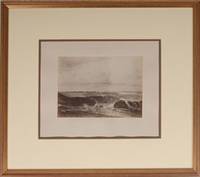
1862rif. 150051862. Whistler James McNeill. Signed albumen photograph of Blue and Silver: The Blue Wave Biarritz after the 1862 painting a document of the Aesthetic Movement and Whistler's articulation of "art for art's sake" within nineteenth century British and transatlantic visual culture. The original canvas executed following Whistler's stay in Biarritz exemplifies his restrained tonal harmonies and emphasis on atmospheric effect rather than narrative or moral instruction. In rejecting overt sentimentality and literary subject matter Whistler advanced a theory of painting grounded in formal relationships of color and composition positioning himself at the forefront of debates over aesthetic autonomy in Victorian art. The present signed photographic reproduction extends that philosophy into the sphere of photographic dissemination reinforcing the circulation and reception of his coastal studies among collectors and fellow artists. Whistler James McNeill. Signed albumen photograph of Blue and Silver: The Blue Wave Biarritz. No place no date. Albumen print affixed to ecru mount image approximately 14 x 11 inches overall approximately 24 x 21 inches framed. Signed on the mount with Whistler's butterfly device. Provenance: private collection of artist Chancery Ryder. The butterfly signature which Whistler developed as a distinctive artistic monogram functioned as both personal emblem and aesthetic statement underscoring the unity of design and authorship central to his practice. Photographic reproductions of his paintings played a significant role in shaping his reputation across Britain France and the United States particularly as debates surrounding modernism and aesthetic theory intensified in the later nineteenth century. Minor surface wear consistent with age; mount stable; signature clear and legible. Overall condition: very good. unknown
1921rif. 150741921. Dufy Raoul. Signed receipt dated December 11 1921 documents the commercial activity of a Fauvist painter whose work expanded beyond painting into textile design ceramics and large-scale decorative commissions during the interwar period. Associated with Fauvism Dufy developed a distinctive visual language characterized by bold color and rhythmic line that translated effectively into applied arts and commercial design. The document situates the artist within the economic structures of the Paris art and design market in the years following World War I when collaborations between fine artists and decorative industries became increasingly central to modern French visual culture. It supports research into artist economies the integration of avant-garde aesthetics into commercial production and the financial documentation of early twentieth-century European artists. Dufy Raoul. Receipt signed. Paris December 11 1921. Single sheet measuring approximately 5.5" x 7" written in French and signed "Raoul Dufy." A 50 centime revenue stamp appears below the signature indicating formal financial validation within the French fiscal system. The document includes docketing holes along the right margin consistent with filing or record-keeping practices. The receipt reflects routine transactional documentation tied to Dufy's professional activities during a period when his designs were widely adapted for textiles and decorative commissions. Created during a decade in which Dufy collaborated with fashion houses and manufacturers including textile production associated with Bianchini-Férier the receipt provides material evidence of the administrative and commercial dimensions of modernist artistic practice. Paris in the early 1920s functioned as a central hub for the fusion of avant-garde art and industrial design with artists like Dufy contributing to the dissemination of modern aesthetics across everyday objects and public spaces. Such financial documents though routine in form contribute to a fuller understanding of how modern artists sustained their practices within evolving markets for both fine and applied art. Minor wear and docketing holes at right margin; document clean and legible; overall in very good condition. unknown
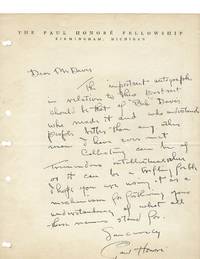
rif. 11345Honoré Paul autograph letter signed undated preserves the American artist's unusually direct assessment of collecting as a means of education and historical understanding. Honoré worked as a painter printmaker muralist and illustrator and was active for much of his career in Detroit; Smithsonian Archives of American Art documentation identifies his studio as a gathering place within the city's artistic community while federal architectural documentation credits him with mural work for Detroit's Players Club. Rather than discussing the acquisition of objects principally as an aesthetic or possessive activity this letter articulates Honoré's belief that a collection should lead its owner toward greater knowledge of the people represented within it giving the manuscript particular relevance to the history of collecting connoisseurship art education and twentieth-century American artistic culture. Honoré Paul. Undated. One page. Dimensions not supplied. Handwritten autograph letter signed on The Paul Honore Fellowship letterhead concluding with the signature "Paul Honore." Addressing the recipient's collecting activity Honoré writes "Collecting can be of tremendous intellectual value" and continues "I hope you are using it as a mechanism for furthering your understanding of what all these names stand for." The remarks provide substantive manuscript content rather than a simple autograph documenting Honoré's conception of collecting as an active process of historical and intellectual investigation. Also included is a small black-and-white photograph signed by Honoré; dimensions of the photograph are not supplied. The original dealer record confirms both the quoted text and the accompanying signed photograph. Honoré's comments gain additional context from his participation in Detroit's artistic community where his studio was remembered as a meeting place for younger artists and his work extended beyond easel painting into murals and printmaking. The letter is therefore useful not only as an autograph association but as a concise statement by a practicing artist about the educational responsibilities of collecting and the importance of understanding the individuals behind collected names and signatures. No physical defects or other condition information were supplied for either the letter or photograph so an overall condition designation cannot be responsibly assigned without inspection. A substantive artist's letter accompanied by a signed portrait with particular value for the study of American collecting culture and the intellectual purposes assigned to personal collections. unknown
rif. 46413141-nnew. unknown
rif. 19793Late 19th - early Twentieth Century. The letters from Gilbey concern the request he has received from the Royal Agricultural Society to write an article on the two Wolstenholmes. Other letters relating to the Wolstenholmes are 3 from J.H. Yoxall 1857-1923 relating to Baxter prints with copies of Wolstenholme's replies; the art dealer Harry Arbuthnot and others including a 4-page letter from the House-boy Brigade and Industrial Printing Works. Thirty pieces in all including 12 in their postally used envelopes. Late 19th - early Twentieth Century. unknown
rif. 44549Eds P. Goupil Manzi Joyant 14 numeros relies en un volume In-4 35 cm 420pp. environ illustr. et photos reliure demi-cuir de l'epoque chagrin noir dos a nerfs orne Ats26 bon etat - Sommaire: L'Art decoratif moderne - La statuette de la Dame Nashaa - L'Exposition du Vandalisme au Petit Palais - L'Academie San Fernando a Madrid - Fructus Belli tapisseries d'apres les cartons de Jules Romain - La vierge d'Autun de Jan Van Eyck - Les Independants - Les sculpteurs de Marie-Antoinette - Collection Barthelemy Rey - Peintres en mission au armees - Le Maroc artistique - Un Van Der Meer inedit - Collection M.F. Gentili di Giuseppe - La verite sur les pastels de La Tour du Musee Lecuyer a Saint Quentin - Les Eaux-fortes de Rembrandt - Tapisserie de guerre - Essai sur Monsieur Degas - Musee d'Aix en Provence - Collection Francois Flameng - Le tombeau de Rodin - Le Musee Rodin etc. unknown
rif. 1022112996.Gpaperback. Good. Access codes and supplements are not guaranteed with used items. May be an ex-library book. paperback
1961rif. ABE-1530971246479Canton: Kuangtung Painters Association 1961 1961 First edition. Elephant folio 54.640cm wt: 8.3kg. 108 tipped-in color plates. Text in Chinese but there is a booklet in English with introduction and list of reproduced paintings laid in. Plastic dustjacket included. Blue silk covered boards. Photos available upon request. 1st Edition. Hardcover. Very Good/Dust Jacket Included. Canton: Kuangtung Painters Association, 1961 hardcover
rif. B9781020459627Hardback. New. hardcover
rif. ria9781020459627_inpHardcover. New. New Book; Fast Shipping from UK; Not signed; Not First Edition; This handbook published by the Brotherhood of Painters Decorators and Paperhangers of America provides detailed instructions for the painting and decorating trade. With chapters on color theory wallpapering and surface preparation hardcover
rif. B9781017087383Hardback. New. hardcover