Greco, GioachinoBiblio.com

2.567 Ergebnisse
Best.-Nr. 110498833X.Gpaperback. Good. Access codes and supplements are not guaranteed with used items. May be an ex-library book. paperback
1714Best.-Nr. 17793Paris: Denis Mouchet 1714. Contemporary mottled calf richly gold-tooled spine red sprinkled edges. 12mo. With a woodcut decoration on the title page and a woodcut headpiece in text. Late edition of the French translation of one of the most famous early chess books originally written in Italian and first presented in manuscript by the author the famous Calabrian chess player Giocchino Greco ca. 1600-1635 to the King of Naples in 1619. At first only manuscript transcriptions were made. The first French edition appeared in 1669 after the first English edition of 1656. After a short explanation of the general principles of the game of chess it teaches chess players by presenting chess games and problems only often with a possible defense added as well. The book is divided into two parts the first with 39 games extensively recorded and the second part with 55 more advanced chess problems.With a partly removed owner's inscription on the title-page repeated and partly removed at the first page of the main text. Slightly browned but otherwise in very good condition. Binding slightly rubbed and with slightly soiled paste-downs otherwise very good.l Bibl. Van der Linde-Niemeijeriana 404; Cat. Schaakboekerij Niemeijer 989; Coll. Rimington-Wilson 566. Denis Mouchet, unknown
1689Best.-Nr. C0924343 pages with woodcut printer's device on title. Duodecimo 5 1/2 x 3 1/4. Bound in leather with raised spine bands and gilt to spine. Originally written in 1619 in Italian. From the library of Lothar Schmid. Biblioteca van Der Niemeijeriana: 400 Third French edition. Gioachino Greco also known as Il Calabrese was born around 1600 in Celico which near Cosenza in Calabria. Calabria had already produced such players as Leonardo di Bono and Michele di Mauro. From his writing it's apparent the he wasn't educated and likely came from a lower class family. Already in 1619 Greco started keeping a notebook of tactics and particularly clever games and he took up the custom of giving copies of his manuscripts to his wealthy patrons. In Rome Monsignor Corsino della casa Minutoli Tegrini Cardinal Savelli and Monsignor Francisco Buoncompagni all received copies of which there are extant copies dated 1620 in the Corsiniana library in Rome under the title Trattato del nobilissimo gioco de scacchi. Despite his popularity in Rome in 1621 Greco took off to test himself against the rest of Europe leaving this paper trail as he went. In 1621 he left a fine copy of his manuscripts with Duke Enrico of Lorraine in Nancy. He traveled to Paris where he played Arnauld Isaac de Corbeville Enrico di Savoia the Marquis of St. Sorlin and the Duke of Nemours and Geneva and others. He had apparently been quite successful because in traveling from Paris to England he was waylaid by robbers who divested him of 5000 scudi a princely sum. Finally making it to London he beat all the best players. Sir Francis Godolphin and Nicholas Mountstephen were given copies of his manuscripts. While in London Greco developed an idea to record entire games rather than positions for study and inclusion in his manuscripts. He returned to Paris in 1624 where he rewrote his manuscript collection to reflect his new ideas. He then went to Spain and played at the court of Philip IV. There he beat his mentor and the strongest player of the time other than himself don Mariano Morano. He finally returned to Italy where he was enticed to traveling to the New Indies the Americas by a Spanish nobleman. He seemingly contracted some disease there and died around 1630 possibly 1634 at the young age of 30 34. He generously left all the money he earned at chess to the Jesuits. Gioachino Greco stood head and shoulders above his contemporaries a feat seldom duplicated. David Hooper in The Oxford Companion to Chess states that Greco probably made up the games in his manuscripts. The question of whether he actually played the games or invented them is rather moot since if he invented them he was perfectly capable of playing them. Lothar Maximilian Lorenz Schmid 10 May 1928 – 18 May 2013 was a German chess grandmaster. He was born in Radebeul near Dresden into a family who were the co-owners of the Karl May Press which published the German Karl May adventure novels. He was best known as the chief arbiter at several World Chess Championship matches in particular the 1972 encounter between Bobby Fischer and Boris Spassky at Reykjavic. He was also an avid collector of chess books and paraphernalia. It was reputed that he owned the largest known private chess library in the world as well as a renowned collection of chess art chess boards and chess pieces from around the globe. Condition: Leather rubbed and scuffed Lothar Schmid's label to front paste down. Spine label missing spine bands rubbed old neat signature to title some doodling to back end papers else a good copy. Jacques le Febure hardcover books
1713Best.-Nr. C0588343 pages. Duodecimo 5 ½" x 3 ¼". Bound in vellum with black lettering to spine. Originally written in 1619 in Italian. Biblioteca van Der Niemeijeriana: 402 Gioachino Greco also known as Il Calabrese was born around 1600 in Celico which near Cosenza in Calabria. Calabria had already produced such players as Leonardo di Bono and Michele di Mauro. From his writing it's apparent the he wasn't educated and likely came from a lower class family. Already in 1619 Greco started keeping a notebook of tactics and particularly clever games and he took up the custom of giving copies of his manuscripts to his wealthy patrons. In Rome Monsignor Corsino della casa Minutoli Tegrini Cardinal Savelli and Monsignor Francisco Buoncompagni all received copies of which there are extant copies dated 1620 in the Corsiniana library in Rome under the title Trattato del nobilissimo gioco de scacchi. Despite his popularity in Rome in 1621 Greco took off to test himself against the rest of Europe leaving this paper trail as he went. In 1621 he left a fine copy of his manuscripts with Duke Enrico of Lorraine in Nancy. He traveled to Paris where he played Arnauld Isaac de Corbeville Enrico di Savoia the Marquis of St. Sorlin and the Duke of Nemours and Geneva and others. He had apparently been quite successful because in traveling from Paris to England he was waylaid by robbers who divested him of 5000 scudi a princely sum. Finally making it to London he beat all the best players. Sir Francis Godolphin and Nicholas Mountstephen were given copies of his manuscripts. While in London Greco developed an idea to record entire games rather than positions for study and inclusion in his manuscripts. He returned to Paris in 1624 where he rewrote his manuscript collection to reflect his new ideas. He then went to Spain and played at the court of Philip IV. There he beat his mentor and the strongest player of the time other than himself don Mariano Morano. He finally returned to Italy where he was enticed to traveling to the New Indies the Americas by a Spanish nobleman. He seemingly contracted some disease there and died around 1630 possibly 1634 at the young age of 30 34. He generously left all the money he earned at chess to the Jesuits. Gioachino Greco stood head and shoulders above his contemporaries a feat seldom duplicated. David Hooper in The Oxford Companion to Chess states that Greco probably made up the games in his manuscripts. The question of whether he actually played the games or invented them is rather moot since if he invented them he was perfectly capable of playing them. Condition: Old owner's inscription laid in to both front and back paste downs some slight foxing still has the original ribbon book mark. Other wise a good copy. Chezz Jacques Le Febvre hardcover books
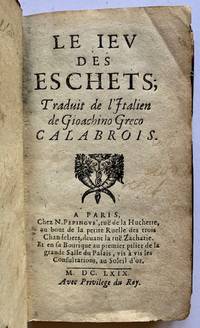
1669Best.-Nr. 20514Paris: Chez N. Pepingve Avec Privilege du Roi 1669. Full leather. The 1669 1st French edition --and 1st published edition-- of Gioachino Greco's seminal "Le Jeu des Eschets". Greco c. 1600 - c. 1634 was the strongest player in Europe in the early 17th century and among the first to record entire games not just particular openings or combinations. His vast influence as cited by H.J.R. Murray among other historians of the game is keenly felt to this day. This copy is likely in its original full-leather binding certainly in a contemporary-to-the-period binding. Solid and VG with minor forgivable wear along the edges and the preliminaries. The interior though is very clean the pages surprisingly crisp and clean. Originally recorded by hand in Greco's native Italian here translated --and issued in book form-- for the first time. Chez N. Pepingve (Avec Privilege du Roi) unknown books
2017[Storia piante officinali mitologia]Formato cm 16,5 x 24 Pag. 208 Illustrazioni: 35 Nei miti possiamo trovare il nucleo vivo e pulsante della filosofia, nascosto nella selva dei simboli; interrogarli significa svelare la ricchissima rete di relazioni che intesse tutte le cose. La definizione di "semplici" ci guiderà nella consapevolezza che la complessità può essere ricondotta a princìpi elementari, energie pure: le piante officinali sono creature umili nel senso più genuinamente etimologico, cioè vicine all'humus, al suolo, grembo materno da cui ricevono nutrimento e forza per trasformarsi in farmaci dispensatori di energie fisiche e spirituali.In origine ogni pianta è stata venerata come divinità, in seguito associata a un dio o a una dea di cui condivide il vissuto mitico, perchè l'aspetto simbolico è parte viva della comprensione della malattia e la soluzione è più facile se sappiamo ricercarla nel suo archetipo.Nelle pieghe segrete di questo patrimonio di tradizioni troveremo piante straordinarie: quelle afrodisiache sacre ad Afrodite, quelle utili per le malattie delle donne, care a Era e Artemide; i veleni e i filtri preparati dalle maghe, le piante solari di Apollo e molte altre. Scopriremo che alcune erbe possono essere magiche, metafisiche o addirittura filosofiche. Ognuna di esse ha una storia da raccontare e qualche enigma da sottoporci.
1988Collana Biblioteca Adelphi, 200. Terza edizione. In 8°; pp. 465; brossura editoriale illustrata con alette; cucito. CONDIZIONI BUONE: lievi tracce d'uso (in particolare alcune piccole abrasioni al piatto posteriore).
18831 Vol. In-16 pag. 114. Copt. ill. Dorso fragile PROG 42072 CATT_ATT 56
1944(Codice CV/9186) In 16° XXVIII-477 pp. Legatura tutta tela editoriale, dorso lievemente scolorito. Volume ottimo. ~~~ SPEDIZIONE IN ITALIA SEMPRE TRACCIATA
1865(Codice LC/1385) In 24° (10,5x7 cm) XXII-448 pp. Ritratto sotto velina. Introduzione di Giuseppe Rigutini. Bella legatura mezza pelle editoriale, nervetti e titolo oro, una cerniera fessurata. Interno in ottimo stato. ~~~ SPEDIZIONE IN ITALIA SEMPRE TRACCIATA
1927(Codice LL/0732) In 8° (21 cm) 280 pp. Bella edizione su carta avorio filigranata, a pieni margini, con barbe. Rari segni marginali a lapis. Brossura originale pergamenata (tipicamente rggrinzita), Ottimo volume. ~~~ SPEDIZIONE IN ITALIA SEMPRE TRACCIATA
1940(Codice LL/1867) Tre volumi in 16° 63+64+56 pp. Traduzione italiana (no testo latino), introduzione e note a cura di Giuseppe Lipparini. Brossure editoriali, in ottimo stato (in parte intonsi)-. ~~~ SPEDIZIONE IN ITALIA SEMPRE TRACCIATA
1958(Codice LL/1120) In 16º 92 pp. Traduzione e premessa di Lodovico Magugliani. Brossura editoriale grigia. ~~~ SPEDIZIONE IN ITALIA SEMPRE TRACCIATA
1900(Codice SH/1106) In 16º (19,3 cm) XVI-220 pp. Prima edizione. Brossura originale. Ottimo e fresco volume. ~~~ SPEDIZIONE IN ITALIA SEMPRE TRACCIATA
1926Mm 110x165 Collana "Biblioteca Agricola" - Volume in copertina rigida con copertina figurata a colori, 80 pagine con 12 tavole in nero fuori testo. Opera in buone-ottime condizioni, spedizione in 24 ore dalla conferma dell'ordine.
1994In-4 (cm. 31.60), brossura illustrata, con alette, pp. 129, (1), con numerose illustrazioni, diverse a piena pagina, in bianco e nero e a colori fuori testo. Apparato in italiano ed inglese. In buono stato di conservazione (good copy).
1883In-8° (cm. 21), pp. 60. Bross. edit. ornata Lievi ombre e firma in cop., mende al dorso.
Città di Castello, Lapi, 1886. In 16°, PP LVI+ 135n. Legatura in tela coeva con titoli n oro al piatto anteriore e al dorso, sciupata dal tempo. Traduzione in versi italiani di A. Franchetti. Introduzione e note di D. Comparetti. Ritratto all’antiporta (curiosamente di Euripide!).
1927Milano, 1927, 8vo stralcio con copertina posticcia muta, pp. 1173/1178 con 8 illustrazioni fotografiche. - !! ATTENZIONE !!: Con il termine estratto (o stralcio) intendiamo riferirci ad un fascicolo contenente un articolo, completo in se, sia che esso sia stato stampato a parte utilizzando la stessa composizione sia che provenga direttamente da una rivista. Le pagine sono indicate come "da/a", ad esempio: 229/231 significa che il testo è composto da tre pagine. Quando la rivista di provenienza non viene indicata é perché ci è sconosciuta. - !! ATTENTION !!: : NOT A BOOK : “extract” or “excerpt” means simply a few pages, original nonetheless, printed in a magazine. Pages are indicated as in "from” “to", for example: 229/231 means the text comprises three pages (229, 230 and 231). If the magazine that contained the pages is not mentioned, it is because it is unknown to us.
1989In 8, cm. 145 x 22,5, pp. 346 + (2), con XVI tavole in bianco e nero fuori testo. Brossura editoriale illustrata. Segni a matita ai margini bianchi del testo.
1973Rizzoli, novembre 1973. Rilegato con copertina rigida e sovraccoperta. Scritta di appartenenza nel frontespizio. Spedizioni tracciabili con raccomandata entro 24 ore dall'ordine. Hardback cover with dust jacket in good conditions, no price clipped. Worldwide delivery.
1778(Codice LL/1765) In 8° (23 cm) 249 pp. Testo latino e traduzione italiana a fronte, con ampie note. Fioriture alle prime 25 pagine, timbri e firme. Copertina originale in cartone rustico, etichetta cartacea calligrafica moderna. Pieni margini, con barbe. Esemplare vissuto, ma valido e cpmpleto ~~~ SPEDIZIONE IN ITALIA SEMPRE TRACCIATA
1833(Codice LL/0362) In 16° 255 pp. Accurata, rara edizione. Nitida impressione su bella carta candida, minime ingialliture. Brossura originale. Vecchi timbri al frontespizio. Ottimo esemplare a pieni margini, intonso. ~~~ SPEDIZIONE IN ITALIA SEMPRE TRACCIATA
1939(Codice LN/4141) In 16° 224 pp. Testo latino con versione italiana a fronte. Arguta introduzione. Legatura originale mezza tela, vignetta alla copertina. Lieve ingiallitura, ottimo e fresco volume. ~~~ SPEDIZIONE IN ITALIA SEMPRE TRACCIATA
1973(Codice CW/1430) In 8º (22,5 cm) 224 pp. Testo latino con versione italiana a fronte. Vari disegni di Mosca. Cartone editoriale, sovraccoperta illustrata. Buono stato. ~~~ SPEDIZIONE IN ITALIA SEMPRE TRACCIATA