CALASSO, Roberto.MareMagnum

2.527 Ergebnisse
1988Collana Biblioteca Adelphi, 200. Terza edizione. In 8°; pp. 465; brossura editoriale illustrata con alette; cucito. CONDIZIONI BUONE: lievi tracce d'uso (in particolare alcune piccole abrasioni al piatto posteriore).
Best.-Nr. AUB-2145Lausanne, éd. Marguerat 1950 (oeuvres complètes vol. 10). Bon in-8 broché, couv. remp. d'éd., 373 p. avec table.
1968Best.-Nr. ABE-1725232283732 PAGES-34 CM X 50 CM-LA "NORMALISATION" A PRAGUE-LES RAPPORTS ENTRE PRAGUE ET MOSCOU-LA GRANDE-BRETAGNE RENFORCE SES POSITIONS MILITAIRES A CHYPRE-LA DOUBLE FACE DU DIEU RHONE, PAR MAURICE LE LANNOU-LES VARIETES PAR CLAUDE SARRAUTE: JULIETTE GRECO A BOBINO-SAINT-ETIENNE A OBTENU DEVANT LE CELTIC DE GLASGOW UN SUCCES MERITOIRE-1 DECOUPE 10X20 P10/11 ANNONCES
1968Best.-Nr. ABE-307967814032 PAGES-JULIETTE GRECO A BOBINO-1 DECOUPE-FRAGILISE EN PLIURE DE UNE
1966Best.-Nr. ABE-155772590410724 PAGES-35 CM X 50 CM-L'AUDITION DES TEMOINS SE POURSUIT AU PROCES DES RAVISSEURS DE M.BEN BARKA, 2P-BRASSENS ET GRECO AU T.N.P., PAR CLAUDE SARRAUTE-FOOTBALL: DEUX NOUVEAUX INTERNATIONAUX CONTRE LA HONGRIE: SUAUDEAU ET REVELLI-
1966Best.-Nr. ABE-157832221111024 PAGES-CUBA A L'AGE DE RAISON IV LA MORT D'UN BUREAUCRATE-VARIETES, PAR CLAUDE FLEOUTER: JULIETTE GRECO, OLYMPIA-COMPLET
1966Best.-Nr. ABE-1637438223916 PAGES FORMAT 34 CM X 56 CM-JULIETTE GRECO SERA-T-ELLE "LA FOLLE DE CHAILLOT" A BROADWAY?-AU CHATELET "MONSIEUR CARNAVAL" DE FREDERIC DARD ET CHARLES AZNAVOUR, PAR JACQUES LONCHAMPT-MORT DE L'ECRIVAIN RENE BEHAINE-LEGERES ROUSSEURS EN PLIURES CENTRALE DE UNE
1964Best.-Nr. ABE-158903798719220 PAGES-VARIETES, PAR CLAUDE SARRAUTE: JULIETTE GRECO OU QUAND LA BELLE SE FAIT BETE, BOBINO
1961Best.-Nr. ABE-157710657917016 PAGES-LES DEUX "K" ET LA GUERRE FROIDE II DU POKER AUX ECHECS-JULIETTE GRECO A BOBINO, PAR CLAUDE SARRAUTE-COMPLET
1954Best.-Nr. ABE-156879512167816 PAGES-35 CM X 50 CM-LE DOUBLE DEBAT INDOCHINOIS A GENEVE ET AU PALAIS BOURBON, 2 PAGES-LES PROBLEMES NORDS AFRICAINS, UNE VISITE AUX COLONS DU KEF, M.RENE COTY EXALTE LA MEMOIRE DE JEAN MOULIN-ZOLA, ASSASSINE? CE QU'EN PENSE LE DOCTEUR JACQUES ZOLA FILS DE L'ECRIVAIN, PAR GABRIEL REUILLARD, MOITIE DE PAGE-ROUEN A CELEBRE LE 523e ANNIVERSAIRE DU SUPPLICE DE JEANNE D'ARC, QUART DE PAGE-LA MUSIQUE, PAR RENE DUMESNIL: RICHARD WAGNER VU PAR BERNARD SHAW, TIERS DE PAGE-LE PRIX VILLA D'ESTE AU PEINTRE LOUIS CHARRAT-A L'OLYMPIA LES MARIONNETTES D'YVES JOLYLES GARCONS DE LA RUE "RENTREE" DE JULIETTE GRECO, PAR CHRISTINE DE RIVOYRE-QUELQUES ROUSSEURS EN UNE-1 DECHIRURE 10 CM EN PLIURE CENTRALE DE UNE-COMPLET
1937Best.-Nr. ABE-4010087003EN COUVERTURE: "L'ALLEE DE LA LUMIERE ET DE LA RADIO A L'EXPOSITION 1937"-RETABLISSEMENT DU CONTROLE NAVAL EN ESPAGNE/LE GENERAL MOLA EST MORT-LE MARIAGE DU DUC CHARMANT/WINDSOR/1P/3 PHOTOS-MONSIEUR ANDRE TARDIEU SE MARIE-HIVERNAGE AU POLE NORD/ARTICLE DE CHARLES TORQUET SUR 2 PAGES/2 PHOTOS-PETITE HISTOIRE DU HAUT DE FORME/2P/5 ILLUSTRATIONS-TROIS BONS FILMS PAR GERMAINE BEAUMONT/L'ENTREPRENANT M.PETROFF/FRED ASTAIRE/GINGER ROGERS/1P/2 PHOTOS-LA BICYCLETTE A EU SA JOURNEE MONDAINE/2P/5 ILLUSTRATIONS-LE RETROSPECTIVE GRECO PAR LOUIS VAUXCELLES-"L'AMOUR, C'EST BEAUCOUP PLUS QUE L'AMOUR" DE JACQUES CHARDONNE/CRITIQUE DE MAURICE MARTIN DU GARD-LEGER MANQUE COIN INF DR 1ER PLAT
2017[Storia piante officinali mitologia]Formato cm 16,5 x 24 Pag. 208 Illustrazioni: 35 Nei miti possiamo trovare il nucleo vivo e pulsante della filosofia, nascosto nella selva dei simboli; interrogarli significa svelare la ricchissima rete di relazioni che intesse tutte le cose. La definizione di "semplici" ci guiderà nella consapevolezza che la complessità può essere ricondotta a princìpi elementari, energie pure: le piante officinali sono creature umili nel senso più genuinamente etimologico, cioè vicine all'humus, al suolo, grembo materno da cui ricevono nutrimento e forza per trasformarsi in farmaci dispensatori di energie fisiche e spirituali.In origine ogni pianta è stata venerata come divinità, in seguito associata a un dio o a una dea di cui condivide il vissuto mitico, perchè l'aspetto simbolico è parte viva della comprensione della malattia e la soluzione è più facile se sappiamo ricercarla nel suo archetipo.Nelle pieghe segrete di questo patrimonio di tradizioni troveremo piante straordinarie: quelle afrodisiache sacre ad Afrodite, quelle utili per le malattie delle donne, care a Era e Artemide; i veleni e i filtri preparati dalle maghe, le piante solari di Apollo e molte altre. Scopriremo che alcune erbe possono essere magiche, metafisiche o addirittura filosofiche. Ognuna di esse ha una storia da raccontare e qualche enigma da sottoporci.
2001Best.-Nr. ABE-166817089581732 PAGES-30 CM X 42 CM-ARCHITECTURE: LA E 1027 EN BEAUTE, EILEEN GRAY, DEMI PAGE, PHOTO-1914 1973: ASGER JORN UN PEINTRE A LA CROISEE DES CHEMINS LE MUSEE D'ART MODERNE ET CONTEMPORAIN DE STRASBOURG CELEBRE LE FONDATEUR DE COBRA, 3 PAGES PAR MICHEL DRAGUET, 5 ILL-LES ANNEES 50 ONT TOUJOURS LA FORME UNE SELECTION D'EXPOSITIONS EN SUISSE ET EN FRANCE, GERARD SCHNEIDER, POLIAKOFF, PIERRE LECUIRE-A L'AVANT-GARDE DE L'AVANT-GARDE LES PREMIERES SEANCES DU CINEMA LETTRISTE, 2 ILL-LES PIONNIERS DU MOBILIER DES ANNEES 50 QUATRE MARCHANDS AMOUREUX DE MEUBLES D'ARCHITECTES, 1P, 4 PHOTOS-L'IRRESISTIBLE ASCENSION D'UN STYLE, TIERS DE PAGE, PHOTO (MEUBLE DE RANGEMENT JEAN PROUVE CHARLOTTE PERRIAND)-ENTRETIEN AVEC JACK LANG, DEMI PAGE, PHOTO-LES CANDEURS DE LA RUE LES PHOTOGRAPHIES D'HELEN LEVITT AU CNP, CENTRE NATIONAL DE LA PHOTOGRAPHIE, PHOTO-HANIWA, TERRES DU JAPON DES SCULPTURES NIPPONES DES Ve ET VIe SIECLES A PARIS, DEMI PAGE, PHOTO-UN PEINTRE EN MISSION BACICCIO ARTISTE DES JESUITES DANS LA REGION DES MARCHES-AU DELA DU CUBISME RETROSPECTIVE ALBERT GLEIZES A LYON, TIERS DE PAGE, PHOTO-DECOUPE 14 CM X 12 CM PAGES 11 12-NAPLES ET L'ART ACTUEL LE CONTEMPORAIN PREND SOUCHE A LA FONDATION MORRA GRECO-(PJ16)
Best.-Nr. 22532Chez Denis Mouchet, Paris, 1714.
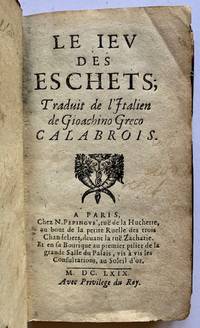
1669Best.-Nr. 20514Paris: Chez N. Pepingve Avec Privilege du Roi 1669. Full leather. The 1669 1st French edition --and 1st published edition-- of Gioachino Greco's seminal "Le Jeu des Eschets". Greco c. 1600 - c. 1634 was the strongest player in Europe in the early 17th century and among the first to record entire games not just particular openings or combinations. His vast influence as cited by H.J.R. Murray among other historians of the game is keenly felt to this day. This copy is likely in its original full-leather binding certainly in a contemporary-to-the-period binding. Solid and VG with minor forgivable wear along the edges and the preliminaries. The interior though is very clean the pages surprisingly crisp and clean. Originally recorded by hand in Greco's native Italian here translated --and issued in book form-- for the first time. Chez N. Pepingve (Avec Privilege du Roi) unknown books
1689Best.-Nr. C0924343 pages with woodcut printer's device on title. Duodecimo 5 1/2 x 3 1/4. Bound in leather with raised spine bands and gilt to spine. Originally written in 1619 in Italian. From the library of Lothar Schmid. Biblioteca van Der Niemeijeriana: 400 Third French edition. Gioachino Greco also known as Il Calabrese was born around 1600 in Celico which near Cosenza in Calabria. Calabria had already produced such players as Leonardo di Bono and Michele di Mauro. From his writing it's apparent the he wasn't educated and likely came from a lower class family. Already in 1619 Greco started keeping a notebook of tactics and particularly clever games and he took up the custom of giving copies of his manuscripts to his wealthy patrons. In Rome Monsignor Corsino della casa Minutoli Tegrini Cardinal Savelli and Monsignor Francisco Buoncompagni all received copies of which there are extant copies dated 1620 in the Corsiniana library in Rome under the title Trattato del nobilissimo gioco de scacchi. Despite his popularity in Rome in 1621 Greco took off to test himself against the rest of Europe leaving this paper trail as he went. In 1621 he left a fine copy of his manuscripts with Duke Enrico of Lorraine in Nancy. He traveled to Paris where he played Arnauld Isaac de Corbeville Enrico di Savoia the Marquis of St. Sorlin and the Duke of Nemours and Geneva and others. He had apparently been quite successful because in traveling from Paris to England he was waylaid by robbers who divested him of 5000 scudi a princely sum. Finally making it to London he beat all the best players. Sir Francis Godolphin and Nicholas Mountstephen were given copies of his manuscripts. While in London Greco developed an idea to record entire games rather than positions for study and inclusion in his manuscripts. He returned to Paris in 1624 where he rewrote his manuscript collection to reflect his new ideas. He then went to Spain and played at the court of Philip IV. There he beat his mentor and the strongest player of the time other than himself don Mariano Morano. He finally returned to Italy where he was enticed to traveling to the New Indies the Americas by a Spanish nobleman. He seemingly contracted some disease there and died around 1630 possibly 1634 at the young age of 30 34. He generously left all the money he earned at chess to the Jesuits. Gioachino Greco stood head and shoulders above his contemporaries a feat seldom duplicated. David Hooper in The Oxford Companion to Chess states that Greco probably made up the games in his manuscripts. The question of whether he actually played the games or invented them is rather moot since if he invented them he was perfectly capable of playing them. Lothar Maximilian Lorenz Schmid 10 May 1928 – 18 May 2013 was a German chess grandmaster. He was born in Radebeul near Dresden into a family who were the co-owners of the Karl May Press which published the German Karl May adventure novels. He was best known as the chief arbiter at several World Chess Championship matches in particular the 1972 encounter between Bobby Fischer and Boris Spassky at Reykjavic. He was also an avid collector of chess books and paraphernalia. It was reputed that he owned the largest known private chess library in the world as well as a renowned collection of chess art chess boards and chess pieces from around the globe. Condition: Leather rubbed and scuffed Lothar Schmid's label to front paste down. Spine label missing spine bands rubbed old neat signature to title some doodling to back end papers else a good copy. Jacques le Febure hardcover books
1713Best.-Nr. C0588343 pages. Duodecimo 5 ½" x 3 ¼". Bound in vellum with black lettering to spine. Originally written in 1619 in Italian. Biblioteca van Der Niemeijeriana: 402 Gioachino Greco also known as Il Calabrese was born around 1600 in Celico which near Cosenza in Calabria. Calabria had already produced such players as Leonardo di Bono and Michele di Mauro. From his writing it's apparent the he wasn't educated and likely came from a lower class family. Already in 1619 Greco started keeping a notebook of tactics and particularly clever games and he took up the custom of giving copies of his manuscripts to his wealthy patrons. In Rome Monsignor Corsino della casa Minutoli Tegrini Cardinal Savelli and Monsignor Francisco Buoncompagni all received copies of which there are extant copies dated 1620 in the Corsiniana library in Rome under the title Trattato del nobilissimo gioco de scacchi. Despite his popularity in Rome in 1621 Greco took off to test himself against the rest of Europe leaving this paper trail as he went. In 1621 he left a fine copy of his manuscripts with Duke Enrico of Lorraine in Nancy. He traveled to Paris where he played Arnauld Isaac de Corbeville Enrico di Savoia the Marquis of St. Sorlin and the Duke of Nemours and Geneva and others. He had apparently been quite successful because in traveling from Paris to England he was waylaid by robbers who divested him of 5000 scudi a princely sum. Finally making it to London he beat all the best players. Sir Francis Godolphin and Nicholas Mountstephen were given copies of his manuscripts. While in London Greco developed an idea to record entire games rather than positions for study and inclusion in his manuscripts. He returned to Paris in 1624 where he rewrote his manuscript collection to reflect his new ideas. He then went to Spain and played at the court of Philip IV. There he beat his mentor and the strongest player of the time other than himself don Mariano Morano. He finally returned to Italy where he was enticed to traveling to the New Indies the Americas by a Spanish nobleman. He seemingly contracted some disease there and died around 1630 possibly 1634 at the young age of 30 34. He generously left all the money he earned at chess to the Jesuits. Gioachino Greco stood head and shoulders above his contemporaries a feat seldom duplicated. David Hooper in The Oxford Companion to Chess states that Greco probably made up the games in his manuscripts. The question of whether he actually played the games or invented them is rather moot since if he invented them he was perfectly capable of playing them. Condition: Old owner's inscription laid in to both front and back paste downs some slight foxing still has the original ribbon book mark. Other wise a good copy. Chezz Jacques Le Febvre hardcover books
Best.-Nr. 9575Traduit de l’italien de Giochino GRECO, Calabrois. In 12 plein cuir fauve raciné à nerfs, pièce de titre cuir rouge, fers, filets dorés, roulette dorée sur coupes, titre XXII, 343 pages. Tranches jaspées A Paris chez la Veuve de N. PEPINGUE, 1689.Petites restaurations à la charnière droite, sinon bon exemplaire de cette très rare seconde édition française.
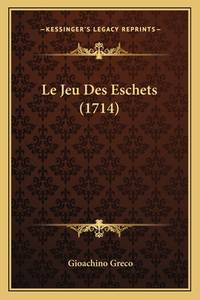
1714Best.-Nr. 24557Paris Denis Mouchet 1714 In-12 10 ffnch-343 pp, un manque de cuir en coin inf. du premier plat, un mors faible . cachet clair au titre et signature
1714Best.-Nr. 9370Paris: Denis Mouchet 1714. Sixth French edition. 12mo 22 344pp. Woodcut device on title. Contemporary speckled calf spine decorated and lettered in gilt. Bookplate of Albert Parsons Sachs on front pastedown and a bibliographic note in his hand on verso of ffep. French private library stamp on title page and blank verso of final leaf of text. Boards with some soiling and rubbing at corners spine ends and joints. Very good and sound. Handsomely bound French edition of this early systematic chess manual by the Italian master Giachino Greco ca. 1600-1634. The text helped standardize early modern opening theory and though it was circulated in manuscript during his lifetime was not printed until 1636 in French and expanded under this title in 1669. The first edition in English was 1656 with Italian editions appearing later. Sachs' note reads: V.D. Linde I 364. Denis Mouchet unknown
1689Best.-Nr. C0924343 pages with woodcut printer's device on title. Duodecimo 5 1/2 x 3 1/4. Bound in leather with raised spine bands and gilt to spine. Originally written in 1619 in Italian. From the library of Lothar Schmid. Biblioteca van Der Niemeijeriana: 400 Third French edition. Gioachino Greco also known as Il Calabrese was born around 1600 in Celico which near Cosenza in Calabria. Calabria had already produced such players as Leonardo di Bono and Michele di Mauro. From his writing it's apparent the he wasn't educated and likely came from a lower class family. Already in 1619 Greco started keeping a notebook of tactics and particularly clever games and he took up the custom of giving copies of his manuscripts to his wealthy patrons. In Rome Monsignor Corsino della casa Minutoli Tegrini Cardinal Savelli and Monsignor Francisco Buoncompagni all received copies of which there are extant copies dated 1620 in the Corsiniana library in Rome under the title Trattato del nobilissimo gioco de scacchi. Despite his popularity in Rome in 1621 Greco took off to test himself against the rest of Europe leaving this paper trail as he went. In 1621 he left a fine copy of his manuscripts with Duke Enrico of Lorraine in Nancy. He traveled to Paris where he played Arnauld Isaac de Corbeville Enrico di Savoia the Marquis of St. Sorlin and the Duke of Nemours and Geneva and others. He had apparently been quite successful because in traveling from Paris to England he was waylaid by robbers who divested him of 5000 scudi a princely sum. Finally making it to London he beat all the best players. Sir Francis Godolphin and Nicholas Mountstephen were given copies of his manuscripts. While in London Greco developed an idea to record entire games rather than positions for study and inclusion in his manuscripts. He returned to Paris in 1624 where he rewrote his manuscript collection to reflect his new ideas. He then went to Spain and played at the court of Philip IV. There he beat his mentor and the strongest player of the time other than himself don Mariano Morano. He finally returned to Italy where he was enticed to traveling to the New Indies the Americas by a Spanish nobleman. He seemingly contracted some disease there and died around 1630 possibly 1634 at the young age of 30 34. He generously left all the money he earned at chess to the Jesuits. Gioachino Greco stood head and shoulders above his contemporaries a feat seldom duplicated. David Hooper in The Oxford Companion to Chess states that Greco probably made up the games in his manuscripts. The question of whether he actually played the games or invented them is rather moot since if he invented them he was perfectly capable of playing them. Lothar Maximilian Lorenz Schmid 10 May 1928 – 18 May 2013 was a German chess grandmaster. He was born in Radebeul near Dresden into a family who were the co-owners of the Karl May Press which published the German Karl May adventure novels. He was best known as the chief arbiter at several World Chess Championship matches in particular the 1972 encounter between Bobby Fischer and Boris Spassky at Reykjavic. He was also an avid collector of chess books and paraphernalia. It was reputed that he owned the largest known private chess library in the world as well as a renowned collection of chess art chess boards and chess pieces from around the globe. Condition: Leather rubbed and scuffed Lothar Schmid's label to front paste down. Spine label missing spine bands rubbed old neat signature to title some doodling to back end papers else a good copy. Jacques le Febure hardcover
1713Best.-Nr. C0588343 pages. Duodecimo 5 ½" x 3 ¼". Bound in vellum with black lettering to spine. Originally written in 1619 in Italian. Biblioteca van Der Niemeijeriana: 402 Gioachino Greco also known as Il Calabrese was born around 1600 in Celico which near Cosenza in Calabria. Calabria had already produced such players as Leonardo di Bono and Michele di Mauro. From his writing it's apparent the he wasn't educated and likely came from a lower class family. Already in 1619 Greco started keeping a notebook of tactics and particularly clever games and he took up the custom of giving copies of his manuscripts to his wealthy patrons. In Rome Monsignor Corsino della casa Minutoli Tegrini Cardinal Savelli and Monsignor Francisco Buoncompagni all received copies of which there are extant copies dated 1620 in the Corsiniana library in Rome under the title Trattato del nobilissimo gioco de scacchi. Despite his popularity in Rome in 1621 Greco took off to test himself against the rest of Europe leaving this paper trail as he went. In 1621 he left a fine copy of his manuscripts with Duke Enrico of Lorraine in Nancy. He traveled to Paris where he played Arnauld Isaac de Corbeville Enrico di Savoia the Marquis of St. Sorlin and the Duke of Nemours and Geneva and others. He had apparently been quite successful because in traveling from Paris to England he was waylaid by robbers who divested him of 5000 scudi a princely sum. Finally making it to London he beat all the best players. Sir Francis Godolphin and Nicholas Mountstephen were given copies of his manuscripts. While in London Greco developed an idea to record entire games rather than positions for study and inclusion in his manuscripts. He returned to Paris in 1624 where he rewrote his manuscript collection to reflect his new ideas. He then went to Spain and played at the court of Philip IV. There he beat his mentor and the strongest player of the time other than himself don Mariano Morano. He finally returned to Italy where he was enticed to traveling to the New Indies the Americas by a Spanish nobleman. He seemingly contracted some disease there and died around 1630 possibly 1634 at the young age of 30 34. He generously left all the money he earned at chess to the Jesuits. Gioachino Greco stood head and shoulders above his contemporaries a feat seldom duplicated. David Hooper in The Oxford Companion to Chess states that Greco probably made up the games in his manuscripts. The question of whether he actually played the games or invented them is rather moot since if he invented them he was perfectly capable of playing them. Condition: Old owner's inscription laid in to both front and back paste downs some slight foxing still has the original ribbon book mark. Other wise a good copy. Chezz Jacques Le Febvre hardcover
Best.-Nr. B9781166319984New. unknown
1669Best.-Nr. 20514Paris: Chez N. Pepingve Avec Privilege du Roi 1669. Full leather. The 1669 1st French edition --and 1st published edition-- of Gioachino Greco's seminal "Le Jeu des Eschets". Greco c. 1600 - c. 1634 was the strongest player in Europe in the early 17th century and among the first to record entire games not just particular openings or combinations. His vast influence as cited by H.J.R. Murray among other historians of the game is keenly felt to this day. This copy is likely in its original full-leather binding certainly in a contemporary-to-the-period binding. Solid and VG with minor forgivable wear along the edges and the preliminaries. The interior though is very clean the pages surprisingly crisp and clean. Originally recorded by hand in Greco's native Italian here translated --and issued in book form-- for the first time. Chez N. Pepingve (Avec Privilege du Roi) unknown
1741Best.-Nr. 227448Liege Belgium: Chez J. F. Bassompierre 1741. New Edition. Contemporary vellum top edge stain black. Internally very clean and crisp without any traces of foxing insecting or toning. Vellum spine-toned with some rubbing hinges and joints remain very tight. Overall a near fine copy. 18 1-343. 5.5" x 3.5" Considered by many to be the first professional chess player Gioachino Greco had already conquered the ranks of the chess elite in Rome London Paris and Madrid by his early 30s. As one of the first players and chess writers to record entire matches Greco revolutionized the way chess was understood and played. His systematic tactical and aggressive gameplay laid the groundwork for modern opening theory. His records were originally handwritten in Italian in the early 17th century and were first published in 1669 in French as Le Jeu des Echecs. They are some of the earliest known play-by-play records of matches and many of Greco's lines of play in these matches especially his traps and attacking techniques became the foundation for later opening strategies such as the "Greco Gambit" in the "King's Gambit Accepted". This wonderful 1741 edition of Greco's classic truly feels like a treasure lost and now found. Within the humble 18th century binding are the notes of a mastermind waiting to be applied in new and creative ways. Chez J. F. Bassompierre unknown