Orazio Flacco Q.MareMagnum

2534 risultati
1944(Codice CV/9186) In 16° XXVIII-477 pp. Legatura tutta tela editoriale, dorso lievemente scolorito. Volume ottimo. ~~~ SPEDIZIONE IN ITALIA SEMPRE TRACCIATA
18831 Vol. In-16 pag. 114. Copt. ill. Dorso fragile PROG 42072 CATT_ATT 56
1988Collana Biblioteca Adelphi, 200. Terza edizione. In 8°; pp. 465; brossura editoriale illustrata con alette; cucito. CONDIZIONI BUONE: lievi tracce d'uso (in particolare alcune piccole abrasioni al piatto posteriore).
2017[Storia piante officinali mitologia]Formato cm 16,5 x 24 Pag. 208 Illustrazioni: 35 Nei miti possiamo trovare il nucleo vivo e pulsante della filosofia, nascosto nella selva dei simboli; interrogarli significa svelare la ricchissima rete di relazioni che intesse tutte le cose. La definizione di "semplici" ci guiderà nella consapevolezza che la complessità può essere ricondotta a princìpi elementari, energie pure: le piante officinali sono creature umili nel senso più genuinamente etimologico, cioè vicine all'humus, al suolo, grembo materno da cui ricevono nutrimento e forza per trasformarsi in farmaci dispensatori di energie fisiche e spirituali.In origine ogni pianta è stata venerata come divinità, in seguito associata a un dio o a una dea di cui condivide il vissuto mitico, perchè l'aspetto simbolico è parte viva della comprensione della malattia e la soluzione è più facile se sappiamo ricercarla nel suo archetipo.Nelle pieghe segrete di questo patrimonio di tradizioni troveremo piante straordinarie: quelle afrodisiache sacre ad Afrodite, quelle utili per le malattie delle donne, care a Era e Artemide; i veleni e i filtri preparati dalle maghe, le piante solari di Apollo e molte altre. Scopriremo che alcune erbe possono essere magiche, metafisiche o addirittura filosofiche. Ognuna di esse ha una storia da raccontare e qualche enigma da sottoporci.
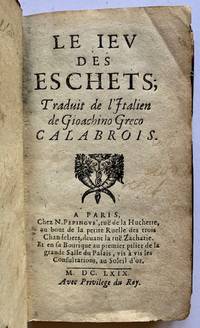
1669rif. 20514Paris: Chez N. Pepingve Avec Privilege du Roi 1669. Full leather. The 1669 1st French edition --and 1st published edition-- of Gioachino Greco's seminal "Le Jeu des Eschets". Greco c. 1600 - c. 1634 was the strongest player in Europe in the early 17th century and among the first to record entire games not just particular openings or combinations. His vast influence as cited by H.J.R. Murray among other historians of the game is keenly felt to this day. This copy is likely in its original full-leather binding certainly in a contemporary-to-the-period binding. Solid and VG with minor forgivable wear along the edges and the preliminaries. The interior though is very clean the pages surprisingly crisp and clean. Originally recorded by hand in Greco's native Italian here translated --and issued in book form-- for the first time. Chez N. Pepingve (Avec Privilege du Roi) unknown books
1689rif. C0924343 pages with woodcut printer's device on title. Duodecimo 5 1/2 x 3 1/4. Bound in leather with raised spine bands and gilt to spine. Originally written in 1619 in Italian. From the library of Lothar Schmid. Biblioteca van Der Niemeijeriana: 400 Third French edition. Gioachino Greco also known as Il Calabrese was born around 1600 in Celico which near Cosenza in Calabria. Calabria had already produced such players as Leonardo di Bono and Michele di Mauro. From his writing it's apparent the he wasn't educated and likely came from a lower class family. Already in 1619 Greco started keeping a notebook of tactics and particularly clever games and he took up the custom of giving copies of his manuscripts to his wealthy patrons. In Rome Monsignor Corsino della casa Minutoli Tegrini Cardinal Savelli and Monsignor Francisco Buoncompagni all received copies of which there are extant copies dated 1620 in the Corsiniana library in Rome under the title Trattato del nobilissimo gioco de scacchi. Despite his popularity in Rome in 1621 Greco took off to test himself against the rest of Europe leaving this paper trail as he went. In 1621 he left a fine copy of his manuscripts with Duke Enrico of Lorraine in Nancy. He traveled to Paris where he played Arnauld Isaac de Corbeville Enrico di Savoia the Marquis of St. Sorlin and the Duke of Nemours and Geneva and others. He had apparently been quite successful because in traveling from Paris to England he was waylaid by robbers who divested him of 5000 scudi a princely sum. Finally making it to London he beat all the best players. Sir Francis Godolphin and Nicholas Mountstephen were given copies of his manuscripts. While in London Greco developed an idea to record entire games rather than positions for study and inclusion in his manuscripts. He returned to Paris in 1624 where he rewrote his manuscript collection to reflect his new ideas. He then went to Spain and played at the court of Philip IV. There he beat his mentor and the strongest player of the time other than himself don Mariano Morano. He finally returned to Italy where he was enticed to traveling to the New Indies the Americas by a Spanish nobleman. He seemingly contracted some disease there and died around 1630 possibly 1634 at the young age of 30 34. He generously left all the money he earned at chess to the Jesuits. Gioachino Greco stood head and shoulders above his contemporaries a feat seldom duplicated. David Hooper in The Oxford Companion to Chess states that Greco probably made up the games in his manuscripts. The question of whether he actually played the games or invented them is rather moot since if he invented them he was perfectly capable of playing them. Lothar Maximilian Lorenz Schmid 10 May 1928 – 18 May 2013 was a German chess grandmaster. He was born in Radebeul near Dresden into a family who were the co-owners of the Karl May Press which published the German Karl May adventure novels. He was best known as the chief arbiter at several World Chess Championship matches in particular the 1972 encounter between Bobby Fischer and Boris Spassky at Reykjavic. He was also an avid collector of chess books and paraphernalia. It was reputed that he owned the largest known private chess library in the world as well as a renowned collection of chess art chess boards and chess pieces from around the globe. Condition: Leather rubbed and scuffed Lothar Schmid's label to front paste down. Spine label missing spine bands rubbed old neat signature to title some doodling to back end papers else a good copy. Jacques le Febure hardcover books
1713rif. C0588343 pages. Duodecimo 5 ½" x 3 ¼". Bound in vellum with black lettering to spine. Originally written in 1619 in Italian. Biblioteca van Der Niemeijeriana: 402 Gioachino Greco also known as Il Calabrese was born around 1600 in Celico which near Cosenza in Calabria. Calabria had already produced such players as Leonardo di Bono and Michele di Mauro. From his writing it's apparent the he wasn't educated and likely came from a lower class family. Already in 1619 Greco started keeping a notebook of tactics and particularly clever games and he took up the custom of giving copies of his manuscripts to his wealthy patrons. In Rome Monsignor Corsino della casa Minutoli Tegrini Cardinal Savelli and Monsignor Francisco Buoncompagni all received copies of which there are extant copies dated 1620 in the Corsiniana library in Rome under the title Trattato del nobilissimo gioco de scacchi. Despite his popularity in Rome in 1621 Greco took off to test himself against the rest of Europe leaving this paper trail as he went. In 1621 he left a fine copy of his manuscripts with Duke Enrico of Lorraine in Nancy. He traveled to Paris where he played Arnauld Isaac de Corbeville Enrico di Savoia the Marquis of St. Sorlin and the Duke of Nemours and Geneva and others. He had apparently been quite successful because in traveling from Paris to England he was waylaid by robbers who divested him of 5000 scudi a princely sum. Finally making it to London he beat all the best players. Sir Francis Godolphin and Nicholas Mountstephen were given copies of his manuscripts. While in London Greco developed an idea to record entire games rather than positions for study and inclusion in his manuscripts. He returned to Paris in 1624 where he rewrote his manuscript collection to reflect his new ideas. He then went to Spain and played at the court of Philip IV. There he beat his mentor and the strongest player of the time other than himself don Mariano Morano. He finally returned to Italy where he was enticed to traveling to the New Indies the Americas by a Spanish nobleman. He seemingly contracted some disease there and died around 1630 possibly 1634 at the young age of 30 34. He generously left all the money he earned at chess to the Jesuits. Gioachino Greco stood head and shoulders above his contemporaries a feat seldom duplicated. David Hooper in The Oxford Companion to Chess states that Greco probably made up the games in his manuscripts. The question of whether he actually played the games or invented them is rather moot since if he invented them he was perfectly capable of playing them. Condition: Old owner's inscription laid in to both front and back paste downs some slight foxing still has the original ribbon book mark. Other wise a good copy. Chezz Jacques Le Febvre hardcover books
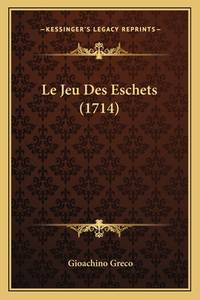
1714rif. 9370Paris: Denis Mouchet 1714. Sixth French edition. 12mo 22 344pp. Woodcut device on title. Contemporary speckled calf spine decorated and lettered in gilt. Bookplate of Albert Parsons Sachs on front pastedown and a bibliographic note in his hand on verso of ffep. French private library stamp on title page and blank verso of final leaf of text. Boards with some soiling and rubbing at corners spine ends and joints. Very good and sound. Handsomely bound French edition of this early systematic chess manual by the Italian master Giachino Greco ca. 1600-1634. The text helped standardize early modern opening theory and though it was circulated in manuscript during his lifetime was not printed until 1636 in French and expanded under this title in 1669. The first edition in English was 1656 with Italian editions appearing later. Sachs' note reads: V.D. Linde I 364. Denis Mouchet unknown
1689rif. C0924343 pages with woodcut printer's device on title. Duodecimo 5 1/2 x 3 1/4. Bound in leather with raised spine bands and gilt to spine. Originally written in 1619 in Italian. From the library of Lothar Schmid. Biblioteca van Der Niemeijeriana: 400 Third French edition. Gioachino Greco also known as Il Calabrese was born around 1600 in Celico which near Cosenza in Calabria. Calabria had already produced such players as Leonardo di Bono and Michele di Mauro. From his writing it's apparent the he wasn't educated and likely came from a lower class family. Already in 1619 Greco started keeping a notebook of tactics and particularly clever games and he took up the custom of giving copies of his manuscripts to his wealthy patrons. In Rome Monsignor Corsino della casa Minutoli Tegrini Cardinal Savelli and Monsignor Francisco Buoncompagni all received copies of which there are extant copies dated 1620 in the Corsiniana library in Rome under the title Trattato del nobilissimo gioco de scacchi. Despite his popularity in Rome in 1621 Greco took off to test himself against the rest of Europe leaving this paper trail as he went. In 1621 he left a fine copy of his manuscripts with Duke Enrico of Lorraine in Nancy. He traveled to Paris where he played Arnauld Isaac de Corbeville Enrico di Savoia the Marquis of St. Sorlin and the Duke of Nemours and Geneva and others. He had apparently been quite successful because in traveling from Paris to England he was waylaid by robbers who divested him of 5000 scudi a princely sum. Finally making it to London he beat all the best players. Sir Francis Godolphin and Nicholas Mountstephen were given copies of his manuscripts. While in London Greco developed an idea to record entire games rather than positions for study and inclusion in his manuscripts. He returned to Paris in 1624 where he rewrote his manuscript collection to reflect his new ideas. He then went to Spain and played at the court of Philip IV. There he beat his mentor and the strongest player of the time other than himself don Mariano Morano. He finally returned to Italy where he was enticed to traveling to the New Indies the Americas by a Spanish nobleman. He seemingly contracted some disease there and died around 1630 possibly 1634 at the young age of 30 34. He generously left all the money he earned at chess to the Jesuits. Gioachino Greco stood head and shoulders above his contemporaries a feat seldom duplicated. David Hooper in The Oxford Companion to Chess states that Greco probably made up the games in his manuscripts. The question of whether he actually played the games or invented them is rather moot since if he invented them he was perfectly capable of playing them. Lothar Maximilian Lorenz Schmid 10 May 1928 – 18 May 2013 was a German chess grandmaster. He was born in Radebeul near Dresden into a family who were the co-owners of the Karl May Press which published the German Karl May adventure novels. He was best known as the chief arbiter at several World Chess Championship matches in particular the 1972 encounter between Bobby Fischer and Boris Spassky at Reykjavic. He was also an avid collector of chess books and paraphernalia. It was reputed that he owned the largest known private chess library in the world as well as a renowned collection of chess art chess boards and chess pieces from around the globe. Condition: Leather rubbed and scuffed Lothar Schmid's label to front paste down. Spine label missing spine bands rubbed old neat signature to title some doodling to back end papers else a good copy. Jacques le Febure hardcover
1713rif. C0588343 pages. Duodecimo 5 ½" x 3 ¼". Bound in vellum with black lettering to spine. Originally written in 1619 in Italian. Biblioteca van Der Niemeijeriana: 402 Gioachino Greco also known as Il Calabrese was born around 1600 in Celico which near Cosenza in Calabria. Calabria had already produced such players as Leonardo di Bono and Michele di Mauro. From his writing it's apparent the he wasn't educated and likely came from a lower class family. Already in 1619 Greco started keeping a notebook of tactics and particularly clever games and he took up the custom of giving copies of his manuscripts to his wealthy patrons. In Rome Monsignor Corsino della casa Minutoli Tegrini Cardinal Savelli and Monsignor Francisco Buoncompagni all received copies of which there are extant copies dated 1620 in the Corsiniana library in Rome under the title Trattato del nobilissimo gioco de scacchi. Despite his popularity in Rome in 1621 Greco took off to test himself against the rest of Europe leaving this paper trail as he went. In 1621 he left a fine copy of his manuscripts with Duke Enrico of Lorraine in Nancy. He traveled to Paris where he played Arnauld Isaac de Corbeville Enrico di Savoia the Marquis of St. Sorlin and the Duke of Nemours and Geneva and others. He had apparently been quite successful because in traveling from Paris to England he was waylaid by robbers who divested him of 5000 scudi a princely sum. Finally making it to London he beat all the best players. Sir Francis Godolphin and Nicholas Mountstephen were given copies of his manuscripts. While in London Greco developed an idea to record entire games rather than positions for study and inclusion in his manuscripts. He returned to Paris in 1624 where he rewrote his manuscript collection to reflect his new ideas. He then went to Spain and played at the court of Philip IV. There he beat his mentor and the strongest player of the time other than himself don Mariano Morano. He finally returned to Italy where he was enticed to traveling to the New Indies the Americas by a Spanish nobleman. He seemingly contracted some disease there and died around 1630 possibly 1634 at the young age of 30 34. He generously left all the money he earned at chess to the Jesuits. Gioachino Greco stood head and shoulders above his contemporaries a feat seldom duplicated. David Hooper in The Oxford Companion to Chess states that Greco probably made up the games in his manuscripts. The question of whether he actually played the games or invented them is rather moot since if he invented them he was perfectly capable of playing them. Condition: Old owner's inscription laid in to both front and back paste downs some slight foxing still has the original ribbon book mark. Other wise a good copy. Chezz Jacques Le Febvre hardcover
rif. B9781166319984New. unknown
1669rif. 20514Paris: Chez N. Pepingve Avec Privilege du Roi 1669. Full leather. The 1669 1st French edition --and 1st published edition-- of Gioachino Greco's seminal "Le Jeu des Eschets". Greco c. 1600 - c. 1634 was the strongest player in Europe in the early 17th century and among the first to record entire games not just particular openings or combinations. His vast influence as cited by H.J.R. Murray among other historians of the game is keenly felt to this day. This copy is likely in its original full-leather binding certainly in a contemporary-to-the-period binding. Solid and VG with minor forgivable wear along the edges and the preliminaries. The interior though is very clean the pages surprisingly crisp and clean. Originally recorded by hand in Greco's native Italian here translated --and issued in book form-- for the first time. Chez N. Pepingve (Avec Privilege du Roi) unknown
1741rif. 227448Liege Belgium: Chez J. F. Bassompierre 1741. New Edition. Contemporary vellum top edge stain black. Internally very clean and crisp without any traces of foxing insecting or toning. Vellum spine-toned with some rubbing hinges and joints remain very tight. Overall a near fine copy. 18 1-343. 5.5" x 3.5" Considered by many to be the first professional chess player Gioachino Greco had already conquered the ranks of the chess elite in Rome London Paris and Madrid by his early 30s. As one of the first players and chess writers to record entire matches Greco revolutionized the way chess was understood and played. His systematic tactical and aggressive gameplay laid the groundwork for modern opening theory. His records were originally handwritten in Italian in the early 17th century and were first published in 1669 in French as Le Jeu des Echecs. They are some of the earliest known play-by-play records of matches and many of Greco's lines of play in these matches especially his traps and attacking techniques became the foundation for later opening strategies such as the "Greco Gambit" in the "King's Gambit Accepted". This wonderful 1741 edition of Greco's classic truly feels like a treasure lost and now found. Within the humble 18th century binding are the notes of a mastermind waiting to be applied in new and creative ways. Chez J. F. Bassompierre unknown
rif. 110498833X.Gpaperback. Good. Access codes and supplements are not guaranteed with used items. May be an ex-library book. paperback
rif. 1020555807.Ghardcover. Good. Access codes and supplements are not guaranteed with used items. May be an ex-library book. hardcover
rif. 1166319989.Gpaperback. Good. Access codes and supplements are not guaranteed with used items. May be an ex-library book. paperback
1714rif. 17793Paris: Denis Mouchet 1714. Contemporary mottled calf richly gold-tooled spine red sprinkled edges. 12mo. With a woodcut decoration on the title page and a woodcut headpiece in text. Late edition of the French translation of one of the most famous early chess books originally written in Italian and first presented in manuscript by the author the famous Calabrian chess player Giocchino Greco ca. 1600-1635 to the King of Naples in 1619. At first only manuscript transcriptions were made. The first French edition appeared in 1669 after the first English edition of 1656. After a short explanation of the general principles of the game of chess it teaches chess players by presenting chess games and problems only often with a possible defense added as well. The book is divided into two parts the first with 39 games extensively recorded and the second part with 55 more advanced chess problems.With a partly removed owner's inscription on the title-page repeated and partly removed at the first page of the main text. Slightly browned but otherwise in very good condition. Binding slightly rubbed and with slightly soiled paste-downs otherwise very good.l Bibl. Van der Linde-Niemeijeriana 404; Cat. Schaakboekerij Niemeijer 989; Coll. Rimington-Wilson 566. Denis Mouchet, unknown
2021br. "In questo volume ho cercato di riunire le mie due identità primarie, quella del ricercatore di epigrafia maturata alla scuola di maestri quali Luigi Moretti e Reinhold Merkelbach, e quella del professore di letteratura greca e latina, consolidata in anni di continuativo esercizio della docenza in tali materie presso il Liceo Dante Alighieri di Roma. Alla sua realizzazione ho raccolto, da alcuni anni, materiali disparati (...). Progressivamente ho cominciato a raccogliere le iscrizioni anche con l'ausilio dei ben noti repertorî epigrafici, anche se spesso, a seconda del criterio adottato, la ricerca pareva vacillare per l'eccessiva abbondanza del materiale pertinente e la conseguenza impossibilità (almeno per un unico redattore) di poterlo elaborare da solo, non oso dire in maniera esaustiva, ma perlomeno significativa. Alla fine ho messo in piedi questa raccolta, di cui ho già pubblicato uno specimen in lingua latina, sotto il titolo di Scriptorum Antiquorum Ttituli I (...). L'opera è sostanzialmente articolata in tre parti: la presente [vol. 1] costituisce una trattazione nella quale sono inglobate notizie e fonti circa gli autori, in particolar modo quelli la cui importanza è sottolineata dal rinvenimento casuale di iscrizioni che li riguardavano (...). La seconda parte del lavoro [vol. 2] è la raccolta medesima delle iscrizioni, collegate attraverso numeri progressivi e lettere (entrambi in neretto) alle pagine del testo (...). La terza parte [vol. 3] è costituita dagli indici." (l'autore)
1928Mm 175x265 Collana "Fonti per la Storia d'Italia" - Testo greco emendato sui manoscritti con traduzione italiana a cura di Domenico Comparetti; edizione postuma licenziata da Domenico Bassi - Volume nella sua brossura originale con copertina a stampa i due colori, lxxx-359 pagine con tre tavole in chiusura non comprese nel testo. Leggere tracce d'uso al dorso, fioriture in alcune parti del testo, peraltro buona copia con legature ben salde. Spedizione in 24 ore dalla conferma dell'ordine.
1926(Codice LL/0203) In 8°(19,5 cm) XII-139. pp. A cura di G.Finzi. Brossura editoriale. Ottimo e freco volume. ~~~ SPEDIZIONE IN ITALIA SEMPRE TRACCIATA
1950Paris, Editions du chêne 1950. In folio en feuillets, sous couverture illustrée rempliée. Introduction de Paul Henri Michel
1969rif. 82803Milano - Paris : Rizzoli Editore - Robert Laffont 1969. reliure d'éditeur sous jaquette. LE GRECO. - LAFUENTE FERRARI Enrique texte de.Le Greco. Les dernières années de Tolede. Avec un appendice de José Manuel Pita Andrade. Maître d’oeuvre pour l’édition française: André Barret. Traduction de Ada Carella Verene Colombano. Collection Les Sommets de l’Art sous la direction de Paolo Lecaldano. Milano - Paris Rizzoli Editore - Robert Laffont1969 420x360mm 155 pages 50 planches en couleurs122 illustrations couleurs contrecollées reliure d'éditeur sous jaquette. Avec emboitage toilé. Exemplaire sur papier vergé pour le texte. Exemplaire à l'état de neuf. No hidden customs fees for orders shipped to the U.S.A with a value of up to 800 USD PDDP shipping we pay the VAT in advance Rizzoli Editore - Robert Laffont unknown
1943Album de reproductions en noir de 49 peintures du peintre d'origine crétoise Le Greco (1541?-1614): d'oeuvres dans leur ensemble suivies de 1 à 6 détails selon les tableaux, certains grandeur nature (nombreuses planches et doubles planches); précédées du texte de Jean COCTEAU (1889-1963) "Le mythe du Gréco" en édition originale, d'un sonnet de GONGORA traduit par Jean COCTEAU, et d'un reportage photographique sur la Crète par le photographe et cinéaste René ZUBER (1902-1979). Dans la collection dirigée par Anna Marsan. Français
1943rif. 450962Paris : Au Divan 1943. First Edition. Softcover. Very good paperback copy; wrappers somewhat dust-toned with some wear to spine extremities and top edge. Back wrapper somewhat unevenly sun-toned. Remains well-preserved overall. Date is suggested. Series; Les demi-dieux. Physical description; unpaginated 49 plates : illustrations reproductions ; 31 cm. Subjects; Greco 1541-1614. Painting Renaissance--Spain. Paris : Au Divan paperback
1911(Codice CV/9481) In 8° (21,5 cm) 137 pp. Prima edizione. Lievi ingialliture. Brossura editoriale, buono stato. ~~~ SPEDIZIONE IN ITALIA SEMPRE TRACCIATA