Wolf, Norbert; Albrecht Durer (DA¼rer)Biblio.com
4009 risultati
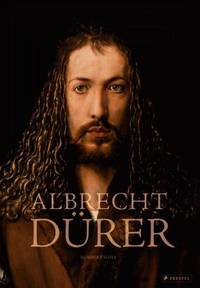
2010rif. C86911Prestel. As New. Hardcover. FREE UPGRADE to Courier/Priority Shipping Upon Request - IN STOCK AND IMMEDIATELY AVAILABLE FOR SHIPMENT - Flawless copy brand new pristine never opened -- Text in English. 299 pages; 200 illustrations in color. Catalogue Raisonne Catalog Raisonné Complete Works Life and Work Raisonnee -- with a bonus offer-- - May be EITHER: out of print OOP and extremely rare in this pristine condition; signed by author or contributor; or a first or special edition; inquire for details; Drawing on the latest research this luxurious volume presents an exciting new interpretation of Durer both as a man and as an artist. Durer's prints and drawings inspired centuries of artists both during his life and after his death. Yet his talent as a painter and colourist and his enthusiasm for the scientific world have not been widely appreciated. Durer's influence was both international and intergenerational; indeed Picasso claimed to have been inspired by the sixteenth-century artist. Reproduced in stunning detail and including illustrations of Durer's most famous prints and drawings a catalogue raisonne of his paintings and biographical research this book presents a Durer for the twenty-first century. Producing more self-portraits than any other artist of his day; mass marketing his best-selling prints; even inventing his own monogram logo; Albrecht Durer was commercially astute long before today's generation of slick self-promoters and savvy mega-bucks artists. There are 55 extant Durer's of which 17 are in dispute. Using the very latest scientific research this book puts all arguments to bed resulting in the definitive catalogue raisonne of the paintings. Not since 1971 has such a feat of painstaking research been attempted. After an almost 40-year wait the truth behind the man and his art can finally be revealed. . 2010. 3791344269 . Prestel hardcover
1969rif. 86394FLAMMARION. As New. 1969. Hardcover. FREE UPGRADE to Courier/Priority Shipping Upon Request - IN STOCK AND IMMEDIATELY AVAILABLE FOR SHIPMENT - AS NEW THE TEXT BLOCK IS PRISTINE CLEAN UNMARKED AND IN EXCELLENT CONDITION - - - 120 pages; over 350 illustrations including 64 color plates. Duerer Catalogue Raisonné Catalogue Raisonne Catalog Raisonnee uvre Oeuvre FLAMMARION hardcover
1968rif. 86395Rizzoli. As New. 1968. Hardcover. FREE UPGRADE to Courier/Priority Shipping Upon Request - IN STOCK AND IMMEDIATELY AVAILABLE FOR SHIPMENT - AS NEW THE TEXT BLOCK IS PRISTINE CLEAN UNMARKED AND IN EXCELLENT CONDITION - - 120 pages; many illustrations. Catalogue Raisonné Catalogue Raisonne Catalog Raisonnee Complete Works Rizzoli hardcover
1871rif. 83819Theodor Ackermann. As New. Hardcover. FREE UPGRADE to Courier/Priority Shipping Upon Request - IN STOCK AND IMMEDIATELY AVAILABLE FOR SHIPMENT - AS NEW THE TEXT BLOCK IS PRISTINE CLEAN UNMARKED AND IN EXCELLENT CONDITION - - - Text in German. 4 169 3 pages; 343 items described; 2 plates; 4to. -- with a bonus offer-- . 1871. Theodor Ackermann hardcover
2010rif. 86911Prestel. New. 2010. Hardcover. 3791344269 . FREE UPGRADE to Courier/Priority Shipping Upon Request - IN STOCK AND IMMEDIATELY AVAILABLE FOR SHIPMENT - Flawless copy brand new pristine never opened -- Text in English. 299 pages; 200 illustrations in color. Catalogue Raisonne Catalog Raisonné Complete Works Life and Work Raisonnee Prestel hardcover
rif. 519621498.Haut: 39 cm.Larg: 28 cm.Gravure sur bois de fil.
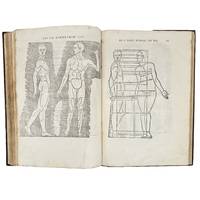
1591rif. durer-della-simmetria-deiVenetia Venice: Domenico Nicolini 1591. First Italian Edition. hardcover. Fine. Dürer Albrecht. Libri quattro. 1591 First Italian Edition. In Folio. Leaves 1 f.e 6 143 including 3 folded plates 1 colophon; 1 r.e. Venetia Venice. Domenico Nicolini. Modern period-style binding full morocco with blind and gilt tooling to boards and spine; spine with five raised bands. Leaf 29 misnumbered 27; leaf 74 skipped in the pagination but complete as in other copies. Four double-page plates on three folded leaves the first two only on the recto; the others printed on recto and verso on the same leaf pp. 96-97. 110 woodcut illustrations throughout the text. Very small numerical calculations in ink on the front endpaper in an early hand; possibly the same hand annotated the rear endpaper with notes in Italian relating to the subject matter of the book with references to Michelangelo Buonarroti. Minor worming at the upper inner margin of the last 40 leaves well away from text and images. The folded plate 98 has been professionally restored at the back of the fold. Light browning to a few of the final text pages. A crisp copy in very good condition. First Italian edition of Albrecht Dürer's celebrated treatise on human proportion translated from the Latin version printed in Nuremberg between 1532 and 1534. Originally conceived as an instructional manual for artists and first published in German in 1528 the work applies mathematical proportion to the depiction of the human body in pursuit of harmonious form. Dürer's position within Renaissance debates is distinctive: unlike Leonardo da Vinci or Michelangelo he rejected anatomical dissection believing that anatomy fragmented the body and obscured its unity. Geometry and proportion by contrast offered a comprehensive vision of the figure. Published posthumously in Venice by Nicolini in 1591 this folio edition is a cornerstone of scientific anthropometry. The translation by Giovanni Paolo Gallucci expands the original four books with a fifth addressing the artistic representation of human diversity. Celebrated and influential the work bridges Renaissance art theory and scientific inquiry. Ref. Cicognara 321; Meder p. 289. This treatise written illustrated and designed by Dürer is the first printed work to address comparative and differential anthropometry drawing on classical sources Villard de Honnecourt Vitruvius Alberti and da Vinci while presenting an original study of human physiques. Dürer's mathematical system of proportion aimed to provide artists with tools to depict all human types treating beauty as relative and grounded in geometry. The four books cover proportions of adults and infants mathematical transformations of proportions and the geometry of bodily movement accompanied by detailed woodcut diagrams with early cross-hatching techniques. The volume contains three double-page plates and over a hundred full-page woodcut illustrations demonstrating Dürer's mathematical and geometric approach to the human form. The illustrations are copies of the original woodcuts from the first German edition Nuremberg 1528 executed by Hieronymus Andreä "Formschneider" literally "the woodblock cutter" after Dürer's widow request. The text systematically examines human proportions through constructed scales and measurements: the body divided into seven and eight parts separate studies of men women and children variations of corpulence and thinness governed by mathematical rules and figures shown in movement and foreshortening. Giovanni Paolo Gallucci's Italian translation proved the most enduring and frequently cited version of Durer's masterwork during the following centuries. The work is grounded in the relationship between beauty and proportion and between microcosm and macrocosm concepts central not only to early modern visual theory but also to music physiognomic and humoral theory astronomy and astrology cosmology theology philosophy and even mnemonics and poetry. Gallucci further expanded the original work by adding a Preface a Life of Dürer and a Fifth Book which provides a philosophical framework for interpreting Dürer's original four books and situates the mathematical study of the body within a broader humanistic worldview. A chance to see inside Dürer's mind as he works through form proportion and beauty across more than a hundred woodcuts on his own design supporting his original approach: rigorous systematic and unmistakably brilliant. Domenico Nicolini hardcover
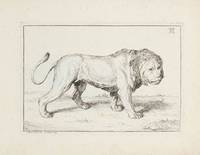
rif. 51-6119Amsterdam: Bernard Picart and Paris : Chereau 1729. Oblong 4to. 25.5 x 18.8cm. Contemporary marbled calf and gilt spine.2 6pp. Engraved title page followed by 42 engravings on 36 plates. Very good with unfoxed plates.OCLC Number / Unique Identifier:469747697; Nissen ZBI 3167; Brunet IV 630; Nagler XII 414 123 Amsterdam: Bernard Picart and Paris : Chereau, 1729. unknown
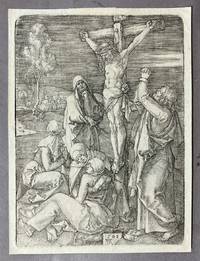
1508rif. 0071401508. No Binding. Very Good. Engraved on laid paper page size: approx. 140 x 105 mm. Signed in the plate with the artist's monogram "AD" and dated 1508. A powerful and highly refined engraving from Durer's mature period depicting the Crucifixion with Christ on the Cross flanked by the Virgin Mary St. John and the mourning women. The composition demonstrates Durer's exceptional command of line with dense controlled burin work used to model form texture and emotional intensity. The carefully articulated landscape and expressive figures exemplify the artist's synthesis of Northern devotional imagery and Renaissance compositional clarity. Durer's early devotional engravings are among the most sought-after works in the history of printmaking prized for their technical brilliance and historical importance. The Crucifixion of 1508 represents a pivotal moment in Durer's development combining emotional gravity with extraordinary precision of line. Fine impressions such as the present example are increasingly scarce on the market particularly in well-balanced condition making this an excellent opportunity for collectors of Old Master prints and early Northern Renaissance art. Condition is a very good well-preserved impression on laid paper. The engraving retains strong clear plate lines with good tonal depth. Light even toning throughout with minor handling wear and slight edge softening consistent with print age. No significant defects tears or restorations noted. Overall a sound and attractive example. Bartsch 15; Meder 14. Ships unmounted and unframed unknown
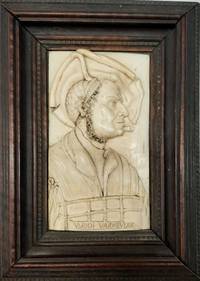
rif. elala5896cGermany: c16th-17th century. The subject Ulrich Varnbüler 1474-1545 was a German humanist and public official. In 1521 he was appointed chancellor to the Reichsregiment 1521-30 which was to exercise imperial powers in Germany in the absence of Charles V. With the Reichsregiment he first resided in Nuremberg where his friend Albrecht Dürer sketched his portrait for a woodcut which was executed in 1522 and upon which this ivory is based. The text in the cartouche of the woodcut reads in translation: "Through this picture Albrecht Dürer from Nuremberg would like to recognize Ulrich the secretary and chief clerk of the Roman imperial government with the surname Varnbüler whom he loves immensely." Varnbüler was also friends with Erasmus and translated into German the latter's adage 'Dulce bellum inexpertis' Basel: 1519. Varnbüler was instrumental in obtaining in the name of the emperor protective privilege against pirated editions for works published by Johan Froben and Andreas Cratander. A number of works were dedicated to him by Cratander Willibald Pirckheimer and Peter II Schöffer. See P.G.Bietenholz Contemporaries of Erasmus' 1987 Vol. III p. 377. 6 3/4 x 3 3/4 inches size of plaque. 10 x 7 ½ inches size with frame. mounted in an antique wooden frame c1840 on a pine backing board a number of minor surface blemishes crack of not more than ½ inch in top near centre & 2 small cracks of not more than ½ inch in hat. elala5896 [cGermany: c16th-17th century]
Xilografia misure: mm 280 x 379 Pittore e incisore tedesco. Dopo una prima istruzione presso la bottega del padre orefice, nel 1486 studia con il pittore Michael Wolgemut, il maggiore pittore e xilografo attivo in quegli anni a Norimberga. Di questo primo periodo si conservano rarissimi disegni che portano la firma "Ad", sostituita con il monogramma nel 1496. A partire dal 1490 Dürer inizia i suoi viaggi per la Germania. Lavorando di volta in volta nei luoghi visitati, anche Venezia nel 1494, il suo nome iniziò a circolare. Proprio il primo viaggio in Italia sarà fondamentale per la sua formazione, in particolare, si arricchì del plastico monumentalismo di Mantegna e delle armonie classiche del Pollaiolo e di Giovanni Bellini. Tornato in patria aprì una bottega molto fiorente e stabilì un importante sodalizio con l'elettore di Sassonia Federico il Saggio. Tra il 1507-09 lo ritroviamo a Venezia al centro della raffinata società di nobili, artisti e umanisti della Serenissima, come artista illustre soprattutto per le sue incisioni. In questo periodo l'artista si soffermò su problemi coloristici, dovuti al contatto con Giorgione e Tiziano, risolvendoli in pale d'altare in cui lo spazio, i colori di smalto, il divino "umanizzato" sono le caratteristiche essenziali. Nell'ultimo periodo di vita si occupò principalmente della pubblicazione dei suoi scritti teorici, arricchiti da disegni scientifici. Dürer è il più grande artista del Rinascimento nordico che, attraverso le sue opere, è stato cerniera tra il nord e il sud dell'Europa. La sua grande passione per l'incisione fa si che tale tecnica venga concepita dall'artista come una forma d'arte a se stante, e ne sviluppa e cura temi diversi e innovativi, che lo portano ad essere forse il migliore incisore di stampe antiche, insieme a Goya e Rembrandt. La scena che vede rappresentati Sansone e il leone, si svolge in un paesaggio descritto accuratamente. Due città fortificate, un boschetto sulla sinistra, alberi, arbusti e profili di montagne sullo sfondo che si riversano nel mare solcato da diverse imbarcazione. Nonostante questi particolari l'attenzione dello spettatore si concentra sulla scena in primo piano ricca di pathos e tensione raccontata nel Libro dei Giudici. Per la raffigurazione del soggetto l'artista ha guardato alle opere del Maestro ES (circa 1420 - circa 1468) e di Israhel van Meckenem (1440 ca. - Bocholt 1503). Sansone giudice biblico dalla forza disumana donata da Dio è a cavallo del leone e cerca di forzare la bocca della bestia; l'eroe avvolto nel suo abito panneggiato e svolazzante afferra con tutta la sua forza l'animale dalla folta criniera quasi tangibile. Questa stampa viene messa in relazione con un'altra incisone di Durer: l'Ercole e i Molionidi per l'enfasi, il soggetto e il paesaggio rappresentato, inoltre per l'espressività del volto di Sansone alcuni studiosi hanno ipotizzato che Durer si sia ispirato al volto di Cristo portacroce di Leonardo. Monogramma in basso al centro. La matrice in legno è conservata al Metropolitan Museum of Art a New York. Impressione eccellente dei neri intensi, il cui rilievo è visibile anche al verso. Ottimo stato di conservazione, eccetto una piccola mancanza nel margine superiore di 4 mm e qualche strappo restaurato lungo i margini. Stato tra b e c: con una spaccatura in corrispondenza della roccia e uno nel profilo delle montagne, ma non sul monogramma. Al verso a matita antiche scritte di catalogazione: N15/ B 2; n 893/ b2. , Un altro esemplare è conservato presso la Raccolta delle Stampe Achille Bertelli. Bibliografia: Meder 107; Bartsch 2; Strauss 33; Dodgson I.271.8; TIB 2 (116), Commentary 1001.202
rif. #[24942]Arnhem Jan Jansz. 1622. Folio half vellum good condition. 266 p. Illustrated with numoerous woodcut prints. Some browning. B0298. hardcover
1557In-4 p. (mm. 307x204), elegante legatura in p. pelle mod., cornici a secco e picc. decorazioni oro ai piatti, dorso a cordoni con fregi e tit. oro, 4 cc.nn., 122 cc.num. (di cui 4, ripiegate: n2 - r1 - r2 e v4 - sono segnate come singole ma contate come doppie nella numerazione). Il volume è ornato da una bella marca tipografica al frontespizio (raffigura un cavaliere su Pegaso nell’intento di trafiggere un drago con la lancia e, sullo sfondo, una città), da una pregevole testata e grandi iniziali a grottesche, ed è illustrato nel da 145 figure (corpi umani della grandezza della pagina), da alc. particolari (crani, mani e piedi) e da diagrammmi. Le interessanti illustrazioni sono copie delle silografie originali di Duerer della prima edizione tedesca, Norimberga, 1528. Celebrata ed importante opera. Cfr. Choulant, p. 143 e ss: "Albrecht Duerer (Nuremberg 1471 - 1528), like Leonardo da Vinci, wrote treatises on mathematics, chemistry, hydraulics, anatomy, and other scientific subjects.. He was one of the first artists in Germany who practiced and taught the rules of perspective, which he is said to have learned from Lucas von Leyden.. His book on human proportions was prepared for the press after his death by his lifelong friend Willibald Pirkheimer, and it appeared in October, 1528.. The work is divided into four books. The first two books treat of the proper proportions of the human form and its separate members, according to a constructed scale. He first divides the body into seven parts, each having the same measurement as the head, and he next considers the same divided into eight parts, giving also a separate consideration to the proportions of children. The woman, he considers, ought to be an eighteenth part shorter than man. In his proportions of the female figure he follows, perhaps unwittingly, the celebrated standard of the Venus de' Medici. In his third book he changes these proportions according to mathematical rule, and gives examples of ludicrously fat and thin figures, in which some one proportion is frightfully exaggerated. In the fourth book he shows the human form in movement, and treats especially of foreshortenings..” - Adams,I, p. 371 - Brunet,II,914 - Cicognara,319: “nitidissima edizione”. Leggerm. corto del margine super.; con qualche lieve alone e uniformi lievi ingialliture ma un buon esemplare.
Xilografia originale, monogrammata in basso al centro, II/VII, mm 395x288, compreso margine da 1 a 2 mm oltre la linea di riquadro. La prova, nitida e ben contrastata nella II variante di 7, stimata intorno al 1504, è impressa su carta databile ai primi del Cinquecento. Grande ed elaboratissima composizione, che illustra l'atroce martirio dei diecimila soldati cristiani avvenuto sul monte Ararat in Armenia: venne commissionata da Federico il Saggio, mecenate dell'artista fin dal 1496. Nel 1508 Durer dipinse per lui un olio su tavola dalla quale eliminò alcuni particolari, come il supplizio del vescovo Acazio a cui venivano cavati gli occhi con un trapano. Federico, che nel 1502 aveva fondato l'Università di Wittenberg dove insegnarono Lutero e Melantone, fu uno dei principi che si impegnarono per proporre la causa della riforma all'imperatore Massimiliano I, e tentò di proporre le tesi di Lutero, messe al bando, e gli trovò rifugio nel suo castello di Wartburg dopo la Dieta di Worms. Il dipinto è oggi custodito presso il Kunsthistorisches Museum di Vienna. . Meder, n. 218 B/G; Bartsch, n. 117; Strauss, n. 35.
Xilografia originale, monogrammata in basso al centro, II/VII, mm 395x288, compreso margine da 1 a 2 mm oltre la linea di riquadro. La prova, nitida e ben contrastata nella II variante di 7, stimata intorno al 1504, è impressa su carta databile ai primi del Cinquecento. Grande ed elaboratissima composizione, che illustra l'atroce martirio dei diecimila soldati cristiani avvenuto sul monte Ararat in Armenia: venne commissionata da Federico il Saggio, mecenate dell'artista fin dal 1496. Nel 1508 Durer dipinse per lui un olio su tavola dalla quale eliminò alcuni particolari, come il supplizio del vescovo Acazio a cui venivano cavati gli occhi con un trapano. Federico, che nel 1502 aveva fondato l'Università di Wittenberg dove insegnarono Lutero e Melantone, fu uno dei principi che si impegnarono per proporre la causa della riforma all'imperatore Massimiliano I, e tentò di proporre le tesi di Lutero, messe al bando, e gli trovò rifugio nel suo castello di Wartburg dopo la Dieta di Worms. Il dipinto è oggi custodito presso il Kunsthistorisches Museum di Vienna. . Meder, n. 218 B/G; Bartsch, n. 117; Strauss, n. 35.
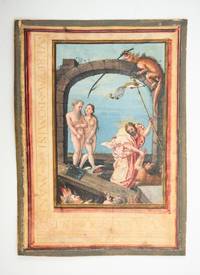
1540rif. ST20622Germany ca. 1540. 183 x 133 mm. 7 1/8 x 5 1/4". WITH A FULL-PAGE MINIATURE DEPICTING THE HARROWING OF HELL featuring a naked Adam and Eve on the left and on the right Christ bending down to rescue John the Baptist the figures framed by a stone archway supporting a hairy creature who aims the point of a spear directly at Adam and Eve the miniature in a thin brown frame with gilt lines surrounded on two sides by the words "VERBUM DOMINI MANET IN ETERNUM" in gilt all framed in gray and red washes with double rules of black and gilt. Light soiling to frame a little flaking to the gray border and a couple of small scuffs and smudges elsewhere verso with spotting but the miniature vibrant and well preserved with only very trivial imperfections. A close copy of an early 16th century engraving by Albrecht Dürer this powerful miniature depicting the Harrowing of Hell is an intriguing artifact that ties together manuscript art print culture and the Reformation. The image depicts an apocryphal tale in the Gospel of Nicodemus in which Christ following his death but before his Resurrection descends into Limbo in order to save righteous souls who had passed away before him particularly figures from the Old Testament. Christ appears here in pale pink robes carrying a long staff with a cross and banner adorning the top. Having just brought down the gates of Hell he stoops to rescue John the Baptist here dressed in furs from its depths. A naked Adam and Eve covering their loins stand at the left of the composition--Adam now a gray-bearded old man as a reflection of sin and mortality but Eve still as she was at the Expulsion in keeping with the period's inclination to retain the classically idealized youthful feminine form. Above them is a stone arch upon which a dog-like demon perches stealthily aiming a spear directly at the oblivious couple. Another demon snaps its jaws at the feet of Christ and we can see a lick of flames below the broken gate as more captive souls clamor to escape. The painting is skillfully done showing the artist's facility with anatomy proportion and foreshortening. The bodies of Adam and Eve are particularly excellent with lovely skin tones and convincing molding. The composition is clearly based on an engraving by Dürer published in 1513 as part of a major series of 16 images known as the "Engraved Passion." In translating a black & white print into a full-color painting the artist here dispensed with a few details seen in Dürer's work such as the shadowy figure behind Adam and Eve and the stigmata on Christ's hand; however the overall composition deviates little from the original suggesting that the artist may have been working from an actual engraving. Although this leaf contains just a few words in the form of a border inscription--"Verbum Domini manet eternum" "the Word of the Lord endures forever"--they are monumentally important. This line from Isaiah 40:8 and 1 Peter 1:25 became the motto of the Lutheran Reformation appearing on art clothing coins and even armor of the 16th century. The Schmalkaldic League an influential group of allied Lutheran principalities in the Holy Roman Empire at the time also adopted it as their motto. Given the dominance of print materials during the Reformation period our hand-painted miniature--possibly produced as a frontispiece--must have been a very special commission. It is also an object that is prime for further study touching on aspects of book production religious art and the transmission of images and ideas in the early modern period. unknown books
1540rif. ST20622Germany ca. 1540. 183 x 133 mm. 7 1/8 x 5 1/4". WITH A FULL-PAGE MINIATURE DEPICTING THE HARROWING OF HELL featuring a naked Adam and Eve on the left and on the right Christ bending down to rescue John the Baptist the figures framed by a stone archway supporting a hairy creature who aims the point of a spear directly at Adam and Eve the miniature in a thin brown frame with gilt lines surrounded on two sides by the words "VERBUM DOMINI MANET IN ETERNUM" in gilt all framed in gray and red washes with double rules of black and gilt. Light soiling to frame a little flaking to the gray border and a couple of small scuffs and smudges elsewhere verso with spotting but the miniature vibrant and well preserved with only very trivial imperfections. A close copy of an early 16th century engraving by Albrecht Dürer this powerful miniature depicting the Harrowing of Hell is an intriguing artifact that ties together manuscript art print culture and the Reformation. The image depicts an apocryphal tale in the Gospel of Nicodemus in which Christ following his death but before his Resurrection descends into Limbo in order to save righteous souls who had passed away before him particularly figures from the Old Testament. Christ appears here in pale pink robes carrying a long staff with a cross and banner adorning the top. Having just brought down the gates of Hell he stoops to rescue John the Baptist here dressed in furs from its depths. A naked Adam and Eve covering their loins stand at the left of the composition--Adam now a gray-bearded old man as a reflection of sin and mortality but Eve still as she was at the Expulsion in keeping with the period's inclination to retain the classically idealized youthful feminine form. Above them is a stone arch upon which a dog-like demon perches stealthily aiming a spear directly at the oblivious couple. Another demon snaps its jaws at the feet of Christ and we can see a lick of flames below the broken gate as more captive souls clamor to escape. The painting is skillfully done showing the artist's facility with anatomy proportion and foreshortening. The bodies of Adam and Eve are particularly excellent with lovely skin tones and convincing molding. The composition is clearly based on an engraving by Dürer published in 1513 as part of a major series of 16 images known as the "Engraved Passion." In translating a black & white print into a full-color painting the artist here dispensed with a few details seen in Dürer's work such as the shadowy figure behind Adam and Eve and the stigmata on Christ's hand; however the overall composition deviates little from the original suggesting that the artist may have been working from an actual engraving. Although this leaf contains just a few words in the form of a border inscription--"Verbum Domini manet eternum" "the Word of the Lord endures forever"--they are monumentally important. This line from Isaiah 40:8 and 1 Peter 1:25 became the motto of the Lutheran Reformation appearing on art clothing coins and even armor of the 16th century. The Schmalkaldic League an influential group of allied Lutheran principalities in the Holy Roman Empire at the time also adopted it as their motto. Given the dominance of print materials during the Reformation period our hand-painted miniature--possibly produced as a frontispiece--must have been a very special commission. It is also an object that is prime for further study touching on aspects of book production religious art and the transmission of images and ideas in the early modern period. unknown
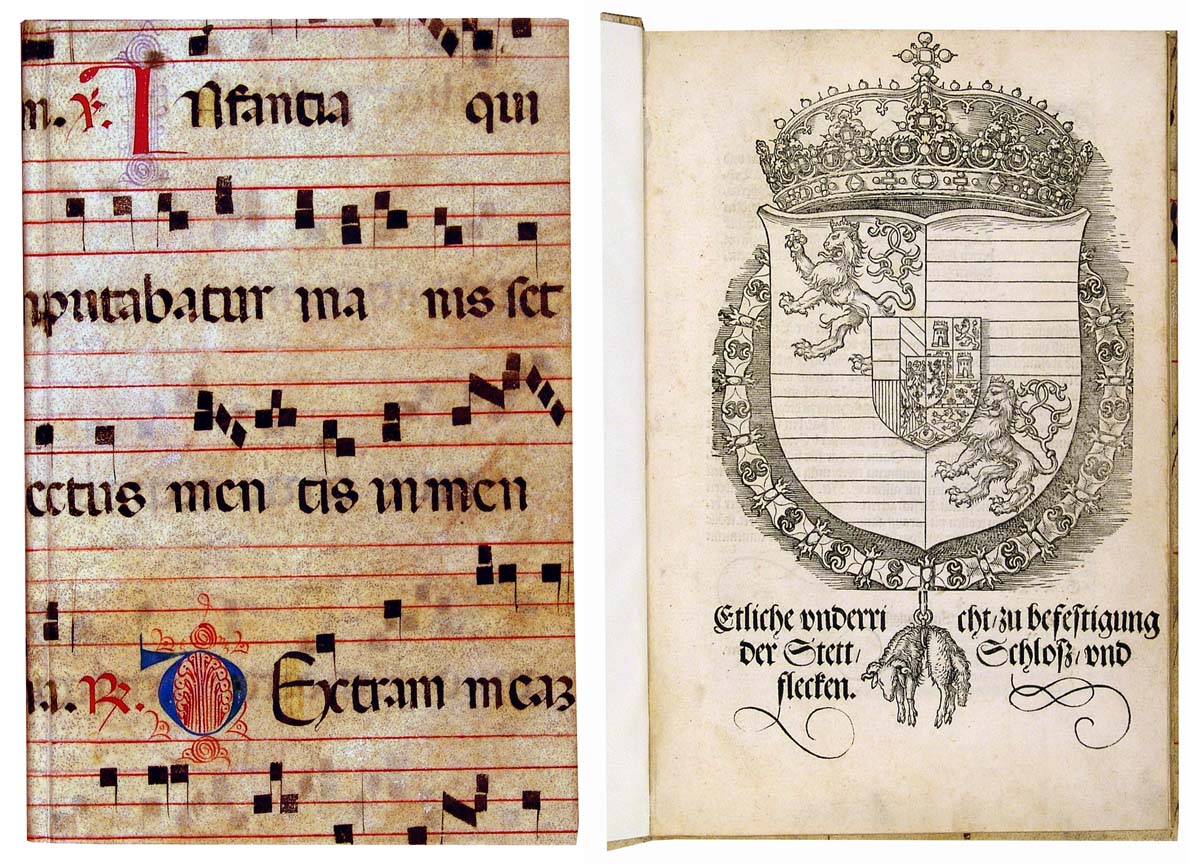
1527rif. 3416Nürnberg, Hieronymus Andreae, 1527. Erste Ausgabe (Ausgabe B der ersten Ausgabe: mit den verbesserten "Irrthumb", Wasserzeichen "Bär mit A"). - Schoch/Mende/Scherbaum III, S. 282ff. - Bohatta 12. - Vorderer Innendeckel mit Exlibris. Stellenweise etwas braunfleckig, die Falten der doppelblattgroßen Blätter teils angeschmutzt. Die letzten 4 Blätter mit Braunfleck im Bundsteg. Ein Doppelblatt mit restauriertem Einriss. - Mit seiner Befestigungslehre begründete Dürer eine eigene deutsche Festungsbaukunst, deren Konzeption beim Bau von vielen Anlagen bis hinein ins 18. Jahrhundert berücksichtigt wurde. Es ist das erste Werk in deutscher Sprache, das eine Befestigungslehre unter Zugrundelegung von Artillerieeinsatz darlegt. Sicherlich wurde das Werk unter dem akuten Eindruck der "Türkengefahr" verfasst. Dürer wollte sich möglicherweise Erzherzog Ferdinand I., dem das Werk gewidmet ist, als Fachmann für Festungsbau empfehlen. - Das Werk gliedert sich in 4 Abschnitte: 1. Anlage einer Stadtbefestigung; 2. Befestigung mit austretenden Streichwehren; 3. Einrichtung einer Passbefestigung; 4. Vorschläge zur Verstärkung älterer Befestigungen. Als Anhang ist noch die Beschreibung einer Lafettenkonstruktion für ein Geschütz beigegeben. - Die Holzschnitte zeigen Ansichten, Pläne, Aufrisse, Details und Perspektiven, sowie ein Geschütz mit Lafette. - Erstes deutschsprachiges Lehrbuch über den Festungsbau aus der Feder des bedeutendsten Künstlers des deutschen Humanismus.
1604rif. 63098Arnhem, Johan Jansen (Jan Jansz), (1603-)1604. Fol. Mit einem Kupferportrait Dürers (monogr. ?DM?) u. zahlr. tlw. ganzs. bzw. gefalt. Holzschnitten (davon 2 m. mont. Einschlagstreifen) von Albrecht Dürer. 2; 90 (das letzte weiß); 131 (davon 4 gefalt.; das letzte weiß); 26 (davon 10 gefalt.) nn. Bll., Etw. späterer orangegefärbter Pgmt.-Bd. m. durchzogenen Bünden u. am Vorderdeckel den Initialen ?HVZ? sowie der Jahreszahl ?1674?.
1532rif. 71508first volume 2 Ai-Oiii 179 leaves including folded second volume a1-j5 55 leaves including folded 268 pages across the 2 books 12 leaves in facsimilie illustrated throughout with black and white line drawings 96 full page illustrations 4 folded plus 24 within the text also various tables within the text text in Latin Published by Hieronymus Andreae [In aedib viduae Durerianae] hardcover
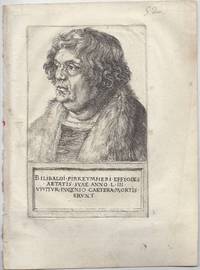
rif. 1060Original engraving 1524. Very clear strong contrast but slightly later impression wide-margined. With the “small coat of arms of Augsburg with ‘A’ and ‘M’” watermark around ca. 1560–1600; Meder 179; Briquet 2119. The inscription in the box below the portrait with no date and monogram. Plate size: 114 × 183 mm; sheet size: 182 × 250 mm. Numbered by old hand in ink at upper right corner. A hole restored at the right margin near the plate with no effect on the print. Very light sporadic foxing on recto more to verso. A small red blot to the left edge of the sheet. A trace of folding at right edge. In passe-partout. Overall in fine condition. Original engraving 1524. Very clear strong contrast but slightly later impression wide-margined. With the “small coat of arms of Augsburg with ‘A’ and ‘M’” watermark around ca. 1560–1600; Meder 179; Briquet 2119. The inscription in the box below the portrait with no date and monogram. Plate size: 114 × 183 mm; sheet size: 182 × 250 mm. Albrecht Dürer’s famous 1524 portrait of his closest friend the humanist scholar and art collector Willibald Pirckheimer. Head and shoulder three-quarter view portrait of Willibald Pirkheimer 1470–1530 facing left wearing a fur-lined coat underneath a tablet with Latin inscription “BILIBALDI PIRKEYMHERI EFFIGIES AETATIS SVAE ANNO L III VIVITVR INGENIO CAETERA MORTIS ERVNT” Portrait of Willibald Pirckheimer at the age of 53. We live by the spirit; the rest belongs to death. The portrait as well as the original plate was given by Dürer to Pirckheimer thus he gave up control over future use of the plate. Pirckheimer used it as a bookplate instead of his actual one that was also designed by Dürer. A very well preserved wide-margined copy. Meder 103; Bartsch 106; Strauss 102; Hollstein 103; Dodgson 101 . unknown
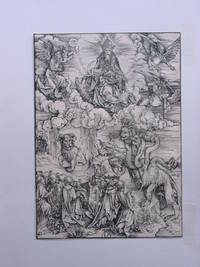
1511rif. 22161511. Woodcut. One of the plates from the set of 16 illustrations of the Apocalypse of Saint John. Fine impression of the only state with the latin text on the verso. 1511. With 1/4" margins 390 x 279 15 3/8 x 11 Meder 175 B. 74 Pan.294 K. 117 T. 137Schoch Mende Scherbaum 123. Watermark: Flower with a triangle M. Watermark #127. Printers crease in upper left corner some glue stains on verso right border not noticeable from the front. Otherwise in fine condition. books
1511rif. 22161511. Woodcut. One of the plates from the set of 16 illustrations of the Apocalypse of Saint John. Fine impression of the only state with the latin text on the verso. 1511. With 1/4" margins 390 x 279 15 3/8 x 11 Meder 175 B. 74 Pan.294 K. 117 T. 137Schoch Mende Scherbaum 123. Watermark: Flower with a triangle M. Watermark #127. Printers crease in upper left corner some glue stains on verso right border not noticeable from the front. Otherwise in fine condition.
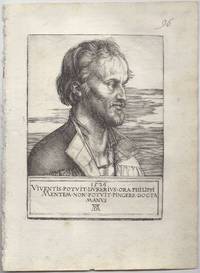
rif. 1059Original engraving 1526. Very clear strong contrasts Meder C impression with the stray burin strokes to the left of the head and the scratch on the forehead. Wide-margined. Plate size: 127 × 173 mm; sheet size: 182 × 250 mm. Numbered by old hand in ink at upper right corner monogrammed and dated 1602 on verso probably by different hand. Very light foxing mostly at edges a brown spot beneath the tablet with inscription. In passe-partout. In fine condition. Original engraving 1526. Very clear strong contrasts Meder C impression with the stray burin strokes to the left of the head and the scratch on the forehead. Wide-margined. Plate size: 127 × 173 mm; sheet size: 182 × 250 mm. Albrecht Dürer’s famous 1526 portrait of Philip Melanchthon the humanist scholar religious reformer theologian and educator. Head and shoulder portrait of Philip Melanchthon 1497–1560 facing right with the background of sky with clouds underneath a tablet with date Dürer’s monogram and the Latin inscription “VIVENTIS POTVIT DVRERIVS ORA PHILIPPI MENTEM NON POTVIT PINGERE DOCTA MANVS” Dürer was able to depict the features of the living Philip but the skilled hand could not portray his mind. This image was the last of the series of five portraits with the use of an inscribed tablet and one of the last of Dürer’s portrait prints to be made. In 1525 Melanchthon worked in Nuremberg to establish a new secular school on behalf of the City Council. While in the city he stayed at Willibald Pirckheimer’s home who was the closest friend of Dürer and the two undoubtedly met either through the host or through other members of the city’s humanist circle. A portrait drawing of Melanchthon was probably made at this time and formed the basis of this engraving that was created in 1526. A very well preserved wide-margined copy. Meder 104; Bartsch 104; Dodgson 102 . unknown
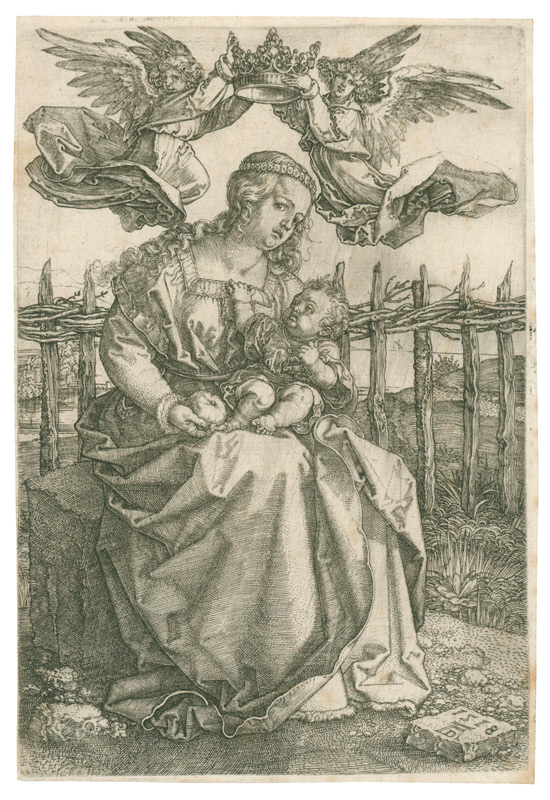
rif. 066-Ao.J. Kupferstich, 1518, auf Bütten. 14,8:10 cm. Literatur: Bartsch 39; Dodgson 87; Meder 38, b-c (von e); Hollstein 38. - Ausgezeichneter, vollkommen warmtoniger Abdruck vor der Vertikalen zwischen der zweiten und dritten Zaunstange rechts, mit kräftigen Bergkonturen im Hintergrund. Wie immer auf Bütten ohne Wasserzeichen. Ringsum mit minimalem Rändchen um die Plattenkante, links teils auf die Plattenkante geschnitten. Abgesehen von einigen kleinen braunen Flecken tadellos erhalten. Provenienz: Sammlung F. Oppermann, Berlin, Lugt 887.