Durer, AlbrechtABAA

4 009 résultats
1966réf. 190023Berlin: German Association of Art Science 1966. Hardcover. Very Good. Cover has general wear. Bookblock has foxing. Tan cloth baords with green title lettering. 510 80 pages: illustrations. German Association of Art Science hardcover books
1938réf. 190025Berlin: German Association of Art Studios 1938. Hardcover. Very Good Cover has general wear. Bookblock has age toning and foxing. Interior pages have age toning. Green cloth boards with gilt lettering. 119 pgs. Illustrations. German Association of Art Studios hardcover books
1938réf. 190282Berlin: German Association of Art Science 1938. Hardcover. Very Good. Cover has general wear. Bookblock has some age tonign and foxing. German language text. Green cloth boards. 119 pages mostly illustrations. German Association of Art Science hardcover books
1994réf. 175455Basel: THC Press 1994. Paperback. VG. Stiff cardboard wraps in cream dust jacket with black illustration and lettering. Unpaginated. Color illustrations. Text in Dutch and English. Catalogue of an exhibition from October 27 to November 3 1994. THC Press paperback books
1971réf. 132247Leningrad 1971. VG- small tear at base of spine. white wraps with black and tan illustration. 108 pp. Approx 44 bw illustrations. In Russian Cyrillic German. 243 works listed. Exhibition catalogue for Durer's graphic work in the collection of the Hermitage. Many large plates. paperback books
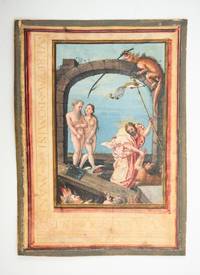
1540réf. ST20622Germany ca. 1540. 183 x 133 mm. 7 1/8 x 5 1/4". WITH A FULL-PAGE MINIATURE DEPICTING THE HARROWING OF HELL featuring a naked Adam and Eve on the left and on the right Christ bending down to rescue John the Baptist the figures framed by a stone archway supporting a hairy creature who aims the point of a spear directly at Adam and Eve the miniature in a thin brown frame with gilt lines surrounded on two sides by the words "VERBUM DOMINI MANET IN ETERNUM" in gilt all framed in gray and red washes with double rules of black and gilt. Light soiling to frame a little flaking to the gray border and a couple of small scuffs and smudges elsewhere verso with spotting but the miniature vibrant and well preserved with only very trivial imperfections. A close copy of an early 16th century engraving by Albrecht Dürer this powerful miniature depicting the Harrowing of Hell is an intriguing artifact that ties together manuscript art print culture and the Reformation. The image depicts an apocryphal tale in the Gospel of Nicodemus in which Christ following his death but before his Resurrection descends into Limbo in order to save righteous souls who had passed away before him particularly figures from the Old Testament. Christ appears here in pale pink robes carrying a long staff with a cross and banner adorning the top. Having just brought down the gates of Hell he stoops to rescue John the Baptist here dressed in furs from its depths. A naked Adam and Eve covering their loins stand at the left of the composition--Adam now a gray-bearded old man as a reflection of sin and mortality but Eve still as she was at the Expulsion in keeping with the period's inclination to retain the classically idealized youthful feminine form. Above them is a stone arch upon which a dog-like demon perches stealthily aiming a spear directly at the oblivious couple. Another demon snaps its jaws at the feet of Christ and we can see a lick of flames below the broken gate as more captive souls clamor to escape. The painting is skillfully done showing the artist's facility with anatomy proportion and foreshortening. The bodies of Adam and Eve are particularly excellent with lovely skin tones and convincing molding. The composition is clearly based on an engraving by Dürer published in 1513 as part of a major series of 16 images known as the "Engraved Passion." In translating a black & white print into a full-color painting the artist here dispensed with a few details seen in Dürer's work such as the shadowy figure behind Adam and Eve and the stigmata on Christ's hand; however the overall composition deviates little from the original suggesting that the artist may have been working from an actual engraving. Although this leaf contains just a few words in the form of a border inscription--"Verbum Domini manet eternum" "the Word of the Lord endures forever"--they are monumentally important. This line from Isaiah 40:8 and 1 Peter 1:25 became the motto of the Lutheran Reformation appearing on art clothing coins and even armor of the 16th century. The Schmalkaldic League an influential group of allied Lutheran principalities in the Holy Roman Empire at the time also adopted it as their motto. Given the dominance of print materials during the Reformation period our hand-painted miniature--possibly produced as a frontispiece--must have been a very special commission. It is also an object that is prime for further study touching on aspects of book production religious art and the transmission of images and ideas in the early modern period. unknown books
1817réf. 19583London: R. Ackermann 1817. First edition. Hardcover. Recased in quarter brown morocco and maroon boards. Very good. Durer Albrecht. 8 pages in text. Folio 38 x 28 cm. Portrait title in red and black forty-three lithographic plates of borders printed in various colors. An important printing milestone the first book printed by lithography in England. ABBEY LIFE 202. "Attempts had been made earlier at lithography as witness Forbes's Oriental Memoirs' which contain a few specimens engraved in 1811 but this book is the first serious attempt to popularize the new method. Books from Ackermann's Lithographic Press' are scanty." Bookplate contents fresh and clean light dampstain to a few leaves at hinge head slight rubbing to joints front cover rehinged. Orig. front cover laid-in at rear. R. Ackermann hardcover books
1922réf. 221613Munich: Riehn & Reusch 1922. Limited. hardcover. near fine. With a 28pp foreword and introduction by Georg Leidinger. Illustrated with 58 beautifully printed color plates accented in gilt and protected with tissue. Folio bound in full vellum intentionally aged to simulate a more ancient volume. Munchen: Riehn & Reusch 1922. Limited edition of 150 copies this one without a number. Covers slightly bowed otherwise a fine copy internally spotless. Contains Durer's imaginative marginal drawings from the Prayer Book of Maximilian I dated 1515 later augmented by Lukas Cranach. Riehn & Reusch unknown books
1930réf. 581401Mainz: Jos. Scholz Verlag 1930. Unbound. Very Good. Unassembled paper model. One folio sheet printed recto only measuring approximately 16¾" x 13" with a second sheet measuring approximately 6" x 8" printing information about the model and advertising others. Model with the unprinted verso tanned a small corner crease that has split the paper on the verso thin strip of residue in the upper right corner where the second sheet was once attached very good. Issued as Scholz-Modelle aus Architektur und Technik Nr. 9035. Jos. Scholz Verlag unknown books
1968réf. 297669Kentfield Calif: Produced by hand at the Allen Press 1968. Near Fine binding. Quarto; in the publisher’s printed mustard colored boards backed with woven fabric with the upper cover printed with a Durer illustration of an ancient theater; 34 leaves with 27 illustrations taken from drawings by Durer; headers printed in brown with chapter number in teal; housed in a mustard paper covered slipcase which has a trivial amount of sunning; one of 140 copies. Near Fine binding. Produced by hand at the Allen Press unknown books
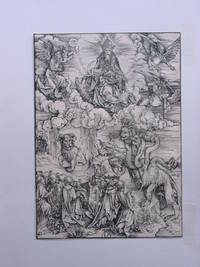
1511réf. 22161511. Woodcut. One of the plates from the set of 16 illustrations of the Apocalypse of Saint John. Fine impression of the only state with the latin text on the verso. 1511. With 1/4" margins 390 x 279 15 3/8 x 11 Meder 175 B. 74 Pan.294 K. 117 T. 137Schoch Mende Scherbaum 123. Watermark: Flower with a triangle M. Watermark #127. Printers crease in upper left corner some glue stains on verso right border not noticeable from the front. Otherwise in fine condition. books
1933réf. 589915Chicago: Art Institute of Chicago 1933. Softcover. Very Good. Exhibition catalog. Small quarto. x 28 xxxiv pp. Illustrated in black and white. Printed wrappers. Wraps lightly toned dampstaining at the lower corner throughout thus very good. A catalog of prints displayed from June 1 to November 1 1933 at the Worlds Fair in Chicago including work by Albrecht Durer Rockwell Kent Martin Schongauer Rembrandt Jean Duvet Eugene Delacroix Paul Cezanne Edgar Degas and others. Art Institute of Chicago unknown books
2007réf. 1399961Frankfurt am Main: Städel Museum 2007. Softcover. Quarto 260 pages. In Good plus condition. Spine is blue with white print. Cover with illustrated front panel; crease to spine. Illustrated: b&w and color. Text in German. Oversized books. Additional postage necessary for expedited/international orders. Economy International shipping unavailable due to size/weight restrictions. For international/expedited customers please inquire for rates. NOTE: Shelved in Locked Annex Area Quarto and Folio Case. 1399961. FP New Rockville Stock. Städel Museum unknown books
1928réf. 17523New York: M. Knoedler & Co 1928. First edition. Paperback. Orig. gray wrappers printed in black. Near fine. 55 pages. Illustrated in black and white. 109 entries. M. Knoedler & Co paperback books
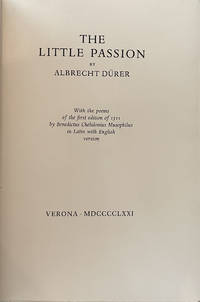
réf. 1450.1971Verone Officina Bodoni 1971. 8vo. 9 x 6 1/4 inches publisher's quarter pigskin spine over Fabriano paper sides; title in gilt on the spine and the emblem of the press in gilt on the cover. In a matching sliding case which is slightly rubbed at the extremities. Copy No. 17 of 140. Original Prospectus laid in.Dürer's Small Passion of 1511 considered by many to be his masterpiece of this genre was published by Giovanni Mardersteig to celebrate the five hundredth anniversary of the artists birth. The woodcuts are here re-engraved by Leonardo Farina master wood engraver. This Officina Bodoni publication follows the first edition of 1511 reprinting the original Latin verses by Fr. Benedictus Chelidonius Benedikt Schwalbe humanist and poet. Mardersteig simultaneously published editions in Italian and German but here the reader is offered a literal translation IN ENGLISH by Robert Fitzgerald himself a poet so that one might have some idea of the poetic content of the Latin originals.The period 1508-1511 marks the height of Dürer's graphic work on religious subjects. In this edition as in the original the woodcuts face the Latin poems which are thought to have been commissioned by the artist as a complement to them. A very handsome edition of Dürers Passion.Mardersteig 173 and 171 Italian edition. Barr 86. THE SMALL PASSION NEWLY CUT ON WOOD Verone Officina Bodoni books
réf. B198894-1Nürnberg 1998. 94 1pp. Prof. illus. numerous color. Lrg. 4to. Wraps. Parallel texts in English German and Italian. Catalogue of the circulating exhibition. Nürnberg, 1998. paperback books
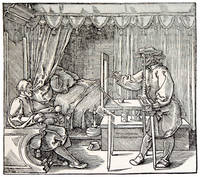
1532réf. 2727Paris: Christian Wechel 1532. First Latin edition of Dürers first book on the theory of art the Unterweisung der Messung bound with the first Latin edition of his treatise on fortification strictly speaking the first treatise dealing exclusively with this subject Krufft with important material on urban planning and utopianism.1 Illustrated by Dürer himself the Institutionum Geometricarum outlines the artists theory of the work of art as a natural object which became an accepted aesthetic dogma until the 19th century. Far more than the German original of 1525 this translation by the humanist Camerarius brought the treatise to the attention of the whole of Europe. As a theoretical statement by the last major painter to be counted a significant geometer Kemp the work is naturally of interest for applications in Dürers own oeuvre as well as for the history of perspective. After his encounter with Luca Pacioli in Italy Dürer became convinced of how close the links are between art and mathematics and devoted himself to the study of form through the resources offered by arithmetic and geometry. The result was the present work. In this work Dürer teaches the principles of perspective and explains the application of practical geometry to drawing and painting. It became a very influential text as its audience broadened from artists to architects sculptors and different craftsmen and was translated and reprinted several times.Panofsky describes the treatises importance as three-fold: for the technical innovation in the construction of a perspective apparatus in which the eye of the observer is dispensed with entirely; for being the first literary document in which a strictly representational problem received a strictly scientific treatment at the hands of a Northerner; and for emphasizing that perspective is not a technical discipline destined to remain subsidiary to painting or architecture but an important branch of mathematics capable of being developed into what is now known as general projective geometry Panofsky p. 252.Book Three contains Dürers famous treatise on the just shaping of Roman capital letters and gothic or Textur letters built up by means of small geometrical forms a method original with Dürer. This text was translated into English by R.T. Nichol for publication by the Grolier Club Of the Just Shaping of Letters New York 1917.2 Inspired by the artists witnessing the siege of Hohenasperg in 1519 and by fear of the advancing Turkish armies Krufft writes De Urbibus employs a dual approach. On the one hand Dürer develops various alternatives for the construction of bastions to defend existing cities; this is the contemporary aspect. At the heart of the treatise he outlines a utopian city in which the nature of fortification merely serves as a spur to the depiction of a social structure organized on the ground. Related trades are placed side by side; smiths are to be housed near foundries etc. The town hall and the houses of the nobility are sited near the royal palace. The whole system of organization is hierarchical and functional. Dürer thinks of every function of the city right down to the taverns Krufft History of Architectural Theory p. 110 . Elsewhere Krufft suggests that Serlio employed the present treatise in book VI.According to Mortimer the woodblocks are close copies of the 1527 German original. 1Mortimer French I.182; Vagnetti E II.b7; Panofsky The Life and Art of Albrecht Dürer Chapter 8 Dürer as a theorist of Art esp. 247-60; Kemp The Science of Art 53ff.; 2 Mortimer French I.184; Fowler 113 1527 German; Krufft History of Architectural Theory 110-111. 4 ff. recto of last leaf blank woodcut of man with lute on verso 185 pp. verso blank 1 f. printers device on verso recto blank; folding extensions on P6 & Q1 as required by Mortimer. Bound in 18th-century calf over boards spine with raised bands re-backed later red morocco title label. Title dusty; occasional toning; small wormtrack through much of volume generally in blank margin but occasionally grazing a partial letter or printed border on plates. Withal a fresh copy very good.Bound with:DÜRER Albrecht. De Urbibus Arcibus castellisque condendis ac muniendis rationes aliquot praesenti bellorum necessitati accomodatissimae . Paris Christian Wechel 1535. 40 ff. including 10 double-page/extended leaves as described by Mortimer. Christian Wechel hardcover books
2007ill., ril. Sono integralmente catalogate e descritte tutte le opere - 748 stampe e un trattato - conservate presso il Gabinetto Disegni e Stampe, e storicamente attribuite al maestro tedesco. Il volume indaga inoltre in maniera analitica la ricezione dell'opera a stampa di Dürer in Italia, attraverso la ricostruzione della fortuna che ogni singola stampa ha avuto nell'arte e nella letteratura fino al 1686, anno di pubblicazione della biografia che Filippo Baldinucci dedica a Dürer nel suo Cominciamento e progresso dell'arte dell'intagliare in rame.
2018br. L'opera più enigmatica di Dürer non ha smesso di ispirare e provocare artisti, intellettuali, osservatori attenti. Questo studio ci guida a cogliere in essa un motivo filosofico mai esplorato prima: la figura principale non è Melancholia, come vuole la lettura consueta, né Geometria (Panofsky), né Astronomia (Schuster), bensì Philosophia. Nata in Grecia dallo stupore melanconico, cresciuta in ambito cristiano, è approdata al nord grazie a una translatio della cultura umanistica promossa da Massimiliano I d'Asburgo, il più potente fra i committenti di Dürer e primo sovrano europeo a puntare decisamente sul potere mediatico delle immagini. L'autrice offre un'indagine esaustiva e originale sull'incisione più famosa del mondo riconosciuta dalla critica come «l'immagine delle immagini».
2013br. Barmont, in questo saggio, analizza l'enigmatica melencolia di Dürer rifacendosi alle osservazioni di René Guénon: i singoli elementi della composizione vengono infatti interpretati in una originale chiave metafisica ed escatologica.
2016br. Dal titolo stesso del saggio si comprende come il capolavoro di Dürer sia chiamato a svolgere la funzione di metafora la cui intelligenza, anche se immediata, richiede anche il supporto di un'attenta esegesi affinché se ne possano ricavare le più nascoste significazioni. Si scopre allora come un'opera artistica divenga stimolo di riflessione politica, o meglio meta-politica. A uomini condannati ad avanzare insieme a compagni scomodi come la Morte e il Diavolo qui si propone un'alternativa al di fuori di vie liberticide ed in grado di affermarsi sul fondamento di valori come dignità, decoro, onore e fedeltà, calpestati dalle masse e dai capi-popolo come dalla catena di ottusi consumatori, imbroglioni, sfruttatori e demagoghi.
2019ill., br. Le celebrazioni del cinquecentenario della morte di Leonardo da Vinci sono state l'occasione per porre l'attenzione su uno degli aspetti meno indagati. dell'attività del maestro, ovvero quello ingegneristico. Perito in idraulica come nella "ingegneria delle macchine", sovente risvolti militari, egli si occupò su scala più ampia anche degli aspetti urbanistico-architettonici atti alla pianificazione difensiva delle città. La mostra inserisce Leonardo in rapporto dialettico con altri ingegneri militari del Rinascimento, evidenziando in particolare i contributi di Michelangelo Buonarroti e Albrecht Dürer allo sviluppo tecnologico della prima metà del Cinquecento.
2021br. «Fu in Germania che, nel Quattrocento, l'invenzione della stampa, dell'incisione e della xilografia fornì al singolo la possibilità di diffondere le proprie idee in tutto il mondo. Proprio mediante le arti grafiche la Germania assurse al ruolo di grande potenza nel campo artistico, grazie principalmente all'attività di un artista che, benché famoso come pittore, divenne una figura internazionale solo per le sue doti di incisore e xilografo: Albrecht Dürer. Le sue stampe per più di un secolo costituirono il canone della perfezione grafica e servirono da modelli per infinite altre stampe, come pure per dipinti, sculture, smalti, arazzi, placche e porcellane, non solo in Germania, ma anche in Italia, in Francia, nei Paesi Bassi, in Russia, in Spagna e, indirettamente, persino in Persia. L'immagine di Dürer, come quella di quasi tutti i grandi, è cambiata secondo l'epoca e la mentalità in cui si è riflessa, ma sebbene le qualità distintive della sua innegabile grandezza furono variamente definite, questa grandezza fu riconosciuta subito e mai messa in dubbio».
2016ill., br. Un dossier dedicato ad Albrecht Dürer. In sommario: L'immagine di sé; Italia magistra: i soggiorni nella penisola e la loro influenza; Un artista al servizio del Sacro romano impero; Il maestro dell'incisione; Fu mai arte luterana? Come tutte le monografie della collana Dossier d'art, una pubblicazione ricca di riproduzioni a colori, completa di un quadro cronologico e di una bibliografia.