BORGET, AugusteABAA

4 risultati
rif. 295983Paris: Goupil & Vibert. Tinted lithograph. Sheet measures 15" x 21 5/8". Image measures 16" x 10". This lovely drawing depicts a Chinese boat anchored in the Hong-Shang river with smaller boats surrounding - presumably for trade. In the background are more small boats lining the river bank traditional buildings standing behind a series of walls and in the distance a tall pagoda sits at the top of a hill. On September 9 1838 the artist described the scene; "At last day broke as we cast anchor before the Custom House of Hong-Shang . and boats began to arrive in great numbers. By and bye many pushed off from the shore and so great was the movement in the part of the river where we were stationed that I took it for the market-place of the city which stretches itself on both sides of the river. The most important part situated on the left bank is built on a hill crowned by a fine tall pagoda." The print is in good condition with wide margins as issued. Minor foxing and stains. Very minor wear to margins not affecting the image. The French artist Auguste Borget 1809-1877 exhibited often in the Paris Salon but he is best known for his drawings of China made into lithographics by Eugene Ciceri and published in 1842 in a book titled Chine et les Chinoise China and the Chinese. Bourget visited the region between 1838 and 1839 as part of a world tour aboard the ship "Psyche" and found it to be one of his favorites. This print evidences his love of the country and its culture. Goupil & Vibert unknown books
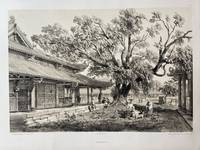
rif. 301535Lithograph. Image measures 12.5" x 17'. Sheet measures 15" x 21.75". This print depicts the courtyard of the Hoi Tong Monastery a Buddhist temple in Guangzhou China. At the time of the artists visit this temple sometimes called the Sea Screen Temple had recently been ceded to the British in the aftermath of the First Opium War. Monks are scattered around the grounds some sitting in the shade and others attending to the temples famously fat pigs. Far in the background a group of monks may be practicing kung-fu which was taught at the monastery. The Sea Screen Temple was one of Auguste Borgets favorite Chinese sites to visit and his delicate yet active rendering of the scene conveys the peaceful quality of the courtyard he loved so much. I have visited the great temple several times he wrote the noise outside the temple was so great and the silence inside the temple was so solemn that I believed myself transported to another world. This print is in very good condition with wide margins as issued. Minor chips to the lower margin and some corners not affecting the image. Bright white paper makes for a lovely and clear image. The French artist Auguste Borget 1809-1877 exhibited often in the Paris Salon but he is best known for his drawings of China made into lithographs by Eugene Ciceri and published in 1842 in a book titled La Chine et les Chinois China and the Chinese. Bourget visited the country aboard the ship "Psyche" to Canton and the surrounding regions in 1838 and 1839 as part of a world tour and found it to be one of his favorites. This print evidences his love of the country and its culture. unknown books
rif. 295998Paris: Goupil & Vibert. Tinted lithograph. Sheet measures 14 7/8" x 21 5/8". Image measures 9 1/4" x 16 1/4" The title translating to "Temple Pagoda and Village On The Canals of the Interior from Macau to Canton" this print depicts a serene cityscape from the entrance into Canton Guangzhou along a canal. The artist wrote "we passed close by a temple built on a little jetty which was reached by a stair descending into the river." Figures are seen rowing boats in the canal and sitting along the jetty. On the opposite bank appears to be a village and a tall pagoda. Further down the canal we can see larger ships docked. The print is in good condition with wide margins as issued. Stains at corner margins and one chip to bottom left corner not affecting the image. The French artist Auguste Borget 1809-1877 exhibited often in the Paris Salon but he is best known for his drawings of China made into lithographs by Eugene Ciceri and published in 1942 in a book titled La Chine et les ChinoisChina and the Chinese. Bourget visited the country aboard the ship "Psyche" to Canton and the surrounding regions in 1838 and 1839 as part of a world tour and found it to be one of his favorites. This print evidences his love of the country and its culture. Goupil & Vibert unknown books
rif. 295963Paris: Goupil & Vibert. Tinted lithograph. Sheet measures 15" x 21 5/8". Top image measures 6 3/4" x 11 1/2". Bottom image measures 8" x 11 1/4". An interior from Macao and a vista of Hong Kong are included together. The top image features the interior view of the Great Temple of Macao of which Borget writes "It is so difficult to describe Chinese objects in European language that I have not yet dared to speak to you of the great temple of Macao - the greatest marvel which I have yet seen. Almost daily I visit this temple - the Chinese name of which Neang-ma-ko signifies the Old Temple of the Lady." The temple is known in the present-day as A-Ma Temple from which the name Macao is thought to be derived". In his writings Borget vividly describes the architectural details of the temple as visible in the image. The bottom image depicts an ornate tomb with a small village visible in the background. The village sits on "a neck of land" separating the Hong Kong bay from the Kowloon bay both of which can be seen in Borget's drawing. The bays are surrounded by lush vegetation rolling hills and the mountains of Hong Kong in the distance. The print is in good condition with wide margins as issued. Chips and tears to the margins stains upper right and left not affecting the image. The French artist Auguste Borget 1809-1877 exhibited often in the Paris Salon but he is best known for his drawings of China made into lithographs by Eugene Ciceri and published in 1842. Bourget visited the country as part of a world tour and found it to be one of his favorites. He traveled aboard the ship "Psyche" to Canton and the surrounding regions in 1838 and 1839. Hard to find. Goupil & Vibert unknown books