8820 risultati
2018rif. __0198428855Oxford University Press 2018. Paperback. New. 27.95x21.26x10.63 inches. Oxford University Press paperback
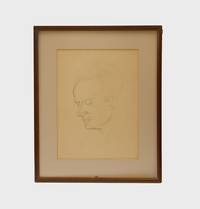
1934rif. 3757511934. Pencil portrait signed "Eric G" lower right identified and dated lower left. 14 x 10 inches matted. Mounted and framed. Some overall toning. Short closed tear underneath matting which is taped to verso of work. Pencil portrait signed "Eric G" lower right identified and dated lower left. 14 x 10 inches matted. David Pepler 1905-1934 was Eric Gill's son-in-law who married his daughter Betty in 1927 also the son of his partner in the Guild of St. Joseph and St. Dominic Hilary Pepler 1878-1951. Pepler died only a couple of weeks after Gill's return from his transformative trip to Jerusalem and he rode with the body from the hospital in London back to Pigotts. After the mass and requiem Gill spent the morning drawing David's portrait a process he described in his memoirs: "When the husband of our eldest daughter died she asked me to draw his portrait as he lay in our chapel. For several hours I stood close beside his body looking closely into his face and trying to transcribe his features accurately. That was a revealing experience - before my eyes death took him further from the living world. Even as I watched the bony structure of his face became more sharp and hard; the flesh contracted on his brows and nose and chin. The nobility and patience of his character became more emphatically visible. It was as it were a race between corruption and revelation. On the one hand his spiritual form became more visible as its fleshly shape became more attenuate - on the other the disintegration which death of the body precisely is became more and more woefully and nauseatingly imminent. I was not horrified I was not even astonished; but it was difficult thinking of the lips she had kissed to keep back my tears." Gill Autobiography pp. 237. unknown
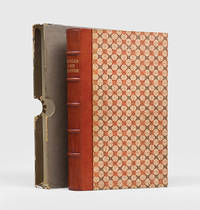
1929rif. 1071401929. Bristol: Douglas Cleverdon 1929. 4to xii 49 5 pp. With an extra suite of the engravings on Japon wood-engraved self-portrait and 103 plates a few printed in red or red and black additional plates loose as issued in pocket at end. Original de luxe binding of quarter vellum. A very good copy. Bookplate of R.L. Langdon-Down. § Limited to 80 de luxe copies signed by Gill with the extra suite on Japon of all the plates printed from the original blocks from a total edition of 490. The de luxe copy of a scarce title - the first collection of Gill's work including his magnificent illustrations for several Golden Cockerel Press books as well as designs for the St. Dominic's Press and many other ephemeral pieces all printed from the original blocks. Evan Gill 17. unknown
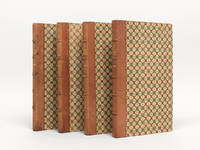
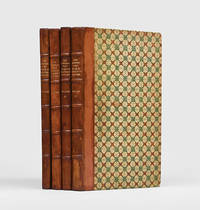
rif. 109542London The Golden Cockerel Press 1929-31. . Limited edition number 439 of 485 copies on paper from a total edition of 500; 4 vols small folio 31.8 x 20 cm; wood engravings by Eric Gill including one full-page 29 half-page tailpieces initials and decorative borders initials printed in red blue and black; original Niger morocco-backed patterned boards by Sangorski & Sutcliffe gilt lettering to spines top edges gilt others uncut light rubbing to extremities slight toning and soiling to boards some spotting and fading to spines as always; an attractive set. One of the major titles of the Golden Cockerel Press and an extraordinary collaboration between the press director and book designer Robert Gibbings 1889-1958 and artist Eric Gill 1882-1940. Printing the Canterbury Tales dominated work at the press for two and a half years and relatively few other books were printed during that period. However despite some critics deeming Gill's illustrations risqué and inappropriate the book was a considerable critical and financial success and grossed £14000. Chanticleer 63; Evan Gill 281. London, The Golden Cockerel Press, 1929-31. hardcover
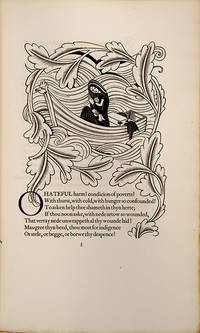
1929rif. 000681One of the most prestigious books published by the Golden Cockerel Press number 80 of a limited edition of 485 copies printed on handmade paper and 15 on vellum. Description: 4 vols. Original quarter niger morocco over patterned papered boards spines with raised bands lettered in gilt bound by Sangorski and Sutcliffe. Quarto: 32 × 20 cm; pp.: vol.i: 4 150 2; vol.ii 4 188 2 vol.iii 4 196 2 vol.iv 2 218 4. With 1 full-page 29 half-page and 269 decorated borders tail-pieces line-fillings and 61 initials engraved on wood by Eric Gill. Printed from 18 pt. Caslon Old Face printed on Batchelor hand-made paper nos. 16–500 in black red and blue. Top edge gilt others trimmed. Ref.: Cave/Manson 63; Chanticleer 63; Gill 281 Condition: Binding somewhat bumped and bruised at corners spine occasionally stained as often fore-edges slightly dusty and with single marginal stains interior clean and free of marks. Notes: Eric Gill's woodcuts for the Golden Cockerel Press edition of Geoffrey Chaucer's The Canterbury Tales are celebrated for their artistic and technical mastery. Gill created an impressive array of wood engravings designing them to harmonise with the typography reflecting his expertise as a typeface designer. The engravings complement the text enhancing the reading experience with a seamless blend of visual and literary art rooted in the tradition of illuminated manuscripts. The borders often featuring leaf and stem motifs are inhabited by figures - girls men kings priests and nuns - that interact with or comment on the tales. These range from playful and erotic to solemn mirroring Chaucer's diverse moods and adding narrative depth. Some of the woodcuts are known to have been rather bold in their depictions and have been seen as controversial in their time; however they have since been recognised as being apt and reflective of the spirit of the text. It is therefore fair to conclude that taken as a whole these features make Gill's woodcuts a standout contribution to 20th-century book illustration marrying technical precision with imaginative flair and thus cementing the edition's status as a landmark in private press publishing. Golden Cockerel Press hardcover
1915rif. 1071844to 13 x 10. Ditchling Sussex: Douglas Pepler 1915. 4to 13 x 10.5 inches. Woodcut title-page with triangular device enclosing the letters HDCP EG 1915. Original printed blue paper wrappers slightly soiled and spotted internally perfect. Enclosed in a quarter blue morocco box. § First printing limited edition; this is # 14 of 15 on Japanese paper printed on one side of the leaf only and signed by Eric Gill in pencil. These emblems were engraved for the "Devil's Devices or Control versus Service" a book written by Douglas Pepler HDCP and published at the Hampshire House Workshops Hammersmith London on Saint Thomas' day 1915. Douglas Pepler unknown books
1915rif. 1071841915. Ditchling Sussex: Douglas Pepler 1915. 4to 13 x 10.5 inches. Woodcut title-page with triangular device enclosing the letters HDCP EG 1915. Original printed blue paper wrappers slightly soiled and spotted internally perfect. Enclosed in a quarter blue morocco box. § First printing limited edition; this is # 14 of 15 on Japanese paper printed on one side of the leaf only and signed by Eric Gill in pencil. These emblems were engraved for the "Devil's Devices or Control versus Service" a book written by Douglas Pepler HDCP and published at the Hampshire House Workshops Hammersmith London on Saint Thomas' day 1915. unknown
1925rif. 140947746Waltham Saint Lawrence in Berkshire: The Golden Cockerel Press 1925. Deluxe Edition. Near Fine. Copy number 24 of the first 30 copies printed on Batchelor handmade papers signed by David Jones; from a limited edition of 450 total. Two volumes; illustrated with 42 woodcuts by David Jones many hand-colored and 27 initials by Eric Gill. Bound in publisher's cream linen cloth with spines lettered in gilt. Near Fine with light edge wear and trace soiling to cloth. Bookplates of former owners at front free pastedowns offsetting at endsheets and light age spotting to preliminaries of Volume II. Light offsetting from plates throughout contents. A beautiful fine press edition of Jonathan Swift's enduring satirical 18th-century novel being the first Golden Cockerel Press book with artist and polymath David Jones' illustrations. The volumes are reproduced from the text of the Henry G. Bohn edition of 1864 under the careful supervision of Robert Gibbings after Hal Taylor's death in 1925. A playful colorful production that charmingly weaves vignettes of the story's protagonist and narrator Gulliver through his several unusual voyages. The Golden Cockerel Press unknown
1928rif. 176203Waltham St Lawrence: Golden Cockerel Press 1928-31. Beautiful Books Limited edition number 135 of 485 copies on handmade paper; a further 15 copies were issued on vellum. The Canterbury Tales was one of the "most important Golden Cockerel editions for which Eric Gill provided the engravings" and showcases his "originality and verve" ODNB. This work was seen as one of the finest books to be produced by the press exhibiting the ideals of the private press movement as if the "author artist and printer have shared one concept and expressed it" Franklin. An announcement of the edition within The Times Literary Supplement on 2 February 1928 noted a publication price of 25 Guineas. It also stated that the vellum copies at 120 Guineas had already been fully subscribed. The publication of the work was a major literary event and was widely covered in the press throughout the four-year publication period. A review within The Times Literary Supplement described the set as "a fine one" and noted that "each page is ornamented at the side with a conventional tree at the top or bottom of which there are usually figures. These figures seems alternately to express an almost frivolous gaiety and a harsh ascetism. Gill portrays these attributes and characteristics of the Middle Ages as if they came down to us from a great distance as pale now romantic shadows of what was once violent and robust. With this mood is at times combined a strain of Post-Impressionism a modern flavour". The review concluded comparing the Golden Cockerel edition to the Kelmscott Chaucer noting that Pre-Raphaelitism was "adaptable to new circumstances". The partners of the Golden Cockerel Press Christopher Sandford Owen Rutter and Anthony Sandford described the set in their bibliography of the press as simply "beautiful books". 4 vols tall octavo. Initials printed in red blue and black. With full-page illustration 29 half-page illustrations decorated borders tailpieces and line fillers all by Gill. Bound for the publishers by Sangorski & Sutcliffe in brown quarter niger spines lettered in gilt patterned paper boards top edge gilt others untrimmed. Some wear to extremities slight colour variance to morocco minor cracking to front joint of vol. 1 minor browning to endpapers as usual: a very good set. Chanticleer 63; Franklin 307; Gill 281. The Times Literary Supplement 2 Feb. 1928 p. 79 & 18 April 1929 p. 310. hardcover
1929rif. 1068034to. Bristol: Douglas Cleverdon 1929. 4to xii 49 5 pp. Frontispiece and 103 plates showing 147 engravings. Original black cloth gilt vignette to upper cover hinges cracked but the covers still firmly attached by the ties. In a new quarter calf folding box. § Limited to 400 copies from a total edition of 490 this copy not numbered. Gill's own copy with his bookplate and filled with corrections and annotations to the List of Engravings plus a marginal note to his Introduction. The Prospectus for this work is loosely inserted with Gill's pencil calculations to the final page as to how much money each variant of the edition will bring in - a total of £3192 plus a press cutting and a couple of other pieces of ephemera inserted as well. The ultimate copy of a scarce title - the first collection of Gill's work including his magnificent illustrations for several Golden Cockerel Press books as well as designs for the St. Dominic's Press and many other ephemeral pieces. Gill's Preface sets out his unique philosophy concluding with two pages of Latin. "Whatever may be said of life it remains that in art desire may be feeble or insufficient but it can never be wrong; it is the intellect that makes mistakes". Next to the sentence "Being a Catholic I naturally accepted the Catholic faith - as one intending to go to Peterborough naturally takes the train there" Gill has written "Why Peterboro' because it was in the train to Peterboro' that this part of this preface was written. EG". The list of engravings has a number of annotations and corrections inserting 6 engravings not mentioned into the list expanding on descriptions and changing some sizes and titles. Evan Gill 17. Douglas Cleverdon hardcover books
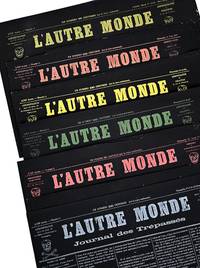
1896rif. 56098Paris: n.p. 1896. First edition. Near fine. Rare complete run of this satirical newspaper on witches war in hell weird tales and more - printed on striking black paper with type in bright color. Though begun as a prank poisson d'avril on 1 April 1877 L'AUTRE MONDE is a wonderfully conceived and executed satire down to its smallest details. Written by the "the dead and buried" it purports to be from the year 3753 based on which calendar is left unsaid; it is printed "along the banks of the Styx"; while subscriptions may be had in the Catacombs. Its front page details a story of murder at the opera by a "grocer." and a soldier's memoir of his own death during the Franco-Prussian War; its final page has a stock exchange report of "dead" and "dying" stocks. The real newspaper LE TEMPS reported that the first issue was "snapped up entirely within five minutes" 3 April 1877. A second issue soon followed printed in red and dedicated to the topic of witches this time with advertisements: sulfuric acid toothpaste a broom that costs "11000 francs and three children's souls" etc. Even the choice of inks adds to the parody: the fourth issue about cuckolded husbands is printed in yellow ink a color "associated with adultery" Brossé BnF. This issue contains a report on a congress of cuckolded husbands the "Coucoupolis." The fifth issue in orange pokes fun at Spiritualism. A short article in it on the American magician duo the Davenport Brothers feels a bit eerie: one the brothers would die on 1 July less than a month after this issue was released. The first five issues appeared in quick succession through April to June of 1877; the elusive sixth issue didn't appear until 1896 but again on April 1. The creators of the newspaper are not definitively known but the 1885 DICTIONNAIRE UNIVERSEL ILLUSTRÉ attributes the first five to the editor and novelist Camille Debans 1832-1919 who had earlier founded a different satirical journal LE BONHOMME late 19th-century France loved them. Debans would publish speculative fiction in the 1880s of HISTOIRES DE TOUS LES DIABLES 1882 and another about an international war of the future LES MALHEURS DE JOHN BULL 1884. The latter suggests similar themes to the third issue here in green which chronicles a massive war between famous figures across time and geography with Machiavelli and Richelieu on one side and Attila the Hun and Napoleon on the other. Any issues of this newspaper are rare and exceptionally so as a complete set; we find only the BnF and Oxford with all six while the Beinecke and Mediatheque de Montpellier have holdings for the first five. A fantastic ephemeral production bibliography in dark mode. Six folio issues 21'' x 14.25'' each. Original black paper sheets folded once to create four pages folded again as likely issued for distribution. Printed in grey red green vivid yellow orange and light greenish yellow respectively. Expected wear at folds with some light edgewear. Intact and bright or dark as it may be. n.p. unknown
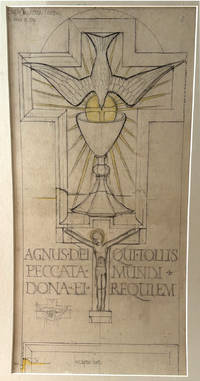
1909rif. 119021909. Extremely large original design for a monumental tombstone in pencil and coloured crayon on wove paper. Nearly a metre high - 790 x 391 mm. Mounted and stuck down onto acid free cardboard.Magnificent and extremely large design for the tombstone of Hannah Boulter which can be found in the cemetery of St Egwin's Church Norton and Lenchwick Worcestershire. With a fine example of Gill’s lettering and perfect balance in design. It is quite possible that this drawing was one of the ‘Designs for a Monument’ listed as nos. 84 to 87 in the Alpine Club Gallery exhibition of Eric Gill’s work in May 1918. unknown
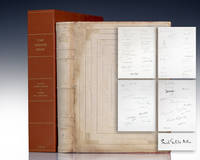
1929rif. 149534London: Privately printed by The Curwen Press for H.R.H. The Prince of Wales 1929. First and limited deluxe edition of the monumental Legion Book; one of only one hundred numbered copies printed for private distribution by the Prince of Wales and signed by a remarkable array of British writers and artists as well as four prime ministers. Quarto original publisher's full deluxe pigskin over boards elaborately decorated in blind and gilt top edge gilt tissue-guarded color frontispiece engraved title-page vignette illustrated with 16 captioned tissued-guarded plates in various techniques some signed by the artist and 32 collotypes. One of one hundred numbered copies printed for private distribution by the Prince of Wales and with five pages signed by each of the 89 contributing writers and illustrators as well as four prime ministers three British Prime Ministers: David Lloyd George Stanley Baldwin and Ramsay MacDonald and French Prime Minister Georges Clemenceau including: Winston Churchill who was not yet a Prime Minister Rudyard Kipling P.G. Wodehouse Eric Gill Stanley Spencer Charles Ricketts W. Heath Robinson Laura Knight William Nicholson Paul Nash David Low Rebecca West John Lavery Max Beerbohm Vita Sackville-West Hilaire Belloc Mark Gertler Edith Sitwell Jacob Epstein W.H. Davies and Aldous Huxley among others. This is number 84. The Legion Book was created at the request of H.R.H. The Prince of Wales—who would later become King Edward VIII and following his abdication the Duke of Windsor—as a fundraising initiative for the British Legion. All profits from its sales were intended to support the organization. The book features contributions from 85 distinguished British writers and artists including Winston Churchill Rudyard Kipling P.G. Wodehouse Aldous Huxley Vita Sackville-West G.K. Chesterton Hilaire Belloc Augustus John Eric Kennington and John Nash. It was compiled and edited by James Humphrey Cotton Minchin 1894–1966 a veteran who served with the Cameronians and the Royal Flying Corps during the First World War. While the trade version saw several reprints a special edition of 600 numbered copies was also produced. Of these 500 bore the editor’s signature but “the first 100 were reserved for H.R.H. the Prince of Wales sponsor of the volume in his gift.” According to the note at the conclusion of the Table of Contents “Five pages of contributors’ signatures appear after the Dedication with additional signed pages opposite Collotype No. 3 and Collotype No. 20.” Every contributor signed the book with the sole exception of John Singer Sargent who died in 1925 before the project was completed. In near fine condition with toning to the extremities of the front panel and front hinge. Housed in the original publisher's custom folding cloth clamshell box. An exceptional example of this rare signed limited edition. Formed in the aftermath of a war that had shattered a generation the Royal British Legion emerged in May 1921 as a unified voice for the countless veterans left wounded—physically mentally and economically—by the First World War. The staggering cost of the conflict with nearly 3.2 million British Empire casualties exposed the inadequacy of postwar support. A fully disabled veteran received just 30 shillings a week and any claim had to be made within seven years of discharge. In response to such injustice several ex-servicemen’s groups came together to create the Legion not merely as a charity but as an advocate for those who had borne the brunt of industrialized warfare. From its inception the Legion fought for fair pensions better employment opportunities and meaningful support for both former service members and their families—laying the groundwork for a broader movement of remembrance welfare and national responsibility that continues to this day. Privately printed by The Curwen Press for H.R.H. The Prince of Wales hardcover
1931rif. 317876n.p. but actually St. Lawrence Waltham: The Golden Cockerel Press 1931. Number 473 of 488 numbered copies printed on Batchelor handmade paper from a total edition of five hundred copies. 64 wood-engraved illustrations and initials printed from the blocks by Eic Gill. 1 vols. Small folio. Three quarter white pigskin and tan polished buckram raised bands t.e.g. by Sangorski & Sutcliffe. Some light soiling and faintest traces of rubbing to spine. Fine copy. Gill Eric. Number 473 of 488 numbered copies printed on Batchelor handmade paper from a total edition of five hundred copies. 64 wood-engraved illustrations and initials printed from the blocks by Eic Gill. 1 vols. Small folio. Gill's Masterpiece. One of Eric Gill's masterpieces as an illustrator. "Conceived in the fruitful mind of Robert Gibbings this is the Golden Cockerel book usually compared with the Doves BIBLE and the Kelmscott CHAUCER. A flower among the best products of English romantic genius it is also surely thanks to its illustrator . the book among all books in which the Roman type has been best mated with any kind of illustration" Chanticleer. Gill Eric Gill 285; Chanticleer 78; Artist & the Book 122; From Manet to Hockney 89 The Golden Cockerel Press unknown books
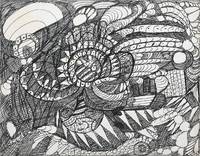
1940rif. 172966c. 1940. With the mastermind true genius will out A characteristic example of Gill's spiritual outsider art a rare double-sided work exhibited at her first major retrospective in Grosvenor Gallery in 1968. We believe this piece to be number 130 "Complex Forms" in the exhibition list. The pencil drawing contains a woman's face a signature motif in Gill's art and the ink drawing shows naturalistic geometric patterns. Gill 1882-1961 was a key exponent of mediumistic art and remains one of the foremost British Outsider artists. She first became compelled to produce art in 1920 and shortly after was first "possessed" by her spirit-guide Myrninerest. Over the next three decades she produced a vast amount of art on cloth card and paper. Her work was exhibited at the Whitechapel Gallery between 1932 and 1947 and was widely acclaimed. However she rejected an offer of a show in a larger West End gallery stating that her art belonged to her spirit guide and could not be sold. After her death the Grosvenor Gallery held a large exhibition of her work focussed on her ink and wash drawings titled Madge Gill: The Guided Hand. Gill's artwork is in the original frame provided by the Grosvenor Gallery and is accompanied by a guide to the exhibition and a typewritten exhibition list. Gill never received any formal artistic training and produced her work in a trance-like state possibly influenced by synaesthetic experiences. The pencil drawing is reminiscent of Girl in High Hat and Milliner's Dream in the formations around the face both of which are dated c.1940. She turned to larger card drawings in the 1950s. Producing her artwork could sometimes take its toll on her as she wrote in a letter to a friend "The crust of the earth beneath lies untold wealth so it is with the mastermind true genius will out. Dear Louise I wish I could be normal" quoted in Cardinal p. 138. Following Gill's death her son Laurie donated many of her drawings to the London Borough of Newham Heritage Service where they are still held today. The majority of Gill's work available in commerce is postcard sized with larger drawings appearing occasionally. We have traced just two examples of her double-sided works in the last ten years sold by Christie's in 2022 and 2017. Two drawings on white card 245 x 312 mm recto in ink verso in pencil framed and glazed in 1960s wooden frame painted silver framed size 331 x 395 with Grosvenor Gallery sticker to back. Together trifold exhibition catalogue page size 298 x 120 mm and 4 pp. wire-stitched typescript list. Housed in an archival box. Card a little browned paint to frame a slightly scratched and chipped in places exhibition list folded. In very good condition. Roger Cardinal Outsider Art 1973. hardcover
1931rif. 317876Waltham St. Lawrence: The Golden Cockerel Press 1931. Number 453 of 488 numbered copies printed on Batchelor handmade paper from a total edition of five hundred copies. 64 wood-engraved illustrations and initials printed from the blocks by Eic Gill. 1 vols. Small folio. Three quarter white pigskin and tan polished buckram raised bands t.e.g. by Sangorski & Sutcliffe. Some light soiling and faintest traces of rubbing to spine. Fine copy. Gill Eric. Number 453 of 488 numbered copies printed on Batchelor handmade paper from a total edition of five hundred copies. 64 wood-engraved illustrations and initials printed from the blocks by Eic Gill. 1 vols. Small folio. One of Eric Gill's masterpieces as an illustrator. "Conceived in the fruitful mind of Robert Gibbings this is the Golden Cockerel book usually compared with the Doves BIBLE and the Kelmscott CHAUCER. A flower among the best products of English romantic genius it is also surely thanks to its illustrator . the book among all books in which the Roman type has been best mated with any kind of illustration" Chanticleer. Gill Eric Gill 285; Chanticleer 78; Artist & the Book 122; From Manet to Hockney 89 The Golden Cockerel Press unknown
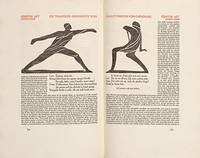
rif. 51-6486Weimar: Cranach-Presse für den Insel-Verlag Leipzig und S. Fischer Berlin 1928-1929. Folio 37 x 25 cm. 1 w. Bll. 202 S. Black calf binding with blind-stamped spine title and geometric filet art deco pattern on the front cover. Linen slipcase with black velvet lining. One of 230 numbered copies.OCLC Number / Unique Identifier: 10741559; Rodenberg 493 - Müller-Krumbach 48 - Brinks 76 - Schauer II 74. - Eines von 230 numerierten Exemplaren Druck in Schwarz und Rot auf Maillol-Kesslerschem Bütten GA 255. - Eines der Hauptwerke der Cranach-Presse. "Die Komposition der Seiten mit Textsynopsen in zwei Schriftgrössen Zweifarbendruck und einmontierten Illustrationen in teilweise zweitoniger Drucktechnik beweist ein Höchstmass an Kunstfertigkeit." 100 Jahre Cranach-Presse S. 158. - Sehr schönes Exemplar.One of the Cranach Press's major works. "The composition of the pages with text synopses in two font sizes two-color printing and mounted illustrations in partially two-tone printing techniques demonstrates a high degree of artistry." 100 Years of Cranach Press p. 158. - A very fine copy.Deutsches Buch- und Schriftmuseum der Deutschen Nationalbibliothek Leipzig: The tragic story of Hamlet Prince of DenmarkA masterpiece from the Cranach-Presse printing house 1929: "I believe it the book will become as one says a ‘milestone’ in the history of printing art and everyone who has worked on producing this monumental work can be congratulated.".From a letter written by Edward Johnston to Harry Graf Kessler.Shakespeare’s Hamlet Prince of Denmark printed by Cranach-Presse in Weimar is one of this printing house’s most important works and one of the most important hand-pressed prints in German book art. Harry Graf Kessler was responsible for the type and print of the volume and it was issued by the publishers Insel-Verlag in Leipzig and den S. Fischer Verlag in Berlin. The work was released in 1929 in a translation by Gerhart Hauptmann. The upper case title letters designed in woodcut were produced by graphic designer and typographer Eric Gill 1882-1940. The printed text in red and black is in a font that was designed especially for this work the Hamlet Fraktur which was developed by font artist Edward Johnston 1872-1944. The woodcuts are based on the designs and figurines for stage sets by the director actor and graphic designer Edward Gordon Craig 1872-1966 who used them here for the purposes of book art.Harry Graf Kessler 1868-1937:Diplomat patron of the arts and bibliophile."A book must be like a festival like those of the Greeks or Louis XV light and rich and bright inside and out.":Harry Graf Kessler to Hugo von Hofmannsthal 1905.Diplomat dandy artist sophisticate compulsive diarist alleged illegitimate son of the German Kaiser – Kessler was a dazzling personality in the cultural life of his epoch. He attempted to unite life and art in Germany as William Morris had in England.He conceived the “Großherzog-Wilhelm-Ernst-Ausgabe” Grand Duke Wilhelm Ernst Edition for the Insel publishing house its 1904 debut marking the beginning of Kessler’s collaboration with English book designers. To implement his idea of the book as a gesamtkunstwerk of content typography illustration and materials he established the Cranach-Presse Weimar in 1913. Working with international artists and using specially-designed type paper and woodcuts the press produced artistic book offerings in a European format until 1931. Weimar: Cranach-Presse für den Insel-Verlag, Leipzig und S. Fischer, Berlin, 1928-1929 unknown
1927rif. 180559Waltham St Lawrence: Golden Cockerel Press 1927. A crown jewel of the press First Golden Cockerel Press edition number 129 of 219 copies printed on Kelmscott handmade paper retaining the seldom-seen original slipcase. Loosely inserted is the equally elusive publisher's prospectus for autumn 1926 describing this edition as "a larger and more elaborate volume than has hitherto been attempted." Troilus and Criseyde was one of the first books that Eric Gill illustrated for the Golden Cockerel Press having joined as chief engraver in 1924. Together with The Song of Songs 1925 Canterbury Tales 1925 and The Four Gospels 1931 it is one of "the classic examples of specialist book production of that period. For a while the Golden Cockerel was Eric Gill" MacCarthy p. 187. Gill's artworks "captured the whimsical interplay between words and images displayed in medieval illuminated manuscripts. In Troilus and Cryseide Gill mixed full page illustrations with a combination of black and white lines and a rich assortment of shapes that presented a sense of motion. He created serpentine flora with simple figures to cushion the distinctive text. These border decorations reflect the narrative stanzas in an unassuming manner" Berona p. v. There were also six copies on vellum. Small folio. Woodcut title page 5 full-page woodcut illustrations ornamental borders throughout by Eric Gill. Text printed in black red and blue in Caslon O. F. type. Original quarter niger by Sangorski & Sutcliffe spine with raised bands second compartment lettered in gilt floral patterned paper-covered sides top edge gilt others untrimmed. Housed in the publisher's card slipcase. Publisher's prospectus loosely inserted. Hint of wear to corners otherwise a fine copy in the slipcase a little worn and with short split to one edge. Chanticleer 50; Gill 279. For the prospectus see Cock-A-Hoop P50. David A. Berona Eric Gill's Masterpieces of Wood Engraving: Over 250 Illustrations 213; Fiona MacCarthy Eric Gill 1989. hardcover
1929rif. 1071404to. Bristol: Douglas Cleverdon 1929. 4to xii 49 5 pp. With an extra suite of the engravings on Japon wood-engraved self-portrait and 103 plates a few printed in red or red and black additional plates loose as issued in pocket at end. Original de luxe binding of quarter vellum. A very good copy. Bookplate of R.L. Langdon-Down. § Limited to 80 de luxe copies signed by Gill with the extra suite on Japon of all the plates printed from the original blocks from a total edition of 490. The de luxe copy of a scarce title - the first collection of Gill's work including his magnificent illustrations for several Golden Cockerel Press books as well as designs for the St. Dominic's Press and many other ephemeral pieces all printed from the original blocks. Evan Gill 17. Douglas Cleverdon hardcover books
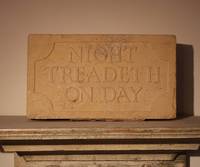
1903rif. 487191903. No Binding. Very Good. c. 1903. Ketton Stone. 21.5 x 38 x 9 cm. The most effective way to introduce this remarkably prescient example of "concrete poetry"-now more than a century old-is to draw extensively from some of the catalogue entries referenced below. The words carved here "Night treadeth on day" are taken from William Morris's poem For the Bed at Kelmscott 1891. The poem was embroidered by his daughter May Morris for the bed at Kelmscott Manor the Morris family's country home. This is the third last line in the poem. In 1989 there is the excellent entry by David Cohen in Peter Nahum Gallery's catalogue #4: "This carved inscription considered here was probably made in the first years of the 20th century. It is rare among Gill's inscriptions in that it is carved in relief for his letters are more usually engraved. The letters are not his own designs as far as we know and a few years later in his career Gill would have been too engrossed in commissions for tombstones memorial plaques and ecclesiastical inscriptions to have devoted such effort to a work most likely undertaken for personal pleasure or experiment. For Gill to choose a text by Morris to inscribe was most natural as there was a great affinity between the two men although Morris had died when Gill was still a teenager. Many of Gill's ideas about the evils of industrialism the value of handicraft socialism and medievalism derive closely from Morris. In 1903 Gill paid several visits to the Arts and Crafts Exhibition with which he himself would show from 1906. The Art Workers Guild which he joined in 1905 was deeply influenced by Morris. In later years after his conversion to Catholicism Gill tended to downplay his debt to Morris preferring instead to trace his pedigree to Ruskin.At the time of `Night treadeth on day' however no such theological barrier came between the young Gill and his mentor. This inscription resonates with the romantic fervour of Gill's early attraction to Morris's poetry and politics. Gill was a man for whom the literary and formal aspects of letters were inseparable. It would not be unreasonable perhaps for a contemporary audience familiar with Ian Hamilton Finlay or Tom Phillips to view this Ketton stone carving as an inadvertent precursor of `concrete poetry'. David Cohen August 1989. Peter Nahum Gallery's catalogue #4. Judith Collins notes several observations about the physical characteristics of the relief inscription in entry #102 of the Barbican 1992 Exhibition Catalogue p. 119. The letters are carved in relief standing out from the stone rather than being incised-a technique Eric Gill occasionally preferred between 1903 and 1910. A similar use of relief lettering can be seen in his 1920 Crucifixion panel. Interestingly this particular stone is not included in Evan Gill's Inventory of the Inscriptional Work of Eric Gill 1964 despite its provenance from the artist's own family. The work was exhibited at the following galleries: Anthony D'Offay Gallery London in Eric Gill: Drawings and Carvings A Centenary Exhibition 1982 catalogue no. 53 illustrated on pages 47 and 55; Peter Nahum Gallery London in British Art from the Twentieth Century 1989 catalogue no. 4 illustrated on pages 10-12; and Barbican Art Gallery London in Eric Gill: Sculpture 1992 catalogue no. 102 illustrated on page 119. Provenance: Rene Hague Gill's printer and husband of Joanna Joan Hague the artist's daughter; consigned to Anthony d'Offay Gallery in 1982; then with the Peter Nahum Gallery in 1989; purchased in 1996 from the Peter Nahum Gallery. unknown