7 544 résultats
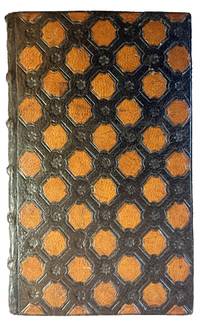
1708réf. 3219Paris: Jacques Vincent for Jacques Estienne 1708. 2 parts in one 12mo binding 137 x 85 mm. 16 284 4 252 12 pages. Woodcut head- and tail-pieces and initial. Ruled in red throughout. At the end is a 4-page catalogue of books sold by Jacques Estienne. Bifolium g6-7 in part 2 bound in reverse order. Mosaic binding of black morocco probably ca. 1725-1735 covers with an all-over design of repeated concave-cornered lozenges of onlaid light brown morocco within a blind-tooled lattice design of double fillets and tiny six-petalled blossoms spine in six compartments five similarly decorated each with one onlaid lozenge second compartment with onlaid silver-tooled brown morocco lettering-piece doublures of dark brown morocco with silver-tooled arabesque roll border edges gilt over marbling rehinged upper joint chipping; modern suede-lined morocco folding box. Provenance: Paul-Louis Weiller 1893-1993 bookplate his sale Paris 30 Nov 1998 lot 32; modern booklabel “non nove sed nova" initials CL. A mosaic “tile” or tessellated binding attributable to Antoine-Michel Padeloup on a popular Jansenist devotional text. This unusual binding reverses the usual color scheme of the small corpus of similar known bindings providing a sober yet striking cover for the book. “Around 1707 mosaic work . began to be used in binding as it did in furniture and became the leading element in the design. These designs were now provided by onlay as opposed to the sixteenth-century use of paint and wax. Such mosaic work was either in a new form of the all-over semis now incorporating a framed structure so that it often resembled a tessellated pavement and was sometimes termed à répétition or with free-hand floral or other asymmetric realistic work” Barber Rothschild Waddesdon Manor catalogue p. 201. Tile-patterned mosaic bindings were usually used on small format books. Their invention is credited to the binder Antoine-Michel Padeloup or Padeloup le jeune 1685-1758 who bound for the entourage of the Regent Philippe II d’Orléans d. 1723. The height of the fashion for this style was probably the late 1720s and 1730s Barber p. 226. This style of decoration had the advantage of requiring little materiel. While “very labour-intensive the tile pattern style requires only a few tools all being common lines and curves `gouges’ and hardly any `figure’ that is expensive engraved tools. It would as such have suited under-capitalised younger binders. But such designs “clearly required careful planning and doubtless the preparation of a scaled plan based on both the exact size of the book and on the tools to be used” loc. cit. The present binding contains only one tool on the outer covers the small fleuron Waddesdon catalogue p. 384 fig. 11 and one roll which was also apparently used only on doublures Waddesdon catalogue I p. 436 RBT 8. Other tessellated mosaic bindings in this style all attributed to Padeloup are known: five of which three using the same tools are described and illustrated in the Waddesdon catalogue; another was reproduced by Michon and in the Esmérian catalogue. Those bindings use black or dark mororcco lozenges gold-tooled on a citron or light brown morocco ground with gold-tooled lattice-work creating a luminous effect. In contrast to those bindings here Padeloup reversed the color scheme: a black ground with restrained silver and blind tooling serves as background for the tile design of unadorned brown morocco lozenges. While visually striking the effect enhanced by the silver-bordered doublures is one of restraint no doubt intentional to reflect the book’s Jansenist content. Barbier Anonymes IV: 814. Giles Barber The James A. de Rothschild Bequest at Waddesdon Manor The National Trust: Printed Books and Bookbindings 2 vols. 2013; see nos. 90 91 92 93 and 572. Cf. Louis Michon Les reliures mosaïquées du XVIIIe siècle no. 89 = Bibliothèque Raphaël Esmérian II no. 89. (Jacques Vincent for) Jacques Estienne unknown books
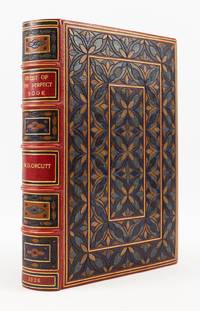
1926réf. ST20086Boston: Little Brown & Co 1926. First Trade Edition. 228 x 160 mm. 9 x 6 1/4". 8 p.l. 316 pp. 1 leaf. SPECTACULAR MOSAIC MOROCCO BY CURTIS WALTERS signed in gilt on rear turn-in covers with animated repeating ogival pattern inlaid in several hues of morocco black navy blue light blue light brown and orange separated into three panels by thin strips of red morocco and gilt rules THE COVERS WITH APPROXIMATELY 662 INLAYS IN TOTAL raised bands spines compartments ruled in gilt and inlaid with a similar design gilt titling NAVY BLUE MOROCCO DOUBLURES bordered with strips of eggplant and red morocco and four gilt rules navy blue watered silk endleaves top edge gilt others trimmed on the rough. Housed in a marbled paper chemise with red morocco back and matching slightly worn slipcase. With color frontispiece and printed tissue guard 48 black & white plates one double-page specimen reproduction and numerous in-text illustrations and specimen page reproductions. With tipped-in "Compliments of the Author" leaf SIGNED by Orcutt. Clizbee "Curtis Walters American Binder" in "The American Book Collector" August September 1932 pp. 124-34 this binding pictured in the second plate. Copy included with this item. Very slight offsetting from plates and the odd trivial imperfection internally otherwise a fine copy IN AN IMMACULATE BINDING. This splendid mosaic binding is a tour-de-force of design and craftsmanship from an underappreciated American binder who specialized in this technique. The foreword to the 10 December 1957 sale catalogue of his bindings at Parke Bernet says that they "constitute a splendid group of American mosaic bindings such as have never been offered for sale before. . . . The description of bindings is always a difficult matter; it becomes practically impossible when one is faced by the stunning variety of complex patterns of colored mosaic inlays which Mr. Walters has assembled with infinite patience extraordinary skill and sophisticated taste . . . He has invented and brought to perfection a new technique whereby the most intricate inlaid designs can be achieved by a few simple tools without the use of dies or punches; gilt dots circlets and fillets are generally applied with restraint. . . . It need hardly be added that all of Mr. Walters' bindings are made of the very finest leathers available and that their workmanship reveals consummate craftsmanship down to the smallest detail." The present item was lot #25 in that sale. Walters became interested in bookbinding around 1900 and studied with such prestigious workshops as William Matthews the Club Bindery and Henry Stikeman. In "Hand Bookbinding in the United States Since the Civil War" Thompson tell us of Walters' work: "The infinite variety of design permitted by mosaic work is combined with Walters' marvelous delicacy in color schemes finely conceived geometric patterns and tasteful use of gold leaf to produce books that no Americans save perhaps the artists of the Club Bindery could have matched. The utter simplicity of Walters' methods he used but four tools belies his perseverance and devotion to his art. Only infinite patience and consummate skill could have produced Walters' bindings." The article by Azalea Clizbee in the accompanying copy of "The American Book Collector" describes Walters' technique for creating his mosaic bindings using only the simplest tools with plates depicting eight of his bindings including this one. Although very secondary here the text is appropriately a celebration of book arts--printing binding and illustration--by William Dana Orcutt 1870-1953 typographer printer and book designer. After graduating from Harvard in 1892 he went to work for the University Press there. He created several typefaces most notably "Humanistic" based on the humanist hand of 15th century scribe Antonio Sinibaldi. With Daniel Updike and Bruce Rogers he established the Boston Society of Printers in 1905. He was the author of several works on printing typography and the making of beautiful books. Little, Brown & Co unknown books
1986réf. ARCH0162Athen, 1986. S. (167)-194, mit 19 Abb. im Text, OBr., klammergeh., geringe Gebrauchsspuren. In Neugriechisch.
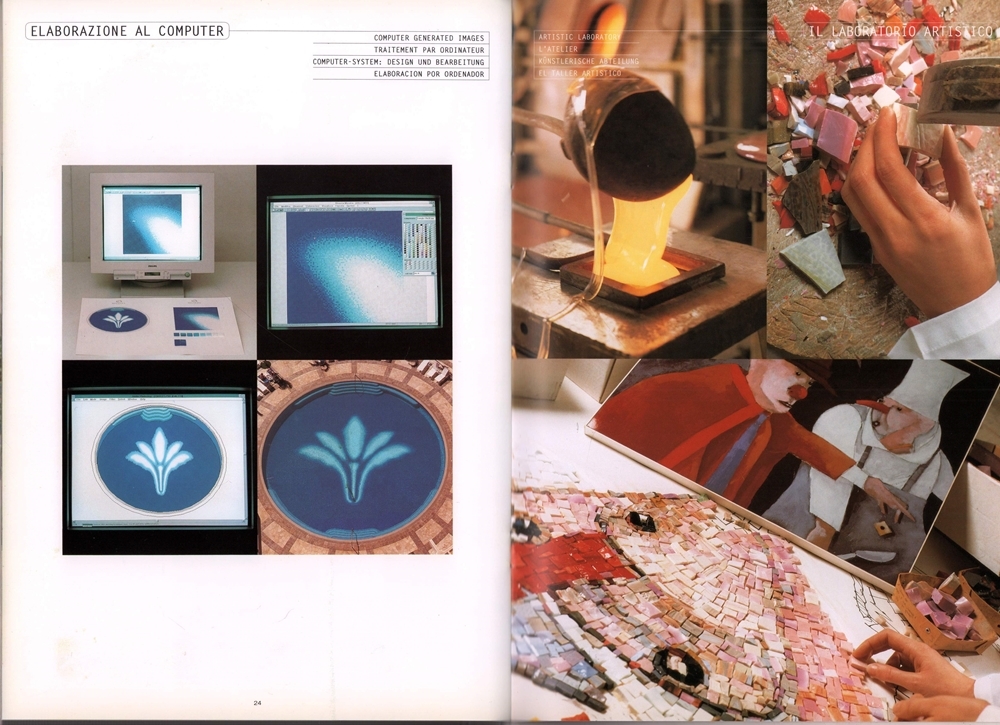
1997réf. 91699Alte-Vicenza, Bisazza, [1997]. 28 S. mit Farbfotos sowie 2 Einfalttaf. (Abbild. v. Farb- und Steinmustern). 30,5 cm. OPp.
1976réf. 62176BBFreiburg im Breisgau, Basel und Wien, Herder Verlag, 1976. Gr.-4°. 36 x 31 cm. 344 Seiten. Original-Kunstleder mit goldgeprägtem Deckel- und Rückentitel im Original-Illustrierte Pappschuber.
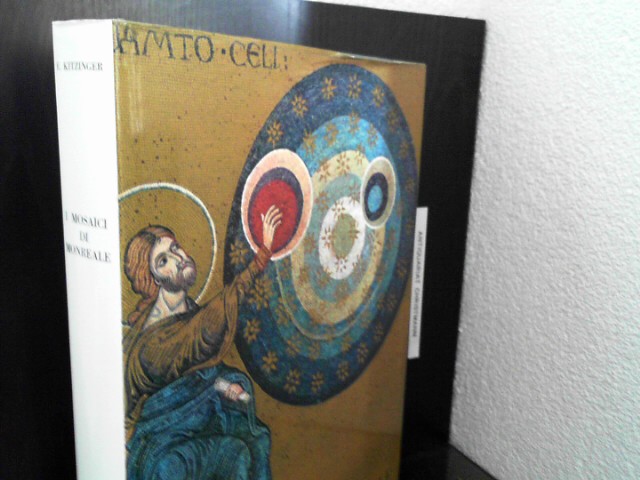
1991réf. 14759Palermo, Flaccovio Editore 1991. 132,XV pp. 57 ills & Tavole: 102 col.plts & 5 fold.maps. / 132 Seiten Text mit Abbildungen, 102 farbige Tafeln und 5 aufklapbare Architekturansichten 35,5 x 28,5 x 4 cm, , gebundene Ausgabe, Leinen, book in good condition, Exemplar in guten Erhaltungszustand
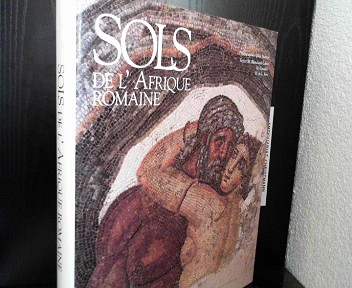
1995réf. 12064Imprimerie Nationale 1995. 32,6 x 28,8 x 3,6 cm, 33x29cm 298pp. 218 ill.coul Carte Plans Biblio.Exposition Gebundene Ausgabe, Leinen, Exemplar in guten Erhaltungszustand
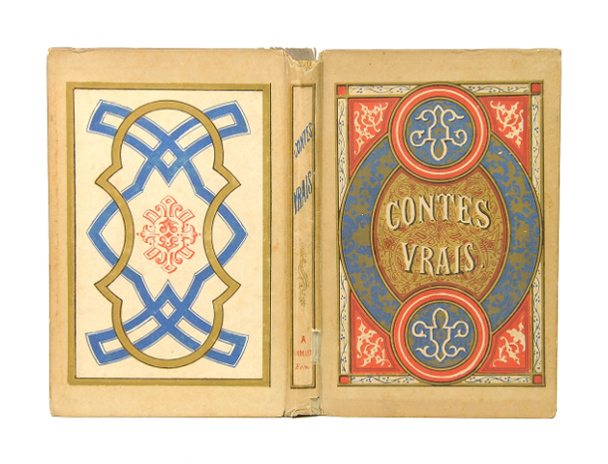
1870réf. 47749Paris, Amédée Bédelet, o. J. (um 1870). 8°. Mit einigen Textholzstichen u. (inkl. Frontispiz) 7 kolor. Holzstichtafeln. 2 Bll., 121 S., Farb. illustr. OPpbd.
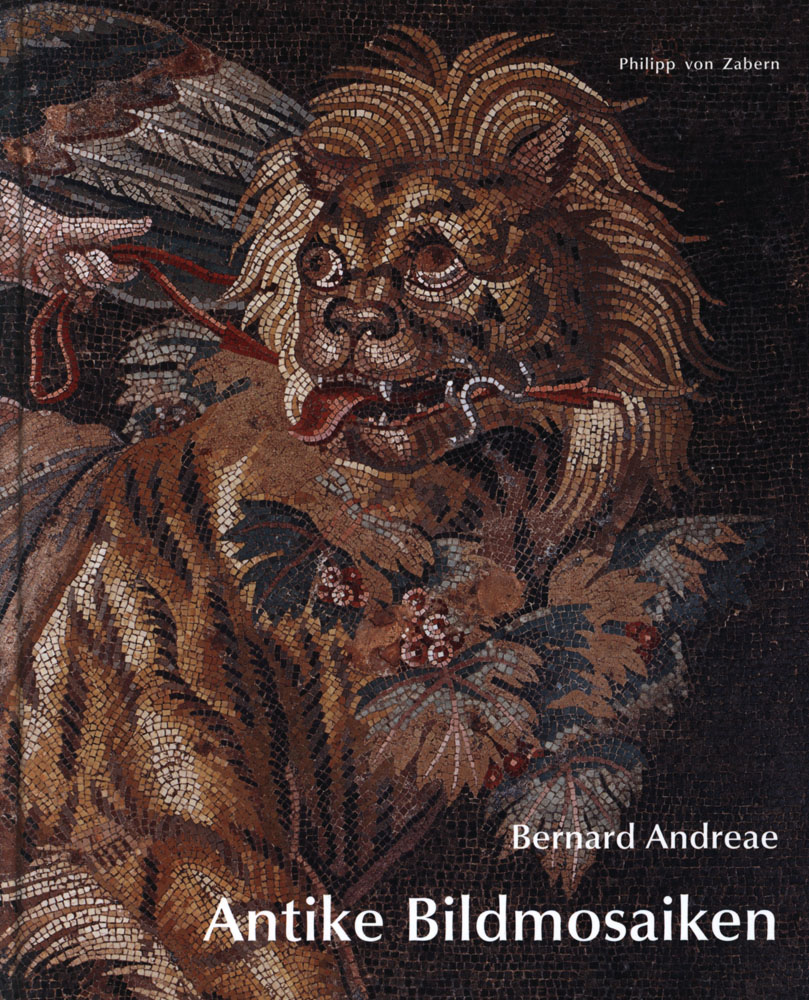
2003réf. 56852CBMainz am Rhein, Verlag Phillip von Zabern, 2003. 4°. 31 cm. 319 Seiten. Original-Pappband.
1953réf. EEzz1956zLondon, Routledge & Kegan Paul Ltd. (1953). gr.-8°, XIII, 97 S., 64 sw. Taf., OLn., Händlermarke am vord. Spiegel, Widmung verso flieg. Vorsatz, In Englisch.
2005réf. EEzz8095Ljubljana 2005. 27,5 quadrat., 140 S. mit zahlr., meist farb. Abb., Foto-Vorsätze, OLn. m. OU., sehr guter Zustand.
réf. 5L1306Philippe Libraire Paris 1838. 412 Seiten mit einem Frontispiz und über 200 Illustrationen in Holzstich Halbleder-Einband mit goldgeprägtem Rückentitel quart Einband berieben/Frontispiz mit kleinen Fehlstellen und ebenso wie die ersten fünf Seiten wasserrandig/fünf Seiten mit kleinen Wurmspuren ohne Textverlust/Seite 105/106 mit kleinem Ausriß und geringem Textverlust/durchgehend kleine Stockflecken. - sonst altersgemäßes Exemplar / Text französisch / 1833 erschien die erste Ausgabe von "La Mosaique - Livre de tout le monde et tout le pays". Die kommerziellen Erfolge in England und Frankreich auf dem Sektor der Pfennigpresse ermutigten den Pariser Buchhändler und Verleger Martin Bossange Père 1766-1865 in Leipzig ein deutsches Pendant zu gründen zumal Bossange in der Messestadt bereits eine Niederlassung unterhielt die von J. J. Weber geleitet wurde. Im Mai 1833 erschien die erste Ausgabe des deutschen "Pfennig-Magazins". 1855 wurde das Magazin eingestellt - unknown
réf. 5L1307Decourchant Paris 1833-1836. Seite 17-418/416 Seiten 28 Seiten fehlen/5 408 Seiten mit zahlreichen Illustrationen in Holzstich Halbleder-Einbände der Zeit mit goldgeprägtem Rückentitel quart ein Rücken stark berieben und angeplatzt sowie mit Fehlstellen/sonst berieben und fleckig/Band 1 Seite 1-16 fehlt/Band 2 Seiten 57/58 99-143 155/160 179/180 und 227/228 fehlen. - sonst altersgemäße Exemplare / Text französisch / 1833 erschien die erste Ausgabe von "La Mosaique - Livre de tout le monde et tout le pays". Die kommerziellen Erfolge in England und Frankreich auf dem Sektor der Pfennigpresse ermutigten den Pariser Buchhändler und Verleger Martin Bossange Père 1766-1865 in Leipzig ein deutsches Pendant zu gründen zumal Bossange in der Messestadt bereits eine Niederlassung unterhielt die von J. J. Weber geleitet wurde. Im Mai 1833 erschien die erste Ausgabe des deutschen "Pfennig-Magazins". 1855 wurde das Magazin eingestellt - unknown
réf. DADAX157076266XNew unknown
réf. DADAX041593656XNew unknown
réf. DADAX0073533890New unknown
réf. SONG1601450737Used: Good unknown
réf. DADAX1565230965New unknown
réf. SONG0889623759Used: Good unknown
réf. DADAX0073332003New unknown
réf. DADAX0195127129New unknown
réf. DADAX1853919756New unknown
réf. DADAX0230202373New unknown
réf. BN370024Venise Saint-Marc les mosaïque l'histoire l'illumination Hardcover Venise Saint-Marc les mosaïque l'histoire l'illumination Hardcover Venise Saint-Marc les mosaïque l'histoire l'illumination Hardcover hardcover
réf. DADAX1497101425New unknown