9 121 résultats
1969réf. 144659New York: Jerome Hellman Productions 1969. Draft script for the 1969 film. Copy belonging to the film's still photographer Ron Munkasci with this name in red holograph ink at the top right corner of the title page. Based on the 1965 novel by James Leo Herlihy about an unlikely friendship between a would-be gigolo and an ailing con artist. Cornerstone film of the New Hollywood cinema nominated for seven Academy Awards winning Best Adapted Screenplay Best Director and Best Picture. Set in New York City shot on location in Miami Manhattan and Big Spring Texas. Dark blue titled wrappers noted as DRAFT SCREENPLAY at the bottom right and with the logo for JEROME HELLMAN PRODUCTIONS at bottom center. Title page present with credits for screenwriter Waldo Salt novelist James Leo Herlihy producer Jerome Hellman and director John Schlesinger noted as "A JEROME HELLMAN-JOHN SCHLESINGER PRODUCTION." 122 leaves with last page of text numbered 113. Mimeograph duplication. Pages Near Fine with some offsetting to the title page due to a newspaper clipping still present laid in wrapper Very Good plus. National Film Registry. Jerome Hellman Productions unknown books
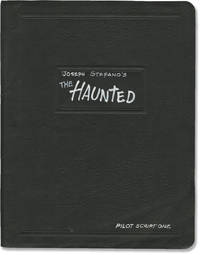
1964réf. 147167Los Angeles: Villa di Stefano Productions 1964. First Draft script for the 1964 television film which originally aired on CBS. With actor Martin Landau's copied annotations throughout. Included are a set of synopses for proposed episodes a shooting schedule a distributor's announcement booklet and various other documents related to production. Also included is an original celluloid print of the film on a single reel in its original mailing case with cloth straps dated 2/18/65 addressed from director Joseph Stefano to Landau on the mailing label in holograph black ink and INSCRIBED by Stefano to Landau at the top left corner of the case in the same ink: "To Martin / Whose splendid brilliance and warmth put the special spark in this bright fire / Your grateful and admiring friend / Joe Stefano." Fearful of being buried alive a woman installs a phone in the crypt in which she plans to be in case of emergencies. Months after her death the phone begins to ring presenting a new ghostly case for Landau's paranormal investigator. The film was intended to be the pilot for a new paranormal thriller series tentatively titled "The Haunted" as titled on the front wrapper but the series wasn't picked up and the pilot was released as a television movie after additional footage was shot. Black titled wrappers with credits for director-screenwriter Joseph Stefano noted as PILOT SCRIPT ONE. Title page present dated July 27 1964 noted as PILOT SCRIPT ONE with credits for director-screenwriter Joseph Stefano. 77 leaves with last page of text numbered 76. Early Xerox rectos only. Pages Near Fine wrapper Near Fine bound internally with three silver brads. Film reel and film stock are unexamined. Villa di Stefano Productions unknown books
1961réf. 145470Culver City CA: Columbia Pictures 1961. Early Draft script for the 1970 film "Cromwell" seen here under the title "Oliver Cromwell." Copy belonging to director/screenwriter Ken Hughes with his annotations throughout. With 11 pages of reproductions from "The Commonweal" newspaper from August and September 1885 laid into the front of the script along with a drawing of how to add pages to the spring binder. A biographical account of the 17th century political and religious struggles taking place in England under the reign of King Charles Alec Guinness. Likely one of the earliest screenplay drafts shelved for almost ten years due to an inability to find funding. Director Ken Hughes' favorite of his own films. Winner of an Academy Award for Best Costume Design and nominated for one other. Shot on location in Spain and England. Red leatherette spring binder with holograph felt ink titles on tape. Title page present dated 26th July 1961 noted as 2nd Screenplay with credits for screenwriter Ken Hughes. 279 leaves with last page of text numbered 279. Mimeograph duplication rectos only with pink revision pages throughout dated 26th July 1961 and 29th September 1961. Pages Near Fine spring binder Very Good plus. Columbia Pictures unknown books
1941réf. 149562Culver City CA: RKO Radio Pictures 1941. Early Draft script for the 1948 film dated June 13 1941 preceding its release by seven years. Based on Edward Anderson's 1937 novel "Thieves Like Us" about an escaped convict who falls in love with a woman who nurses him back to health after he is injured in a robbery. In December 1936 RKO's considered Anderson's novel but rejected it prior to any adaptation being written. Writer-director Rowland Brown who by 1941 controlled the rights to the novel wrote the first attempted draft of a screenplay. This time around RKO accepted it and Brown sold the rights to them for $10000. When Brown's script was first submitted to the Breen Office in April 1941 director Joseph I. Breen deemed it "unacceptable" claiming that it contained too much criminal activity and "loose sex." Brown revised the first draft on June 13 1941 but it was again rejected by the Breen Office. A revised script written by Robert D. Andrews was submitted in October 1941 and was rejected for the same reasons as Brown's drafts. RKO did not submit the script again until September 1944 when it was rejected for a fourth time. From Aug 1946 to May 1947 when Ray was working on the script the PCA rejected three more versions of the story stating each time that the adaptation dwelt too much on the characters' crimes and not enough on morality. Script approval finally came in June 1947 after RKO executives met directly with Breen an incorporated his suggestions into the story. Set in the American West shot on location throughout California including Canoga Park Newhall Arcadia Griffith Park Benedict Canyon the San Fernando Valley San Bernardino Mountains and the RKO Encino Ranch. Gray titled wrappers noted as production No. 1243 dated June 13 1941 with a credit for Rowland Brown. Title page integral with first page of text with a credit for Rowland Brown. 153 leaves with last page of text numbered 152. Carbon typescript rectos only. Pages Near Fine wrapper Very Good plus bound with three gold brads with washers. RKO Radio Pictures unknown books
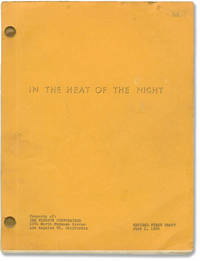
1966réf. 152454Los Angeles: The Mirisch Corporation 1966. Revised First Draft script for the 1967 film. Laid in is a Call Sheet from the production dated Tuesday November 29 1966. Based on John Ball's 1965 novel. An African American police detective from Philadelphia is recruited to help solve a murder in a small bigoted Mississippi town. Winner of five Academy Awards including Best Picture and Best Actor for Rod Steiger nominated for two others. After the success of the film version the characters were developed further for a police procedural television series in 1988 developed by James Lee Barrett and starring Carroll O'Connor and Howard Rollins which aired on NBC then CBS from 1988 to 1995. Set in the fictional town of Sparta Mississippi and shot largely on location in Illinois. Poitier insisted the movie be filmed in the North because of a 1964 incident in Mississippi in which he and Harry Belafonte had been run off the road and almost killed by Klansmen while in the state to support the SNCC Student Non-Violent Coordinating Committee. Goldenrod titled wrappers noted as REVISED FIRST DRAFT on the front wrapper rubber-stamped copy No. 84 dated July 1 1966. Title page present dated July 1 1966 noted as REVISED FIRST DRAFT with credits for screenwriter Stirliing Silliphant. 134 leaves with last page of text numbered 140. Mimeograph duplication rectos only with blue pink and white revision pages throughout dated variously between 7/27/66 and 8/10/66. Pages with damp stain on top right of last several pages else Near Fine wrapper Very Good plus bound with two gold brads. Call Sheet 8.5 x 14 inches folded horizontally. Near Fine National Film Registry. Criterion Collection 959. Penzler 101 Greatest Films of Mystery and Suspense. The Mirisch Corporation unknown books
1943réf. 133635Hollywood: Paramount Pictures 1943. Revised Draft script for the 1943 film. Co-written for the screen by Raymond Chandler and Frank Partos. Chandler's contribution to the script had mostly to do with Alan Ladd's character and his tough dialogue elements sneered at by the media upon the film's release. Laid in is an 8-page shooting schedule on blue stock a 6-page revision to sequence "A" on yellow onionskin stock and 14 pages of "inter-office communication" on yellow studio stationery comments on scenes sequences and pages of the script. Based on Rachel Field's 1942 novel about Emily Blair Loretta Young a wealthy deaf girl whose hometown is named for her family. Doctor Vance Ladd who grew up on the other side of town resents the Blair family but is working on a serum to cure deafness which he tries on Emily and she is eventually cured. One of only five screenplays written by Chandler this being the second following his script for the classic "Double Indemnity" 1944 based on James M. Cain's novel. Chandler had a tumultuous career in Hollywood including a suspension in late 1945 from Paramount for "refusing to perform under a contract which is not a proper expression of my standing in the motion picture business" but his influence on film adaptation is nearly unmatched with scripts and stories that pushed the limits of the Production Code Administration. Script: White self wrappers production No. SF 8577 dated December 3 1943 with credits for screenwriters Partos and Chandler. Title page integral with front wrapper in the Paramount style. 137 leaves mimeograph duplication with blue and light blue revision pages throughout dated variously between 1/11/43 possibly a typo and 3/30/44 other leaves dated variously between 12/3/43 and 12/5/44 possibly a typo. Pages Near Fine wrapper now encapsulated in mylar with cello tape and spine label remnants bound with two gold brads. Shooting Schedule: Corner-stapled blue stock noted as 4TH TENTATIVE BLUE / BASED ON A-B-C-D-E PART SEQUENCES dated 12/13/43 start and 2/9/44 close with credits for director Pichel assistant director O. Oscar Rudolph and businessmanager B. Bernard McEveety. 8 pages folded horizontally rust to the staple else Near Fine. Revision: Yellow onionskin stock loose but bound with a paperclip. Holograph annotations in pencil to the last leaf recto and verso detailing a few scene changes. 6 pages folded horizontally paperclip indentation and rust to the clip else Near Fine. Inter-Office Communication: Corner-stapled yellow studio stationery dated variously between 2/15/43 and 1/3/44. The earliest dated page contains notes on the script noting Talbot Jennings as the screenwriter. 14 pages hole punches at the top edges rust to the staples else Near Fine. Luhr Raymond Chandler and Film US. MacShane US. Paramount Pictures unknown books
1954réf. 146173Burbank CA: Walt Disney Productions 1954. Final Shooting Script for the 1954 film with blue yellow and green revisions throughout. Based on the 1870 novel "Twenty Thousand Leagues Under the Sea" by Jules Verne. Walt Disney's "20000 Leagues Under the Sea" was one of the most expensive and ambitious productions of its time. A 200 foot submarine a 225 pound diving suit a specially built soundstage with a 90 x 165 foot tank and a giant squid which weighed two tons and required a crew of 28 to operate were just some of the monumental challenges of the production. Disney's first CinemaScope motion picture "20000 Leagues Under the Sea" was a resounding success and went on to be considered one of greatest live-action adventure movies ever made. In 1868 off the coast of San Francisco Professor Aronnax Paul Lukas his assistant Conseil Peter Lorre and master harpooner Ned Land Kirk Douglas set sail upon a armed frigate to investigate a spate of sinkings rumored to be caused by a sea monster. After months of searching the "monster" is spotted sinking a merchant vessel and the frigate attacks only to be sunk themselves. Adrift in the ocean the three come upon a strange metal vessel and realize the "monster" is a "submerging boat." The trio are captured by Captain Nemo James Mason and taken aboard the submarine the Nautilus and journey on a voyage of adventure and discovery under the sea. Nominated for three Academy Awards winning two for Art Direction and Special Effects. Shot on location in California Jamaica and the Bahamas. Blue titled wrappers with affixed Walt Disney Productions label as called for with Disney scripts from this era noted as FINAL SHOOTING SCRIPT on the front wrapper with credits for screenwriter Earl Felton. Title page present with credits for screenwriter Earl Felton. 146 leaves with last page of text numbered 141. Mimeographed rectos only with blue yellow and green revision pages throughout dated variously between 1/30/54 and 3/1/54. Pages Near Fine plus wrapper Near Fine bound internally with three gold brads. Walt Disney Productions unknown books
1964réf. 131051Beverly Hills CA: Metro-Goldwyn-Mayer MGM 1964. Draft script for the 1965 film based on the 1948 novel by Evelyn Waugh legendarily co-written by Terry Southern and Christopher Isherwood. Deluxe working script belonging to uncredited crew member William Todd Mason with his name and phone number in holograph ink on the title page and some brief penciled annotations on three pages. Laid in is a corner stapled three page Staff and Crew list with two name additions in holograph red ink on the second page. Included is a vintage studio still photograph from the film. An early draft issued nearly two years prior to the film's October 1965 release with substantial differences from the finished film. The sister film to "Dr. Strangelove" and in the eyes of many just as much a masterpiece of exquisitely wrought black humor. Made in the US but in a dense British-American style. Ostensibly a satire on the funeral business in which a young British poet winds up in a Hollywood cemetery as part of an inheritance arrangement-but in reality a satire of Hollywood itself as well as the Western malaise of the mid 1960s. Script: Self wrappers presumably as this draft was issued. Title page present rubber stamped copy No. 70 dated July 21 1964 with credits for screenwriters Southern and Isherwood. 158 leaves mimeograph duplication with blue revision pages throughout dated 7-22-64. Pages Fine wrapper Fine bound with two gold brads. Staff and Crew listing: two leaves slightly worn with annotations on the second page. Metro-Goldwyn-Mayer [MGM] unknown books
1924réf. 137520Beverly Hills CA: Metro-Goldwyn-Mayer MGM 1924. Continuity Draft script for the 1925 film. Studio File Copy rubber-stamped on the front wrapper. Brief notation on one page in holograph pencil. Based on Tod Robbins' 1917 novel a classic of horror fiction about a trio of circus freaks who escape captivity in the circus open a curiosity shop and use it as a base from which to launch a devastating crime wave. Robbins would see another of his short stories "Spurs" adapted by Browning as the classic 1932 film "Freaks." This is the first of two adaptations being a silent starring Lon Chaney as Professor Echo the ventriloquist Victor McLaglen as Hercules the strongman and Harry Earles as Tweedledee the dwarf. The second version was directed by Jack Conway in 1930 as a talkie with Chaney and Earles reprising their roles and Ivan Linow as Hercules. Set in New York. Goldenrod titled wrappers noted as copy No. 2 in holograph ink and production No. 1505 dated 12/20/24 with credits for screenwriter Young. Title page present undated with credits for writer Robbins and screenwriter Young. 113 leaves with last page of text numbered 111. Multilith reproduction. Pages Near Fine wrapper Very Good plus bound with two gold brads. Lentz US. Metro-Goldwyn-Mayer [MGM] unknown books
1966réf. 152454Los Angeles: The Mirisch Corporation 1966. Revised First Draft script for the 1967 film. Laid in is a Call Sheet from the production dated Tuesday November 29 1966. Based on John Ball's 1965 novel. An African American police detective from Philadelphia is recruited to help solve a murder in a small bigoted Mississippi town. Winner of five Academy Awards including Best Picture and Best Actor for Rod Steiger nominated for two others. After the success of the film version the characters were developed further for a police procedural television series in 1988 developed by James Lee Barrett and starring Carroll O'Connor and Howard Rollins which aired on NBC then CBS from 1988 to 1995. Set in the fictional town of Sparta Mississippi and shot largely on location in Illinois. Poitier insisted the movie be filmed in the North because of a 1964 incident in Mississippi in which he and Harry Belafonte had been run off the road and almost killed by Klansmen while in the state to support the SNCC Student Non-Violent Coordinating Committee. Goldenrod titled wrappers noted as REVISED FIRST DRAFT on the front wrapper rubber-stamped copy No. 84 dated July 1 1966. Title page present dated July 1 1966 noted as REVISED FIRST DRAFT with credits for screenwriter Stirliing Silliphant. 134 leaves with last page of text numbered 140. Mimeograph duplication rectos only with blue pink and white revision pages throughout dated variously between 7/27/66 and 8/10/66. Pages with damp stain on top right of last several pages else Near Fine wrapper Very Good plus bound with two gold brads. Call Sheet 8.5 x 14 inches folded horizontally. Near Fine National Film Registry. Criterion Collection 959. Penzler 101 Greatest Films of Mystery and Suspense. The Mirisch Corporation unknown
réf. 132794Universal City CA: Universal Pictures 1986. Archive of three title card maquettes hand lettered by Harold Adler for the 1963 film. Also included are two fascinating autograph letters both elaborately designed and executed in a calligraphic style from Adler to author illustrator and editor Fridolf Johnson relating to Adler's work with Hitchcock. Harold Adler was a calligrapher who created hand lettered titles on over 100 films worked frequently with Alfred Hitchcock and was a favorite of legendary title sequence designers Saul Bass and Pablo Ferro. In addition to "The Birds" 1963 his credits include "Comanche!" 1956 "The Man with the Golden Arm" 1955 "The Seven Year Itch" 1955 "Carmen Jones" 1954 "Psycho" 1960 "In the Heat of the Night" 1967 and "Justine" 1969. In 2012 an exhibition of Adler's work was organized by noted typographer and design historian Jill Bell at the American Advertising Federation Kansas City. In the first letter dated May 16 1986 Adler describes after touching on other topics meeting Hitchcock and then presenting him with layout ideas for the titles. He then goes into detail regarding his answer to a question about the techniques of artist Eric Gill stating that Hitchcock "was amazed" by this answer and after that would "request 'to be sure to bring that nice young man along" meaning Adler whenever he had a job for Adler's firm. The second letter dated June 10th 1986 focuses almost exclusively on Adler's work on "The Birds" going into some detail regarding both the creative and technical processes of producing hand lettered titles for films. He also describes Hitchcock as "an unusual person to work with. He was a master at what he did knew what he wanted and smoked the finest cigars." He then concludes the letter with some brief remarks on how his approach to title lettering evolved over the course of his career. The letters themselves are works of art executed in a variety of inks in Adler's detailed penmanship with Johnson's name on each in particular receiving full calligraphic treatment. Also included are draft title cards for the film stylistically similar to each other but much different from the titles used in the finished film. Two of the cards are marked as "camera ready" in manuscript colored pencil with titles executed in white paint on black board. The third card photo stat on black paper which accompanied the June 10th letter has been annotated by Adler on both the recto and verso explaining the in more detail the technical process of putting the lettering on film. Overall a significant collection of material illuminating a little explored aspect of film design with a direct and significant connection to a seminal work by a director known for personally overseeing all aspects of production. Each letter 19 x 24 inches single leaf rectos only. May 16th letter folded twice for mailing June 10th letter folded. Two long diagonal creases to the May 16th letter else both are Fine. Original mailing envelope for the May 16th letter included. "Camera ready" title cards 22 x 14 inches. Lightly rubbed and about Near Fine. Third card 18 x 4 inches. Near Fine. National Film Registry. Clover Men Women and Chainsaws. Godard Histoires du cinema. Universal Pictures unknown
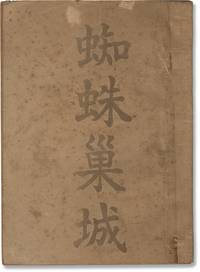
1957réf. 1717261957. Draft script for the 1957 Japanese film. Text and titles in Japanese. Akira Kurosawa's visceral ghostly adaptation of Shakespeare's "Macbeth" transposed to feudal Japan with elements drawn from Noh theatre. Shot on location in Shizuoka Tokyo and on Mount Fuji Japan. Brown titled wrappers. Approximately 57 leaves. Mimeograph duplication printed on rectos and versos. Pages Very Good wrapper Good perfect-bound with moderate toning throughout wrappers foxed and small chips and creases to page edges. BFI 2017. Criterion Collection 190. unknown
1955réf. 156909Burbank CA: Warner Brothers 1955. Draft script for the 1956 revisionist Western. Near the end of Randolph Scott's career producer Harry Brown Scott and director Budd Boetticher began work on a series of intelligent films that would combine Scott's minimalist acting style with Boetticher's lean approach to filmmaking. The result was a series of films today referred to as the "Ranown" cycle a rich canon that formed a strong stylistic whole. Boetticher's approach to storytelling was traditional in the sense that it involved traditional Western characters but revisionist in that his protagonist invariably worked alone and sought his own brand of morality rather than one established by tradition government and family. Apart from ardent fans of Westerns these films went unrecognized by most until Martin Scorsese made a case for them in his 1995 BFI documentary "A Personal Journey with Martin Scorsese Through American Movies." Gray titled wrappers dated September 15 1955 with credits for screenwriter Burt Kennedy. Title page present dated September 15 1955 with credits for screenwriter Burt Kennedy. 100 leaves with last page of text numbered 99. Mimeograph duplication rectos only with blue revision pages throughout dated variously between 9/19/55 and 9/20/55. Pages and wrapper Very Good plus with tide marks on the bottom edges of the title page and front wrapper bound internally with three gold brads. Housed in a custom brown quarter-leather clamshell box. Pitts 3788. Schrader 52. Scorsese A Personal Journey Through American Movies. Warner Brothers unknown
1957réf. 172280N.p.: N.p. 1957. Final script for the 1957 film. Specially bound copy belonging to actress Jacqueline Evans who played the uncredited role of Mrs. Braddock with her annotations in manuscript pencil underlining dialogue on several leaves. SIGNED in round-robin fashion by numerous cast and crew members on the first seven leaves some with inscriptions. Signatures include director Henry King and actors Ava Gardner Mel Ferrer Tyrone Power and Errol Flynn humorously signing as "E. Hemingway" among others. Full provenance available. The first screen adaptation of the 1926 novel by Ernest Hemingway. One of the most honest film adaptations of its era attributable mainly to the screenplay by novelist and Hemingway acolyte Peter Viertel. Featuring a standout performance by Errol Flynn as the hedonistic hard-drinking burned-out Mike Campbell. in other words as himself. Shot on location in Pamplona Paris Biarritz and Mexico. Title page present noted as Final Script dated February 20 1957. 147 leaves with last page of text numbered 142. Mimeograph duplication on eye-rest green stock rectos only with blue revision pages throughout dated variously between March 11 and 14 1957. Pages Near Fine binding Very Good plus specially bound in textured brown cloth with an orange ribbon bookmark. N.p. unknown
1962réf. 171100Stockholm: Svensk Filmindustri SF 1962. Draft script for the 1963 Swedish film. Copy belonging to actor Bertha Sånnell with her name in manuscript ink on a label affixed to the front wrapper her annotations in manuscript ink and pencil on two script pages and on a sheet of lined paper bound in at the rear of the script. The second entry in Ingmar Bergman's legendary and highly personal "Faith" trilogy a series of films that launched an important phase in the director's career. A quiet relentless meditation on the nature of faith imperfection and beauty. Red untitled wrappers. Title page present undated with credit for Bergman. 135 leaves with last page of text numbered 133. Mimeograph duplication rectos only. Pages Very Good plus wrapper Good perfect-bound with the spine of the wrapper and the first two leaves detached from the text block. Criterion Collection 210. Ebert III. Svensk Filmindustri [SF] unknown
1934réf. 144598Culver City CA: RKO Radio Pictures 1934. Draft script for the 1935 film. In a custom quarter leather clamshell box. The second of two films based on Liam O'Flaherty's 1925 novel the first being Arthur Robison's 1929 British feature about a former Republic Army member during the Irish War of Independence who turns in one of his comrades to the British in order to use the bounty money to book passage to America for himself and his girlfriend who has been forced into prostitution. Winner of four Academy Awards including Best Adapted Screenplay Best Director and Best Actor for McLaglen nominated for two others including Best Picture. Screenwriter Dudley Nichols became the first person to decline an Academy Award when his refused his Oscar due to an ongoing dispute between the Screen Writers Guild and the Academy though he would eventually claim it three years later. Detached green wrappers noting the title screenwriter and director on the spine in manuscript ink. Title page integral with first page of text with credits for screenwriter Nichols and novelist O'Flaherty. 105 leaves with last page of text numbered 105. Mimeograph duplication. Pages Near Fine wrapper Very Good side-stapled. National Film Registry. RKO Radio Pictures unknown
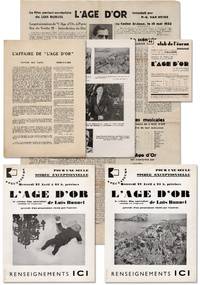
1932réf. 169144N.p.: N.p. 1932. A small archive of five vintage French pamphlets flyers and broadsides announcing 1931 and 1932 screenings of the banned 1930 surrealist film. All items are housed loose in a custom bound volume with a "L'Affaire de L'Age d'Or" label on the spine with each item laid in on separate leaves overlaid with heavy protective tissue housed in a custom slipcase. Rare. The archive includes: "L'Affaire de 'L'Age d'Or'" bi-fold pamphlet printed on rectos and versos with a satin-finish photo illustrated insert also printed on the recto and verso published by Nancy Cunard on the occasion of her January 1931 private screening of the film in London. The bi-fold includes the essay "Exposé des Faits" "Statement of Facts" describing the film's initial riotous reception "Extraits du Programme" "Excerpts from the Program" a "Questionnaire" regarding political and legal actions taken in response to the film and an extensive "Extraits de la Presse" "Excerpts from the Press" followed the names of signatories Maxime Alexandre Aragon André Breton René Char René Crevel Salvador Dali Paul Eluard Georges Malkine Benjamin Péret Man Ray Georges Sadoul Yves Tanguy André Thirion Tristan Tzara Pierre Unik and Albert Valentin. Two satin-finish variants of a flyer printed on rectos only for a screening of the film on April 27 1932 by Les Spectateurs de l'Avant-Garde at La Bellevilloise a workers' cooperative theatre with each flyer featuring a different image from the film. A second screening was later added on April 30 not noted on the flyers. The screenings were decidedly low-key private events with Buñuel insisting "No protests." French director Jean Vigo was reportedly among the participants of the screenings. And two items relating to a screening presented by Le Club de L'Ecran at Cine-Casino in Belgium on May 10 1932: A 4 x 5.5 inch announcement for the screening printed on the recto only noting the film as being presented by P.G. van Hecke Paul-Gustave Van Hecke followed by seating and ticket prices purchase locations and Club de L'Ecran membership prices. A large newsprint broadside printed on the recto and the verso for Le Club de L'Ecran announcing the May 10th screening with articles on the recto regarding the film club's activities and an excerpt from the Surrealist manifesto published upon the film's premiere with the verso dedicated entirely to numerous texts and articles on "L'Age d'Or" featuring two images from the film and a portrait of Buñuel. A key and archetypal work of Surrealist cinema alongside "Un Chien Andalou" 1929 also written by Buñuel and Dali and directed by Buñuel featuring a series of absurdist vignettes scathingly and sardonically rebuking the sexual hypocrisy of bourgeois society the Catholic Church and 20th century European society in general. The violence the uproar "L'Age d'Or" created remains as shocking as the film itself: days into the first screenings at Studio 28 on December 3 1930 the theatre was stormed by fascist youths enraged at the film's perceived anti-patriotic and anti-Christian message. Demonstrators threw ink at the screen shouted anti-Semitic death threats smashed the theatre windows and completely destroyed an exhibition of surrealist books and art in the foyer. In response the Board of Censors re-reviewed the film and on December 10 the film was banned from further public showings in France. The film's producers subsequently withdrew "L'Age d'or" from commercial distribution and public exhibition for more than 40 years although three years later in 1933 the film was privately exhibited at the Museum of Modern Art in New York. "L'Affaire de 'L'Age d'Or':" Bi-fold 7.5 x 10.5 inches. About Near Fine with a Very Good plus 7.5 x 10 inch insert with both items previously folded horizontally. Two Les Spectateurs April 27 Flyers: 8.25 x 10.5 inches. One Near Fine. One Very Good plus with light creasing faint toning and a .25 inch closed tear to the top edge. Le Club de L'Ecran Announcement: 4 x 5.5 inches. Near Fine. Le Club de L'Ecran Broadside: 14.25 x 21.75 inches folded as issued. About Near Fine with an additional lightly toned horizontal fold. Housed in a 9.25 x 12 inch custom bound Near Fine volume with a 9.5 x 12.25 inch Near Fine slipcase. BFI. Rosenbaum 1000. Vogel Film as a Subversive Art. N.p. unknown
réf. 166560N.p.: N.p. 1972. Early Draft script for the 1974 film file copy belonging to director Sam Peckinpah. Dated July 8 1972 over a year before production commenced and notably featuring the original ending with Bennie getting away-in true Peckinpah fashion the director would later rewrite the ending to show Bennie dying in a shootout. With Peckinpah's brief annotations in manuscript ink on the title page and two leaves of the script. Warren Oates stars as Bennie a bartender who travels through the Mexican underworld accompanied by his sex worker girlfriend to collect the bounty on the head of a gigolo. The only Peckinpah film not re-cut by the studio. Shot on location in Mexico. Yellow titled wrappers. Title page present dated July 8 1972 with credits for Peckinpah and screenwriter Gordon Dawson. 128 leaves with last page of text numbered 126. Xerographic duplication rectos only. Pages Near Fine wrapper Very Good plus bound with two gold brads. Ebert II. Nilsen Warped and Faded. Rosenbaum 1000. Twilight Time 497. N.p. unknown
1967réf. 149909New York: Andy Warhol Film 1967. Vintage poster for the 1967 film. The film originally screened at the Hudson Theater in a 95 minute version although this cut is considered lost. A 109 minute version would screen in 1968 as the first film shown at the New Andy Warhol Garrick Theater renamed as such after Warhol recovered from being shot by Valerie Solanas. One of several sexploitation influenced films made by Warhol an episodic story of a biker who has no bike and is both eroticized by the camera and emasculated by various Warhol superstars throughout. 19 x 25 inches rolled. Near Fine with some light soil and an almost imperceptible professional repair to a tear at the top edge. Murphy The Black Hole of Cinema. Warholstars. Andy Warhol Film unknown books
1961réf. 122148Universal City CA: Republic Pictures / Pax Films / Universal Pictures 1961. Forrest J. Ackerman's copy of scripts from two key science fiction films bound together including original front wrappers in red buckram with Ackerman's name in gilt at the bottom right corner of the front board. "The Lady and the Monster": Shooting script for the 1944 film. The first of three adaptations of Curt Siodmak's classic 1942 novel in which an honest hard-working scientist preserves a dead man's brain only to be remote-controlled by it. Shot by the legendary John Alton at the very peak of his work in the mid-1940s. Yellow front studio wrapper noted as SHOOTING SCRIPT at the top right dated October 13 1943 a penciled notation of the working title "The Lady and the Monster" just below the printed title noted as production No. 1194 and with credits for associate producer George Sherman and Republic Studios at the bottom. Two-page cast of characters with the actors' names added in ribbon copy type just below the character names. Title page present with credits for director Sherman and novelist Siodmak. 94 leaves mimeograph duplication with blue yellow green and pink revision pages leaves dated variously between 10/18/43 and 11/8/43. Pages and wrapper about Near Fine. "The Day the Earth Caught Fire": An early and apparently abandoned draft by director Val Guest to film his screen story for Pax Films as a five-part British serial. Guest ultimately directed the story as a feature-length movie for Pax one of the most understated and intelligent science fiction films ever made. Light green wrappers both front and rear wrappers present. The front wrapper reads: "A Five Part Serialisation of / THE DAY THE EARTH CAUGHT FIRE / A Val Guest Production." Just below in holograph ink and in what we would assume is Guest's hand is written "Dedicated to Brian Aldiss." We think it likely that the script was gifted to the very connected Ackerman by Guest though the provenance beyond Ackerman's ownership is unknown. 41 pages divided into five parts each beginning with a two-color memo on PAX stationery describing what will happen in the following section. Pages and wrapper about Near Fine. Buckram binding containing the two scripts is Very Good with some light scuffing and soil. Martin 413. Republic Pictures / Pax Films / Universal Pictures unknown books
1969réf. 145809London: N.p. 1969. Draft script for the 1969 film. An early version of the screenplay with the provisional title "A Kestrel for a Knave." "6x" in black holograph marker on top right of title page. The second film and breakthrough by esteemed British social realist filmmaker Ken Loach. Based upon the 1968 novel by Barry Hines "A Kestrel for a Knave" a heart-wrenching story of a working underclass youth who finds temporary respite from his oppressive life and even grace in the training and caring of a found fledgling kestrel whom he calls Kes. Set in Yorkshire England shot on location in Yorkshire England. Burgundy wrapper with a die-cut window in the British style. Title page present with credits for author Barry Hines. 91 leaves with last page of text numbered 90. Mechanical duplication rectos only. Pages Very Good Plus wrapper Very Good bound internally with two flat metal brads. Eureka Masters of Cinema 151. Criterion Collection 561. N.p. unknown books
1952réf. 121979Mexico City: Ultramar Films 1952. Draft script for the 1954 Mexican film. Included is a typed letter signed from the film's producer Edward L. Alperson on his custom rough-edged stationery discussing the possibility of distribution within the US. Distribution was eventually taken on by United Artists and Daniel O'Herlihy received a Best Actor nomination for his performance. Also included are seven film still photographs from the film. A rare pre-production script from Luis Bunuel's first color film one of the key productions from his Mexican period written with Hugo Butler who was at the time living in self-imposed exile in Mexico with Dalton Trumbo both blacklisted by the HUAC and writing under various pseudonyms. Single substantive holograph pencil correction toward the end of the text. One of Bunuel's more straightforward narratives quite faithful to the source material but with a whopping dream sequence as bizarre as anything one might find in the director's later work. Tall side-stapled self-wrappers dated "Mexico / 1952" with credits for director-screenwriter Bunuel screenwriter Butler under the Roll pseudonym and producers Oscar Dancigers and Henry F. Ehrlich. 95 leaves mimeograph duplication. Very Good condition toned at the edges some offsetting to the front wrapper and a 1-inch tear at the left margin. Ultramar Films unknown books
1937réf. 149222N.p.: N.p. 1937. Treatment script here called a "Suggested Screen Treatment" for the 1939 film by British playwright and screenwriter Mordaunt Shairp. Annotation in holograph pencil on upper left of front wrapper partially lost because of chipping. Shairp during his brief three year run as a screenwriter worked previously with producer Samuel Goldwyn in 1935 on "The Dark Angel" directed by Sidney Franklin and starring Fredric March and Merle Oberon. Based on the 1847 novel by Emily Bronte. While "Wuthering Heights" proved to be a difficult production following a difficult casting Goldwyn insisted for years that it was the best film he ever created-and it is certainly one of his finest. After a prolonged dispute with director William Wyler about the film's grim tone Goldwyn went over Wyler's head to shoot a final scene suggesting that Heathcliffe Laurence Olivier and Cathy Merle Oberon were together in the afterlife strongly departing from the source work and creating a rift between Goldwyn and Wyler that would never heal even as the film went on to be both critically and publicly lauded. Olivier would later attribute much of his film acting technique to Wyler who was known for forcing actors to repeat scenes ad nauseum in this instance forcing Olivier to tone down sequences of overacting that were better suited for the stage. Winner of an Academy Award and nominated for seven others including Best Picture. Gray titled wrappers noted as Suggested Screen Treatment on the front wrapper with credits for author Emily Bronte and screenwriter Mordaunt Shairp. Title page integral with first page with credits for author Emily Bronte and screenwriter Mordaunt Shairp. 44 leaves with last page of text numbered 44. Mimeograph duplication rectos only. Pages Near Fine wrappers Fair with the very dry and brittle front wrapper separated closed tears and chipping at extremities of front and rear wrapper. bound with three gold brads. N.p. unknown books
1969réf. 137209Burbank CA: American Broadcasting Company ABC 1969. Collection of 217 individually numbered contact sheets amounting to 2650 images from the 1969 film. Housed in two original three-ring binders from the film's publicity department. The occasional frame is circled or crossed through in red marker. A robust collection that documents nearly every facet of the film's production including numerous candid images of the cast and crew at work. Woody Allen's first film as a director one of the great American comedies the film that set the template for Allen's 1970s work. A massive archive documenting the birth of an utterly new and unique voice in cinema one that would become something even bigger in 1979. Set and shot in San Francisco and inside the walls of San Quentin State Prison. Sheets 8 x 10 inches most in three-hole mylar sleeves some with holes punched directly in left margin others laid in. Very Good overall few frames excised general modest edgewear. Binders with signs of use as expected one spine label missing other partially lacking but with titles intact. American Broadcasting Company [ABC] unknown books
1967réf. 149869New York: Andy Warhol Film 1967. Vintage poster for the 1967 film. Two versions of the film were shot - one with an all nude all male cast that was never released publicly and one with both male and female actors wearing G-strings which was originally screened at the Hudson Theater in New York. A stylistic breakthrough in that the film entirely jettisons any pretense to plot dramatic action or sex found in Andy Warhol's previous sexploitation experiments instead featuring extended monologues by superstar Viva and conversations with others that touch on a variety of controversial topics. One of Warhol's most overtly political films also starring draft resister Andrew Duggan and the first pairing of Viva with Taylor Mead who would appear together in several more Warhol films. 19 x 25 inches rolled on archival linen with a small amount of professional restoration and repair. Near Fine with minor soil. Murphy The Black Hole of the Camera. Warholstars. Andy Warhol Film unknown books