11 046 résultats
1931réf. 151422Beverly Hills CA: Metro-Goldwyn-Mayer MGM 1931. Draft script for the 1931 film with annotations in manuscript pencil primarily in later half of script largely regarding dialogue but also setting and shots. A largely fictionalized account of the life of Mata Hari exotic dancer and courtesan who was executed by France for espionage during World War I. A sensation in the US and Europe it was Greta Garbo's most commercially successful film. The pre-Code film was censored upon its reissue in 1936 which was the only version believed to exist until 2005 when an uncut French and Dutch subtitled version was screened at the Cinematheque Royale de Belgique in Brussels. Set in 1917 Paris shot on location in Agoura California. Tan titled wrappers with credits for screenwriters Benjamin Glazer and Leo Birinski and M-G-M label dated "Copied May 4 1931." Title page present with credits for screenwriters Benjamin Glazer and Leo Birinski. 172 leaves with last page of text numbered 169. Mimeograph duplication rectos only with six white revision pages dated June 5 1931. Pages Very Good plus with foxing and edgewear and stain to upper right of title page Wrapper Very Good with light soiling and chipping and closed tears to extremities and spine and upper right section cut from rear wrapper bound with two gold brads. Metro-Goldwyn-Mayer [MGM] unknown books
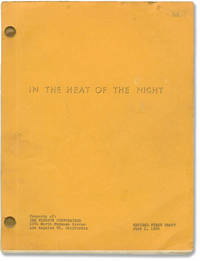
1966réf. 152454Los Angeles: The Mirisch Corporation 1966. Revised First Draft script for the 1967 film. Laid in is a Call Sheet from the production dated Tuesday November 29 1966. Based on John Ball's 1965 novel. An African American police detective from Philadelphia is recruited to help solve a murder in a small bigoted Mississippi town. Winner of five Academy Awards including Best Picture and Best Actor for Rod Steiger nominated for two others. After the success of the film version the characters were developed further for a police procedural television series in 1988 developed by James Lee Barrett and starring Carroll O'Connor and Howard Rollins which aired on NBC then CBS from 1988 to 1995. Set in the fictional town of Sparta Mississippi and shot largely on location in Illinois. Poitier insisted the movie be filmed in the North because of a 1964 incident in Mississippi in which he and Harry Belafonte had been run off the road and almost killed by Klansmen while in the state to support the SNCC Student Non-Violent Coordinating Committee. Goldenrod titled wrappers noted as REVISED FIRST DRAFT on the front wrapper rubber-stamped copy No. 84 dated July 1 1966. Title page present dated July 1 1966 noted as REVISED FIRST DRAFT with credits for screenwriter Stirliing Silliphant. 134 leaves with last page of text numbered 140. Mimeograph duplication rectos only with blue pink and white revision pages throughout dated variously between 7/27/66 and 8/10/66. Pages with damp stain on top right of last several pages else Near Fine wrapper Very Good plus bound with two gold brads. Call Sheet 8.5 x 14 inches folded horizontally. Near Fine National Film Registry. Criterion Collection 959. Penzler 101 Greatest Films of Mystery and Suspense. The Mirisch Corporation unknown
réf. 132794Universal City CA: Universal Pictures 1986. Archive of three title card maquettes hand lettered by Harold Adler for the 1963 film. Also included are two fascinating autograph letters both elaborately designed and executed in a calligraphic style from Adler to author illustrator and editor Fridolf Johnson relating to Adler's work with Hitchcock. Harold Adler was a calligrapher who created hand lettered titles on over 100 films worked frequently with Alfred Hitchcock and was a favorite of legendary title sequence designers Saul Bass and Pablo Ferro. In addition to "The Birds" 1963 his credits include "Comanche!" 1956 "The Man with the Golden Arm" 1955 "The Seven Year Itch" 1955 "Carmen Jones" 1954 "Psycho" 1960 "In the Heat of the Night" 1967 and "Justine" 1969. In 2012 an exhibition of Adler's work was organized by noted typographer and design historian Jill Bell at the American Advertising Federation Kansas City. In the first letter dated May 16 1986 Adler describes after touching on other topics meeting Hitchcock and then presenting him with layout ideas for the titles. He then goes into detail regarding his answer to a question about the techniques of artist Eric Gill stating that Hitchcock "was amazed" by this answer and after that would "request 'to be sure to bring that nice young man along" meaning Adler whenever he had a job for Adler's firm. The second letter dated June 10th 1986 focuses almost exclusively on Adler's work on "The Birds" going into some detail regarding both the creative and technical processes of producing hand lettered titles for films. He also describes Hitchcock as "an unusual person to work with. He was a master at what he did knew what he wanted and smoked the finest cigars." He then concludes the letter with some brief remarks on how his approach to title lettering evolved over the course of his career. The letters themselves are works of art executed in a variety of inks in Adler's detailed penmanship with Johnson's name on each in particular receiving full calligraphic treatment. Also included are draft title cards for the film stylistically similar to each other but much different from the titles used in the finished film. Two of the cards are marked as "camera ready" in manuscript colored pencil with titles executed in white paint on black board. The third card photo stat on black paper which accompanied the June 10th letter has been annotated by Adler on both the recto and verso explaining the in more detail the technical process of putting the lettering on film. Overall a significant collection of material illuminating a little explored aspect of film design with a direct and significant connection to a seminal work by a director known for personally overseeing all aspects of production. Each letter 19 x 24 inches single leaf rectos only. May 16th letter folded twice for mailing June 10th letter folded. Two long diagonal creases to the May 16th letter else both are Fine. Original mailing envelope for the May 16th letter included. "Camera ready" title cards 22 x 14 inches. Lightly rubbed and about Near Fine. Third card 18 x 4 inches. Near Fine. National Film Registry. Clover Men Women and Chainsaws. Godard Histoires du cinema. Universal Pictures unknown
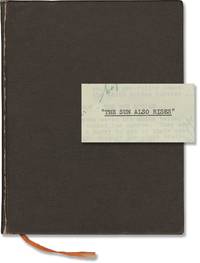
1957réf. 172280N.p.: N.p. 1957. Final script for the 1957 film. Specially bound copy belonging to actress Jacqueline Evans who played the uncredited role of Mrs. Braddock with her annotations in manuscript pencil underlining dialogue on several leaves. SIGNED in round-robin fashion by numerous cast and crew members on the first seven leaves some with inscriptions. Signatures include director Henry King and actors Ava Gardner Mel Ferrer Tyrone Power and Errol Flynn humorously signing as "E. Hemingway" among others. Full provenance available. The first screen adaptation of the 1926 novel by Ernest Hemingway. One of the most honest film adaptations of its era attributable mainly to the screenplay by novelist and Hemingway acolyte Peter Viertel. Featuring a standout performance by Errol Flynn as the hedonistic hard-drinking burned-out Mike Campbell. in other words as himself. Shot on location in Pamplona Paris Biarritz and Mexico. Title page present noted as Final Script dated February 20 1957. 147 leaves with last page of text numbered 142. Mimeograph duplication on eye-rest green stock rectos only with blue revision pages throughout dated variously between March 11 and 14 1957. Pages Near Fine binding Very Good plus specially bound in textured brown cloth with an orange ribbon bookmark. N.p. unknown
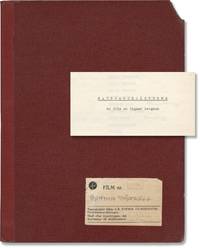
1962réf. 171100Stockholm: Svensk Filmindustri SF 1962. Draft script for the 1963 Swedish film. Copy belonging to actor Bertha Sånnell with her name in manuscript ink on a label affixed to the front wrapper her annotations in manuscript ink and pencil on two script pages and on a sheet of lined paper bound in at the rear of the script. The second entry in Ingmar Bergman's legendary and highly personal "Faith" trilogy a series of films that launched an important phase in the director's career. A quiet relentless meditation on the nature of faith imperfection and beauty. Red untitled wrappers. Title page present undated with credit for Bergman. 135 leaves with last page of text numbered 133. Mimeograph duplication rectos only. Pages Very Good plus wrapper Good perfect-bound with the spine of the wrapper and the first two leaves detached from the text block. Criterion Collection 210. Ebert III. Svensk Filmindustri [SF] unknown
1934réf. 144598Culver City CA: RKO Radio Pictures 1934. Draft script for the 1935 film. In a custom quarter leather clamshell box. The second of two films based on Liam O'Flaherty's 1925 novel the first being Arthur Robison's 1929 British feature about a former Republic Army member during the Irish War of Independence who turns in one of his comrades to the British in order to use the bounty money to book passage to America for himself and his girlfriend who has been forced into prostitution. Winner of four Academy Awards including Best Adapted Screenplay Best Director and Best Actor for McLaglen nominated for two others including Best Picture. Screenwriter Dudley Nichols became the first person to decline an Academy Award when his refused his Oscar due to an ongoing dispute between the Screen Writers Guild and the Academy though he would eventually claim it three years later. Detached green wrappers noting the title screenwriter and director on the spine in manuscript ink. Title page integral with first page of text with credits for screenwriter Nichols and novelist O'Flaherty. 105 leaves with last page of text numbered 105. Mimeograph duplication. Pages Near Fine wrapper Very Good side-stapled. National Film Registry. RKO Radio Pictures unknown
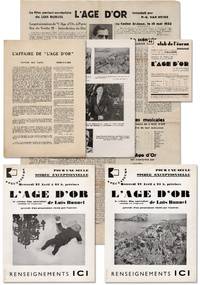
1932réf. 169144N.p.: N.p. 1932. A small archive of five vintage French pamphlets flyers and broadsides announcing 1931 and 1932 screenings of the banned 1930 surrealist film. All items are housed loose in a custom bound volume with a "L'Affaire de L'Age d'Or" label on the spine with each item laid in on separate leaves overlaid with heavy protective tissue housed in a custom slipcase. Rare. The archive includes: "L'Affaire de 'L'Age d'Or'" bi-fold pamphlet printed on rectos and versos with a satin-finish photo illustrated insert also printed on the recto and verso published by Nancy Cunard on the occasion of her January 1931 private screening of the film in London. The bi-fold includes the essay "Exposé des Faits" "Statement of Facts" describing the film's initial riotous reception "Extraits du Programme" "Excerpts from the Program" a "Questionnaire" regarding political and legal actions taken in response to the film and an extensive "Extraits de la Presse" "Excerpts from the Press" followed the names of signatories Maxime Alexandre Aragon André Breton René Char René Crevel Salvador Dali Paul Eluard Georges Malkine Benjamin Péret Man Ray Georges Sadoul Yves Tanguy André Thirion Tristan Tzara Pierre Unik and Albert Valentin. Two satin-finish variants of a flyer printed on rectos only for a screening of the film on April 27 1932 by Les Spectateurs de l'Avant-Garde at La Bellevilloise a workers' cooperative theatre with each flyer featuring a different image from the film. A second screening was later added on April 30 not noted on the flyers. The screenings were decidedly low-key private events with Buñuel insisting "No protests." French director Jean Vigo was reportedly among the participants of the screenings. And two items relating to a screening presented by Le Club de L'Ecran at Cine-Casino in Belgium on May 10 1932: A 4 x 5.5 inch announcement for the screening printed on the recto only noting the film as being presented by P.G. van Hecke Paul-Gustave Van Hecke followed by seating and ticket prices purchase locations and Club de L'Ecran membership prices. A large newsprint broadside printed on the recto and the verso for Le Club de L'Ecran announcing the May 10th screening with articles on the recto regarding the film club's activities and an excerpt from the Surrealist manifesto published upon the film's premiere with the verso dedicated entirely to numerous texts and articles on "L'Age d'Or" featuring two images from the film and a portrait of Buñuel. A key and archetypal work of Surrealist cinema alongside "Un Chien Andalou" 1929 also written by Buñuel and Dali and directed by Buñuel featuring a series of absurdist vignettes scathingly and sardonically rebuking the sexual hypocrisy of bourgeois society the Catholic Church and 20th century European society in general. The violence the uproar "L'Age d'Or" created remains as shocking as the film itself: days into the first screenings at Studio 28 on December 3 1930 the theatre was stormed by fascist youths enraged at the film's perceived anti-patriotic and anti-Christian message. Demonstrators threw ink at the screen shouted anti-Semitic death threats smashed the theatre windows and completely destroyed an exhibition of surrealist books and art in the foyer. In response the Board of Censors re-reviewed the film and on December 10 the film was banned from further public showings in France. The film's producers subsequently withdrew "L'Age d'or" from commercial distribution and public exhibition for more than 40 years although three years later in 1933 the film was privately exhibited at the Museum of Modern Art in New York. "L'Affaire de 'L'Age d'Or':" Bi-fold 7.5 x 10.5 inches. About Near Fine with a Very Good plus 7.5 x 10 inch insert with both items previously folded horizontally. Two Les Spectateurs April 27 Flyers: 8.25 x 10.5 inches. One Near Fine. One Very Good plus with light creasing faint toning and a .25 inch closed tear to the top edge. Le Club de L'Ecran Announcement: 4 x 5.5 inches. Near Fine. Le Club de L'Ecran Broadside: 14.25 x 21.75 inches folded as issued. About Near Fine with an additional lightly toned horizontal fold. Housed in a 9.25 x 12 inch custom bound Near Fine volume with a 9.5 x 12.25 inch Near Fine slipcase. BFI. Rosenbaum 1000. Vogel Film as a Subversive Art. N.p. unknown
1966réf. 152454Los Angeles: The Mirisch Corporation 1966. Revised First Draft script for the 1967 film. Laid in is a Call Sheet from the production dated Tuesday November 29 1966. Based on John Ball's 1965 novel. An African American police detective from Philadelphia is recruited to help solve a murder in a small bigoted Mississippi town. Winner of five Academy Awards including Best Picture and Best Actor for Rod Steiger nominated for two others. After the success of the film version the characters were developed further for a police procedural television series in 1988 developed by James Lee Barrett and starring Carroll O'Connor and Howard Rollins which aired on NBC then CBS from 1988 to 1995. Set in the fictional town of Sparta Mississippi and shot largely on location in Illinois. Poitier insisted the movie be filmed in the North because of a 1964 incident in Mississippi in which he and Harry Belafonte had been run off the road and almost killed by Klansmen while in the state to support the SNCC Student Non-Violent Coordinating Committee. Goldenrod titled wrappers noted as REVISED FIRST DRAFT on the front wrapper rubber-stamped copy No. 84 dated July 1 1966. Title page present dated July 1 1966 noted as REVISED FIRST DRAFT with credits for screenwriter Stirliing Silliphant. 134 leaves with last page of text numbered 140. Mimeograph duplication rectos only with blue pink and white revision pages throughout dated variously between 7/27/66 and 8/10/66. Pages with damp stain on top right of last several pages else Near Fine wrapper Very Good plus bound with two gold brads. Call Sheet 8.5 x 14 inches folded horizontally. Near Fine National Film Registry. Criterion Collection 959. Penzler 101 Greatest Films of Mystery and Suspense. The Mirisch Corporation unknown books
réf. 132794Universal City CA: Universal Pictures 1986. Archive of three title card maquettes hand lettered by Harold Adler for the 1963 film. Also included are two fascinating autograph letters both elaborately designed and executed in a calligraphic style from Adler to author illustrator and editor Fridolf Johnson relating to Adler's work with Hitchcock. Harold Adler was a calligrapher who created hand lettered titles on over 100 films worked frequently with Alfred Hitchcock and was a favorite of legendary title sequence designers Saul Bass and Pablo Ferro. In addition to "The Birds" 1963 his credits include "Comanche!" 1956 "The Man with the Golden Arm" 1955 "The Seven Year Itch" 1955 "Carmen Jones" 1954 "Psycho" 1960 "In the Heat of the Night" 1967 and "Justine" 1969. In 2012 an exhibition of Adler's work was organized by noted typographer and design historian Jill Bell at the American Advertising Federation Kansas City. In the first letter dated May 16 1986 Adler describes after touching on other topics meeting Hitchcock and then presenting him with layout ideas for the titles. He then goes into detail regarding his answer to a question about the techniques of artist Eric Gill stating that Hitchcock "was amazed" by this answer and after that would "request 'to be sure to bring that nice young man along" meaning Adler whenever he had a job for Adler's firm. The second letter dated June 10th 1986 focuses almost exclusively on Adler's work on "The Birds" going into some detail regarding both the creative and technical processes of producing hand lettered titles for films. He also describes Hitchcock as "an unusual person to work with. He was a master at what he did knew what he wanted and smoked the finest cigars." He then concludes the letter with some brief remarks on how his approach to title lettering evolved over the course of his career. The letters themselves are works of art executed in a variety of inks in Adler's detailed penmanship with Johnson's name on each in particular receiving full calligraphic treatment. Also included are draft title cards for the film stylistically similar to each other but much different from the titles used in the finished film. Two of the cards are marked as "camera ready" in manuscript colored pencil with titles executed in white paint on black board. The third card photo stat on black paper which accompanied the June 10th letter has been annotated by Adler on both the recto and verso explaining the in more detail the technical process of putting the lettering on film. Overall a significant collection of material illuminating a little explored aspect of film design with a direct and significant connection to a seminal work by a director known for personally overseeing all aspects of production. Each letter 19 x 24 inches single leaf rectos only. May 16th letter folded twice for mailing June 10th letter folded. Two long diagonal creases to the May 16th letter else both are Fine. Original mailing envelope for the May 16th letter included. "Camera ready" title cards 22 x 14 inches. Lightly rubbed and about Near Fine. Third card 18 x 4 inches. Near Fine. National Film Registry. Clover Men Women and Chainsaws. Godard Histoires du cinema. Universal Pictures unknown books
1957réf. 172280N.p.: N.p. 1957. Final script for the 1957 film. Specially bound copy belonging to actress Jacqueline Evans who played the uncredited role of Mrs. Braddock with her annotations in manuscript pencil underlining dialogue on several leaves. SIGNED in round-robin fashion by numerous cast and crew members on the first seven leaves some with inscriptions. Signatures include director Henry King and actors Ava Gardner Mel Ferrer Tyrone Power and Errol Flynn humorously signing as "E. Hemingway" among others. Full provenance available. The first screen adaptation of the 1926 novel by Ernest Hemingway. One of the most honest film adaptations of its era attributable mainly to the screenplay by novelist and Hemingway acolyte Peter Viertel. Featuring a standout performance by Errol Flynn as the hedonistic hard-drinking burned-out Mike Campbell. in other words as himself. Shot on location in Pamplona Paris Biarritz and Mexico. Title page present noted as Final Script dated February 20 1957. 147 leaves with last page of text numbered 142. Mimeograph duplication on eye-rest green stock rectos only with blue revision pages throughout dated variously between March 11 and 14 1957. Pages Near Fine binding Very Good plus specially bound in textured brown cloth with an orange ribbon bookmark. N.p. unknown books
1962réf. 171100Stockholm: Svensk Filmindustri SF 1962. Draft script for the 1963 Swedish film. Copy belonging to actor Bertha Sånnell with her name in manuscript ink on a label affixed to the front wrapper her annotations in manuscript ink and pencil on two script pages and on a sheet of lined paper bound in at the rear of the script. The second entry in Ingmar Bergman's legendary and highly personal "Faith" trilogy a series of films that launched an important phase in the director's career. A quiet relentless meditation on the nature of faith imperfection and beauty. Red untitled wrappers. Title page present undated with credit for Bergman. 135 leaves with last page of text numbered 133. Mimeograph duplication rectos only. Pages Very Good plus wrapper Good perfect-bound with the spine of the wrapper and the first two leaves detached from the text block. Criterion Collection 210. Ebert III. Svensk Filmindustri [SF] unknown books
1934réf. 144598Culver City CA: RKO Radio Pictures 1934. Draft script for the 1935 film. In a custom quarter leather clamshell box. The second of two films based on Liam O'Flaherty's 1925 novel the first being Arthur Robison's 1929 British feature about a former Republic Army member during the Irish War of Independence who turns in one of his comrades to the British in order to use the bounty money to book passage to America for himself and his girlfriend who has been forced into prostitution. Winner of four Academy Awards including Best Adapted Screenplay Best Director and Best Actor for McLaglen nominated for two others including Best Picture. Screenwriter Dudley Nichols became the first person to decline an Academy Award when his refused his Oscar due to an ongoing dispute between the Screen Writers Guild and the Academy though he would eventually claim it three years later. Detached green wrappers noting the title screenwriter and director on the spine in manuscript ink. Title page integral with first page of text with credits for screenwriter Nichols and novelist O'Flaherty. 105 leaves with last page of text numbered 105. Mimeograph duplication. Pages Near Fine wrapper Very Good side-stapled. National Film Registry. RKO Radio Pictures unknown books
1932réf. 169144N.p.: N.p. 1932. A small archive of five vintage French pamphlets flyers and broadsides announcing 1931 and 1932 screenings of the banned 1930 surrealist film. All items are housed loose in a custom bound volume with a "L'Affaire de L'Age d'Or" label on the spine with each item laid in on separate leaves overlaid with heavy protective tissue housed in a custom slipcase. Rare. The archive includes: "L'Affaire de 'L'Age d'Or'" bi-fold pamphlet printed on rectos and versos with a satin-finish photo illustrated insert also printed on the recto and verso published by Nancy Cunard on the occasion of her January 1931 private screening of the film in London. The bi-fold includes the essay "Exposé des Faits" "Statement of Facts" describing the film's initial riotous reception "Extraits du Programme" "Excerpts from the Program" a "Questionnaire" regarding political and legal actions taken in response to the film and an extensive "Extraits de la Presse" "Excerpts from the Press" followed the names of signatories Maxime Alexandre Aragon André Breton René Char René Crevel Salvador Dali Paul Eluard Georges Malkine Benjamin Péret Man Ray Georges Sadoul Yves Tanguy André Thirion Tristan Tzara Pierre Unik and Albert Valentin. Two satin-finish variants of a flyer printed on rectos only for a screening of the film on April 27 1932 by Les Spectateurs de l'Avant-Garde at La Bellevilloise a workers' cooperative theatre with each flyer featuring a different image from the film. A second screening was later added on April 30 not noted on the flyers. The screenings were decidedly low-key private events with Buñuel insisting "No protests." French director Jean Vigo was reportedly among the participants of the screenings. And two items relating to a screening presented by Le Club de L'Ecran at Cine-Casino in Belgium on May 10 1932: A 4 x 5.5 inch announcement for the screening printed on the recto only noting the film as being presented by P.G. van Hecke Paul-Gustave Van Hecke followed by seating and ticket prices purchase locations and Club de L'Ecran membership prices. A large newsprint broadside printed on the recto and the verso for Le Club de L'Ecran announcing the May 10th screening with articles on the recto regarding the film club's activities and an excerpt from the Surrealist manifesto published upon the film's premiere with the verso dedicated entirely to numerous texts and articles on "L'Age d'Or" featuring two images from the film and a portrait of Buñuel. A key and archetypal work of Surrealist cinema alongside "Un Chien Andalou" 1929 also written by Buñuel and Dali and directed by Buñuel featuring a series of absurdist vignettes scathingly and sardonically rebuking the sexual hypocrisy of bourgeois society the Catholic Church and 20th century European society in general. The violence the uproar "L'Age d'Or" created remains as shocking as the film itself: days into the first screenings at Studio 28 on December 3 1930 the theatre was stormed by fascist youths enraged at the film's perceived anti-patriotic and anti-Christian message. Demonstrators threw ink at the screen shouted anti-Semitic death threats smashed the theatre windows and completely destroyed an exhibition of surrealist books and art in the foyer. In response the Board of Censors re-reviewed the film and on December 10 the film was banned from further public showings in France. The film's producers subsequently withdrew "L'Age d'or" from commercial distribution and public exhibition for more than 40 years although three years later in 1933 the film was privately exhibited at the Museum of Modern Art in New York. "L'Affaire de 'L'Age d'Or':" Bi-fold 7.5 x 10.5 inches. About Near Fine with a Very Good plus 7.5 x 10 inch insert with both items previously folded horizontally. Two Les Spectateurs April 27 Flyers: 8.25 x 10.5 inches. One Near Fine. One Very Good plus with light creasing faint toning and a .25 inch closed tear to the top edge. Le Club de L'Ecran Announcement: 4 x 5.5 inches. Near Fine. Le Club de L'Ecran Broadside: 14.25 x 21.75 inches folded as issued. About Near Fine with an additional lightly toned horizontal fold. Housed in a 9.25 x 12 inch custom bound Near Fine volume with a 9.5 x 12.25 inch Near Fine slipcase. BFI. Rosenbaum 1000. Vogel Film as a Subversive Art. N.p. unknown books
réf. 149056New York: Greenwich Film Productions 1985. Draft script for the 1985 film. With manuscript pencil annotations throughout. Text titles and annotations in Japanese. Based on Shakespeare's play "King Lear." An elderly warlord in medieval Japan divides his vast empire among his three sons. The power corrupts them and turns them on each other as well as their father. Nominated for four Academy Awards including Best Director for Kurosawa winning one. Set in medieval Japan shot on location in Kumamoto Shizuoka Himeji Oita Aichi Yamagata and Tokyo Japan. Bright blue titled wrappers. Title page present. 96 leaves with last page of text numbered 176. Xerographic duplication printed on rectos and versos. Pages Very Good plus wrapper Very Good plus with a lightly faded spine perfectly bound. Greenwich Film Productions unknown
1966réf. 140604Los Angeles: Expanding Cinema 1966. Shooting final for the 1966 film. Copy belonging to actor Peter Haskell with his manuscript annotations throughout and his shooting schedule laid in. Mary Ellen Bute's final film and the first cinematic adaptation of James Joyce's masterfully complex work of fiction. Shot over a two year period Bute was tasked with transforming Joyce's impenetrable prose without losing any of the work's surreal lyrical essence. The subsequent film maintains the original novel's oneiric style. Bute and her husband Ted Nemeth were longtime collaborators and Nemeth worked as both cinematographer and producer of the film. In 1965 it was honored at the Cannes Film Festival as Best Debut and remains Bute's sole feature length film. Shot on location in New York City and Dublin. Brown untitled wrappers. Title page present dated March 4 1963 and December 3 1962 noted as Shooting Final with credits for screenwriters Mary Ellen Bute Romana Javitz and T. J. Nemeth Jr and editor A.I.M.S. Street. 148 leaves with last page of text numbered 139. Mimeograph duplication with onionskin revision pages throughout. Pages Very Good plus wrapper Very Good plus. Some pages detaching and wrapper slightly cracked. Bound internally with prong binding. Expanding Cinema unknown
réf. 149056New York: Greenwich Film Productions 1985. Draft script for the 1985 film. With manuscript pencil annotations throughout. Text titles and annotations in Japanese. Based on Shakespeare's play "King Lear." An elderly warlord in medieval Japan divides his vast empire among his three sons. The power corrupts them and turns them on each other as well as their father. Nominated for four Academy Awards including Best Director for Kurosawa winning one. Set in medieval Japan shot on location in Kumamoto Shizuoka Himeji Oita Aichi Yamagata and Tokyo Japan. Bright blue titled wrappers. Title page present. 96 leaves with last page of text numbered 176. Xerographic duplication printed on rectos and versos. Pages Very Good plus wrapper Very Good plus with a lightly faded spine perfectly bound. Greenwich Film Productions unknown books
1966réf. 140604Los Angeles: Expanding Cinema 1966. Shooting final for the 1966 film. Copy belonging to actor Peter Haskell with his manuscript annotations throughout and his shooting schedule laid in. Mary Ellen Bute's final film and the first cinematic adaptation of James Joyce's masterfully complex work of fiction. Shot over a two year period Bute was tasked with transforming Joyce's impenetrable prose without losing any of the work's surreal lyrical essence. The subsequent film maintains the original novel's oneiric style. Bute and her husband Ted Nemeth were longtime collaborators and Nemeth worked as both cinematographer and producer of the film. In 1965 it was honored at the Cannes Film Festival as Best Debut and remains Bute's sole feature length film. Shot on location in New York City and Dublin. Brown untitled wrappers. Title page present dated March 4 1963 and December 3 1962 noted as Shooting Final with credits for screenwriters Mary Ellen Bute Romana Javitz and T. J. Nemeth Jr and editor A.I.M.S. Street. 148 leaves with last page of text numbered 139. Mimeograph duplication with onionskin revision pages throughout. Pages Very Good plus wrapper Very Good plus. Some pages detaching and wrapper slightly cracked. Bound internally with prong binding. Expanding Cinema unknown books
réf. 150822Culver City CA: Culver City Studios 1973. Third Revision Draft script for the 1973 film with the name "Jim Woods" in manuscript ink on top right of front wrapper and page two of screenplay likely uncredited Set Painter James T. Woods with copy numbers "76" on top left of front wrapper and "13" on top right of title page in manuscript marker and on back wrapper are numeric entries in manuscript ink. Following script is a one page "APPENDIX A -- TV PLATE -- LUNA'S PARTY" featuring dialogue between a mother and child regarding a holiday party. Woody Allen is a health food store owner who is cryogenically frozen in 1973 only to be revived 200 years later to help lead a rebellion against an inept totalitarian government. Winner of a Hugo Award for Best Dramatic Presentation. Shot on location in Colorado and California. Beige titled wrappers. Title page present dated March 1 1973 noted as REVISION #3 with credits for screenwriters Woody Allen and Marshall Brickman. 131 leaves with last page of text numbered 129. Mimeograph duplication rectos only with yellow and blue revision pages throughout. Pages Very Good plus with silverfish damage to outer edge of last 15 pages wrapper Very Good plus with silverfish damage to outer edge of back wrapper bound with two gold brads. Culver City Studios unknown
réf. 150822Culver City CA: Culver City Studios 1973. Third Revision Draft script for the 1973 film with the name "Jim Woods" in manuscript ink on top right of front wrapper and page two of screenplay likely uncredited Set Painter James T. Woods with copy numbers "76" on top left of front wrapper and "13" on top right of title page in manuscript marker and on back wrapper are numeric entries in manuscript ink. Following script is a one page "APPENDIX A -- TV PLATE -- LUNA'S PARTY" featuring dialogue between a mother and child regarding a holiday party. Woody Allen is a health food store owner who is cryogenically frozen in 1973 only to be revived 200 years later to help lead a rebellion against an inept totalitarian government. Winner of a Hugo Award for Best Dramatic Presentation. Shot on location in Colorado and California. Beige titled wrappers. Title page present dated March 1 1973 noted as REVISION #3 with credits for screenwriters Woody Allen and Marshall Brickman. 131 leaves with last page of text numbered 129. Mimeograph duplication rectos only with yellow and blue revision pages throughout. Pages Very Good plus with silverfish damage to outer edge of last 15 pages wrapper Very Good plus with silverfish damage to outer edge of back wrapper bound with two gold brads. Culver City Studios unknown books
1930réf. 166622Paris: Studio 28 1930. Vintage review-program for Luis Buñuel's 1930 surrealist masterpiece created for the film's public premiere at Studio 28 cinema in Montmartre. Program in two parts bound dos-a-dos. Text in French. The first section of the review-program is dedicated to "L'Age d'or" presenting the film's scenario alongside subtitles and dialogue accompanied by a manifesto on surrealism and a catalog of 20 works by Max Ernst Salvador Dalí Man Ray and others which were exhibited alongside the film's screenings at Studio 28. The second part of the program is an overview of film programs at Studio 28 with stills from films by Epstein Ivens Melies and others. The violence of the uproar "L'Age d'Or" created remains almost as shocking as the film itself: days into the first screenings at Studio 28 on December 3 1930 the theatre was stormed by fascist youths enraged at the film's perceived anti-patriotic and anti-Christian message. Demonstrators threw ink at the screen shouted antisemitic death threats smashed the theatre windows and completely destroyed the exhibition of surrealist books and artwork in the foyer. In response the Board of Censors re-reviewed the film and on December 10 the film was banned from further public showings in France. The film's producers subsequently withdrew "L'Age d'or" from commercial distribution and public exhibition for more than 40 years although three years later in 1933 the film was privately exhibited at the Museum of Modern Art in New York. Page edges faintly foxed else about Near Fine in perfect-bound gold wrappers with a single annotation in manuscript ink censoring a line relating to one of the film's characters and Jesus Christ. Lacking the errata slip. Studio 28 unknown
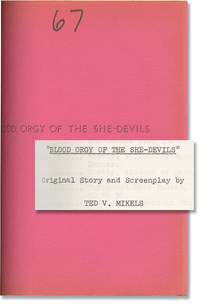
réf. 155115Hollywood: Occult Productions 1973. Draft script for the 1973 film. Working production copy housed in a black leather binder with production materials bound in before and after the script including handwritten cast and crew contact information and call sheets. A young woman joins a black magic coven governed by a psychic witch queen with dubious and eventually murderous intentions. Considered one of the best and arguably most polished releases from noted psychotronic Z-budget horror director Ted V. Mikels heavily inspired by "Rosemary's Baby" 1968 and the occult concerns of the Age of Aquarius. Pink titled wrappers. Title page present undated with credits for director-screenwriter Ted V. Mikels. 67 leaves with last page of text numbered 64. Mimeograph duplication rectos only. Pages Near Fine wrapper Near Fine. Nightmare USA. Occult Productions unknown
1930réf. 166622Paris: Studio 28 1930. Vintage review-program for Luis Buñuel's 1930 surrealist masterpiece created for the film's public premiere at Studio 28 cinema in Montmartre. Program in two parts bound dos-a-dos. Text in French. The first section of the review-program is dedicated to "L'Age d'or" presenting the film's scenario alongside subtitles and dialogue accompanied by a manifesto on surrealism and a catalog of 20 works by Max Ernst Salvador Dalí Man Ray and others which were exhibited alongside the film's screenings at Studio 28. The second part of the program is an overview of film programs at Studio 28 with stills from films by Epstein Ivens Melies and others. The violence of the uproar "L'Age d'Or" created remains almost as shocking as the film itself: days into the first screenings at Studio 28 on December 3 1930 the theatre was stormed by fascist youths enraged at the film's perceived anti-patriotic and anti-Christian message. Demonstrators threw ink at the screen shouted antisemitic death threats smashed the theatre windows and completely destroyed the exhibition of surrealist books and artwork in the foyer. In response the Board of Censors re-reviewed the film and on December 10 the film was banned from further public showings in France. The film's producers subsequently withdrew "L'Age d'or" from commercial distribution and public exhibition for more than 40 years although three years later in 1933 the film was privately exhibited at the Museum of Modern Art in New York. Page edges faintly foxed else about Near Fine in perfect-bound gold wrappers with a single annotation in manuscript ink censoring a line relating to one of the film's characters and Jesus Christ. Lacking the errata slip. Studio 28 unknown books
réf. 155115Hollywood: Occult Productions 1973. Draft script for the 1973 film. Working production copy housed in a black leather binder with production materials bound in before and after the script including handwritten cast and crew contact information and call sheets. A young woman joins a black magic coven governed by a psychic witch queen with dubious and eventually murderous intentions. Considered one of the best and arguably most polished releases from noted psychotronic Z-budget horror director Ted V. Mikels heavily inspired by "Rosemary's Baby" 1968 and the occult concerns of the Age of Aquarius. Pink titled wrappers. Title page present undated with credits for director-screenwriter Ted V. Mikels. 67 leaves with last page of text numbered 64. Mimeograph duplication rectos only. Pages Near Fine wrapper Near Fine. Nightmare USA. Occult Productions unknown books
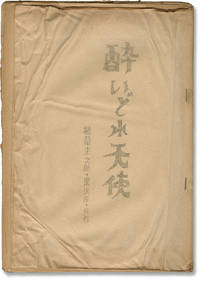
1948réf. 151633Tokyo: Toho Company 1948. Draft script for the 1948 Japanese film noir. Text and titles in Japanese. The first of sixteen film collaborations between director Akira Kurosawa and actor Toshiro Mifune. Kurosawa's seventh film saw him exploring the inter workings and motivations of the yakuza and machismo. Censorship was tight regarding the occupation forbidding criticism of Americans leading Kurosawa to slip in references to the US presence in Japan satirizing jazz "pan pan" girls unlicensed prostitutes catering to American soldiers and Western clothing and hairstyles. Set in the slums of postwar Japan. White titled wrappers. Approximately 40 leaves with last page of text numbered 79. Mimeograph duplication printed on rectos and versos. Pages Very Good plus wrapper Very Good plus covered in a protective plastic wrapping from when the script was used during filming side stapled. BFI 638. Criterion Collection 413. Grant Japan. Toho Company unknown
1967réf. 149909New York: Andy Warhol Film 1967. Vintage poster for the 1967 film. The film originally screened at the Hudson Theater in a 95-minute version although this cut is considered lost. A 109-minute version would screen in 1968 as the first film shown at the New Andy Warhol Garrick Theater renamed as such after Warhol recovered from being shot by Valerie Solanas. One of several sexploitation influenced films made by Warhol an episodic story of a biker who has no bike and is both eroticized by the camera and emasculated by various Warhol superstars throughout. 19 x 25 inches rolled. Near Fine with some light soil and an almost imperceptible professional repair to a tear at the top edge. Murphy The Black Hole of Cinema. Warholstars. Andy Warhol Film unknown