10 264 résultats
1976réf. 147023N.p.: Constantin-Film 1976. Vintage French-Canadian poster for the 1974 German film "Magdalena vom Teufel besessen" released in the US as "Beyond the Darkness" "Magdalena Possessed by the Devil" and "The Devil's Female." With the latter title tipped on to the poster demonstrating the ad hoc distribution process for grindhouse and exploitation films which often saw titles change at a moment's notice to better catch the public's attention and sometimes trick them into seeing a film they've already seen. German sexploitation knock-off of William Friedkin's 1973 horror classic "The Exorcist" about a student at a girl's boarding school who is possessed by a demon. 22 x 34 inches folded as issued. Very Good with some light edgewear several small closed tears to right edge pinholes to corners and light rubbing to center text but still bright and unfaded. Constantin-Film unknown
1976réf. 147023N.p.: Constantin-Film 1976. Vintage French-Canadian poster for the 1974 German film "Magdalena vom Teufel besessen" released in the US as "Beyond the Darkness" "Magdalena Possessed by the Devil" and "The Devil's Female." With the latter title tipped on to the poster demonstrating the ad hoc distribution process for grindhouse and exploitation films which often saw titles change at a moment's notice to better catch the public's attention and sometimes trick them into seeing a film they've already seen. German sexploitation knock-off of William Friedkin's 1973 horror classic "The Exorcist" about a student at a girl's boarding school who is possessed by a demon. 22 x 34 inches folded as issued. Very Good with some light edgewear several small closed tears to right edge pinholes to corners and light rubbing to center text but still bright and unfaded. Constantin-Film unknown books
réf. 142842N.p.: N.p. 1981. Handmade vernacular conceptual journal documenting the shooting of Robert Frank's 1981 film "Energy and How to Get It" circa 1980-1981. Includes tipped in ephemera drawings business cards and 46 Polaroids of Wurlitzer Robert Frank June Leaf and "Lightning" Bob. Annotations and captions throughout by Wurlitzer. Also included are 4 reference photos all likely unique from the shooting of the film: two showing both Wurlitzer and Frank one showing Wurlitzer and one of the "Enola Gay" aircraft in the film. Mead Memo notebook spiral bound. Green wrappers. 4.25 x 6 inches Very Good overall tipped in photos Near Fine. Reference photos 8 x 10 inches Near Fine. N.p. unknown
réf. 142842N.p.: N.p. 1981. Handmade vernacular conceptual journal documenting the shooting of Robert Frank's 1981 film "Energy and How to Get It" circa 1980-1981. Includes tipped in ephemera drawings business cards and 46 Polaroids of Wurlitzer Robert Frank June Leaf and "Lightning" Bob. Annotations and captions throughout by Wurlitzer. Also included are 4 reference photos all likely unique from the shooting of the film: two showing both Wurlitzer and Frank one showing Wurlitzer and one of the "Enola Gay" aircraft in the film. Mead Memo notebook spiral bound. Green wrappers. 4.25 x 6 inches Very Good overall tipped in photos Near Fine. Reference photos 8 x 10 inches Near Fine. N.p. unknown books
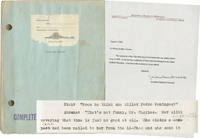
1935réf. 124528Beverly Hills CA: Metro-Goldwyn-Mayer MGM 1935. Dashiell Hammett's original submitted Treatment script for the first sequel to "The Thin Man" here referred to only as "Thin Man Sequel" and ultimately titled "After the Thin Man." With a single manuscript correction by Hammett and letter of provenance from Hammett's daughter Josephine Hammett Marshall regarding the discovery of the treatment in the family's estate. The first "Thin Man" film released in 1934 and based on Hammett's novel was a smash hit and is today a key film in the American screwball comedy cycle. Five sequels were made between 1936 and 1947 all starring the original acting team of William Powell and Myrna Loy and this previously unknown attempt at a sequel by Hammett was clearly commissioned by MGM but never produced making this script an entire unpublished Hammett work. The story is a completely original one never reworked for the other films very much written in Hammett's trademark style and reading a bit more like a story treatment i.e. a novel than a final screenplay which is likely as far as the story got on the road to production. The piece is dated Sept. 17 1935 at the lower right corner of the front panel along with Hammett's name and Hammett's name is noted in pencil next to the title label though not in Hammett's hand. There is only one single-word correction to the entire text at page 83 in Hammett's hand where the word "compact" is replaced with "cigarette case." Accompanying the screenplay is a typed letter signed from Hammett's daughter who edited a recently published collection of Hammett's letters on her personal stationery stating that the screenplay was discovered by Hammett's wife in 1980 and that it had been a part of the family's estate until that time. Probably one of only 2-3 copies that could have been produced and very possibly the only copy extant. To our knowledge no other copy of this story in any form has ever been recorded at auction or sold on the market. Light blue titled wrappers with the white MGM studio label present manuscript pencil notation of Hammett's name secretarial rubber-stamped COMPLETE dated September 17 1935 with a single credit for Hammett. 115 leaves mimeograph duplication. Pages and wrapper Very Good plus bound with two gold brads. In a custom clamshell box. Full pagination available upon request. Metro-Goldwyn-Mayer [MGM] unknown
1935réf. 124528Beverly Hills CA: Metro-Goldwyn-Mayer MGM 1935. Dashiell Hammett's original submitted Treatment script for the first sequel to "The Thin Man" here referred to only as "Thin Man Sequel" and ultimately titled "After the Thin Man." With a single manuscript correction by Hammett and letter of provenance from Hammett's daughter Josephine Hammett Marshall regarding the discovery of the treatment in the family's estate. The first "Thin Man" film released in 1934 and based on Hammett's novel was a smash hit and is today a key film in the American screwball comedy cycle. Five sequels were made between 1936 and 1947 all starring the original acting team of William Powell and Myrna Loy and this previously unknown attempt at a sequel by Hammett was clearly commissioned by MGM but never produced making this script an entire unpublished Hammett work. The story is a completely original one never reworked for the other films very much written in Hammett's trademark style and reading a bit more like a story treatment i.e. a novel than a final screenplay which is likely as far as the story got on the road to production. The piece is dated Sept. 17 1935 at the lower right corner of the front panel along with Hammett's name and Hammett's name is noted in pencil next to the title label though not in Hammett's hand. There is only one single-word correction to the entire text at page 83 in Hammett's hand where the word "compact" is replaced with "cigarette case." Accompanying the screenplay is a typed letter signed from Hammett's daughter who edited a recently published collection of Hammett's letters on her personal stationery stating that the screenplay was discovered by Hammett's wife in 1980 and that it had been a part of the family's estate until that time. Probably one of only 2-3 copies that could have been produced and very possibly the only copy extant. To our knowledge no other copy of this story in any form has ever been recorded at auction or sold on the market. Light blue titled wrappers with the white MGM studio label present manuscript pencil notation of Hammett's name secretarial rubber-stamped COMPLETE dated September 17 1935 with a single credit for Hammett. 115 leaves mimeograph duplication. Pages and wrapper Very Good plus bound with two gold brads. In a custom clamshell box. Full pagination available upon request. Metro-Goldwyn-Mayer [MGM] unknown books
1949réf. 137478Universal City CA: Universal Pictures 1949. Final shooting script for the 1950 film. Copy belonging to actor Marshall Reed who here plays the role of the villain with his name in black manuscript ink on the front wrapper. A ruthless man attempts to rekindle a settled feud between two rancher families in order to take both their lands when they kill each other off. Luckily the town has a good sheriff and a standup rancher gal to help save the day. An odd short musical western with a good crop of the genre's favorite themes bar brawls ambushes sharpshooters to help round out the plot. Red titled wrappers noted as FINAL SHOOTING SCRIPT on the front wrapper production No. A7 dated November 2 1949. Title page present with credits for screenwriter Joseph O'Donnell. 47 leaves with last page of text numbered 46. Mimeograph duplication. Pages Fair wrapper Fair bound with three gold brads. Foxing and dampstaining to much of the wrappers and extremities. Universal Pictures unknown
1949réf. 137478Universal City CA: Universal Pictures 1949. Final shooting script for the 1950 film. Copy belonging to actor Marshall Reed who here plays the role of the villain with his name in black manuscript ink on the front wrapper. A ruthless man attempts to rekindle a settled feud between two rancher families in order to take both their lands when they kill each other off. Luckily the town has a good sheriff and a standup rancher gal to help save the day. An odd short musical western with a good crop of the genre's favorite themes bar brawls ambushes sharpshooters to help round out the plot. Red titled wrappers noted as FINAL SHOOTING SCRIPT on the front wrapper production No. A7 dated November 2 1949. Title page present with credits for screenwriter Joseph O'Donnell. 47 leaves with last page of text numbered 46. Mimeograph duplication. Pages Fair wrapper Fair bound with three gold brads. Foxing and dampstaining to much of the wrappers and extremities. Universal Pictures unknown books
réf. 132794Universal City CA: Universal Pictures 1986. Archive of three title card maquettes hand lettered by Harold Adler for the 1963 film. Also included are two fascinating autograph letters both elaborately designed and executed in a calligraphic style from Adler to author illustrator and editor Fridolf Johnson relating to Adler's work with Hitchcock. Harold Adler was a calligrapher who created hand lettered titles on over 100 films worked frequently with Alfred Hitchcock and was a favorite of legendary title sequence designers Saul Bass and Pablo Ferro. In addition to "The Birds" 1963 his credits include "Comanche!" 1956 "The Man with the Golden Arm" 1955 "The Seven Year Itch" 1955 "Carmen Jones" 1954 "Psycho" 1960 "In the Heat of the Night" 1967 and "Justine" 1969. In 2012 an exhibition of Adler's work was organized by noted typographer and design historian Jill Bell at the American Advertising Federation Kansas City. In the first letter dated May 16 1986 Adler describes after touching on other topics meeting Hitchcock and then presenting him with layout ideas for the titles. He then goes into detail regarding his answer to a question about the techniques of artist Eric Gill stating that Hitchcock "was amazed" by this answer and after that would "request 'to be sure to bring that nice young man along" meaning Adler whenever he had a job for Adler's firm. The second letter dated June 10th 1986 focuses almost exclusively on Adler's work on "The Birds" going into some detail regarding both the creative and technical processes of producing hand lettered titles for films. He also describes Hitchcock as "an unusual person to work with. He was a master at what he did knew what he wanted and smoked the finest cigars." He then concludes the letter with some brief remarks on how his approach to title lettering evolved over the course of his career. The letters themselves are works of art executed in a variety of inks in Adler's detailed penmanship with Johnson's name on each in particular receiving full calligraphic treatment. Also included are draft title cards for the film stylistically similar to each other but much different from the titles used in the finished film. Two of the cards are marked as "camera ready" in manuscript colored pencil with titles executed in white paint on black board. The third card photo stat on black paper which accompanied the June 10th letter has been annotated by Adler on both the recto and verso explaining the in more detail the technical process of putting the lettering on film. Overall a significant collection of material illuminating a little explored aspect of film design with a direct and significant connection to a seminal work by a director known for personally overseeing all aspects of production. Each letter 19 x 24 inches single leaf rectos only. May 16th letter folded twice for mailing June 10th letter folded. Two long diagonal creases to the May 16th letter else both are Fine. Original mailing envelope for the May 16th letter included. "Camera ready" title cards 22 x 14 inches. Lightly rubbed and about Near Fine. Third card 18 x 4 inches. Near Fine. National Film Registry. Clover Men Women and Chainsaws. Godard Histoires du cinema. Universal Pictures unknown books
1964réf. 170747N.p.: N.p. 1964. Vintage borderless reference photograph from the 1964 film showing Frank A. Coe as Frankenstein's monster holding a nude woman. Layout annotations in manuscript pencil on the verso. An alien lands on Earth in order to kidnap the perfect human woman to use to create a race of servants for his home world. He finds the answer in the laboratory of mad scientist Dr. Breedlove. Originally titled "Dr. Breedlove or How I Learned to Stop Worrying and Love" then retitled "Kiss Me Quick" in order to exploit Billy Wilder's "Kiss Me Stupid." 8 x 10 inches. Very Good plus. N.p. unknown
1964réf. 170747N.p.: N.p. 1964. Vintage borderless reference photograph from the 1964 film showing Frank A. Coe as Frankenstein's monster holding a nude woman. Layout annotations in manuscript pencil on the verso. An alien lands on Earth in order to kidnap the perfect human woman to use to create a race of servants for his home world. He finds the answer in the laboratory of mad scientist Dr. Breedlove. Originally titled "Dr. Breedlove or How I Learned to Stop Worrying and Love" then retitled "Kiss Me Quick" in order to exploit Billy Wilder's "Kiss Me Stupid." 8 x 10 inches. Very Good plus. N.p. unknown books
1980réf. 141121Beverly Hills CA: Orion Pictures 1980. Collection of five lobby cards for the 1980 film. Based Carolyn Cassady's 1976 book about the lives of and relationships between Neal Cassady Carolyn and Jack Kerouac with some focus on Kerouac's writing his novel "On the Road." One of the earliest feature films about central Beat figures. Shot on location in San Francisco. Orion Pictures unknown
1980réf. 141121Beverly Hills CA: Orion Pictures 1980. Collection of five lobby cards for the 1980 film. Based Carolyn Cassady's 1976 book about the lives of and relationships between Neal Cassady Carolyn and Jack Kerouac with some focus on Kerouac's writing his novel "On the Road." One of the earliest feature films about central Beat figures. Shot on location in San Francisco. Orion Pictures unknown books
1991réf. 167974N.p.: N.p. 1991. Draft script for the 1993 American-German-Dutch film. Single numeric annotation in manuscript pencil on the title page. Text in English. A struggling jazz musician provides music lessons to make ends meet although his students are ambivalent at best while maintaining a romance with a bartender at a local Irish bar. One of two feature films directed by Sara Driver known for producing the first two films of her longtime partner director Jim Jarmusch. Shot on location in Hamburg. Mylar front wrapper black rear wrapper. Title page present dated 1991 with credits for screenwriter Ray Dobbins and story writer Sara Driver. 91 leaves with last page of text numbered 90. Xerographic duplication rectos only. Pages Near Fine wrapper Very Good plus with a black Velo binding. N.p. unknown
1991réf. 167974N.p.: N.p. 1991. Draft script for the 1993 American-German-Dutch film. Single numeric annotation in manuscript pencil on the title page. Text in English. A struggling jazz musician provides music lessons to make ends meet although his students are ambivalent at best while maintaining a romance with a bartender at a local Irish bar. One of two feature films directed by Sara Driver known for producing the first two films of her longtime partner director Jim Jarmusch. Shot on location in Hamburg. Mylar front wrapper black rear wrapper. Title page present dated 1991 with credits for screenwriter Ray Dobbins and story writer Sara Driver. 91 leaves with last page of text numbered 90. Xerographic duplication rectos only. Pages Near Fine wrapper Very Good plus with a black Velo binding. N.p. unknown books
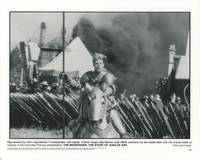
1999réf. 173100N.p.: Gaumont 1999. Eight vintage satin-finished studio still photographs from the 1999 film including one photograph of director Luc Besson on the set of the 1999 film. A fictionalized account of the life of Joan of Arc including her heading the siege of Orléans and eventual heresy trial in England ending in her execution. Set in France and England shot on location in France and the Czech Republic. 8 x 10 inches. Fine. Gaumont unknown
1999réf. 173100N.p.: Gaumont 1999. Eight vintage satin-finished studio still photographs from the 1999 film including one photograph of director Luc Besson on the set of the 1999 film. A fictionalized account of the life of Joan of Arc including her heading the siege of Orléans and eventual heresy trial in England ending in her execution. Set in France and England shot on location in France and the Czech Republic. 8 x 10 inches. Fine. Gaumont unknown books
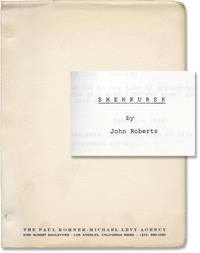
1977réf. 146401N.p.: N.p. 1977. Draft script for an unproduced film. Included with the script is a typed letter from screenwriter John Roberts to casting agent Paul Kohner submitting the script for consideration by prospective director John Huston with a manuscript pencil annotation across the top: "Irene / Please explain John's present status / Does he want to wait" Likely from Kohner to his secretary or reader. A gritty war drama detailing the 1919 Battle of Shenkursk an important battle in the Russian Civil War. Set in Russia. White generic Paul Kohner-Michael Levy Agency wrappers. Title page present with credits for screenwriter John Roberts. 185 leaves with last page of text numbered 183. Xerographic duplication rectos only. Pages Very Good plus wrapper Very Good plus with light soil and toning to the extremities bound with two gold brads. N.p. unknown
1977réf. 146401N.p.: N.p. 1977. Draft script for an unproduced film. Included with the script is a typed letter from screenwriter John Roberts to casting agent Paul Kohner submitting the script for consideration by prospective director John Huston with a manuscript pencil annotation across the top: "Irene / Please explain John's present status / Does he want to wait" Likely from Kohner to his secretary or reader. A gritty war drama detailing the 1919 Battle of Shenkursk an important battle in the Russian Civil War. Set in Russia. White generic Paul Kohner-Michael Levy Agency wrappers. Title page present with credits for screenwriter John Roberts. 185 leaves with last page of text numbered 183. Xerographic duplication rectos only. Pages Very Good plus wrapper Very Good plus with light soil and toning to the extremities bound with two gold brads. N.p. unknown books
1963réf. 132008New York: Louis de Rochemont Associates 1963. Third Draft script for an unproduced film about John Knox the Scottish clergyman and theologian considered to be the founder of the Presbyterian denomination in Scotland. Screenwriter Sloane credited as Sloan here was a screenwriter and wardrobe consultant whose film credits include "Martin Luther" 1953 "Stalag 17" 1953 "The Monster That Challenged the World" 1957 and a host of television movies and episodes. Presumed the only screen treatment on Knox the leader of the Protestant Reformation. Titled self wrappers noted as Third Draft on the front wrapper dated March 15 1963 with credits for screenwriter Sloane as Sloan and presenter Lothar Wolff. 109 leaves with last page of text numbered 108. Mechanical duplication. Near Fine bound with two gold brads. Louis de Rochemont Associates unknown
1963réf. 132008New York: Louis de Rochemont Associates 1963. Third Draft script for an unproduced film about John Knox the Scottish clergyman and theologian considered to be the founder of the Presbyterian denomination in Scotland. Screenwriter Sloane credited as Sloan here was a screenwriter and wardrobe consultant whose film credits include "Martin Luther" 1953 "Stalag 17" 1953 "The Monster That Challenged the World" 1957 and a host of television movies and episodes. Presumed the only screen treatment on Knox the leader of the Protestant Reformation. Titled self wrappers noted as Third Draft on the front wrapper dated March 15 1963 with credits for screenwriter Sloane as Sloan and presenter Lothar Wolff. 109 leaves with last page of text numbered 108. Mechanical duplication. Near Fine bound with two gold brads. Louis de Rochemont Associates unknown books
1985réf. 152106N.p.: N.p. 1985. First Draft script for an unproduced film. With a brief handwritten note clipped to the first leaf on PanArts letterhead dated 9/7/89 addressed to actor Johnny Crawford from Robert Crawford introducing the script. Based on the nineteenth-century novel by Hayden Carruth. A young boy finds himself lost in a snowstorm in the northwestern prairie and must struggle to survive aided by his cat Pawsy and his dog Kaiser. Set in the Dakota Territory. Self wrappers. Title page present dated February 28 1985 noted as FIRST DRAFT with credits for novelist Hayden Carruth and screenwriter Eric Bercovici. 124 leaves with last page of text numbered 122. Xerographic duplication rectos only. Pages Very Good plus overall bound with two gold brads. N.p. unknown
1985réf. 152106N.p.: N.p. 1985. First Draft script for an unproduced film. With a brief handwritten note clipped to the first leaf on PanArts letterhead dated 9/7/89 addressed to actor Johnny Crawford from Robert Crawford introducing the script. Based on the nineteenth-century novel by Hayden Carruth. A young boy finds himself lost in a snowstorm in the northwestern prairie and must struggle to survive aided by his cat Pawsy and his dog Kaiser. Set in the Dakota Territory. Self wrappers. Title page present dated February 28 1985 noted as FIRST DRAFT with credits for novelist Hayden Carruth and screenwriter Eric Bercovici. 124 leaves with last page of text numbered 122. Xerographic duplication rectos only. Pages Very Good plus overall bound with two gold brads. N.p. unknown books
1994réf. 159660Santa Monica: NuWilshire Theater 1994. Vintage flyer advertising two screenings of the US release of the 1992 British film Thursday July 7 and Monday July 11 1994 at the NuWilshire Theater in Santa Monica California. Based on the 1985 novel "Geraldine For the Love of a Transvestite" by Monica Jay. Gerald an American banker who is secretly a cross-dresser is thrown out of his house when is wife discovers women's undergarments in their bedroom. Gerald takes up lodgings with Monica a 50-year old recently divorced housewife smitten with Gerald who slowly discovers Gerald's secret his alter-ego Geraldine and learns to accept and appreciate and support Gerald. Set and shot on location in London. 8.5 x 11 inches on lilac paper. Some light edgewear else Near Fine. NuWilshire Theater unknown books
1981réf. 157696London: GTO Films 1981. Vintage pressbook from the 1981 British film. Kit includes one full-color bi-fold booklet and three studio still photographs. A comic documentary film following the exploits of British pop group Madness following their rise to fame from their humble pub-band origins. Booklet: 11.5 x 8.5 inches. Very Good plus with a light vertical crease on the fore-edges. Photographs 8 x 10 inches. Very Good plus one with annotations in manuscript ink on the recto. GTO Films unknown books