11,067 results
1958ref. 159350N.p.: Intermondia Films 1958. Two vintage studio still photographs from the 1958 film. With a two page press sheet detailing captions for photographs from the film. A serial killer has been targeting women. A detective suspects he may know who the killer is until a woman questions his reasoning. Shot on location in Paris France. 10 x 8 inches. About Fine. Grant France. Intermondia Films unknown books
1961ref. 140962Paris: G. de Boissiere 1961. Original French press kit for the 1961 French-Italian film "Le rendez-vous." Text in French. Resembling the star biography and film credit packets often seen with US press kits this material details film credits cast and crew biographies and a synopsis. The film was produced by Cinetel but here is credited to publicity manager G. de Boissiere with their cute cat logo. Unseen noir based on Patrick Quentin's 1955 novel "The Man with Two Wives" released in France as "La Verite du Mensonge." Pierre Pascal witnesses a murder while with his wife Madeleine Girardot the decease being a photographer who snapped some lurid photos of Pierre's sister-in-law Daphne Parisy. Pierre gives Daphne a false alibi and the police discover the photographer was Madeleine's lover. 22 leaves printed rectos a few corner-stapled on "DEB de Boissiere parchment mimeograph duplication. Housed in a DEB pocketed paper folder 8.5 x 12.25 inches. Near Fine overall. G. de Boissiere unknown books
1972ref. 132630California: National Screen Service / Gamalex Associates 1972. Eight vintage black-and-white still photographs from the US release of the 1970 French-Italian-German film. Title layovers affixed to the rectos over the original titles. Based on a novel by French writer Francis Ryck aka Yves Delville about a woman who kills her husband under the suspicion of infidelity when in reality the man was a secret agent. 8 x 10 inches. Light creases to the extremities else Near Fine. National Screen Service / Gamalex Associates unknown books
1961ref. 160374Paris: Cinedis 1961. Vintage invitation from Cinedis for a private screening of the 1961 film. The event was held Sunday March 26 at 9:45 AM at the Marivaux theater in Paris. The invitation is indicated as only being good for two people. The Princess of Cleves develops feelings for a young Duke even though she is married. She tells her husband who becomes dangerously jealous. Shot on location at Chateau de Chambord and Montlouis-sur-Loire. 5.5 x 4.25 inches. Near Fine. Cinedis unknown books
1958ref. 159350N.p.: Intermondia Films 1958. Two vintage studio still photographs from the 1958 film. With a two page press sheet detailing captions for photographs from the film. A serial killer has been targeting women. A detective suspects he may know who the killer is until a woman questions his reasoning. Shot on location in Paris France. 10 x 8 inches. About Fine. Grant France. Intermondia Films unknown
1961ref. 140962Paris: G. de Boissiere 1961. Original French press kit for the 1961 French-Italian film "Le rendez-vous." Text in French. Resembling the star biography and film credit packets often seen with US press kits this material details film credits cast and crew biographies and a synopsis. The film was produced by Cinetel but here is credited to publicity manager G. de Boissiere with their cute cat logo. Unseen noir based on Patrick Quentin's 1955 novel "The Man with Two Wives" released in France as "La Verite du Mensonge." Pierre Pascal witnesses a murder while with his wife Madeleine Girardot the decease being a photographer who snapped some lurid photos of Pierre's sister-in-law Daphne Parisy. Pierre gives Daphne a false alibi and the police discover the photographer was Madeleine's lover. 22 leaves printed rectos a few corner-stapled on "DEB de Boissiere parchment mimeograph duplication. Housed in a DEB pocketed paper folder 8.5 x 12.25 inches. Near Fine overall. G. de Boissiere unknown
1972ref. 132630California: National Screen Service / Gamalex Associates 1972. Eight vintage black-and-white still photographs from the US release of the 1970 French-Italian-German film. Title layovers affixed to the rectos over the original titles. Based on a novel by French writer Francis Ryck aka Yves Delville about a woman who kills her husband under the suspicion of infidelity when in reality the man was a secret agent. 8 x 10 inches. Light creases to the extremities else Near Fine. National Screen Service / Gamalex Associates unknown
1965ref. 159827Paris: UniFrance Film 1965. Vintage borderless reference photograph of director Georges Franju on the set of the 1965 French film arranging the coat of actress Emmanuele Riva. Stamp specific to the film's French release on the verso along with the stamp of UniFrance Film. Based on the 1923 novel by Jean Cocteau about a teenager who is mistaken for the nephew of the popular General de Fontenoy during World War I. Shot on location in Paris and Oise. 9.5 x 7.25 inches. Near Fine. UniFrance Film unknown books
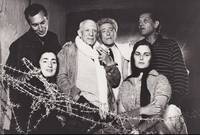
1960ref. 170422Paris: Gok in Sipahio lu 1960. Vintage borderless oversize photograph from the set of the 1960 film showing Jean Cocteau with Pablo Picasso and his wife Jacqueline Luis Miguel Dominguin Serge Lifar and Lucia Bose-all of whom appeared in cameos in the film. French mimeo snipe and stamp of Sipa Press founder Gök in Sipahio lu on the verso. The final film in Cocteau's "Orphic" trilogy following "The Blood of a Poet" 1930 and "Orphee" 1950. The only film in the trilogy featuring Cocteau himself as an aging poet who knows he is dying as indeed he was his greatest desire being to experience rebirth so that he can qualify for celestial immortality. A few seconds of color are spliced in at one point a surreal effect used prior to this film in "Portrait of Jennie" 1948 and later in Samuel Fuller's "Shock Corridor" 1963. Having run out of funds in mid-production Cocteau was given money to complete filming by François Truffaut who used the prize money he had won at Cannes for "Les Quatre Cents Coups" 1959. 11.75 x 8 inches. Light edgewear else Near Fine. Gok in Sipahio lu unknown books
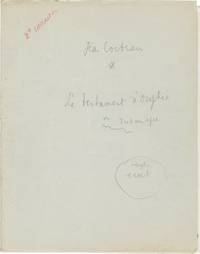
1958ref. 167441N.p.: N.p. 1958. Vintage ribbon copy typescript treatment for the 1960 French film. With substantive annotations in director Jean Cocteau's hand throughout noting deletions and amending dialogue. Full provenance available. The final film in Cocteau's "Orphic" trilogy following "The Blood of a Poet" 1930 and "Orphee" 1950. The only film in the trilogy featuring Cocteau himself as an aging poet who knows he is dying as indeed he was his greatest desire being to experience rebirth so that he can qualify for celestial immortality. With cameos by Pablo Picasso Charles Aznavour bullfighter Luis Miguel Dominguen and Yul Brynner. A few seconds of color are spliced in at one point a surreal effect used prior to this film in "Portrait of Jennie" 1948 and later in Samuel Fuller's "Shock Corridor" 1963. Having run out of funds in mid-production Cocteau was given money to complete filming by François Truffaut who used the prize money he had won at Cannes for "Les Quatre Cents Coups" 1959. Unbound housed in a gray paper folder. Title and Cocteau's name in manuscript pencil on the front of the folder. 31 leaves with last page of text numbered 28. Ribbon copy typescript on onionskin stock rectos only. Pages Fine unbound. N.p. unknown books
1948ref. 151699N.p.: N.p. 1948. Vintage borderless reference photograph of director Jean Cocteau in conversation with actress Silvia Monfort while cinematographer Christian Matras looks on to the left. With the stamp of Le Parisien archive on the verso. Based on Cocteau's 1946 play. In nineteenth-century Europe a suicidal anarchist poet falls in love with the long-secluded queen who has been absent from the public eye for ten years due to her grief over her husband's death. Set in the fictional country of Krantz. 7 x 5.25 inches. Near Fine. N.p. unknown books
1950ref. 151573N.p.: N.p. 1950. Vintage borderless reference photograph from the 1950 film showing actress Maria Casares. With manuscript layout annotations on the verso along with the stamp of still photographer Roger Corbeau. A variation on the Greek myth of Orpheus and Eurydice about a young poet in Paris whose despair after his wife's death leads him to the underworld where he begs for her return to the living. The second film in director Jean Cocteau's Orphic trilogy following "The Blood of a Poet" 1930 and preceding "Testament of Orpheus" 1960. Set and shot on location in Paris. 7 x 9 inches. Very Good plus overall. N.p. unknown books
1950ref. 151573N.p.: N.p. 1950. Vintage borderless reference photograph from the 1950 film showing actress Maria Casares. With manuscript layout annotations on the verso along with the stamp of still photographer Roger Corbeau. A variation on the Greek myth of Orpheus and Eurydice about a young poet in Paris whose despair after his wife's death leads him to the underworld where he begs for her return to the living. The second film in director Jean Cocteau's Orphic trilogy following "The Blood of a Poet" 1930 and preceding "Testament of Orpheus" 1960. Set and shot on location in Paris. 7 x 9 inches. Very Good plus overall. N.p. unknown
1960ref. 170422Paris: Gok in Sipahio lu 1960. Vintage borderless oversize photograph from the set of the 1960 film showing Jean Cocteau with Pablo Picasso and his wife Jacqueline Luis Miguel Dominguin Serge Lifar and Lucia Bose-all of whom appeared in cameos in the film. French mimeo snipe and stamp of Sipa Press founder Gök in Sipahio lu on the verso. The final film in Cocteau's "Orphic" trilogy following "The Blood of a Poet" 1930 and "Orphee" 1950. The only film in the trilogy featuring Cocteau himself as an aging poet who knows he is dying as indeed he was his greatest desire being to experience rebirth so that he can qualify for celestial immortality. A few seconds of color are spliced in at one point a surreal effect used prior to this film in "Portrait of Jennie" 1948 and later in Samuel Fuller's "Shock Corridor" 1963. Having run out of funds in mid-production Cocteau was given money to complete filming by François Truffaut who used the prize money he had won at Cannes for "Les Quatre Cents Coups" 1959. 11.75 x 8 inches. Light edgewear else Near Fine. Gok in Sipahio lu unknown
1958ref. 167441N.p.: N.p. 1958. Vintage ribbon copy typescript treatment for the 1960 French film. With substantive annotations in director Jean Cocteau's hand throughout noting deletions and amending dialogue. Full provenance available. The final film in Cocteau's "Orphic" trilogy following "The Blood of a Poet" 1930 and "Orphee" 1950. The only film in the trilogy featuring Cocteau himself as an aging poet who knows he is dying as indeed he was his greatest desire being to experience rebirth so that he can qualify for celestial immortality. With cameos by Pablo Picasso Charles Aznavour bullfighter Luis Miguel Dominguen and Yul Brynner. A few seconds of color are spliced in at one point a surreal effect used prior to this film in "Portrait of Jennie" 1948 and later in Samuel Fuller's "Shock Corridor" 1963. Having run out of funds in mid-production Cocteau was given money to complete filming by François Truffaut who used the prize money he had won at Cannes for "Les Quatre Cents Coups" 1959. Unbound housed in a gray paper folder. Title and Cocteau's name in manuscript pencil on the front of the folder. 31 leaves with last page of text numbered 28. Ribbon copy typescript on onionskin stock rectos only. Pages Fine unbound. N.p. unknown
1948ref. 151699N.p.: N.p. 1948. Vintage borderless reference photograph of director Jean Cocteau in conversation with actress Silvia Monfort while cinematographer Christian Matras looks on to the left. With the stamp of Le Parisien archive on the verso. Based on Cocteau's 1946 play. In nineteenth-century Europe a suicidal anarchist poet falls in love with the long-secluded queen who has been absent from the public eye for ten years due to her grief over her husband's death. Set in the fictional country of Krantz. 7 x 5.25 inches. Near Fine. N.p. unknown
1965ref. 159827Paris: UniFrance Film 1965. Vintage borderless reference photograph of director Georges Franju on the set of the 1965 French film arranging the coat of actress Emmanuele Riva. Stamp specific to the film's French release on the verso along with the stamp of UniFrance Film. Based on the 1923 novel by Jean Cocteau about a teenager who is mistaken for the nephew of the popular General de Fontenoy during World War I. Shot on location in Paris and Oise. 9.5 x 7.25 inches. Near Fine. UniFrance Film unknown
1956ref. 143289Paris: Cite Films 1956. Collection of 24 vintage reference photographs from the 1956 French film here under the French title "Le couturier de ces dames." 13 photographs with numeric annotations on the versos in pencil and one with "Le couturier de ces dames" in mimeograph duplication to same. A tailor needs to create a lasting fashion line to save his business. He does but he also cavorts a little with the models only for his wife to discover his infidelity. A send-up of the new haute couture popular at the time with notable designers Yves Saint Laurent Pierre Cardin who worked on the film and Japanese native Hanae Mori representing the "new look." Shot on location in Val-de-Marne France. One photo 3.25 x 4.25 inches the balance 5 x 7 inches. Generally Near Fine. Cite Films unknown books
1956ref. 143289Paris: Cite Films 1956. Collection of 24 vintage reference photographs from the 1956 French film here under the French title "Le couturier de ces dames." 13 photographs with numeric annotations on the versos in pencil and one with "Le couturier de ces dames" in mimeograph duplication to same. A tailor needs to create a lasting fashion line to save his business. He does but he also cavorts a little with the models only for his wife to discover his infidelity. A send-up of the new haute couture popular at the time with notable designers Yves Saint Laurent Pierre Cardin who worked on the film and Japanese native Hanae Mori representing the "new look." Shot on location in Val-de-Marne France. One photo 3.25 x 4.25 inches the balance 5 x 7 inches. Generally Near Fine. Cite Films unknown
1957ref. 144607Paris: Chronos Films 1957. Collection of 6 original black-and-white photographs for the 1959 French film all featuring starring actor Richard in uniforms on bicycles and drinking Perrier bottled water. Film title in manuscript ink on the versos 1 photo with a "Le Parisien libere" press rubberstamp. A little seen comedy about a two French towns who compete at football soccer the goalie of what town who is traded to the other for a cow becomes infatuated by a local young woman Tanguy. Director Bastia was an assistant director in the 1940s and 1950s when he worked almost exclusively with director Jean Boyer until his debut with this film the first in this series involving gendarmes and Champignol followed by "The Gendarm of Champignol" 1959 and "The Boss of Champignol" 1966. Photographs range 3 x 4.25 inches to 9.25 x 11.75 inches. Very Good overall light curling a few brief creases slight discoloration to one a few with pinholes. Chronos Films unknown books
1959ref. 144110Paris: Cinedis 1959. Collection of 269 vintage black-and-white photographs for the 1959 French film. The collection consists of two unique and complimentary pieces one being a film still keybook with 68 contact prints of small format negatives most with 12 images per print amounting to over 800 images captured. Nearly all images with series number bordering the image and credits at the top for photo laboratory Tele-Photo film studio Cinedis film title and photographer Rosselle housed in a 2-ring paper binder with original French titles. The other piece is nearly 170 smaller photographs elegantly presented mounted with cello tape on thick stock in a "Lavis aquarelle" brand spiral bound notebook with maroon faux leather front wrapper. Series numbers and small "x" annotations in manuscript ink on the pages several with small white borders and several with series number on the verso in manuscript pencil. Photos without borders also have series number at the edges etched in the original film negative before photo development as on the keybook prints. Nearly all photographs have numerical annotations in manuscript pencil on the versos a few smaller photographs have rubber-stamps on the versos crediting Richard Pierre film titles director Bastia and costars Alfred Adam and Noel Roquevart. Also included are 27 loose photographs a few with rubber-stamps on the verso crediting starring actors and French film titles and a small press packet from Cinedis detailing film credits synopsis and star biographies. Starring actors Richard and Pierre are amply represented in the collection and seen in nearly every image mostly in their official uniforms. Actress Zuber is equally present in striking high-contrast images cuddling bunnies fishing at a river and wielding a rifle. The notebook depicts images seen in the film while the keybook depicts on-the-set sequences test shots candid moments and images of the crew; the loose photos show both candid and action shots. An expansive perspective of a little seen comedy about a gendarme who travels to a small town looking for a disappeared woman a town known for its distrust of police officers. Director Bastia was an assistant director in the 1940s and 1950s when he worked almost exclusively with director Jean Boyer until his debut with "Nous autres à Champignol" 1957 the first in this series involving gendarmes and Champignol followed by this film and finally "The Boss of Champignol" 1966. Photographs in large quarto notebook 3.5 x 4.75 inches keybook contact prints 8.25 x 10.5 inches 2-hole punched several trimmed and loose photos range from 4.75 x 6.75 inches to 7 x 9.25 inches. Photographs about Near Fine with light curling a handful with short creases press packet Near Fine notebook Near Fine and binder Very Good. Cinedis unknown books
1957ref. 144607Paris: Chronos Films 1957. Collection of 6 original black-and-white photographs for the 1959 French film all featuring starring actor Richard in uniforms on bicycles and drinking Perrier bottled water. Film title in manuscript ink on the versos 1 photo with a "Le Parisien libere" press rubberstamp. A little seen comedy about a two French towns who compete at football soccer the goalie of what town who is traded to the other for a cow becomes infatuated by a local young woman Tanguy. Director Bastia was an assistant director in the 1940s and 1950s when he worked almost exclusively with director Jean Boyer until his debut with this film the first in this series involving gendarmes and Champignol followed by "The Gendarm of Champignol" 1959 and "The Boss of Champignol" 1966. Photographs range 3 x 4.25 inches to 9.25 x 11.75 inches. Very Good overall light curling a few brief creases slight discoloration to one a few with pinholes. Chronos Films unknown
1959ref. 144110Paris: Cinedis 1959. Collection of 269 vintage black-and-white photographs for the 1959 French film. The collection consists of two unique and complimentary pieces one being a film still keybook with 68 contact prints of small format negatives most with 12 images per print amounting to over 800 images captured. Nearly all images with series number bordering the image and credits at the top for photo laboratory Tele-Photo film studio Cinedis film title and photographer Rosselle housed in a 2-ring paper binder with original French titles. The other piece is nearly 170 smaller photographs elegantly presented mounted with cello tape on thick stock in a "Lavis aquarelle" brand spiral bound notebook with maroon faux leather front wrapper. Series numbers and small "x" annotations in manuscript ink on the pages several with small white borders and several with series number on the verso in manuscript pencil. Photos without borders also have series number at the edges etched in the original film negative before photo development as on the keybook prints. Nearly all photographs have numerical annotations in manuscript pencil on the versos a few smaller photographs have rubber-stamps on the versos crediting Richard Pierre film titles director Bastia and costars Alfred Adam and Noel Roquevart. Also included are 27 loose photographs a few with rubber-stamps on the verso crediting starring actors and French film titles and a small press packet from Cinedis detailing film credits synopsis and star biographies. Starring actors Richard and Pierre are amply represented in the collection and seen in nearly every image mostly in their official uniforms. Actress Zuber is equally present in striking high-contrast images cuddling bunnies fishing at a river and wielding a rifle. The notebook depicts images seen in the film while the keybook depicts on-the-set sequences test shots candid moments and images of the crew; the loose photos show both candid and action shots. An expansive perspective of a little seen comedy about a gendarme who travels to a small town looking for a disappeared woman a town known for its distrust of police officers. Director Bastia was an assistant director in the 1940s and 1950s when he worked almost exclusively with director Jean Boyer until his debut with "Nous autres à Champignol" 1957 the first in this series involving gendarmes and Champignol followed by this film and finally "The Boss of Champignol" 1966. Photographs in large quarto notebook 3.5 x 4.75 inches keybook contact prints 8.25 x 10.5 inches 2-hole punched several trimmed and loose photos range from 4.75 x 6.75 inches to 7 x 9.25 inches. Photographs about Near Fine with light curling a handful with short creases press packet Near Fine notebook Near Fine and binder Very Good. Cinedis unknown
ref. 021745Jean Vincent-Bréchignac (1901-1981), écrivain, journaliste, scénariste. L.A.S., 16 octobre 1950, 1p 1/2 in-4. A l'écrivain René Johannet (1884-1972). « Joie de trouver votre Péguy, mon cher ami, sur un bureau où s'amoncellent tant de paperasses rébarbatives. Je tiens à vous remercier d'avoir pensé au jeune élève du lycée de Cherbourg qui fréquentait la maison de Quoniam en 1916. Mes hommages à madame Johannet et très fidèlement vôtre J Vincent Bréchignac ». Papier un peu affaibli aux plis. [526]
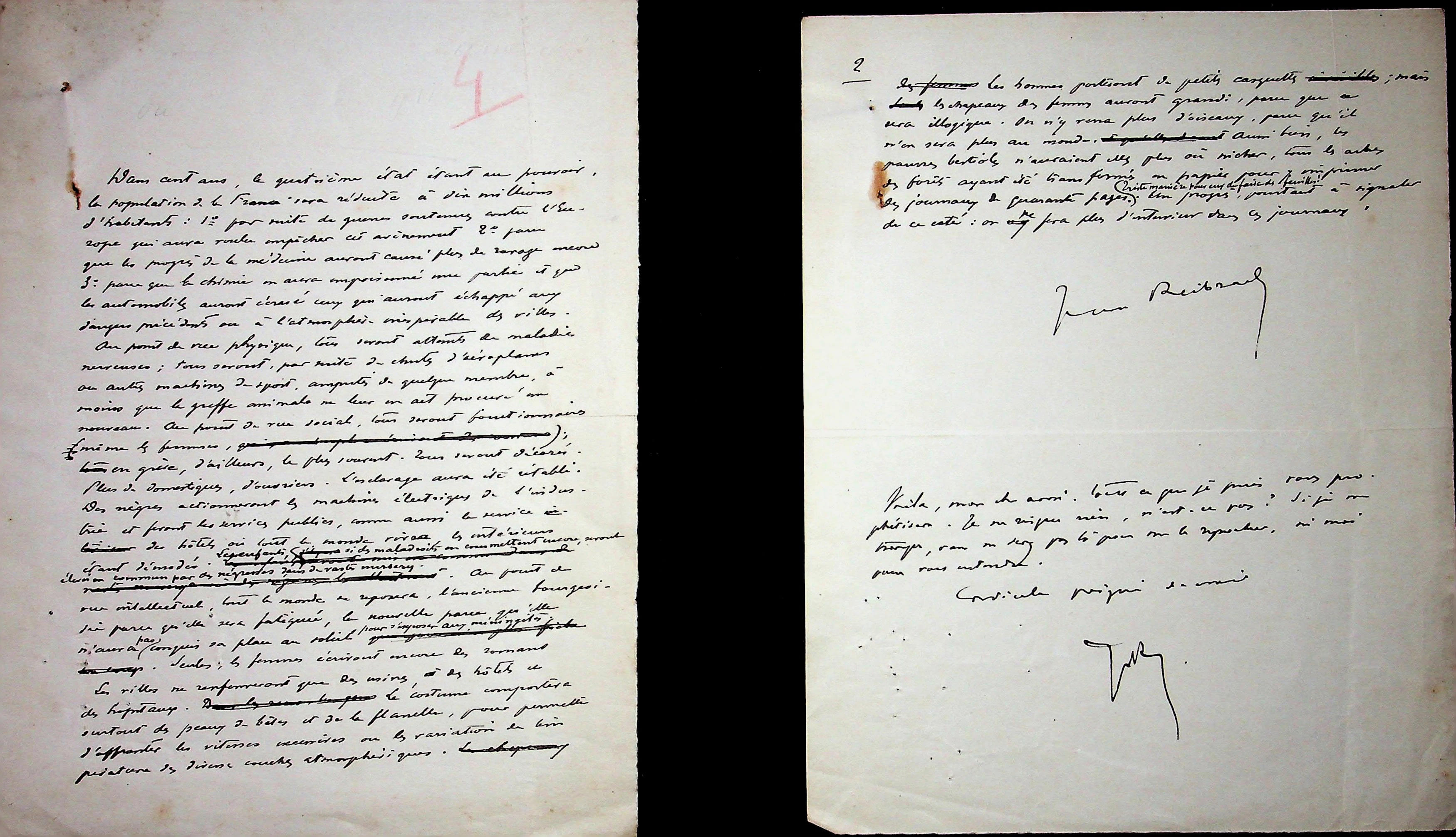
ref. 022448Jean Chabrier dit Jean Reibrach (1853-1927), écrivain, scénariste. Manuscrit A.S., sd, 2p in-4. Amusante vision de la France dans cent ans, pour une enquête de Jean Bernard, dans laquelle il prédit que le 4e état dirigera la France, diminuée à 10 millions d'habitants, prédisant des maladies, des greffes animales, le retour de l'esclavage. [548]