4,062 results
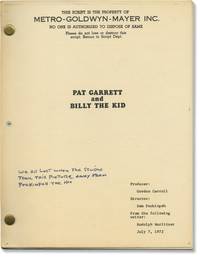
ref. 166485Beverly Hills CA: Metro-Goldwyn-Mayer MGM 1972. Draft script for the 1975 film. Annotation in manuscript ink on the front wrapper noting incorrectly we would argue "We all lost when the studio took this picture away from Peckinpah the hed" sic. A very nearly experimental Western made by Sam Peckinpah at his peak a highspot of genre revisionism. Comparable to "McCabe and Mrs. Miller" 1971 and "The Shooting" 1966 in terms of sheer impressionism being laid upon the genre with iconic imagery and super-stylization in every frame. Shot on location in Durango Mexico. Beige titled Metro-Goldwyn-Mayer front wrapper dated July 7 1972 with credits for Peckinpah and screenwriter Rudolph Wurlitzer. Missing rear wrapper. Title page integral with front wrapper. 125 leaves with last page of text numbered 134. Mimeograph duplication rectos only with blue and gray revision pages throughout dated variously between July 3 and 25 1972. Pages Very Good plus wrapper Very Good bound with two gold brads. Metro-Goldwyn-Mayer [MGM] unknown
1936ref. 147033Burbank CA: Warner Brothers 1936. Collection of nine vintage oversize photographs from the 1936 film. Each with a mimeo snipe on the verso. Based on the 1930 Pulitzer Prize winning play by Marc Connelly itself based on "Ol' Man Adam an' His Chillun" a 1928 collection of pseudo African American folk tales by Roark Bradford. One of only a handful of films to feature an all-Black cast made by a major Hollywood studio during the Golden Age becoming the highest grossing such film and remaining so until surpassed by "Carmen Jones" in 1954. 14 x 11 inches. Very Good with light edgewear and light vertical creasing down the center. Warner Brothers unknown
1938ref. 163880N.p.: N.p. 1938. James Hilton's typescript draft screenplay for the 1939 film an adaptation of his own 1937 novel the only such adaptation he ever completed. With the author's profuse manuscript ink annotations as well as many pages executed entirely in manuscript ink throughout. Included is a privately commissioned essay by Hilton scholar Kurt Kausler detailing both the history of Hilton's work on the film an analysis and a breakdown of the manuscript. Almost certainly Hilton's first corrected manuscript screenplay for the film. After Jack Warner raised concerns about the script being too long screenwriter Milton Krims was employed to clean up and shorten it-though in the end Hilton received sole credit as screenwriter. A man hires an Austrian governess and both are suspected of murder when his wife is discovered to be dead. 123 leaves a gathering demonstrating the author's method his attention to detail and his extreme frugality with the use of paper the last most likely due to wartime shortages. The script consists of a ribbon copy typescript leaves on both onionskin and paper stock with manuscript emendations on virtually every page in many cases both recto and verso with some leaves executed on the versos of unrelated previous work by Hilton b leaves consisting entirely of text executed in manuscript ink c hand-cut partial leaves and d a handful of later Xerographically duplicated facsimiles of Hilton's original annotated typescript leaves. Included is a very detailed analysis of the manuscript as well as the events surrounding its creation along with a detailed breakdown of the manuscript elements. Hilton's manuscript leaves Very Good to Fine quite supple and well preserved. Housed in a modern white three-ring binder. Leaves individually held in modern mylar page protectors. N.p. unknown
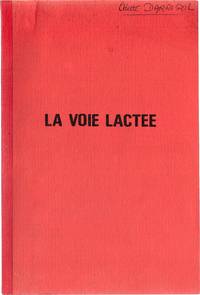
1969ref. 170400Paris: Greenwich Film Production 1969. Draft script for the 1969 French film. Copy belonging to production secretary Odette Darrigol with her name in manuscript ink on the front wrapper. Text in French. Included with the script are four pages of spirit duplication revision pages and eight gatherings of production documents including a shooting schedule and several crew contact lists. A surrealist comedy about a pair of vagrants who take a pilgrimage route from Paris to Santiago de Compostela. The first entry in Luis Buñuel's trilogy about what he called "the search for truth" followed by "The Discreet Charm of the Bourgeoisie" 1972 and "The Phantom of Liberty" 1974. Shot on location in France. Tall red titled wrappers. Title page present undated with credits for Buñuel and screenwriter Jean Claude Carrière and producer Serge Silberman. 115 leaves with last page of text numbered 114. Mimeograph duplication rectos only. Pages Near Fine wrapper Very Good plus perfect bound. Greenwich Film Production unknown
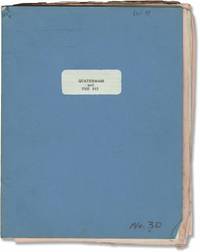
1967ref. 162979London: Hammer Film Productions 1967. Draft script for the 1967 film. Working script belonging to an unknown cast or crew member with annotations in manuscript pencil and ink throughout largely noting deletions. A gathering of ancient human remains and a mysterious metallic object are discovered buried beneath the site of a planned extension to the London Underground. Renowned scientist Bernard Quatermass is called in to investigate. Based on the successful 1950s British science fiction serial "The Quatermass Experiment" and a follow-up to the films "The Quatermass Xperiment" 1955 and "Quatermass 2" 1957. Blue untitled wrappers with a die-cut title window in the British style on the front wrapper. Title page present dated 25th January 1967 with credit for screenwriter Nigel Kneale. 154 leaves with last page of text numbered 131. Roneograph duplication on eye-rest green stock rectos only with undated pink and green revision pages mimeograph laid in throughout. Pages Good moderately worn with foxing on some revision fore-edges wrapper Very Good plus bound internally with two silver brads. Hammer Film Productions unknown
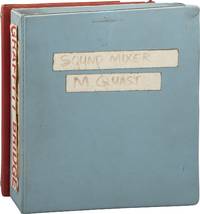
ref. 169944Chanhassen MN: Graffiti Bridge Inc 1990. Archive of two original scripts and over 100 pages of production documents from the 1990 film all belonging to Sound Mixer and Playback Operator Matthew Quast. The archive consists of: A Fourth Draft script dated February 1 1990 with manuscript ink annotations on the versos of two pages and the recto of a third housed in a large generic blue three-ring binder with the labels "Graffiti Bridge" on the spine and "Sound Mixer / M. Quast" on the front board. Bound in preceding the script are: 40 pages of song lyrics with manuscript ink and highlighter annotations noting timing of stanzas on nearly every page. Seven pages of employment applications agreements and memos. Sixteen pages of crew contact information. And thirteen pages of One-Line Schedules dated February 8 20 and 26 1990. An undated Revised Draft script lacking the first seven pages and title page housed in a narrow generic red three-ring binder. Bound in following the script is a six-page "Contact Suppliers List" an eight-page "Area Info" and four pages of maps and directions to Prince's Paisley Park studio. Laid in with the scripts are: Copies of Prince's wardrobe sketches on three pages and one half leaf. A four page Music List dated January 26 1990. Four Call Sheets dated 3/13/90 3/26/90 3/27/90 and 3/28/90 with a memo dated March 27 1990 stapled to the last call sheet. A three page One-Line Schedule dated March 20 1990. A copy of a handwritten page listing six scenes for "Thursday 3/8/90." And six "Graffiti Bridge" film reel labels and a blank Avalon Entertainment employee time and reimbursement submission form with the attached carbon copy. Prince's standalone sequel to his hit 1984 movie "Purple Rain" and his third and final film role following "Purple Rain" and the 1986 film "Under the Cherry Moon" Prince's directorial debut. Prince returns as "The Kid" now a club owner in a "West Side Story" style rivalry with competing club owner Morris Morris Day and puts his club on the line with a bet with Morris over who can write the best song. Set and shot on location in Eden Prairie and Minneapolis Minnesota. Fourth Draft script: Housed in a large blue generic three-ring binder. Title page present dated February 1 1990 noted as FOURTH DRAFT with credits for screenwriter Prince. 70 leaves with last page of text numbered 66. Xerographic duplication rectos only with blue and yellow revision pages throughout dated variously between 2/7/90 and 3/9/90. Pages Near Fine bound in a Very Good plus three-binder. Revised Draft script: Housed in a thin red generic three-ring binder. 56 leaves with last page of text numbered 60. Xerographic duplication rectos only with undated blue revision pages. Pages Near Fine bound in a Very Good plus three-ring binder. Other production documents 8.5 x 11 inches to 8.5 x 14 inches. Near Fine overall. Graffiti Bridge Inc unknown
1949ref. 143058Tokyo: Film Art Association 1949. First Draft script for the 1949 Japanese film noir. Manuscript ink and pencil annotations from production on two leaves. Text in Japanese. Generally considered to be the greatest film noir made in Japan and hugely influential on American film noir of the 1950s and 1960s. White titled wrappers. 96 leaves with last page of text numbered 96. Mechanical duplication. Toning due to aging throughout wrapper split at spine with mild foxing otherwise Good condition. BFI 534. Criterion Collection 233. Grant Japan. Selby Japan. Spicer Japan Classic Noir. Film Art Association unknown
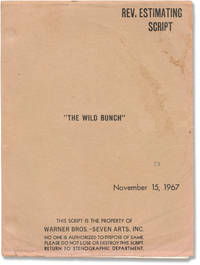
1967ref. 160830Burbank CA: Warner Brothers / Seven Arts 1967. Revised Estimating script for the 1969 Western film. Sam Peckinpah's classic revisionist Western of nearly inestimable importance and violence made at the peak of his career and which-along with "Straw Dogs" 1971-remains the lasting testament to his vision. A major contributor to the "end of the West" theme so prevalent of the genre in the 1970s and one of the earliest New Hollywood Westerns. Set in Mexico shot on location in Mexico and Spain. Beige titled Warner Brothers wrappers dated November 15 1967 noted as Rev. Estimating Script and stamped copy No. 75. Title page present dated 11/15/67 with credits for screenwriters Wallen Green and Sam Peckinpah and story credit for Roy Sickner. 125 leaves with last page of text numbered 123. Mimeograph duplication rectos only. Pages about Fine wrapper Very Good plus bound internally with two gold brads. National Film Registry. Ebert I. Hardy US. Pitts 4934. Rosenbaum 1000. Schrader Canon Fodder 28. Warner Brothers / Seven Arts unknown
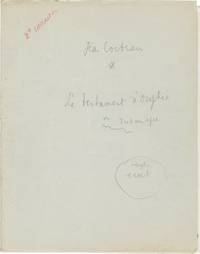
1958ref. 167441N.p.: N.p. 1958. Vintage ribbon copy typescript treatment for the 1960 French film. With substantive annotations in director Jean Cocteau's hand throughout noting deletions and amending dialogue. Full provenance available. The final film in Cocteau's "Orphic" trilogy following "The Blood of a Poet" 1930 and "Orphee" 1950. The only film in the trilogy featuring Cocteau himself as an aging poet who knows he is dying as indeed he was his greatest desire being to experience rebirth so that he can qualify for celestial immortality. With cameos by Pablo Picasso Charles Aznavour bullfighter Luis Miguel Dominguen and Yul Brynner. A few seconds of color are spliced in at one point a surreal effect used prior to this film in "Portrait of Jennie" 1948 and later in Samuel Fuller's "Shock Corridor" 1963. Having run out of funds in mid-production Cocteau was given money to complete filming by François Truffaut who used the prize money he had won at Cannes for "Les Quatre Cents Coups" 1959. Unbound housed in a gray paper folder. Title and Cocteau's name in manuscript pencil on the front of the folder. 31 leaves with last page of text numbered 28. Ribbon copy typescript on onionskin stock rectos only. Pages Fine unbound. N.p. unknown
ref. 142842N.p.: N.p. 1981. Handmade vernacular conceptual journal documenting the shooting of Robert Frank's 1981 film "Energy and How to Get It" circa 1980-1981. Includes tipped in ephemera drawings business cards and 46 Polaroids of Wurlitzer Robert Frank June Leaf and "Lightning" Bob. Annotations and captions throughout by Wurlitzer. Also included are 4 reference photos all likely unique from the shooting of the film: two showing both Wurlitzer and Frank one showing Wurlitzer and one of the "Enola Gay" aircraft in the film. Mead Memo notebook spiral bound. Green wrappers. 4.25 x 6 inches Very Good overall tipped in photos Near Fine. Reference photos 8 x 10 inches Near Fine. N.p. unknown
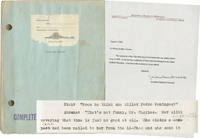
1935ref. 124528Beverly Hills CA: Metro-Goldwyn-Mayer MGM 1935. Dashiell Hammett's original submitted Treatment script for the first sequel to "The Thin Man" here referred to only as "Thin Man Sequel" and ultimately titled "After the Thin Man." With a single manuscript correction by Hammett and letter of provenance from Hammett's daughter Josephine Hammett Marshall regarding the discovery of the treatment in the family's estate. The first "Thin Man" film released in 1934 and based on Hammett's novel was a smash hit and is today a key film in the American screwball comedy cycle. Five sequels were made between 1936 and 1947 all starring the original acting team of William Powell and Myrna Loy and this previously unknown attempt at a sequel by Hammett was clearly commissioned by MGM but never produced making this script an entire unpublished Hammett work. The story is a completely original one never reworked for the other films very much written in Hammett's trademark style and reading a bit more like a story treatment i.e. a novel than a final screenplay which is likely as far as the story got on the road to production. The piece is dated Sept. 17 1935 at the lower right corner of the front panel along with Hammett's name and Hammett's name is noted in pencil next to the title label though not in Hammett's hand. There is only one single-word correction to the entire text at page 83 in Hammett's hand where the word "compact" is replaced with "cigarette case." Accompanying the screenplay is a typed letter signed from Hammett's daughter who edited a recently published collection of Hammett's letters on her personal stationery stating that the screenplay was discovered by Hammett's wife in 1980 and that it had been a part of the family's estate until that time. Probably one of only 2-3 copies that could have been produced and very possibly the only copy extant. To our knowledge no other copy of this story in any form has ever been recorded at auction or sold on the market. Light blue titled wrappers with the white MGM studio label present manuscript pencil notation of Hammett's name secretarial rubber-stamped COMPLETE dated September 17 1935 with a single credit for Hammett. 115 leaves mimeograph duplication. Pages and wrapper Very Good plus bound with two gold brads. In a custom clamshell box. Full pagination available upon request. Metro-Goldwyn-Mayer [MGM] unknown
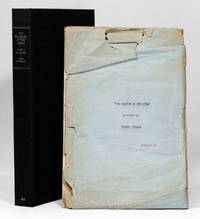
1925ref. 3105California: Universal Pictures 1925. First edition. original wrappers. Good. AN EARLY WORKING DRAFT OF THE 1925 PHANTOM OF THE OPERA PRESERVING THE DARKER SCENARIO UNIVERSAL WROTE BEFORE ITS FRONT OFFICE ORDERED THE TERROR TONED DOWN AND INCLUDING AN ORIGIN STORY FOR THE PHANTOM THAT NEVER REACHED THE SCREEN. Lon Chaney's unmasking in The Phantom of the Opera remains one of the most famous moments in film history. The picture that audiences finally saw in 1925 though came out of a long and difficult production shaped by poorly received previews reshoots and repeated re-editing. Its story begins with Universal staff writer Elliott J. Clawson's adaptation of Gaston Leroux's 1910 novel. The present typescript records his scenario at an early stage before the studio's successive revisions reshaped it. THE PHANTOM'S LOST ORIGIN STORY: The most striking feature of the draft is a lengthy origin episode absent from every filmed version of the story. In it a Sultan condemns the Phantom to die on an anthill and the Persian who becomes his lifelong associate rescues him. Leroux's novel only alludes to its Phantom's past in Persia where a police official spared him from the Shah's death sentence. Clawson turned that background into a full dramatic sequence. The episode though was abandoned before filming began. Philip J. Riley mentions it in his narrative account of the production The Making of the Phantom of the Opera 1999 but the present manuscript preserves it as Clawson actually wrote it. Riley records that by the fifth revised shooting script most of the genuinely frightening scenes like the anthill death scene had been removed because the front office feared the original material would drive audiences out of the theater. RELATIONSHIP TO THE KNOWN RECORD: Riley's study draws on two principal script documents: an early Clawson draft which he quotes in places and the fifth revised shooting script which he reproduces in full. The present manuscript shares the general scope and character of the early draft yet it differs in both scene numbering and the wording of specific directions. At the bedchamber scene Riley's source is numbered 286; here the same scene is numbered 289. The three-scene offset indicates that this manuscript contains material Riley's source lacks at that point suggesting either an earlier compositional layer or a fuller parallel version. Riley does not say where his early draft is held so the relationship between the two documents remains open. Our comparison is limited to the passages Riley chose to quote and a full collation may well reveal further differences. THE ANNOTATIONS: Pencil annotations appear intermittently throughout. They are pointed and analytical raising questions of continuity pacing and plot logic. One asks how Christine could communicate with Raoul while held captive and another asks why certain developments do not occur earlier in a sequence. They suggest close review by a reader with editorial authority over the script. Note: Although the draft breaks off during the climactic rescue attempt by Raoul and Ledoux and does not include the full text as we've come to know the story the draft appears complete as it originally existed. There is no sign of removed pages - in fact the last page with type seems to be on a different stock and serves also as the rear wrapper - which is consistent with an unfinished working draft rather than later loss. RARITY: Universal silent-era screenplays rarely survive. Scripts were typed in small numbers on unstable pulp paper and much of the studio's early paper record was later discarded. This draft documents The Phantom of the Opera before commercial pressure and successive rewrites displaced Clawson's original conception. It preserves a version of the film that Universal chose not to make. Typescript working draft. Universal City California: Universal Pictures ca. 1925. More than 200 pages typed on 8.5 x 13 inch legal-size pulp stock; original blue wrapper; pale toned rear wrapper. Pencil annotations throughout. Front wrapper present but detached; leaves brittle with edge chipping creases foxing marginal staining and small losses as is typical of Universal scripts of the period. Housed in custom archival presentation box. Universal Pictures unknown